
XRPL is testing quantum-safe proofs to block future hacks. This ensures long-term security. Follow for updates.
#XRPL #QuantumSafe
Quick Video Breakdown: This Blog Article
This video clearly explains this blog article.
Even if you don’t have time to read the text, you can quickly grasp the key points through this video. Please check it out!
If you find this video helpful, please follow the YouTube channel “BlockChainBulletin,” which delivers daily Crypto news.
https://www.youtube.com/@BlockChainBulletins
Read this article in your native language (10+ supported) 👉
[Read in your language]
XRPL’s Quantum-Safe Leap: Ditching Elliptic Curves for 2,420-Byte Proofs
Jon: Hey Lila, I came across this interesting update on the XRP Ledger—it’s flipping to quantum-safe signatures, replacing elliptic curves with these 2,420-byte proofs. It’s from a recent CryptoSlate article, and it seems like a big step toward future-proofing blockchain security against quantum computing threats.
Lila: Quantum-safe signatures? That sounds futuristic. I’ve heard about quantum computers potentially breaking current crypto, but what’s the deal with XRPL specifically? Break it down for me.
Jon: Sure thing. The XRP Ledger, or XRPL, is the blockchain behind XRP, known for fast, low-cost transactions. This update involves adopting post-quantum cryptography on their AlphaNet testnet. Essentially, they’re moving from elliptic curve digital signatures, which are vulnerable to quantum attacks, to something called ML-DSA or Dilithium-based signatures. These new proofs are larger—2,420 bytes each—but they’re designed to withstand quantum computers that could crack the old system.
Lila: Why does this matter? Is quantum computing an immediate threat, or is this just precautionary?
Jon: It’s mostly precautionary, but timely. Quantum computers aren’t breaking blockchains yet, but experts like Vitalik Buterin estimate a 20% chance of cryptographically relevant quantum tech by 2035. XRPL is getting ahead, especially since Bitcoin‘s upgrade could take years. This positions XRPL as more resilient, potentially attracting developers worried about “Q-Day”—the day quantum breaks current crypto. No hype, but it’s worth watching for anyone building on blockchains.
Lila: Got it. So, it’s about long-term security without disrupting the network right away.
Jon: Exactly. Now, let’s dive into the problem this solves.
Lila: Alright, what’s the core issue here? Quantum computing sounds abstract—can you make it relatable?
Jon: Think of current blockchain security like a bank’s vault protected by complex combination locks—those are elliptic curve signatures. They rely on math problems that are hard for classical computers to solve, like factoring large numbers or discrete logarithms. But quantum computers are like a super-powered lockpick that could crack those in minutes using algorithms like Shor’s.
Lila: So, if quantum tech advances, someone could forge signatures and steal funds?
Jon: Precisely. It’s not just theft; it could undermine the entire trust in the ledger. Analogy time: Imagine a highway system where traffic lights use simple codes to manage flow. Works great until a hacker with a quantum decoder overrides them, causing chaos. XRPL is upgrading to unbreakable lights—bigger and bulkier, but secure against that hacker. The 2,420-byte proofs are from Dilithium, a lattice-based scheme that’s quantum-resistant because it uses math problems quantum computers struggle with, like finding short vectors in lattices.
Lila: Lattices? Like a grid?
Jon: Yeah, think of it as a multidimensional grid where solving for the shortest path is insanely hard, even for quantum machines. This isn’t just XRPL; it’s part of a broader push, like NIST’s post-quantum standards. But XRPL’s implementation on AlphaNet includes native smart contracts too, tying it all together.
Lila: Makes sense. So, the “why” is protecting against a future where quantum threats are real, without waiting for disaster.
Jon: Spot on. Risks remain, though—larger proofs mean higher transaction sizes, which could affect efficiency.
Under the Hood: How it Works
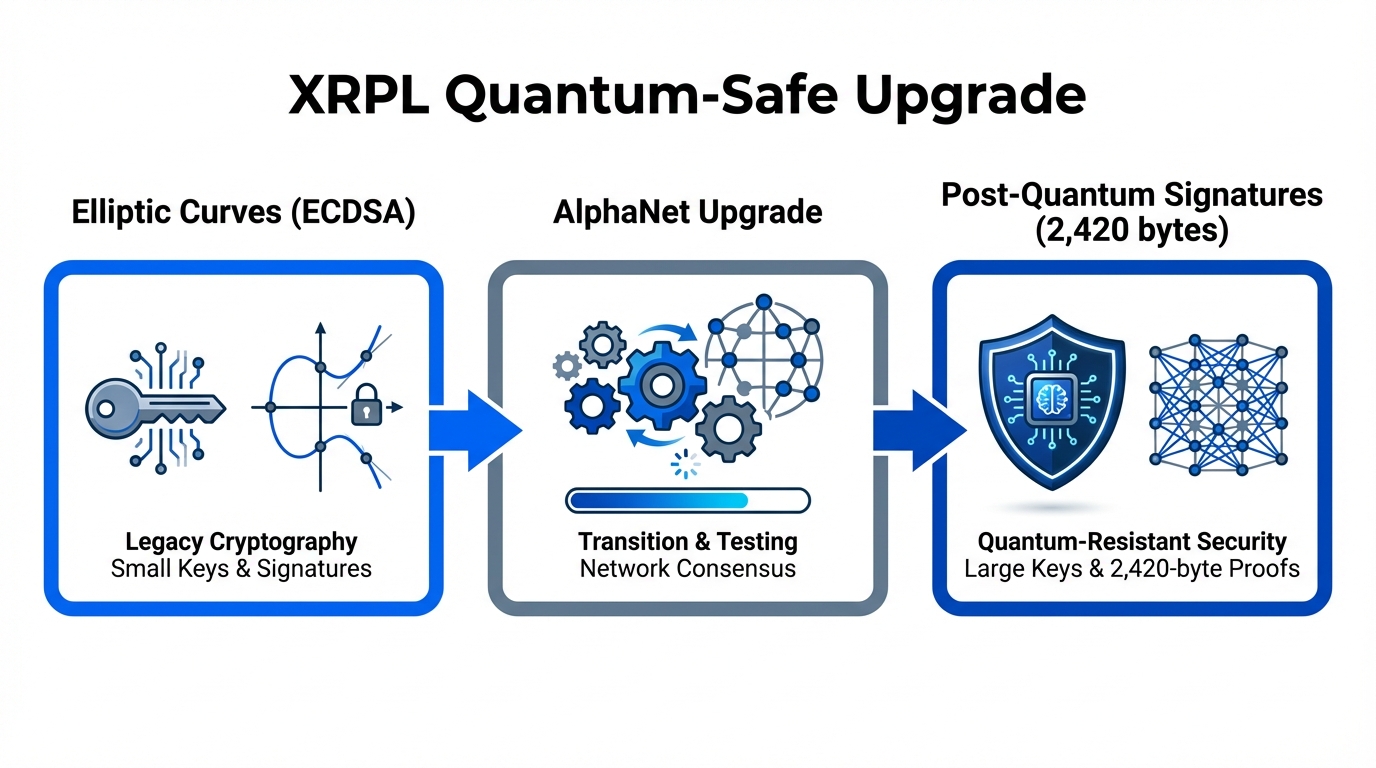
Jon: Alright, let’s get technical. The diagram above illustrates the shift—click it to enlarge. XRPL is integrating ML-DSA (Module-Lattice-based Digital Signature Algorithm), specifically Dilithium, which generates these 2,420-byte proofs. In the old system, elliptic curves like Ed25519 use compact 64-byte signatures. Now, transactions, accounts, and validator consensus are updated to use these quantum-safe keys.
Lila: So, how does a transaction work now? Is it plug-and-play?
Jon: Not quite seamless yet—this is on AlphaNet, a test environment. When you sign a transaction, instead of elliptic curve math, it uses lattice-based cryptography. The proof size jumps to 2,420 bytes, which is about 38 times larger, but XRPL’s efficient consensus (not proof-of-work) can handle it without massive fees. It’s backward-compatible for now, but full adoption means rotating keys to quantum-safe ones.
Lila: Backward-compatible? Meaning old wallets still work?
Jon: Yes, during transition. But for full security, users will need to migrate. There’s also a proposal for single-use signing keys per transaction, inspired by devs like Nik Bougalis and David Schwartz, adding another layer against quantum threats.
Jon: To compare, here’s a quick table breaking down elliptic curves versus the new quantum-safe approach.
| Aspect | Elliptic Curves (Old) | Quantum-Safe Proofs (New) |
|---|---|---|
| Signature Size | ~64 bytes (compact) | 2,420 bytes (larger) |
| Quantum Resistance | Vulnerable to Shor’s algorithm | Resistant via lattice problems |
| Performance Impact | Fast verification, low overhead | Slightly slower, higher storage needs |
| Adoption Stage | Widespread, mature | Testing on AlphaNet, upcoming mainnet |
Lila: That table helps visualize the trade-offs. Bigger sizes for better security—fair enough.
Jon: Exactly. It’s not perfect; verification might take a bit longer, but XRPL’s design minimizes that.
Lila: So who actually uses this? Beyond just XRP holders, I mean.
Jon: Great question. At the developer level, this enables building quantum-secure dApps, like DeFi protocols or cross-border payments that need long-term trust. For example, institutions using XRPL for remittances can now assure clients their transactions won’t be compromised in a quantum future. Users benefit indirectly—safer wallets and NFTs without fearing retroactive attacks. It’s also a boon for smart contracts on XRPL, as the update ties into native Hooks, allowing programmable logic that’s quantum-safe from the ground up. Think supply chain tracking or tokenized assets where security is paramount.
Lila: So, technical reliability over quick profits.
Jon: Yep, focus on the mechanics: it reduces risks in critical sectors like finance, without assuming any ROI.
Lila: If someone’s interested in learning more, where do they start? Safely, of course.
Jon: Let’s break it into levels. Level 1: Research and observation. Start by reading the XRPL docs at xrpl.org—they have sections on post-quantum upgrades. Check the AlphaNet explorer to see live quantum-safe transactions. Whitepapers on Dilithium from NIST are free and explain the math without needing a PhD.
Lila: And for hands-on? Level 2?
Jon: Use the testnet. Download the XRPL Labs wallet or Rippled software, connect to AlphaNet, and experiment with signing transactions using the new signatures. It’s zero-risk—no real funds involved. You can even contribute to GitHub discussions on Amendment #420 for single-use keys. Remember, this is for understanding the tech, not speculation.
Lila: Perfect—no pressure, just learning.
Jon: To wrap up, this XRPL update is a smart engineering move, addressing quantum risks head-on with proven crypto like Dilithium. It gives the ledger an edge in security, potentially influencing other chains. Limitations? The larger proofs could strain low-bandwidth networks, and full rollout depends on community votes.
Lila: True, and let’s not forget crypto’s volatility—tech advances don’t eliminate market uncertainties or regulatory shifts.
Jon: Absolutely. It’s an evolving space; stay informed, but approach with caution.
References
- XRPL flips to quantum-safe signatures; 2,420-byte proofs replace elliptic curves
- Official XRPL Website
- XRP Ledger AlphaNet Tests Quantum-Resistant Security Upgrade
- XRP Jumps Ahead of Bitcoin on Quantum Resistance With Major Testnet Upgrade