
Want to know crypto’s next big moves? XRP ETFs hit $1B and prediction markets are pushing for federal regulation, shaping future finance.#XRPEtf #PredictionMarkets #Web3News
Quick Video Breakdown: This Blog Article
This video clearly explains this blog article.
Even if you don’t have time to read the text, you can quickly grasp the key points through this video. Please check it out!
If you find this video helpful, please follow the YouTube channel “BlockChainBulletin,” which delivers daily Crypto news.
https://www.youtube.com/@BlockChainBulletins
Read this article in your native language (10+ supported) 👉
[Read in your language]
Daily Crypto & Web3 News: XRP ETFs Surge and Prediction Markets Push for Regulation – What It Means for the Future
Hey everyone, welcome to today’s dive into the world of crypto and Web3! Imagine a world where sending money across borders is as easy as sending a text, or where people can bet on real-world events like elections in a regulated way that actually helps predict outcomes. That’s the kind of innovation we’re seeing in crypto right now. Today, we’re unpacking big moves in XRP ETFs and a new coalition for prediction markets. Why does this matter to you? These developments could shape how everyday finance works, from faster payments to smarter forecasting tools. But remember, cryptocurrency involves high risks – it’s volatile, and you could lose money. We’re here to explain the tech and trends, not give financial advice. For quick research on projects like these, check out Genspark to summarize the latest info.
XRP’s Fifth U.S. Spot ETF Wins Cboe Approval as Institutional Flows Race Toward $1 Billion
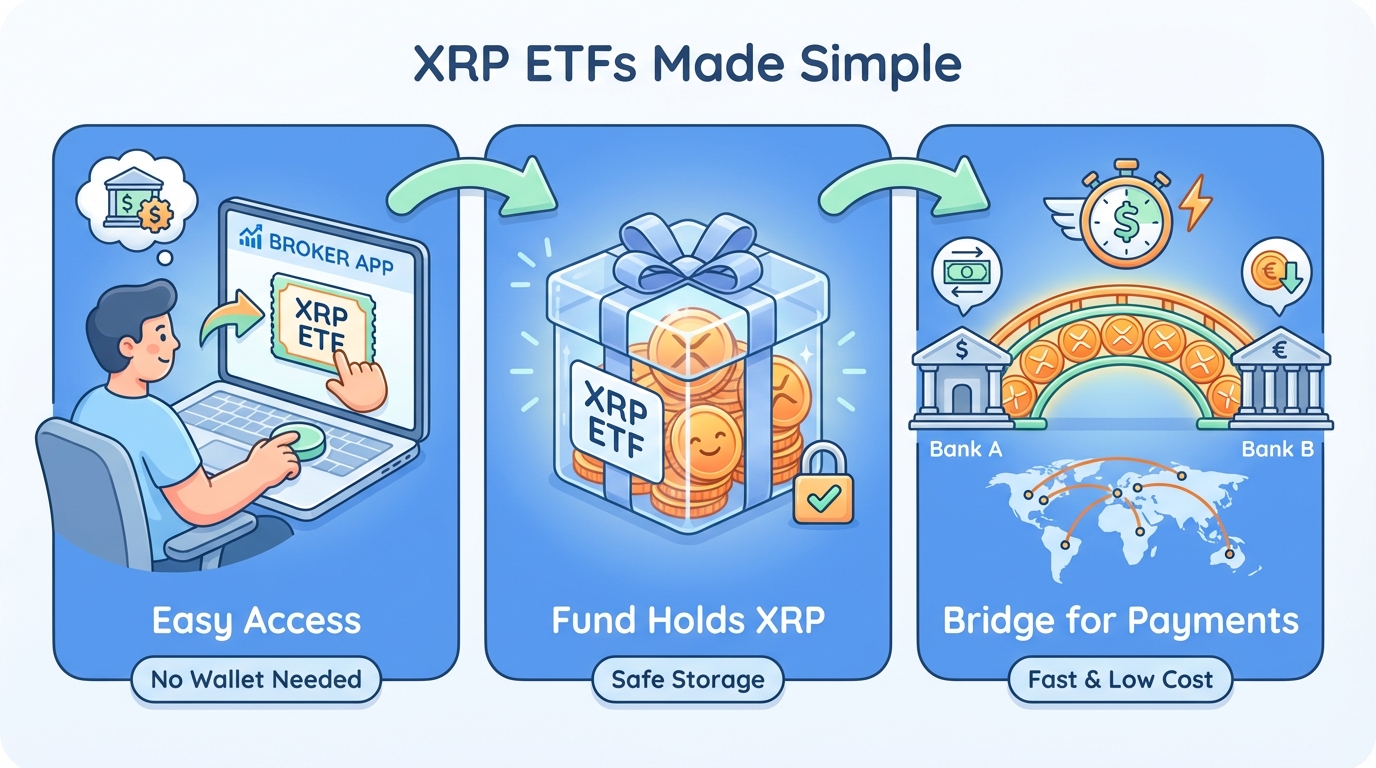
Jon: Alright, Lila, let’s kick this off with some exciting news from the crypto world. The big buzz today is about XRP, a cryptocurrency that’s been making waves in cross-border payments. Cboe BZX just approved the listing for the 21Shares XRP ETF, trading under the ticker TOXR. This is the fifth spot XRP ETF in the U.S., and together, these funds are nearing $1 billion in assets under management (AUM) in under four weeks. That’s super fast growth, similar to what we saw with Ethereum ETFs early on. It shows big institutions are getting comfy with XRP for long-term plays in regulated finance.
Lila: Whoa, Jon, slow down – what’s an ETF? And why is this a big deal for someone like me who’s just dipping toes into crypto?
Jon: Great question! Think of an ETF like a basket of fruits at the market – it lets you buy a share that represents real XRP without handling the coins yourself. These are “spot” ETFs, meaning they’re backed by actual XRP held in secure storage. They track the price closely through mechanisms where big players can create or redeem shares. This makes it easy for investors to get exposure without dealing with wallets or exchanges. For everyday folks, it means crypto is becoming more like traditional stocks, potentially integrating into retirement accounts or apps you already use. But hey, crypto is high-risk – prices swing wildly, so always research thoroughly.
Lila: Okay, got it. So, what’s special about XRP itself? I’ve heard it’s fast for payments.
Jon: Exactly! XRP runs on the XRP Ledger (XRPL), a Layer-1 blockchain – that’s like the base highway for transactions. It uses a Byzantine Fault Tolerant consensus, which is a fancy way of saying validators (trusted nodes) agree on transactions every 3-5 seconds without energy-hungry mining like Bitcoin. No block rewards mean no inflation from new coins. XRP’s total supply is capped at 100 billion, all pre-created, with some released from escrow over time. Fees are tiny and burned, making it slightly deflationary as usage grows. It’s designed as a bridge for cross-border money transfers, faster and cheaper than old systems like SWIFT.
Lila: Deflationary? Like, the supply decreases? And what about regulations – isn’t XRP tangled with legal stuff?
Jon: Spot on. Burning fees means less XRP over time if activity ramps up. On regs, there was a long SEC case with Ripple (the company behind XRP), but in a 2025 settlement, courts said secondary-market XRP trades are like commodities, not securities. That’s huge – it cleared the path for these ETFs. Now, institutions see XRP as less risky. If you’re curious about the tech docs, tools like Gamma can help you create quick presentations on whitepapers.
Lila: Interesting! But the price is down – XRP is at about $1.99, off 7% this week and 45% from its all-time high. Why are ETFs booming if the price isn’t?
Jon: Ah, the classic disconnect. ETF inflows are steady from advisors and funds betting on XRP’s utility in payments, not short-term flips. Meanwhile, spot price faces macro pressures like market jitters. Ripple’s buying Hidden Road for their Ripple Prime platform and launching RLUSD stablecoin boosts real-world use. Singapore even expanded Ripple’s license for payments. So, the tech and adoption are advancing, even if price lags. For beginners, this highlights crypto’s risks – focus on utility, not speculation.
Lila: So what? How does this impact me or the future?
Jon: It could mean faster, cheaper global payments for everyone. Imagine remitting money home without high fees. ETFs make this accessible, but remember, crypto investments are volatile. Always DYOR – do your own research.
Prediction Market Heavyweights Join Forces: Kalshi, Crypto.com and Industry Giants Launch Coalition for Federal Recognition
Jon: Shifting gears, Lila – another hot topic is prediction markets. Kalshi and Crypto.com just launched the Coalition for Prediction Markets (CPM), teaming up with big names like Coinbase, Robinhood, and Underdog. Their mission? Get federal recognition for these markets as legit financial tools, not gambling. This comes amid billion-dollar trading volumes on events like elections or rate changes.
Lila: Prediction markets? Sounds like betting, but fancier. Break it down for me.
Jon: Think of it like a crowd-sourced crystal ball. People trade contracts on outcomes – e.g., “Will interest rates drop?” A token pays $1 if yes, zero if no. Platforms like Kalshi are regulated by the CFTC (Commodity Futures Trading Commission), while crypto ones like Polymarket use blockchains for 24/7 access. On-chain, smart contracts – self-executing code on networks like Ethereum – handle bets, using automated market makers (AMMs) to adjust odds based on trades. It’s tokenizing information into prices, turning opinions into data.
Lila: Ethereum? That’s the one with smart contracts, right? How does consensus fit in?
Jon: Yes! Ethereum uses proof-of-stake, where validators stake coins to secure the network. Prediction apps build on top, inheriting that security. The coalition wants CFTC oversight to standardize rules, fight state crackdowns labeling them as gambling. Kalshi just won a temporary halt in Connecticut court, blocking a shutdown until 2026 hearings. If you’re into coding smart contracts, check out Nolang for AI-guided learning.
Lila: Why form this coalition now? And what’s the tech utility?
Jon: Volumes are exploding, showing real demand for forecasting tools. CPM pushes for federal rules on integrity – like anti-insider trading – to treat them as useful for policy and hedging, not just fun bets. In DeFi (decentralized finance, like banking without banks), this could integrate into yields or insurance. For example, hedge against inflation via on-chain contracts. It’s about making crypto composable – pieces fitting together like LEGO.
Lila: Risks? And how does this affect non-techies?
Jon: Huge risks – it’s speculative, and regs are evolving. Critics say it feels like gambling. But if done right, it could improve decision-making in finance or politics. For you, it means Web3 tools for everyday predictions, but approach with caution. Crypto is high-risk; never invest what you can’t lose.
| Top Story | Key Highlights | Impact on Web3 |
|---|---|---|
| XRP Spot ETFs Approval | Fifth ETF (TOXR) approved; nearing $1B AUM in weeks; backed by real XRP | Boosts adoption for cross-border payments; clearer regs attract institutions |
| Coalition for Prediction Markets | Kalshi, Crypto.com lead with Coinbase, etc.; push for federal oversight | Could legitimize on-chain forecasting; integrates with DeFi for hedging |
In summary, today’s news highlights how crypto is maturing through regulation and institutional tools. XRP’s ETF boom shows growing trust in its payment tech, while the prediction markets coalition aims to turn speculation into useful data. These steps could bring Web3 closer to daily life, but always remember the high risks involved. Encourage yourself to learn more – do your own research (DYOR)! For automating your research workflows, try Make.com.

👨💻 Author: SnowJon (Web3 & AI Practitioner / Investor)
A researcher who leverages knowledge gained from the University of Tokyo Blockchain Innovation Program to share practical insights on Web3 and AI technologies. While working as a salaried professional, he operates 8 blog media outlets, 9 YouTube channels, and over 10 social media accounts, while actively investing in cryptocurrency and AI projects.
His motto is to translate complex technologies into forms that anyone can use, fusing academic knowledge with practical experience.
*This article utilizes AI for drafting and structuring, but all technical verification and final editing are performed by the human author.
⚠️ IMPORTANT RISK WARNING
Cryptocurrency investments are highly volatile and high-risk. You could lose your entire investment. Past performance is not indicative of future results. This content is for educational and informational purposes only and does NOT constitute financial advice. Always do your own research (DYOR) before making any decisions.
🛑 Affiliate Disclaimer
This article contains affiliate links. Tools mentioned are based on current information. Use at your own discretion.
▼ Recommended Tools for Research & Productivity
- 🔍 Genspark: An AI agent that saves you research time by summarizing search results.
- 📊 Gamma: Create beautiful presentations and docs in seconds just by typing.
- 🎥 Revid.ai: Turn your text or blogs into viral short videos instantly.
- 👨💻 Nolang: Learn coding or any topic by chatting with an AI tutor.
- ⚙️ Make.com: Automate boring tasks by connecting your favorite apps.