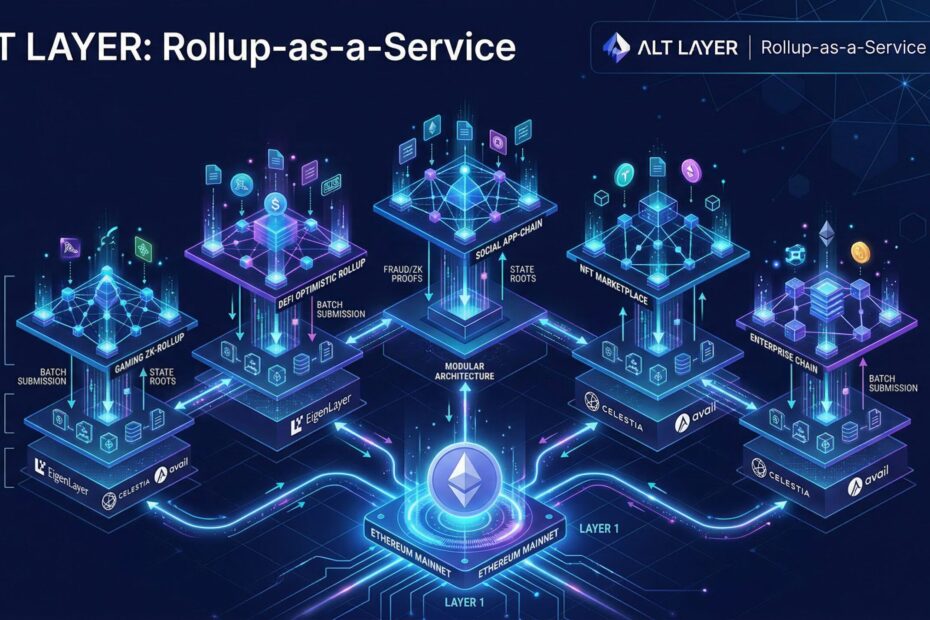
What Is AltLayer?
AltLayer is a decentralized protocol for launching, securing, and operating application-specific blockchain networks called rollups. It specializes in Rollup-as-a-Service (RaaS) — providing the infrastructure that allows developers and enterprises to deploy their own scalable Layer 2 or app-specific blockchain in minutes, without needing to manage complex underlying infrastructure.
AltLayer’s core innovation goes beyond simply hosting rollups. It introduced the concept of Restaked Rollups — a framework that uses EigenLayer’s restaking mechanism to provide cryptoeconomic security, fast finality, and decentralized verification to rollups that would otherwise rely entirely on a single sequencer and slow fraud-proof windows. This approach makes rollups built on AltLayer significantly more secure, decentralized, and fast than standard standalone rollups.
The native token of the AltLayer protocol is ALT, which functions as the economic backbone of the ecosystem — used for protocol fees, staking, governance, and operator rewards. As of March 2026, ALT trades at approximately $0.0075, with a market capitalization of around $42.7 million.
The Problem AltLayer Solves
To understand why AltLayer exists, it helps to understand the challenge facing Ethereum‘s scaling ecosystem.
Ethereum is the dominant smart contract platform, but its base layer cannot process enough transactions per second to support global-scale decentralized applications. The solution that has emerged is the rollup: a blockchain that processes transactions off the Ethereum mainchain (off-chain), compresses them, and posts proofs or summaries back to Ethereum for settlement. This allows rollups to inherit Ethereum’s security while offering dramatically higher throughput and lower fees.
The challenge is that building and operating a rollup is technically demanding. A standalone rollup needs to:
- Run a sequencer (the entity that orders and processes transactions)
- Manage data availability (ensuring transaction data is accessible for verification)
- Handle settlement back to Ethereum L1
- Provide fast finality to users (so transactions aren’t in a “pending” state for minutes or hours)
- Maintain decentralization (avoiding the single-point-of-failure risk of a centralized sequencer)
Most teams — especially startups and gaming studios — do not have the engineering resources to build all of this themselves. AltLayer abstracts away this complexity, allowing teams to deploy a production-ready rollup through a no-code dashboard and then optionally enhance it with AltLayer’s restaked security and finality services.
AltLayer’s Core Product: Restaked Rollups
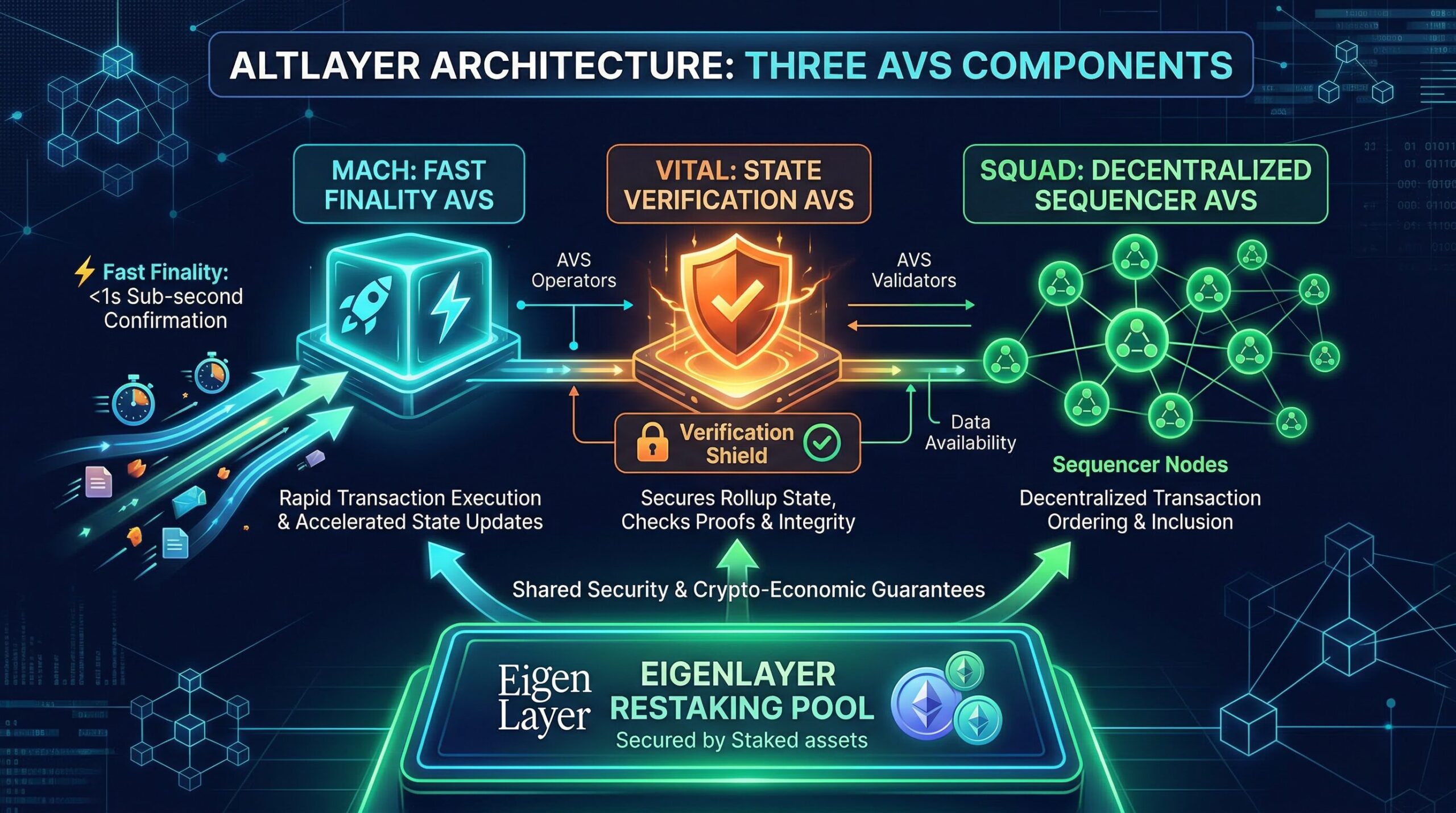
The defining feature of AltLayer’s protocol is the Restaked Rollup framework, which adds three distinct security and performance services to any rollup. Each service is implemented as an Actively Validated Service (AVS) on EigenLayer — meaning it is secured by a decentralized network of operators who have restaked ETH or other eligible assets and face economic penalties (slashing) for malicious behavior.
MACH: Fast Finality
MACH is AltLayer’s fast-finality AVS. Standard Ethereum optimistic rollups have a challenge period of approximately seven days before withdrawals are fully finalized on L1 — a significant friction point for users and cross-chain bridges. Even during normal operation (before the challenge period), users rely on “soft confirmations” from a centralized sequencer that carry no cryptoeconomic guarantee.
MACH resolves this by providing pre-confirmations backed by restaked capital. A network of MACH operators independently verify and attest to rollup states. Because they have staked economic collateral that can be slashed, their attestations carry real guarantees. The result is transaction pre-confirmation in under one second — with economic backing that no centralized sequencer can provide.
MACH currently supports major rollup ecosystems including Ethereum’s Optimism Mainnet and Arbitrum One, two of the largest Layer 2 networks by TVL.
VITAL: Decentralized State Verification
VITAL is AltLayer’s state verification AVS. It maintains a decentralized network of operators that continuously verify the state roots proposed by rollup sequencers. If a VITAL operator detects an invalid state root, it can initiate a fraud proof challenge through a bisection protocol, preventing fraudulent state transitions from being accepted.
VITAL can operate in multiple modes:
- Standard fraud proof mode: Operators challenge invalid state roots using the bisection protocol, requiring the sequencer to prove correctness step by step.
- Optimistic ZK mode: Operators can demand that sequencers generate a zero-knowledge proof for a disputed state root, providing a cryptographic guarantee of correctness rather than relying on the bisection game.
VITAL is a critical component for rollups seeking to advance toward “Stage 2” decentralization — the fully decentralized operational state where a rollup’s security does not depend on any trusted third party. AltLayer’s documentation describes VITAL as the mechanism that can bring rollups to Stage 2.
SQUAD: Decentralized Sequencing
SQUAD addresses the sequencer centralization problem. In most production rollups today, a single sequencer orders and processes all transactions. This creates risks: the sequencer can go offline (liveness failure), extract value through unfair ordering (MEV), or theoretically censor specific transactions.
SQUAD provides decentralized sequencing by distributing the sequencer role across a set of economically bonded operators on EigenLayer. Decentralized sequencing eliminates single points of failure, reduces MEV extraction, and provides stronger resistance to censorship — all backed by restaked collateral that can be slashed for protocol violations.
Rollup-as-a-Service: How Developers Use AltLayer
AltLayer’s RaaS platform enables developers to deploy rollups through two main pathways:
No-Code Dashboard Deployment
AltLayer provides a web-based dashboard where developers can configure and deploy a rollup without writing infrastructure code. Configuration options include:
- Execution environment: EVM (compatible with all Solidity code), WASM, or other runtimes
- Rollup type: Optimistic rollup or ZK rollup
- Data availability layer: Ethereum DA, Celestia, Avail, or EigenDA
- Settlement layer: Ethereum mainnet or another supported chain
- Ephemeral or persistent: Developers can spin up temporary “Flash Layers” for specific events (NFT drops, gaming tournaments) or deploy permanent application-specific rollups
Once deployed, the rollup can optionally be enhanced with MACH, VITAL, and SQUAD services from AltLayer’s restaked rollup suite.
Flash Layers
One of AltLayer’s distinctive products is the Flash Layer — a temporary, purpose-built rollup that can be deployed for a specific event and then shut down after the event concludes, with final state settled back to Ethereum L1. This is particularly useful for:
- NFT mint events that generate sudden spikes in transaction demand
- Gaming tournaments that need a dedicated high-performance chain for the duration of the event
- Token launches that require isolated, high-throughput transaction processing
Flash Layers allow projects to burst scale without committing to permanent infrastructure — they pay for what they use and nothing more.
Multi-Chain Support
AltLayer is not tied to a single ecosystem. As of 2026, the protocol supports rollup deployment and enhancement across:
- Ethereum (OP Stack, Arbitrum Orbit, Polygon CDK, zkSync ZK Stack)
- EigenLayer (for restaked security)
- Polkadot (Native Rollups)
- Starknet
- Avail
- Celestia
- And more than a dozen additional ecosystems
This multi-chain positioning makes AltLayer a neutral infrastructure provider rather than a competitor to any single rollup ecosystem. A developer building on Arbitrum Orbit can use AltLayer’s MACH for fast finality just as easily as a developer on the OP Stack. AltLayer acts as a cross-ecosystem accelerator for rollup security and performance.
The ALT Token: Utility and Economics
The ALT token serves multiple functions within the AltLayer protocol:
Protocol Fees
Applications using AltLayer’s restaked rollup services pay fees in ALT tokens. As usage of MACH, VITAL, and SQUAD grows, demand for ALT as a fee token grows proportionally.
Staking and Economic Bond
ALT is used alongside restaked ETH to provide economic bond for AltLayer operators. Operators stake ALT to participate in the network, and their stake can be slashed if they behave maliciously. This gives the ALT token direct economic significance in maintaining protocol security.
Governance
ALT token holders can vote on governance decisions affecting the AltLayer protocol, including parameter changes, new feature activation, and ecosystem fund allocation.
Operator Rewards
Network participants who run AltLayer services (MACH operators, VITAL verifiers, SQUAD sequencers) earn ALT rewards for their contributions, creating a distributed incentive for network participation.
Token Wrappers: reALT and stALT
AltLayer has created two token wrappers for ALT:
- reALT: “Restaked ALT” — an ERC-20 interest-bearing token representing ALT staked in the main staking pool. reALT accumulates rewards through compound interest, allowing holders to earn yield without actively managing positions.
- stALT: A staked ALT representation used in specific liquidity and governance contexts.
AltLayer’s 2025–2026 Development: Key Milestones
AltLayer has been an active protocol, shipping meaningful updates through 2025 and into 2026:
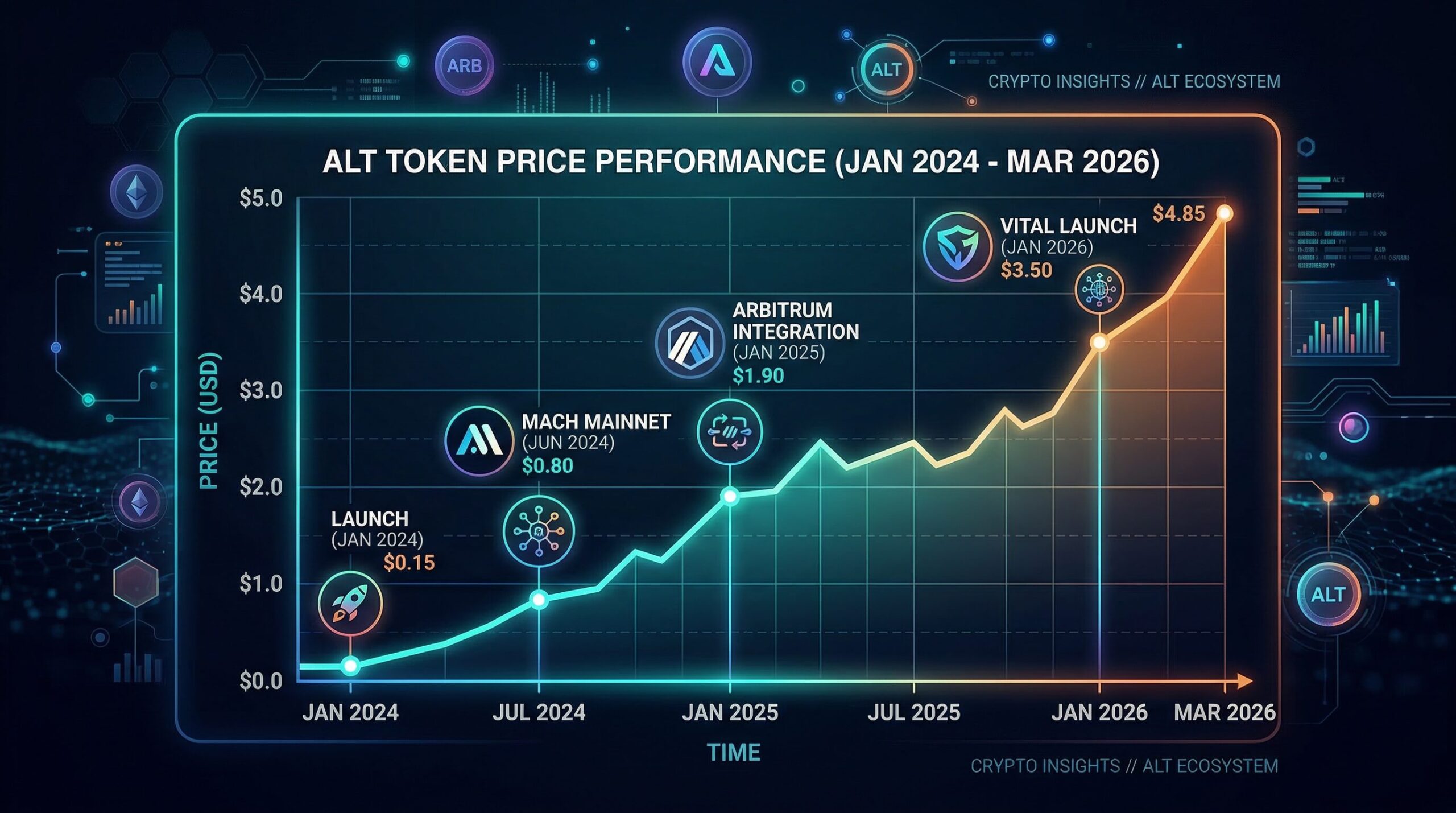
- January 2024: ALT token launched via Binance Launchpool, achieving a market cap of approximately $360 million quickly and establishing the token on major exchanges.
- April 2024: MACH fast-finality AVS launched on mainnet with OP Stack support.
- July 2024: MACH added support for Arbitrum One, extending AltLayer’s fast-finality service to two of Ethereum’s largest rollup ecosystems.
- November 2024: VITAL AVS introduced, bringing decentralized state verification to the restaked rollup framework.
- 2025: AltLayer expanded its ecosystem beyond pure rollup infrastructure, launching Wizard (AI-native tooling), Autonome, and 8004_scan. The protocol also added Polkadot Native Rollup support and Gattaca’s based rollup stack integration.
- October 2025: AltLayer entered its SOC 2 Type II audit phase, targeting institutional credibility.
- January 2026: AltLayer achieved ISO/IEC 27001:2022 certification — a significant milestone for institutional trust. This internationally recognized information security certification demonstrates that AltLayer meets rigorous security management standards.
ALT Token Market Data (March 2026)
As of March 20, 2026, ALT market data reflects the broader crypto market correction:
- Current price: approximately $0.0075
- Market capitalization: approximately $42.7 million
- 24-hour trading volume: approximately $6.2 million
- All-time high: $0.6881 (March 2024)
- Price vs. 1 year ago: approximately -79% (from $0.036 in March 2025 to $0.0075 in March 2026)
ALT’s price decline reflects a combination of the broader altcoin market downturn and token supply pressure from scheduled unlock events. In July 2025, approximately 240 million ALT tokens (6% of total supply) were released through scheduled unlocks, adding sell pressure during a period of weaker market sentiment.
ALT launched at an initial market cap of approximately $360 million in January 2024 during a bull market peak. The current valuation represents a significant compression, though the protocol’s underlying development has continued uninterrupted through the price decline.
The RaaS Competitive Landscape
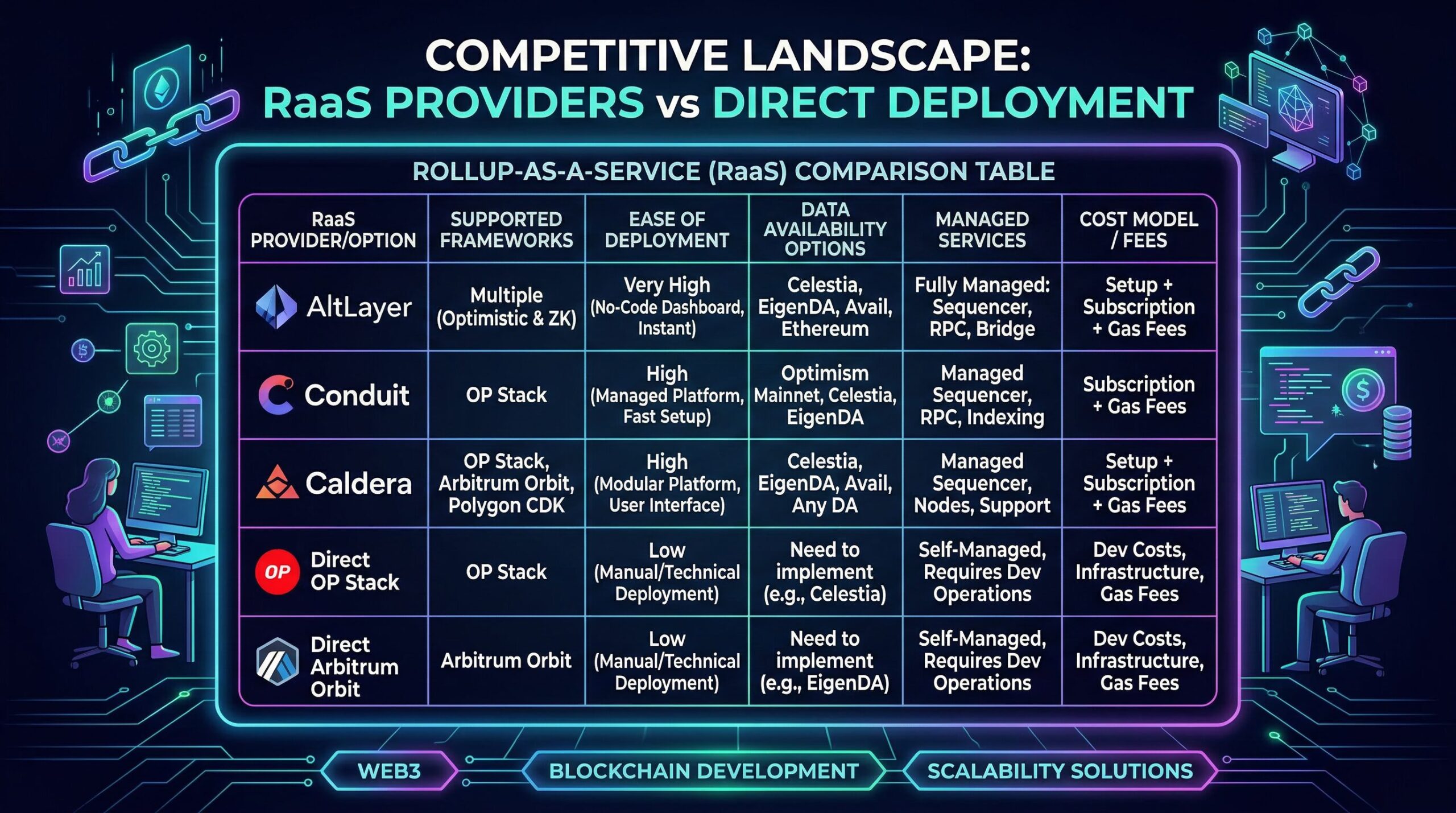
AltLayer operates in a growing but competitive market for rollup infrastructure. Key competitors and ecosystem alternatives include:
Conduit
Conduit is a managed RaaS provider focused primarily on the OP Stack and Arbitrum Orbit ecosystems. It has attracted multiple notable clients and emphasizes ease of deployment with managed operations. Conduit is more focused on the operator/deployment layer than on the restaked security layer that differentiates AltLayer.
Caldera
Caldera is another RaaS provider supporting multiple rollup stacks. Like Conduit, it focuses on deployment and management rather than adding a restaking security layer. Caldera has launched a significant number of rollups and has attracted venture backing.
Arbitrum Orbit and OP Stack
Developers can also build custom rollups using Arbitrum’s Orbit framework or Optimism’s OP Stack directly, without a dedicated RaaS provider. These options are more technically demanding but give teams maximum control. AltLayer actually supports both stacks through its RaaS platform, meaning it can serve teams that want these ecosystems’ technology with AltLayer’s operational and security services on top.
AltLayer’s Differentiation
AltLayer’s defining advantage over competitors is the Restaked Rollup framework — the combination of MACH, VITAL, and SQUAD that provides EigenLayer-backed security, fast finality, and decentralized sequencing. No direct competitor offers this complete stack of cryptoeconomically-backed services for rollups across multiple ecosystems simultaneously.
The ISO/IEC 27001:2022 certification achieved in January 2026 further differentiates AltLayer for institutional and enterprise clients who require verifiable security standards before deploying on third-party infrastructure.
Use Cases: Who Uses AltLayer?
AltLayer’s products serve several categories of builders:
GameFi and NFT Projects
High-frequency gaming and NFT applications need transaction throughput and finality far beyond what Ethereum mainnet can provide affordably. AltLayer’s Flash Layers and persistent gaming rollups with MACH fast-finality are a natural fit for projects like blockchain MMORPGs, digital trading card games, and large-scale NFT minting events.
DeFi Protocols
DeFi applications that need sub-second price confirmation, fast withdrawal finality, and resistance to sequencer MEV benefit directly from AltLayer’s restaked rollup services. A DeFi protocol using MACH and SQUAD can offer users genuine fast finality and censorship resistance rather than relying on a centralized sequencer’s promises.
Enterprise Applications
Enterprises building private or consortium blockchains can use AltLayer’s customization options — custom validator sets, controlled access, jurisdiction-specific rule enforcement — while inheriting Ethereum’s security for settlement. The ISO/IEC 27001:2022 certification makes AltLayer’s infrastructure suitable for institutional procurement processes.
Existing Rollups Seeking Upgrades
An existing rollup — including Arbitrum One and OP Mainnet — can adopt individual AltLayer services without rebuilding. Adding MACH for fast finality, for example, does not require changing the rollup’s core architecture. This makes AltLayer’s services additive to the existing ecosystem rather than competing with established rollups.
AltLayer and the 2026 Ethereum Scaling Landscape
Ethereum’s Pectra upgrade (May 2025) doubled blob capacity for rollup data, making it cheaper for rollups to post data to Ethereum L1. The subsequent Fusaka upgrade (December 2025) activated PeerDAS, enabling validators to verify blob data by sampling rather than downloading it entirely, with estimates suggesting it could cut L2 data fees by a further 40–60%. These upgrades make Ethereum an increasingly attractive settlement layer for rollups, which directly benefits AltLayer by lowering the operating costs for rollups secured by its protocol.
The Ethereum L2 landscape in 2026 has undergone significant consolidation. According to the 21Shares “State of Crypto” report from December 2025, Base, Arbitrum, and Optimism now process nearly 90% of all L2 transactions, while more than 50 smaller rollups compete for the remaining activity. This consolidation does not eliminate the market for AltLayer — rather, it underscores the value of the restaked rollup framework for rollups that need to differentiate on security and finality, and the Flash Layer offering for episodic use cases that do not require a permanent chain.
Risks and Investment Considerations for ALT
Investors considering ALT should weigh the following factors:
- Token unlock pressure: Scheduled token unlocks have historically created sell pressure on ALT. Monitoring the unlock schedule and market absorption capacity is important for timing-sensitive investors.
- Market cap vs. protocol usage: At $42.7 million market cap, ALT is priced at a fraction of its launch valuation despite continued development. Whether this represents undervaluation or appropriate pricing depends on RaaS adoption metrics that remain modest relative to early expectations.
- Ecosystem dependency: AltLayer’s value is deeply linked to the growth of the EigenLayer restaking ecosystem. If EigenLayer faces regulatory or technical challenges, AltLayer’s security model is affected.
- Competition: The RaaS market is well-funded and competitive. Conduit, Caldera, and direct rollup framework providers remain significant rivals.
- Regulatory uncertainty: Staking services and restaking protocols face evolving regulatory treatment in the US and EU. AltLayer’s compliance push (SOC 2 Type II, ISO 27001) mitigates but does not eliminate this risk.
Frequently Asked Questions About AltLayer
What blockchain is AltLayer built on?
AltLayer is not a standalone blockchain. It is a protocol that operates across multiple ecosystems — primarily through EigenLayer on Ethereum, but extending to Polkadot, Arbitrum, Optimism, and others. ALT is an ERC-20 token on Ethereum mainnet.
How does AltLayer differ from Arbitrum or Optimism?
Arbitrum and Optimism are specific rollup networks with their own user-facing ecosystems. AltLayer is infrastructure that can be used to deploy and enhance rollups — including rollups built on the Arbitrum Orbit framework or the OP Stack. Think of AltLayer as the security and tooling layer above the rollup itself, not a competitor to specific rollup networks.
What is a Flash Layer?
A Flash Layer is a temporary rollup deployed for a specific event — an NFT drop, a gaming tournament, a token launch. It operates at high performance during the event and then settles its final state back to Ethereum L1, after which it is decommissioned. Teams pay only for the duration of use.
What is EigenLayer restaking?
EigenLayer is a protocol that allows ETH stakers to “restake” their already-staked ETH to secure additional services (called Actively Validated Services, or AVSs) beyond just the Ethereum mainchain. AltLayer’s MACH, VITAL, and SQUAD are all AVSs on EigenLayer, meaning they are secured by the same economic collateral backing Ethereum itself.
Where can I buy ALT token?
ALT is available on Binance (launched via Binance Launchpool in January 2024), KuCoin, OKX, Bybit, Kraken, Gate.io, MEXC, HTX Global, and other major centralized exchanges. It can also be traded on Uniswap and other Ethereum DEXs using the token’s contract address.