
From my view Strategy selecting Bitcoin is notable. Corporate balance sheets are evolving.#Bitcoin #Strategy
Quick Video Breakdown: This Blog Article
This video clearly explains this blog article.
Even if you don’t have time to read the text, you can quickly grasp the key points through this video. Please check it out!
If you find this video helpful, please follow the YouTube channel “BlockChainBulletin,” which delivers daily Crypto news.
https://www.youtube.com/@BlockChainBulletins
Read this article in your native language (10+ supported) 👉
[Read in your language]
Michael Saylor’s Strategy ($MSTR) Spends $2.13 Billion to Buy 22,305 Bitcoin
Jon: Hey Lila, have you seen the latest from Michael Saylor and his company, now rebranded as Strategy? They just announced spending $2.13 billion to acquire 22,305 Bitcoin. This pushes their total holdings to over 709,000 BTC, valued at around $54 billion based on current prices. It’s their biggest buy in a while, and it’s making waves in the crypto space.
Lila: Wow, Jon, that’s a massive number. I know Saylor’s been all-in on Bitcoin for years, but dropping over two billion in just eight days? That’s bold. Why does this matter, especially now in 2026?
Jon: It matters because Strategy—formerly MicroStrategy—is essentially treating Bitcoin as a core treasury asset, like a digital reserve currency. This purchase comes amid market volatility, with Bitcoin hovering around $76,000 per coin or so, based on recent reports. Saylor’s arguing it’s a better store of value than traditional options like U.S. Treasurys. But it’s not without risks—their stock, $MSTR, dropped about 5% on the news, showing how tied it is to Bitcoin’s price swings.
Lila: Okay, that high-level view helps. But let’s dig into the “why” behind this. What’s the problem Strategy is trying to solve by hoarding all this Bitcoin?
Jon: At its core, the problem is capital allocation in a world of inflation and low-yield assets. Traditional companies hold cash or bonds, but those can lose value over time due to inflation—think of it like money sitting in a bank account that’s slowly leaking because the interest doesn’t keep up with rising prices. Saylor sees Bitcoin as “digital gold,” a hedge against that erosion. By converting cash into BTC, Strategy aims to preserve and potentially grow their capital. Of course, Bitcoin’s volatility means it’s more like riding a rollercoaster than parking in a safe garage.
Lila: Leaking bank account analogy makes sense—I’ve felt that with savings rates. But clarify: is this just about fighting inflation, or is there more to their strategy?
Jon: It’s multifaceted. Imagine a company’s treasury as a plumbing system: cash flows in from operations, but if you don’t invest it wisely, it stagnates or depreciates. Strategy’s “Bitcoin strategy” reroutes that flow into BTC, betting on its scarcity—only 21 million will ever exist—versus fiat money that can be printed endlessly. They’ve been doing this since 2020, and this latest buy is part of a pattern: raise funds through stock sales or debt, buy Bitcoin, repeat. Analysts note it’s yielding them around 8.1% in BTC terms for potential 2027 recovery, but it’s high-risk plumbing—if Bitcoin crashes, the whole system backs up.
Lila: Got it. So, it’s like upgrading from old, leaky pipes to a high-pressure system that could burst if not handled right. That analogy clicks.
Under the Hood: How it Works
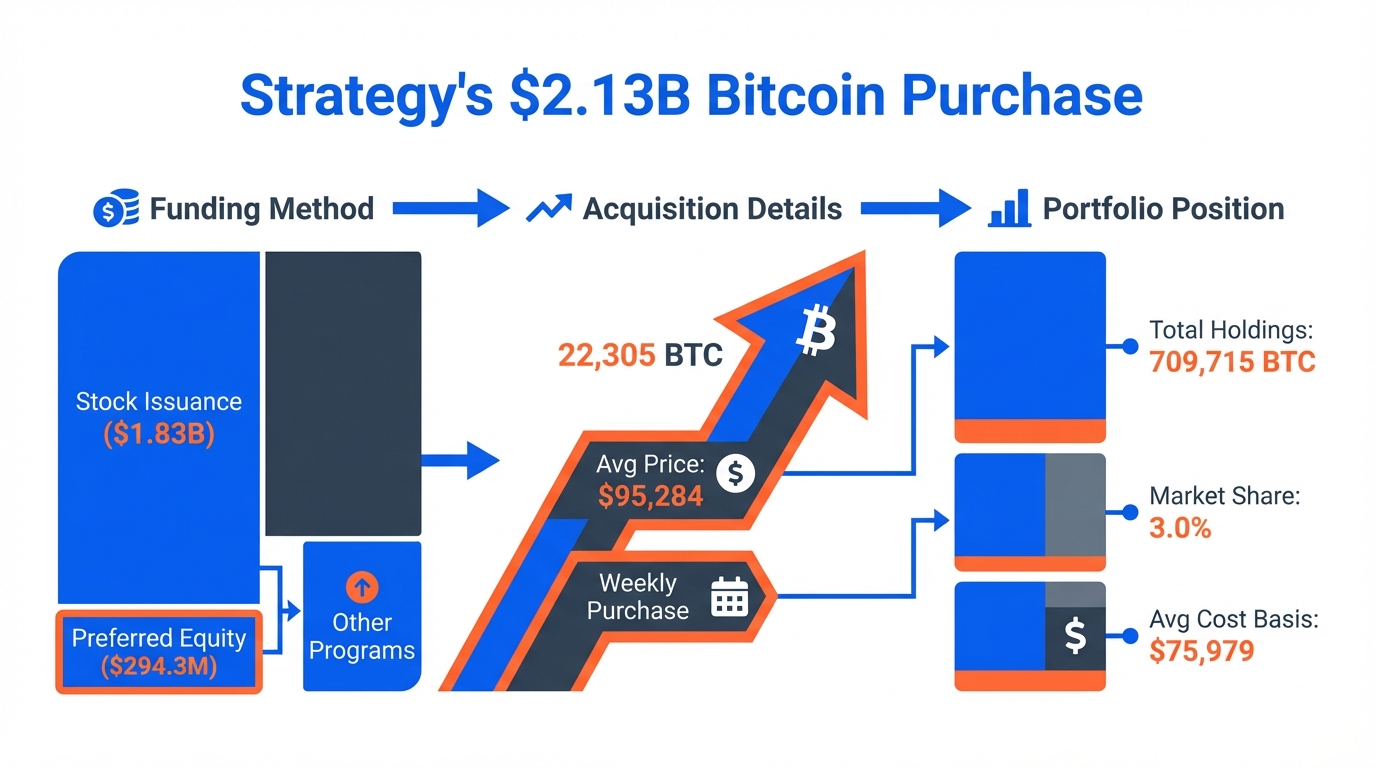
Jon: Alright, let’s peel back the layers on how Strategy’s Bitcoin play actually operates. At the heart is their capital raising and acquisition cycle. They issue convertible notes or sell shares—recently, they raised cash through stock sales—to fund BTC purchases. This latest one: $2.13 billion for 22,305 BTC at an average price of about $95,500 per coin, based on reports. It’s integrated into their balance sheet, where Bitcoin is classified as an indefinite-lived intangible asset, meaning they don’t have to mark it down if the price dips below purchase cost, per accounting rules.
Lila: Indefinite-lived intangible—that sounds jargony. Rephrase: it’s like owning a patent that doesn’t expire, and you don’t depreciate it yearly?
Jon: Exactly. Under U.S. GAAP, Bitcoin fits that category, so Strategy only impairs it if the market value falls below carrying value at quarter-end, but they can hold through volatility. Mechanically, they use over-the-counter trades or exchanges to buy large volumes without spiking the market price. Saylor’s added a “BTC Rating” metric on their site, scoring Bitcoin’s performance against other assets—think of it as a report card for why BTC beats gold or stocks in their view.
Lila: Okay, confirming: this isn’t some fancy blockchain tech; it’s corporate finance meets crypto holding?
Jon: Spot on. No new token or protocol here—it’s pure Bitcoin adoption at scale. To illustrate differences, let’s compare Strategy’s approach to traditional corporate treasuries.
| Aspect | Traditional Treasury (e.g., Cash/Bonds) | Strategy’s Bitcoin Approach |
|---|---|---|
| Yield Potential | Low, fixed (e.g., 4-5% on Treasurys) | High but volatile (e.g., 8.1% forecasted BTC yield) |
| Inflation Hedge | Poor; value erodes over time | Strong due to fixed supply |
| Volatility | Low and stable | High; can swing 20%+ in days |
| Accounting Treatment | Marked to market or amortized | Indefinite-lived, impaired only if below cost |
| Liquidity | High; easy to sell | Moderate; large sales can move markets |
Lila: That table really highlights the trade-offs. It’s not all upside—volatility could be a killer.
Jon: Precisely. And remember, this is built on Bitcoin’s proof-of-work consensus: miners secure the network by solving puzzles, ensuring transactions are immutable. Strategy doesn’t mine; they just hold, betting on network growth.
Lila: So who actually uses this? I mean, beyond Strategy itself, what’s the broader application?
Jon: Good question. On a developer level, it’s inspiring treasury management tools—think open-source scripts for tracking BTC holdings or integrating with accounting software like QuickBooks for crypto assets. For users, it’s a model for institutions: pension funds are dipping in, like a recent U.S. fund buying $MSTR shares. Technically, it showcases Bitcoin as a balance sheet optimizer, reducing reliance on fiat. Use cases include hedging against currency devaluation in emerging markets or as collateral for loans without selling BTC.
Lila: Makes sense for big players. But for everyday folks or smaller devs, how does this translate?
Jon: Smaller entities can mimic on a micro scale—using Bitcoin for long-term savings via self-custody wallets. Developers might build apps around BTC yield metrics, like Saylor’s rating system, to analyze asset performance. The technical benefit is decentralization: no central bank controls supply, offering resilience in unstable economies.
Lila: Alright, shifting to learning. If someone’s interested, what’s a safe way to dive in without risks? Start with Level 1?
Jon: Absolutely, Level 1 is research and observation. Begin by reading Strategy’s investor reports on their site—microstrategy.com or strategy.com now. Check whitepapers on Bitcoin.org for core mechanics. Use explorers like Blockchain.com to track Strategy’s BTC addresses; they’re public, so you can see holdings in real-time. Dashboards on CoinMarketCap or Glassnode provide analytics on corporate BTC adoption. It’s about understanding patterns without committing funds.
Lila: That sounds low-pressure. What about Level 2—hands-on learning? How to try safely?
Jon: For Level 2, focus on testnets or simulations. Bitcoin has a testnet where you can experiment with transactions using fake BTC—no real value at stake. Tools like Electrum wallet let you set up testnet modes to practice sending/receiving. If you’re into finance, simulate treasury strategies with open-source tools like Python libraries (e.g., yfinance for stock data, ccxt for crypto APIs) to model what-if scenarios for holding BTC vs. bonds. Emphasize: this is for education; real markets have risks, so start minimal and learn the ropes.
Lila: Perfect—testnets keep it safe and educational.
Jon: To wrap up, Strategy’s move underscores Bitcoin’s evolving role as a corporate asset. With holdings now over 3% of total BTC supply, it’s a bold bet on scarcity and adoption. Limitations include regulatory hurdles—like pending Trump tariffs decisions—and market whims. Analysts see potential S&P 500 inclusion boosting $MSTR, but it’s no sure thing.
Lila: Yeah, and remember the volatility—prices can crash as fast as they rise. It’s worth watching for tech insights, but uncertainty reigns in crypto. Stay informed, folks.
—
References
- Michael Saylor’s Strategy ($MSTR) Spends $2.13 Billion to Buy 22,305 Bitcoin
- Official Strategy (MicroStrategy) Website
- Bitcoin hoarder Strategy buys $2.13 billion in bitcoin in eight days – Yahoo Finance
- Strategy Makes Biggest Bitcoin Buy Since November 2024 – Coinpaper
- Michael Saylor’s Strategy ($MSTR) Spends $2.13 Billion to Buy 22,305 Bitcoin – AInvest
▼ AI tools to streamline research and content production (free tiers may be available)
Free AI search & fact-checking
👉 Genspark
Recommended use: Quickly verify key claims and track down primary sources before publishing
Ultra-fast slides & pitch decks (free trial may be available)
👉 Gamma
Recommended use: Turn your article outline into a clean slide deck for sharing and repurposing
Auto-convert trending articles into short-form videos (free trial may be available)
👉 Revid.ai
Recommended use: Generate short-video scripts and visuals from your headline/section structure
Faceless explainer video generation (free creation may be available)
👉 Nolang
Recommended use: Create narrated explainer videos from bullet points or simple diagrams
Full task automation (start from a free plan)
👉 Make.com
Recommended use: Automate your workflow from publishing → social posting → logging → next-task creation
※Links may include affiliate tracking, and free tiers/features can change; please check each official site for the latest details.