
In my view, Steak ‘n Shake adding Bitcoin signals a major shift in how companies store value.#Bitcoin #Finance
Quick Video Breakdown: This Blog Article
This video clearly explains this blog article.
Even if you don’t have time to read the text, you can quickly grasp the key points through this video. Please check it out!
If you find this video helpful, please follow the YouTube channel “BlockChainBulletin,” which delivers daily Crypto news.
https://www.youtube.com/@BlockChainBulletins
Read this article in your native language (10+ supported) 👉
[Read in your language]
Steak ‘n Shake Adds $10 Million in Bitcoin to Corporate Treasury
Jon: Hey Lila, have you seen the latest news? Steak ‘n Shake, that classic American burger chain, just announced they’re adding $10 million worth of Bitcoin to their corporate treasury. It’s all over Bitcoin Magazine – here’s the link if you want to check it out.
Lila: Oh, interesting! I love their milkshakes, but Bitcoin in a burger company’s treasury? That’s a plot twist. What’s the big deal here?
Jon: Exactly, it’s not every day a 91-year-old fast-food icon dips into crypto like this. From what I’ve read, this move comes after they started accepting Bitcoin payments via the Lightning Network about eight months ago. Sales reportedly picked up, and now they’re channeling some of that into a Bitcoin reserve. It’s their first major direct investment in BTC, turning crypto revenue into a strategic asset on their balance sheet.
Lila: Why does this matter? Is it just hype, or is there something deeper for companies like this?
Jon: Great question. It matters because it’s a real-world example of corporations treating Bitcoin not just as a payment method, but as a treasury asset – like digital gold to hedge against inflation or currency devaluation. No hype here; it’s about diversification in a volatile economy. But let’s dive deeper into why a company might do this.
Jon: So, the core problem we’re looking at is how traditional corporations manage their cash reserves. In a world of inflation – think 3-7% annual rates in recent years – holding too much fiat currency like dollars can erode value over time. It’s like leaving money in a leaky bucket. Companies need ways to preserve purchasing power without taking on excessive risk.
Lila: That makes sense, but can you break it down? What’s the “leaky bucket” part?
Jon: Sure. Imagine your corporate treasury as a savings account. Inflation is like a slow drip draining it – prices go up, so your dollars buy less tomorrow. Bitcoin, with its fixed supply of 21 million coins, is pitched as an alternative: a non-leaky vault. Steak ‘n Shake isn’t the first; companies like MicroStrategy have been doing this for years, but seeing a burger chain join in shows it’s going mainstream. The “problem” is finding assets that hold value amid economic uncertainty, without relying solely on stocks or bonds that can be correlated with market crashes.
Lila: Okay, analogy time – hit me with a real-world one to make this stick.
Jon: Think of it like managing a restaurant’s pantry. Traditional cash is like perishable goods – they spoil over time due to inflation. Bitcoin is like canning those goods: it preserves value longer because no central bank can “print” more. But it’s not without risks; the “cans” can get dented in price swings. Steak ‘n Shake is essentially canning some profits from their Bitcoin-accepting sales to build a reserve that might appreciate or at least not depreciate as fast.
Lila: Got it. So, for a company like this, it’s about protecting against that spoilage. What’s the engineering side of how they actually implement this?
Under the Hood: How it Works
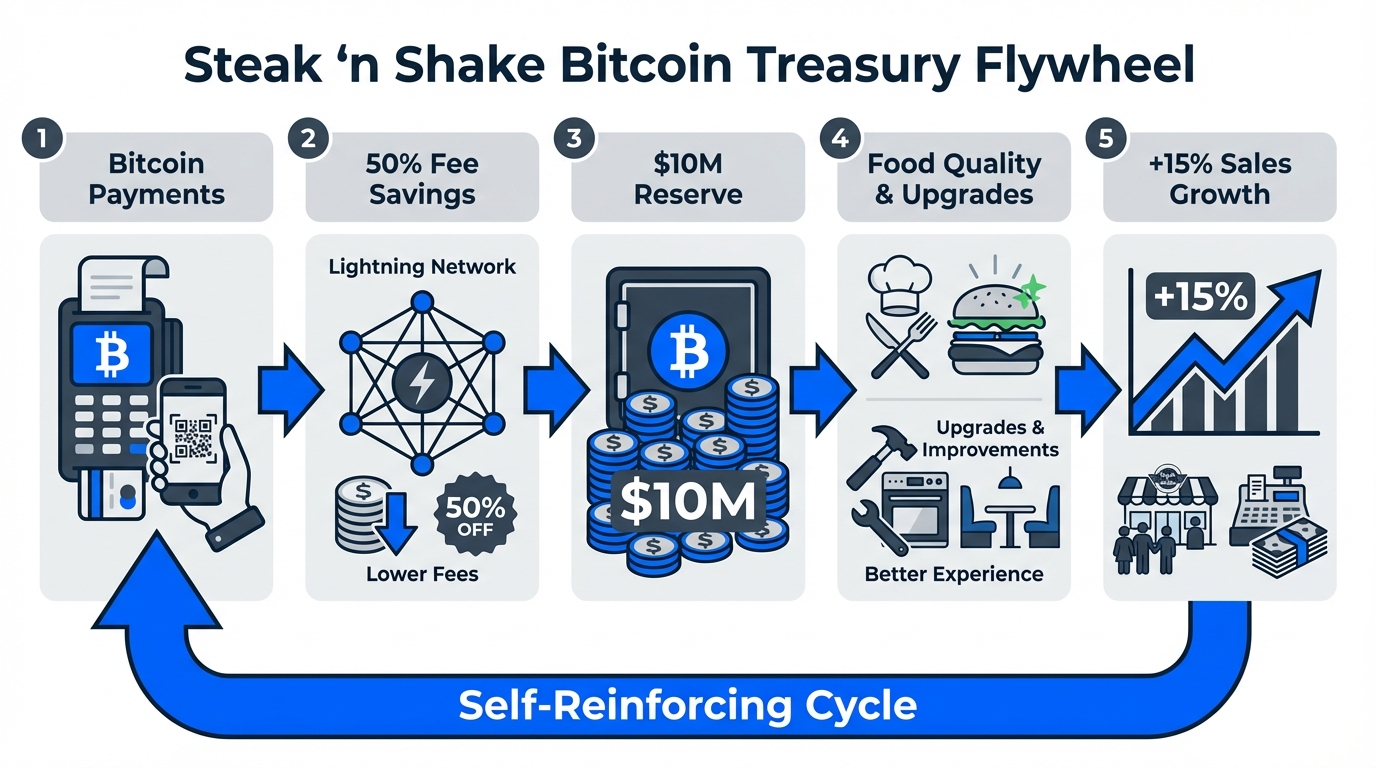
Jon: Alright, let’s peel back the layers. At its core, adding Bitcoin to a corporate treasury involves buying and holding BTC as a balance sheet asset. For Steak ‘n Shake, this started with integrating Bitcoin payments via the Lightning Network, which is a layer-2 scaling solution on Bitcoin for faster, cheaper transactions. Revenue from those payments feeds into their Bitcoin reserve.
Lila: Lightning Network – that’s the thing that makes Bitcoin usable for everyday stuff like buying burgers, right? Not waiting hours for confirmations?
Jon: Spot on. Bitcoin’s base layer uses proof-of-work consensus: miners solve puzzles to validate blocks every 10 minutes, securing the network but making it slow for small payments. Lightning sets up payment channels off-chain, like pre-authorized tabs at a bar – you settle the tab on the main chain only when closing the channel. This cut fees and boosted sales for Steak ‘n Shake, creating a cycle where crypto revenue funds more BTC buys.
Lila: So, the treasury part – how do they actually hold and manage it?
Jon: They likely use secure wallets, possibly multi-signature ones for corporate governance, and custodians like those from Fidelity or Coinbase for large holdings. Token mechanics-wise, Bitcoin isn’t a “token” like ERC-20s; it’s the native asset of its blockchain. Supply is capped, halvings every four years reduce new issuance, driving scarcity. For treasury, it’s accounted as an intangible asset, revalued periodically – that’s why they reported a $10 million notional increase recently, probably from price appreciation.
Lila: That’s helpful. To compare, how does this stack up against traditional treasury assets?
Jon: Let’s table it out for clarity.
| Aspect | Traditional Treasury (e.g., Cash/Bonds) | Bitcoin Treasury |
|---|---|---|
| Supply Mechanism | Unlimited printing by central banks | Fixed at 21 million, algorithmic issuance |
| Inflation Hedge | Vulnerable to devaluation | Designed as scarce asset |
| Volatility | Low, but yields can be negative real | High, with potential for appreciation |
| Accessibility | Regulated banks, easy but centralized | Decentralized, but requires secure storage |
| Integration Example | Standard accounting | Like Steak ‘n Shake: Payments to treasury cycle |
Lila: Wow, that table really highlights the trade-offs. Bitcoin’s scarcity is a big draw, but the volatility – that’s the dent in the can you mentioned.
Jon: Precisely. And for Steak ‘n Shake, this isn’t just holding; it’s tied to operations. They bought about 105 BTC at current prices, and the value has already notched up, per reports.
Lila: So who actually uses this? I mean, beyond burger chains, what’s the practical application?
Jon: Good pivot. On the user side, it’s companies in inflationary environments or those with excess cash seeking diversification. Think tech firms like Tesla (they did it briefly) or MicroStrategy, which holds billions in BTC. Technically, it benefits by providing a decentralized store of value – no single entity controls it, reducing counterparty risk.
Lila: And for developers or builders?
Jon: Developers can build on Lightning for payment apps, or use Bitcoin’s scripting for smart contracts, though limited compared to Ethereum. For treasuries, it’s about integrating wallets with accounting software – tools like those from BitGo or custom scripts for multisig setups. The technical benefit is immutability: once in the blockchain, it’s tamper-proof, great for audits. Steak ‘n Shake uses it to fund upgrades from crypto sales, creating a self-reinforcing loop without relying on banks.
Lila: So, applications range from corporate hedging to operational efficiency. Not about getting rich quick, but smarter asset management.
Jon: Exactly. Now, if someone’s curious to learn more hands-on, without any financial commitments…
Lila: Yeah, what’s a safe way to explore this?
Jon: Let’s break it into levels. Level 1: Research and observation. Start by reading the Bitcoin whitepaper – it’s short and foundational. Use block explorers like Blockstream.info to track transactions, or dashboards on sites like Clark Moody to see network stats, halvings, and supply. For corporate treasuries, check Saylor.org or public filings from companies like MicroStrategy to understand accounting practices. It’s all about building knowledge without risk.
Lila: That sounds accessible. What about getting hands-on without real money?
Jon: Level 2: Testnet experimentation. Bitcoin has a testnet – a free playground where you can get fake BTC from faucets. Set up a wallet like Electrum, create Lightning channels, and simulate payments. Tools like LND (Lightning Network Daemon) let you run a node locally. It’s minimal-risk learning: experiment with transactions, understand fees, and even mimic a small “treasury” by holding testnet BTC. Emphasize security basics, like backing up seeds, but remember, this is educational – real-world volatility and regulations apply if you go live.
Lila: Perfect, keeps it safe and focused on mechanics.
Jon: To wrap up, Steak ‘n Shake’s move is a fascinating case of Bitcoin going from fringe to corporate staple. It shows potential for treasury innovation, but limitations like price swings and regulatory scrutiny remain.
Lila: Absolutely, and remember, crypto is volatile – understand the risks and uncertainties before diving in.
Jon: Well said. It’s worth watching how this evolves, but always with a critical eye.
References & Further Reading
- Steak ‘n Shake Adds $10 Million in Bitcoin to Corporate Treasury
- Official Bitcoin Website
- Bitcoin-loving burger joint Steak ‘n Shake adds $10m to crypto treasury
- Steak ‘n Shake adds $10 million to BTC treasury eight months after Lightning Network rollout
▼ AI tools to streamline research and content production (free tiers may be available)
Free AI search & fact-checking
👉 Genspark
Recommended use: Quickly verify key claims and track down primary sources before publishing
Ultra-fast slides & pitch decks (free trial may be available)
👉 Gamma
Recommended use: Turn your article outline into a clean slide deck for sharing and repurposing
Auto-convert trending articles into short-form videos (free trial may be available)
👉 Revid.ai
Recommended use: Generate short-video scripts and visuals from your headline/section structure
Faceless explainer video generation (free creation may be available)
👉 Nolang
Recommended use: Create narrated explainer videos from bullet points or simple diagrams
Full task automation (start from a free plan)
👉 Make.com
Recommended use: Automate your workflow from publishing → social posting → logging → next-task creation
※Links may include affiliate tracking, and free tiers/features can change; please check each official site for the latest details.