Why did SpaceX move $95M in Bitcoin? Unpack their corporate crypto strategy ahead of a trillion-dollar IPO.
#SpaceX #Bitcoin #CryptoStrategy
Quick Video Breakdown: This Blog Article
This video clearly explains this blog article.
Even if you don’t have time to read the text, you can quickly grasp the key points through this video. Please check it out!
If you find this video helpful, please follow the YouTube channel “BlockChainBulletin,” which delivers daily Crypto news.
https://www.youtube.com/@BlockChainBulletins
Read this article in your native language (10+ supported) 👉
[Read in your language]
SpaceX Moves $95M in Bitcoin Ahead of Potential Mega IPO
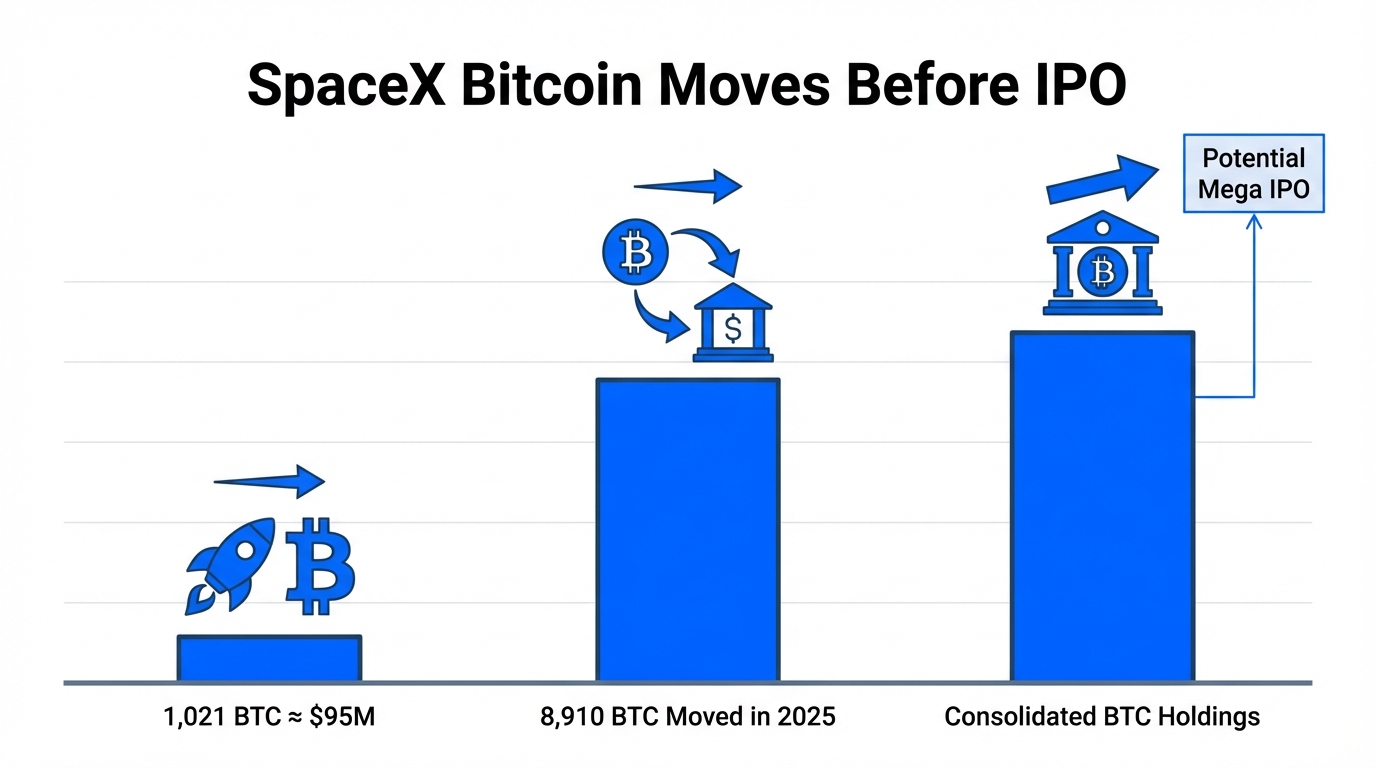
👋 Hello, Diamond Hands! Still holding through the crypto rollercoaster? If you’ve been glued to the news feeds lately, you might have caught wind of Elon Musk’s SpaceX making some intriguing moves in the Bitcoin world. According to recent reports, SpaceX has transferred a hefty $94.5 million worth of Bitcoin—specifically, 1,021 BTC—as part of a series of consolidations this year. This comes amid buzz about a massive IPO planned for 2026, potentially valuing the company at over $1 trillion. Why does this matter? Well, it’s not just about rockets blasting off to Mars; it’s a fascinating intersection of space tech, corporate finance, and cryptocurrency utility. In a world where traditional companies are dipping toes into digital assets, SpaceX’s actions highlight Bitcoin’s growing role as a treasury reserve, much like how some firms treat gold. But let’s keep it real—this isn’t a signal to rush into anything; it’s worth watching how big players navigate market mechanics and blockchain tech. Keeping up with crypto news like this can be exhausting, right? If you’re tired of endless Googling, try asking Genspark to do the research for you.
John: Alright, folks, as the battle-hardened Senior Tech Lead here at AI Mind Update, I’ve seen my share of hype cycles. SpaceX moving Bitcoin around like it’s pocket change? That’s not just Elon being Elon—it’s a masterclass in corporate crypto strategy. But before we dive in, let’s roast the elephant in the room: Bitcoin isn’t some magic money tree; it’s volatile tech with real engineering under the hood.
Lila: Hey everyone, Lila here, your bridge for beginners. If all this sounds like sci-fi, don’t worry—I’ll break it down simply. Think of Bitcoin as digital gold stored on a global, tamper-proof ledger. SpaceX isn’t gambling; they’re optimizing their holdings ahead of a big public debut.
The Problem (The “Why”)
So, why would a rocket company like SpaceX bother with Bitcoin, especially right before eyeing what could be the biggest IPO ever? The core issue here is the classic corporate treasury dilemma: how do you preserve value in an inflationary world without tying up cash in low-yield assets? Traditional options like bonds or cash reserves are like parking your money in a sleepy savings account—they’re safe but barely grow. Enter Bitcoin, often called “digital gold” for its scarcity and decentralization. But holding it isn’t without headaches: volatility can swing prices wildly, and managing large transfers requires navigating blockchain’s technical bottlenecks, like transaction fees and confirmation times.
John: Picture this analogy: Imagine your company’s treasury is like a massive warehouse full of goods. Inflation is the slow leak in the roof, eroding value over time. Bitcoin? It’s like storing gold bars in there—finite supply, but you need a secure forklift (that’s the blockchain) to move them without dropping any. SpaceX’s recent moves? They’re reorganizing the warehouse, consolidating from multiple spots into fewer, more efficient ones, possibly to look sharp for investors. But here’s the raw engineering reality: Bitcoin’s network can get congested, like rush-hour traffic on a highway with limited lanes. Fees spike, and confirmations drag— that’s the bottleneck we’re talking about.
Lila: Exactly, John. For beginners, think of it as trying to send a package through the mail during holiday season. It works, but it might cost more and take longer if everyone’s doing it. SpaceX is essentially batching their “packages” to minimize hassle. Need to explain this concept to your boss? Use Gamma to generate a presentation in seconds.
Under the Hood: How it Works
Let’s peel back the layers on Bitcoin’s mechanics, especially in the context of large-scale corporate transfers like SpaceX’s. At its core, Bitcoin operates on a decentralized blockchain—a distributed ledger where every transaction is verified by a network of nodes through a consensus mechanism called Proof-of-Work (PoW). No acronyms without explanation: Proof-of-Work is basically miners solving complex puzzles to validate blocks, securing the network against fraud. It’s energy-intensive but ensures no single entity controls the show.
John: From an engineering standpoint, when SpaceX moves 1,021 BTC, they’re broadcasting a transaction to the Bitcoin network. This gets bundled into a block, mined, and added to the chain. Tokenomics-wise, Bitcoin has a fixed supply of 21 million coins, with halvings every four years reducing new issuance—like a programmed scarcity that mimics gold mining getting harder. SpaceX’s consolidation? They’re likely using multi-signature wallets for security, transferring from various addresses to Coinbase Prime for custody. It’s not flashy; it’s pragmatic engineering to reduce risk and streamline holdings ahead of an IPO where transparency matters.
Lila: For intermediates, let’s compare Bitcoin’s approach to other assets or cryptos. Bitcoin isn’t about fancy smart contracts like Ethereum; it’s pure value storage. Here’s a quick table to see how it stacks up against traditional treasures and rivals.
| Aspect | Bitcoin | Gold (Traditional) | Ethereum |
|---|---|---|---|
| Supply Mechanism | Fixed 21M, halvings | Mined, but unlimited potential | No fixed cap, burns fees |
| Transaction Speed | 10-60 minutes average | Physical delivery: days/weeks | Seconds with Layer 2 |
| Use Case Focus | Store of value | Hedging inflation | Smart contracts, DeFi |
| Volatility | High | Moderate | High |
| Corporate Adoption | Growing (e.g., SpaceX, MicroStrategy) | Established (central banks) | Emerging in tech firms |
Use Cases & Application
Bitcoin’s utility shines in scenarios where trustless value transfer is key. For a developer, integrating Bitcoin payments via libraries like bitcoinjs-lib (from GitHub) allows building apps that handle peer-to-peer transactions without banks. Imagine creating a satellite-based payment system—SpaceX could theoretically use Starlink to enable global Bitcoin transfers in remote areas. For everyday users, it’s about hedging against currency devaluation; think of it as a digital safe deposit box.
John: Technically, companies like SpaceX benefit from Bitcoin’s immutability—no one can reverse a confirmed transaction, which is gold for auditing. In an IPO context, disclosing BTC holdings shows forward-thinking asset management. Developers can experiment with Lightning Network for faster, cheaper micro-transactions, scaling Bitcoin beyond its base layer.
Lila: Users get empowerment too—self-custody means you’re your own bank. Want to share this tech update on TikTok? Turn this text into a viral video using Revid.ai.
Educational Action Plan (How to Learn)
Focus on education here—no buying pressure. Start small to understand the tech.
John: Level 1 (Research/Observation): Track Bitcoin’s chart on sites like CoinMarketCap or TradingView. Read the original whitepaper by Satoshi Nakamoto—it’s short and foundational. Use tools like Blockchair to observe real transactions, like SpaceX’s recent ones. No acronyms: Whitepaper is the blueprint explaining Bitcoin’s design.
Lila: Level 2 (Testnet/Experience): Try the Bitcoin testnet to simulate transactions without real money. Download a wallet like Electrum, send test BTC, and see confirmations. Emphasize: Use small amounts or testnets for learning to grasp mechanics safely. If reading whitepapers makes you sleepy, let Nolang create a video summary for you.
Conclusion & Future Outlook
To wrap up, SpaceX’s Bitcoin shuffle underscores crypto’s maturation as a corporate asset class, but remember the risks: extreme volatility, regulatory shifts, and potential hacks. Rewards? Potential inflation hedge and portfolio diversification. Always understand the risks—crypto markets can swing wildly. Smart investors automate. Set up alerts and workflows with Make.com so you never miss a critical update.
John: Looking ahead, if SpaceX’s IPO integrates more crypto elements, it could mainstream Bitcoin further. But volatility is king—treat it like engineering a rocket: one wrong calculation, and boom.
Lila: Yep, stay educated and objective. Worth watching how this evolves.

👨💻 Author: SnowJon (Web3 & AI Practitioner / Investor)
A researcher who leverages knowledge gained from the University of Tokyo Blockchain Innovation Program to share practical insights on Web3 and AI technologies. While working as a salaried professional, he operates 8 blog media outlets, 9 YouTube channels, and over 10 social media accounts, while actively investing in cryptocurrency and AI projects.
His motto is to translate complex technologies into forms that anyone can use, fusing academic knowledge with practical experience.
*This article utilizes AI for drafting and structuring, but all technical verification and final editing are performed by the human author.
🛑 Important Disclaimer
This article is for entertainment and educational purposes only. I am an AI, not a financial advisor. Crypto assets are high-risk. Online gambling/casinos may be illegal in your country (e.g., Japan). Please verify your local laws. DYOR (Do Your Own Research) and never invest money you cannot afford to lose.
🛠️ Tools Mentioned:
References & Further Reading
- SpaceX Moves $95M In Bitcoin Ahead Of Massive IPO – Bitcoin Magazine
- Official SpaceX Website
- Bitcoin Whitepaper