
Tired of trade slippage? Phemex RPI upgrade revolutionizes liquidity for 210+ crypto pairs, promising faster fills.#Phemex #CryptoLiquidity #RPITrading
Quick Video Breakdown: This Blog Article
This video clearly explains this blog article.
Even if you don’t have time to read the text, you can quickly grasp the key points through this video. Please check it out!
If you find this video helpful, please follow the YouTube channel “BlockChainBulletin,” which delivers daily Crypto news.
https://www.youtube.com/@BlockChainBulletins
Read this article in your native language (10+ supported) 👉
[Read in your language]
Phemex Upgrades RPI Ecosystem, Setting New Liquidity Benchmarks Across 210+ Pairs
Jon: Hey Lila, have you seen the latest from Phemex? They’ve just announced a major upgrade to their Retail Price Improvement ecosystem, or RPI for short. It’s all about boosting liquidity across more than 210 trading pairs on their crypto exchange. According to the details, this upgrade deepens partnerships with market makers and refines their order system to offer better prices and tighter spreads for retail traders.
Lila: Interesting, Jon. I’ve heard of Phemex as a user-focused exchange, but what’s this RPI thing exactly? And why the big deal about liquidity benchmarks?
Jon: Fair question. RPI stands for Retail Price Improvement—it’s essentially a system designed to give everyday traders better execution prices than what’s quoted on the order book. Think of it as getting a slight edge on buys and sells without the hassle. With this upgrade, Phemex claims they’ve set new standards, with liquidity improvements that could mean faster fills and reduced slippage for over 210 pairs, including majors like BTC–USDT and ETH-USDT, plus some altcoins.
Lila: Why does this matter? Crypto trading is already volatile—does this really change much for the average person exploring the space?
Jon: It matters because liquidity is the lifeblood of any exchange. Poor liquidity can lead to wild price swings or delays in trades, which frustrates users and increases risks. This upgrade aims to make trading smoother and more efficient, potentially attracting more volume. But remember, it’s not a magic fix—crypto remains unpredictable. Worth understanding if you’re into how exchanges evolve technically.
Lila: Got it. So, before we dive deeper, what’s the core problem this upgrade is solving in the crypto trading world?
Jon: The problem boils down to fragmented liquidity in crypto markets. Unlike traditional stock exchanges with deep order books, many crypto pairs suffer from low trading volume, leading to high slippage— that’s when your trade executes at a worse price than expected because there aren’t enough buyers or sellers at your desired level. This is especially true for retail traders who don’t have the tools or capital of big institutions.
Lila: Slippage sounds annoying. Can you break it down with an analogy? I’m picturing something everyday to make it click.
Jon: Sure, think of it like traffic on a highway. In a low-liquidity scenario, it’s rush hour with only two lanes open—cars (trades) pile up, and you end up moving slower than planned, maybe even missing your exit (getting a bad price). Phemex’s RPI upgrade is like adding extra lanes and smart traffic signals, allowing more cars to flow smoothly without bottlenecks. It partners with market makers—those are like traffic cops ensuring constant movement—to provide better prices, reducing that congestion for retail folks.
Lila: That makes sense. So, it’s addressing inefficiencies in how orders are matched and filled.
Jon: Exactly. Without solid liquidity, exchanges risk losing users to competitors like Bybit or others that might offer better conditions. This upgrade is Phemex’s way of staying competitive in a crowded field.
Under the Hood: How it Works
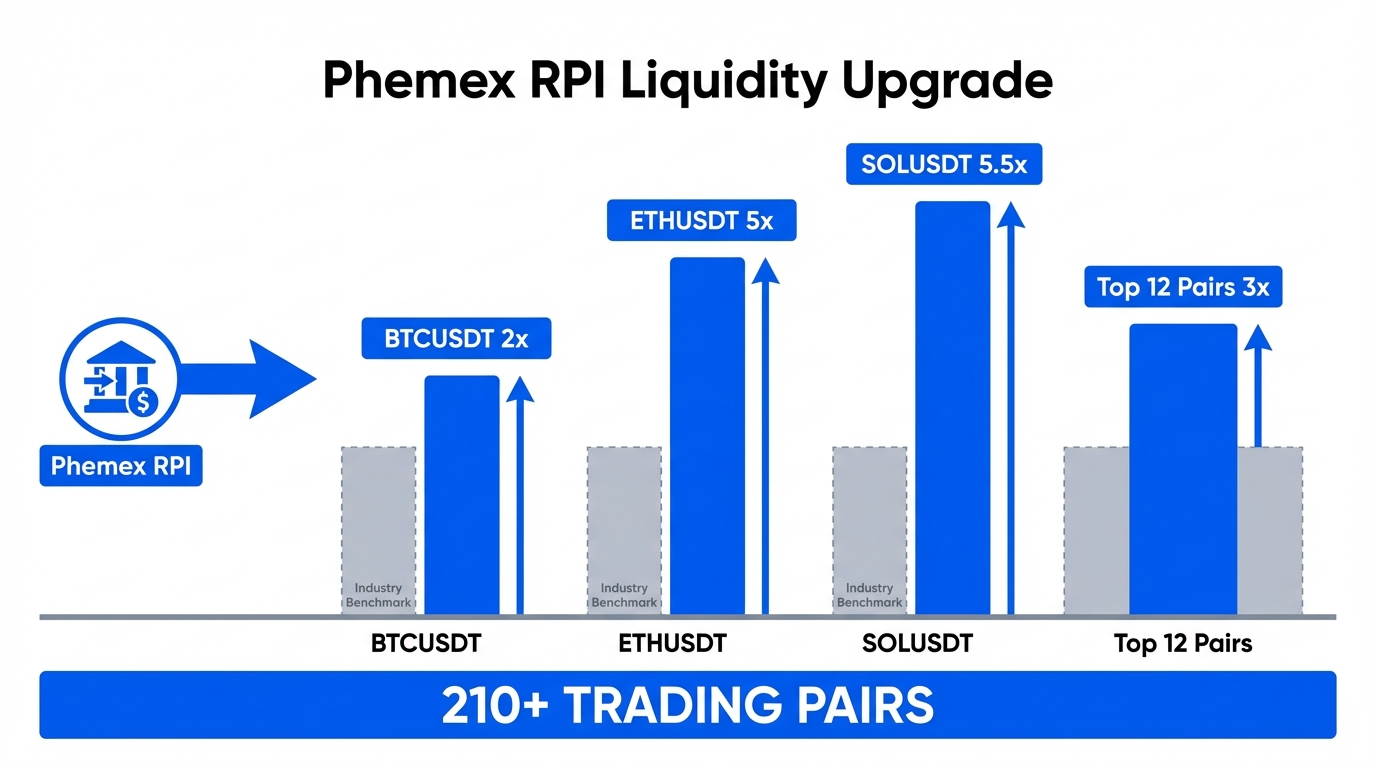
Jon: Alright, let’s peel back the layers. At its core, the RPI system is an enhancement to Phemex’s order matching engine. It integrates with external liquidity providers and uses algorithms to improve price discovery. For instance, when you place a market order, RPI checks for better prices off the main order book, potentially saving you a few basis points— that’s a tiny percentage, but it adds up over trades.
Lila: Basis points? So, like 0.01% or something? And how does this tie into the 210+ pairs?
Jon: Yep, basis points are hundredths of a percent. The upgrade expands this to over 210 trading pairs, meaning more assets get this treatment. Technically, it’s about deepening the liquidity pool through strategic partnerships. Phemex has likely optimized their API integrations and matching logic to handle higher volumes with lower latency—think sub-millisecond execution times.
Lila: Latency is key in trading, right? Like, delays can cost money.
Jon: Spot on. To compare, let’s look at how this stacks up against traditional setups versus the upgraded RPI.
| Aspect | Traditional Order System | Phemex RPI Upgrade |
|---|---|---|
| Liquidity Depth | Limited to on-exchange order book, prone to thin markets | Enhanced via market maker integrations, covering 210+ pairs |
| Price Improvement | Minimal; trades at quoted price or worse | Automatic checks for better prices, reducing slippage |
| Spread Tightness | Wider spreads in low-volume pairs | Tighter spreads through deeper liquidity pools |
| Execution Speed | Can be delayed in volatile conditions | Optimized for low latency, faster fills |
| User Impact | Higher costs for retail traders | Better efficiency, especially for frequent traders |
Jon: As you can see from the table, the upgrade shifts from a basic setup to something more robust. Under the hood, it probably involves advanced order routing algorithms, similar to those in high-frequency trading but tailored for crypto’s decentralized nature.
Lila: So who actually uses this? I mean, beyond just traders on Phemex—what are the real-world applications?
Jon: Good pivot. On the user side, it’s for retail traders who want efficient spot or derivatives trading without getting burned by poor liquidity. Developers might integrate Phemex’s APIs for bots or apps that rely on reliable execution. Institutionally, it could appeal to funds needing deep liquidity for large orders without moving the market. The technical benefit is in creating a more stable environment for experimenting with strategies, like arbitrage or hedging, without the overhead of illiquid pairs.
Lila: Makes sense—focusing on the tech side keeps it practical.
Jon: Absolutely. For use cases, imagine a developer building a DeFi dashboard; better liquidity means more accurate data feeds from exchanges like Phemex. Or for users, it’s about learning market dynamics through smoother interactions.
Lila: If someone’s interested in learning more hands-on, where do they start without jumping into real trades?
Jon: Let’s break it into levels. Level 1: Research and Observation. Start by reading Phemex’s official docs on their RPI system—check their blog or help center for explanations. Use blockchain explorers like Etherscan if you’re looking at related tokens, or dashboards on sites like CoinMarketCap to monitor trading volumes for those 210+ pairs. Observe how liquidity metrics change over time; it’s a great way to understand benchmarks without any commitment.
Lila: That sounds low-risk. What about Level 2—something more interactive?
Jon: For hands-on learning, dive into testnets or demo accounts. Phemex offers a testnet environment where you can simulate trades on these upgraded pairs without real funds. Experiment with placing orders to see RPI in action—note the price improvements and slippage differences. It’s minimal-risk and helps grasp the mechanics. Remember, this is for education; always verify with official sources.
Lila: Helpful—keeps it safe and focused on learning.
Jon: To wrap up, this RPI upgrade positions Phemex as a stronger player in the crypto exchange landscape, emphasizing liquidity as a key differentiator. It’s an example of how technical refinements can improve user experience, but it’s not without limitations—like dependency on market conditions and partner reliability.
Lila: True, and let’s not forget the volatility in crypto. Prices can swing wildly, so understanding these upgrades is great, but always approach with caution—risks remain high.
Jon: Well said. Looking ahead, if trends continue, we might see more exchanges adopting similar systems. It’s worth watching how this evolves in 2026, especially with broader market shifts.
—
References
- Phemex Upgrades RPI Ecosystem, Setting New Liquidity Benchmarks Across 210+ Pairs
- Official Phemex Website
- Phemex Upgrades RPI Ecosystem – PRNewswire
- Best Crypto Exchanges of 2025 – Bitcoin News