
Personally, seeing a major bank pursue a Bitcoin ETF highlights shifting financial norms.#Bitcoin #MorganStanley
Quick Video Breakdown: This Blog Article
This video clearly explains this blog article.
Even if you don’t have time to read the text, you can quickly grasp the key points through this video. Please check it out!
If you find this video helpful, please follow the YouTube channel “BlockChainBulletin,” which delivers daily Crypto news.
https://www.youtube.com/@BlockChainBulletins
Read this article in your native language (10+ supported) 👉
[Read in your language]
Morgan Stanley Seeks SEC Approval for Spot Bitcoin ETF
Jon: Hey Lila, have you seen the latest buzz in the crypto world? Morgan Stanley, one of the big Wall Street players, just filed with the SEC for a spot Bitcoin ETF. According to Bitcoin Magazine, this is a significant step as it signals growing institutional interest in regulated crypto products. It’s not approved yet, but the filing alone is turning heads.
Lila: Oh, interesting! I’ve heard about Bitcoin ETFs before, but Morgan Stanley jumping in? That’s a name I associate with traditional finance. Can you break it down a bit—what exactly is a spot Bitcoin ETF, and what’s the news here?
Jon: Sure thing. A spot Bitcoin ETF is essentially an exchange-traded fund that tracks the actual, real-time price of Bitcoin—hence “spot.” Unlike futures-based ETFs, which bet on future prices, this one would hold actual Bitcoin in custody. The news is from a filing dated around January 6, 2026, where Morgan Stanley submitted applications to the U.S. Securities and Exchange Commission. They’re aiming to launch funds tied to Bitcoin, and from related reports, even Solana and potentially Ether. This comes as Bitcoin is trading near $92K, per recent updates, showing how mainstream crypto is getting.
Lila: Why does this matter? Isn’t there already a bunch of Bitcoin ETFs out there?
Jon: It matters because Morgan Stanley is a heavyweight in finance, managing trillions in assets. Their entry could bring more legitimacy and liquidity to crypto. Think of it as Wall Street’s seal of approval—potentially opening doors for everyday investors to gain Bitcoin exposure through familiar brokerage accounts, without dealing with wallets or exchanges directly. But remember, it’s still in the filing stage; approval isn’t guaranteed, and crypto remains volatile.
Lila: Got it. So, what’s the problem this is solving? Crypto seems accessible already, but I guess there’s more to it.
Jon: Exactly. The core problem here is accessibility and regulation in traditional finance. For years, institutional investors and retail folks have been wary of Bitcoin because it’s decentralized and lacks the oversight of stocks or bonds. Direct ownership means handling private keys, security risks, and tax headaches. Plus, many pension funds or advisors are restricted from unregulated assets. A spot ETF bridges that gap by wrapping Bitcoin in a regulated, tradable security.
Lila: That makes sense, but can you clarify with an analogy? I’m picturing something everyday.
Jon: Absolutely. Imagine Bitcoin as raw gold nuggets—valuable but hard to store, transport, or divide without hassle. Traditional investors prefer gold ETFs, which are like neat certificates representing gold stored in a secure vault. You trade the certificate on the stock market without touching the gold. Similarly, a spot Bitcoin ETF lets you “own” Bitcoin exposure via shares, custodied by pros, all under SEC rules. It solves the “plumbing” issues of crypto for those who want familiarity, not the wild west of direct holding.
Lila: Nice analogy—gold nuggets versus certificates. So, it’s about making crypto feel safer and more integrated with regular investing.
Under the Hood: How it Works
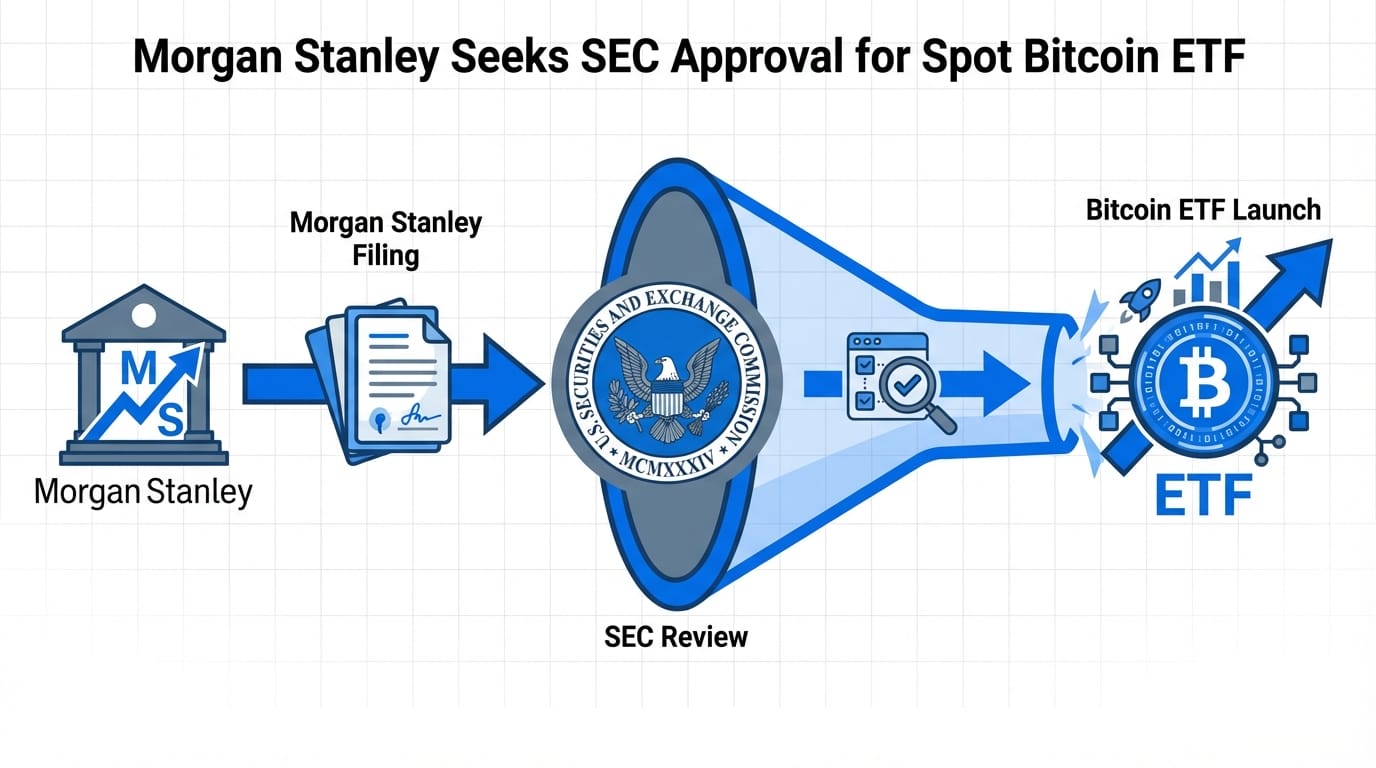
Jon: Let’s dive into the mechanics. At its core, a spot Bitcoin ETF operates like any ETF but with Bitcoin as the underlying asset. The fund issuer—here, potentially Morgan Stanley—buys and holds actual Bitcoin through custodians like Coinbase or Fidelity. Shares of the ETF are then listed on exchanges like Nasdaq, trading throughout the day at prices closely tracking Bitcoin’s spot value. The SEC’s role is to ensure transparency, like requiring daily disclosures of holdings and net asset value (NAV).
Lila: So, it’s not just a promise— they actually own the Bitcoin? That sounds straightforward, but what’s the architecture behind it?
Jon: Precisely. The architecture involves a few key players: the sponsor (Morgan Stanley), the custodian (securely storing the BTC), and authorized participants (APs) who create or redeem ETF shares in large blocks, keeping the price in line with Bitcoin’s value. This uses an arbitrage mechanism—if the ETF trades at a premium or discount to NAV, APs buy/sell to correct it. Token mechanics aren’t directly involved since it’s not a blockchain token; it’s a traditional security representing Bitcoin exposure. But on the crypto side, the held Bitcoin sits in cold storage wallets, secured with multi-signature tech.
Lila: Okay, rephrasing to confirm: It’s like a basket holding real Bitcoin, and shares of that basket trade like stocks. No need for me to manage keys?
Jon: Spot on. For a quick comparison, let’s look at spot ETFs versus futures-based ones, which have been around longer.
| Aspect | Spot Bitcoin ETF | Futures Bitcoin ETF |
|---|---|---|
| Underlying Asset | Actual Bitcoin held in custody | Bitcoin futures contracts (bets on future prices) |
| Price Tracking | Directly mirrors current Bitcoin spot price | Tracks futures prices, which can diverge due to contango/backwardation |
| Risks | Custody risks, Bitcoin volatility | Rollover costs, potential tracking errors |
| Investor Appeal | Simpler for long-term holding | More for hedging or short-term plays |
Lila: The table helps—spot seems more direct. So who actually uses this?
Jon: Great question. On the user side, it’s ideal for retail investors who want Bitcoin exposure in their IRA or 401(k) without crypto exchanges. Institutions like hedge funds use it for diversified portfolios, as it’s regulated and liquid. Developers and builders in Web3 might see indirect benefits—more capital flowing into Bitcoin could fund ecosystem growth, like Lightning Network improvements for faster transactions. Technically, it enhances liquidity without altering Bitcoin’s core protocol, benefiting miners and node operators through higher demand.
Lila: So, not just for traders, but potentially boosting the whole network. Now, if someone’s curious, how can they learn more without jumping in headfirst?
Jon: Let’s break it into levels for safe exploration. Level 1: Research and Observation. Start by reading the official SEC filings on edgar.sec.gov—search for Morgan Stanley’s S-1 forms. Check whitepapers on Bitcoin.org for the asset’s basics, and use explorers like Blockchain.com to track real-time Bitcoin transactions. Dashboards from CoinMarketCap or Glassnode offer insights into ETF inflows without any commitment.
Lila: That sounds low-risk. What about Level 2—something hands-on?
Jon: For Level 2: Testnet Experimentation. Bitcoin has testnets where you can play with fake BTC. Set up a wallet like Electrum on testnet mode, simulate transactions, and understand custody without real money. For ETF mechanics, tools like TradingView let you chart existing Bitcoin ETFs (e.g., from BlackRock) to observe price tracking. It’s all about learning the ropes safely—emphasize minimal-risk setups to grasp the tech.
Lila: Perfect, keeps it educational.
Jon: In summary, Morgan Stanley’s filing is a nod to crypto’s maturation, potentially channeling billions into Bitcoin via regulated channels. But limitations persist—regulatory hurdles, market volatility, and the fact that ETFs don’t give you direct control over Bitcoin keys.
Lila: Right, and remember, crypto is unpredictable. Volatility and uncertainty are par for the course—approach with eyes wide open.
Jon: Absolutely. It’s worth watching how this evolves, but always prioritize understanding over speculation.
References & Further Reading
- Morgan Stanley Seeks SEC Approval for Spot Bitcoin ETF
- U.S. Securities and Exchange Commission (SEC) Official Site
- Morgan Stanley files for bitcoin, solana ETFs in digital assets push | Reuters
- Bitcoin Official Site