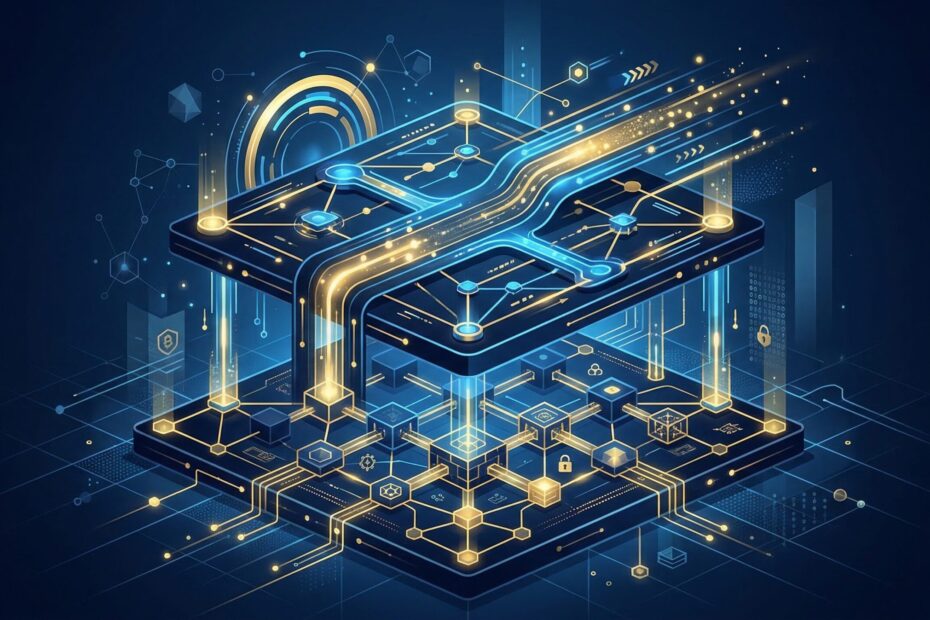
- Layer 1 (L1) blockchains are the foundational networks — Bitcoin, Ethereum, Solana — where all transactions ultimately settle.
- Layer 2 (L2) solutions are built on top of L1s to improve speed and reduce costs, inheriting the security of the base layer.
- Ethereum’s Dencun upgrade (March 2024) dramatically cut L2 fees via EIP-4844 blob transactions, accelerating L2 adoption.
- Polygon rebranded from MATIC to POL in 2024 and now powers its multi-chain AggLayer ecosystem.
- Choosing between L1 and L2 depends on your priorities: security, speed, cost, or developer ecosystem.
The blockchain scaling debate has defined the industry for years — and in 2026, the Layer 1 vs Layer 2 conversation is more relevant than ever. With billions of dollars flowing through both base-layer networks and scaling solutions, understanding how these layers differ, interact, and compete is essential knowledge for any crypto participant. This guide breaks it all down, from fundamentals to the latest developments.
What Is a Layer 1 Blockchain?
A Layer 1 blockchain is the foundational network — the base layer where all transactions are ultimately validated and recorded. It includes the core consensus mechanism, native token, and security model. When someone says “Ethereum” or “Bitcoin,” they’re referring to L1 networks.
Layer 1 blockchains are defined by the blockchain trilemma: the challenge of simultaneously achieving decentralization, security, and scalability. Most L1s optimize for two of these at the expense of the third.
Major Layer 1 Networks
- Bitcoin: The original L1. Prioritizes security and decentralization; processes ~7 transactions per second (TPS). The Lightning Network is Bitcoin’s primary L2 scaling solution.
- Ethereum: The leading smart contract platform. Post-Merge, Ethereum uses Proof of Stake and processes ~15–30 TPS natively, but its L2 ecosystem dramatically extends its capacity.
- Solana: A high-throughput L1 capable of 50,000+ TPS using Proof of History combined with Proof of Stake. Trades some decentralization for performance.
- BNB Chain: Binance’s L1 with fast block times and lower fees, popular for DeFi. More centralized than Ethereum but highly active.
- Avalanche: Offers sub-second finality with a subnet architecture allowing customizable blockchain deployments.
What Is a Layer 2 Blockchain?
Layer 2 solutions process transactions off the main chain, bundle them together, and periodically settle the results back on L1. This means they inherit the security guarantees of the underlying blockchain without congesting it. The core value proposition: dramatically lower fees and higher throughput, without sacrificing the trust model of the base layer.
Types of Layer 2 Solutions
Optimistic Rollups
Optimistic rollups batch transactions and post them to L1, assuming all transactions are valid by default (“optimistic”). A challenge period (typically 7 days) allows fraud proofs to be submitted if invalid transactions are detected. This delay is the main trade-off. Leading examples include Optimism and Arbitrum, which together hold the majority of Ethereum L2 TVL.
ZK Rollups (Zero-Knowledge Rollups)
ZK rollups use cryptographic validity proofs (zero-knowledge proofs) to mathematically verify the correctness of every batch of transactions before posting to L1. This eliminates the challenge period, providing near-instant finality. The computational overhead is higher, but hardware improvements are rapidly closing the gap. Key players include zkSync Era, Starknet, and Polygon’s zkEVM.
State Channels
State channels (like Bitcoin’s Lightning Network) allow two parties to open a private payment channel and conduct unlimited transactions between themselves off-chain. Only the opening and closing transactions are recorded on L1. Ideal for high-frequency, low-value transfers between known participants.
The Game-Changer: Ethereum’s EIP-4844 and Blob Transactions
In March 2024, Ethereum’s Dencun upgrade activated EIP-4844 (Proto-Danksharding), one of the most impactful scaling improvements in blockchain history. The upgrade introduced a new transaction type called blob-carrying transactions — temporary data packets that L2 rollups use to post their transaction data to L1 at a fraction of the previous cost.
The results were immediate and dramatic. Layer 2 transaction fees dropped by 90% or more almost overnight. Arbitrum, Optimism, and Base all saw fees fall to fractions of a cent, making Ethereum-based L2s genuinely competitive with centralized systems for everyday use. EIP-4844 is a stepping stone to full Danksharding, which will expand blob capacity further and push Ethereum’s scalability into the hundreds of thousands of TPS.
Polygon’s Evolution: From MATIC to POL and AggLayer
Polygon was long the most prominent Ethereum L2 scaling solution. In September 2024, it completed a major transformation: the MATIC token was rebranded to POL, reflecting Polygon’s evolution from a single sidechain into a multi-chain ecosystem. The POL token now serves as a universal staking token across all Polygon-powered chains.
The centerpiece of this evolution is the AggLayer (Aggregation Layer) — a protocol that aggregates liquidity and state from multiple ZK-powered chains into a unified, interoperable network. As of early 2026, AggLayer consolidates over $1.14 billion in tokenized assets and processes a significant share of global USDC transactions. The March 2026 Lisovo Hardfork introduced further smart contract performance improvements and AI-based automation features.
Key Layer 2 Networks to Know in 2026
- Arbitrum One: The largest Ethereum L2 by TVL, using optimistic rollup technology. Home to a thriving DeFi and gaming ecosystem.
- Base: Coinbase’s L2 built on the OP Stack. Grew rapidly through 2024-2025 on the strength of Coinbase’s user base and developer grants.
- Optimism / OP Stack: The technology powering multiple chains (Base, Worldchain, etc.) via the “Superchain” vision of shared sequencers and bridges.
- zkSync Era: A ZK rollup with full EVM compatibility. Strong developer ecosystem and innovative account abstraction features.
- Starknet: Uses STARK proofs (quantum-resistant cryptography) and its own Cairo language. Focused on maximum throughput and security.
- Lightning Network (Bitcoin): Bitcoin’s primary L2 for fast, cheap payments. Used for microtransactions, remittances, and point-of-sale applications.
L1 vs L2: Which Should You Use?
The right layer depends on what you’re doing:
- Long-term storage or high-value settlements: L1 (Ethereum or Bitcoin) offers the highest security and permanence.
- DeFi, NFTs, and everyday transactions: L2s like Arbitrum, Base, or zkSync offer Ethereum security at a fraction of the cost.
- High-frequency, low-value payments: State channels (Lightning Network) or Solana’s L1 offer the best throughput at minimal fees.
- Developer building cross-chain apps: Consider ecosystems with strong interoperability tooling, such as Polygon’s AggLayer or Cosmos IBC.
Final Thoughts
The L1 vs L2 distinction is no longer just an academic debate — it has practical implications for fees, speed, security, and ecosystem access. With EIP-4844 dramatically lowering L2 costs and ZK proof technology maturing rapidly, the Ethereum L2 ecosystem in particular is entering a golden era. Meanwhile, alternative L1s like Solana continue to prove that the base-layer approach can also achieve high performance.
For most users and developers in 2026, the answer isn’t L1 or L2 — it’s understanding when to use each layer, and leveraging the right tool for the right job.