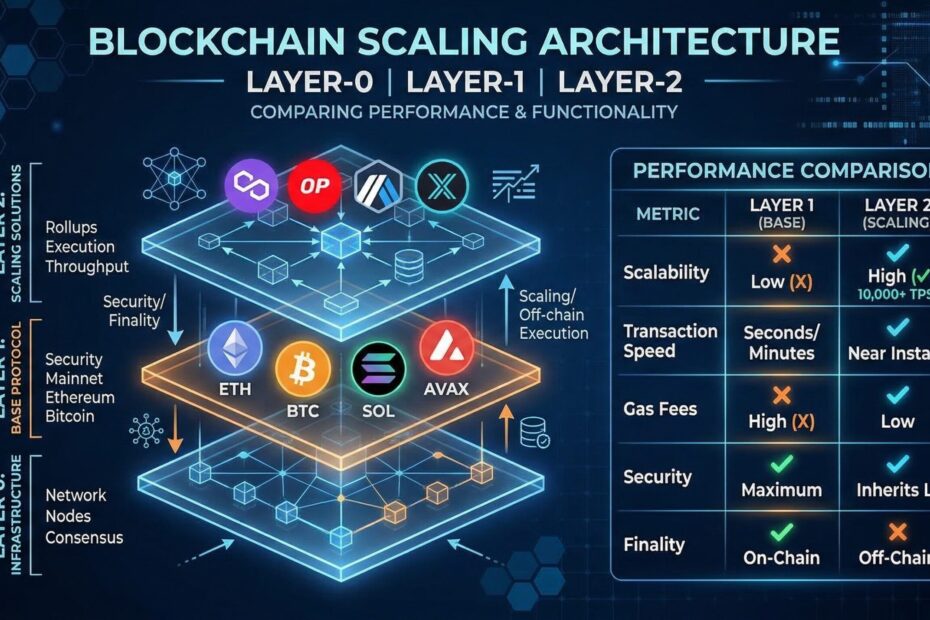
The Layer-1 blockchain landscape in 2026 is both exciting and treacherous. Every market cycle produces a new wave of projects claiming to have solved the blockchain trilemma — offering scalability, security, and decentralization simultaneously. Some deliver. Many disappear. A few quietly build real ecosystems that compound value over years.
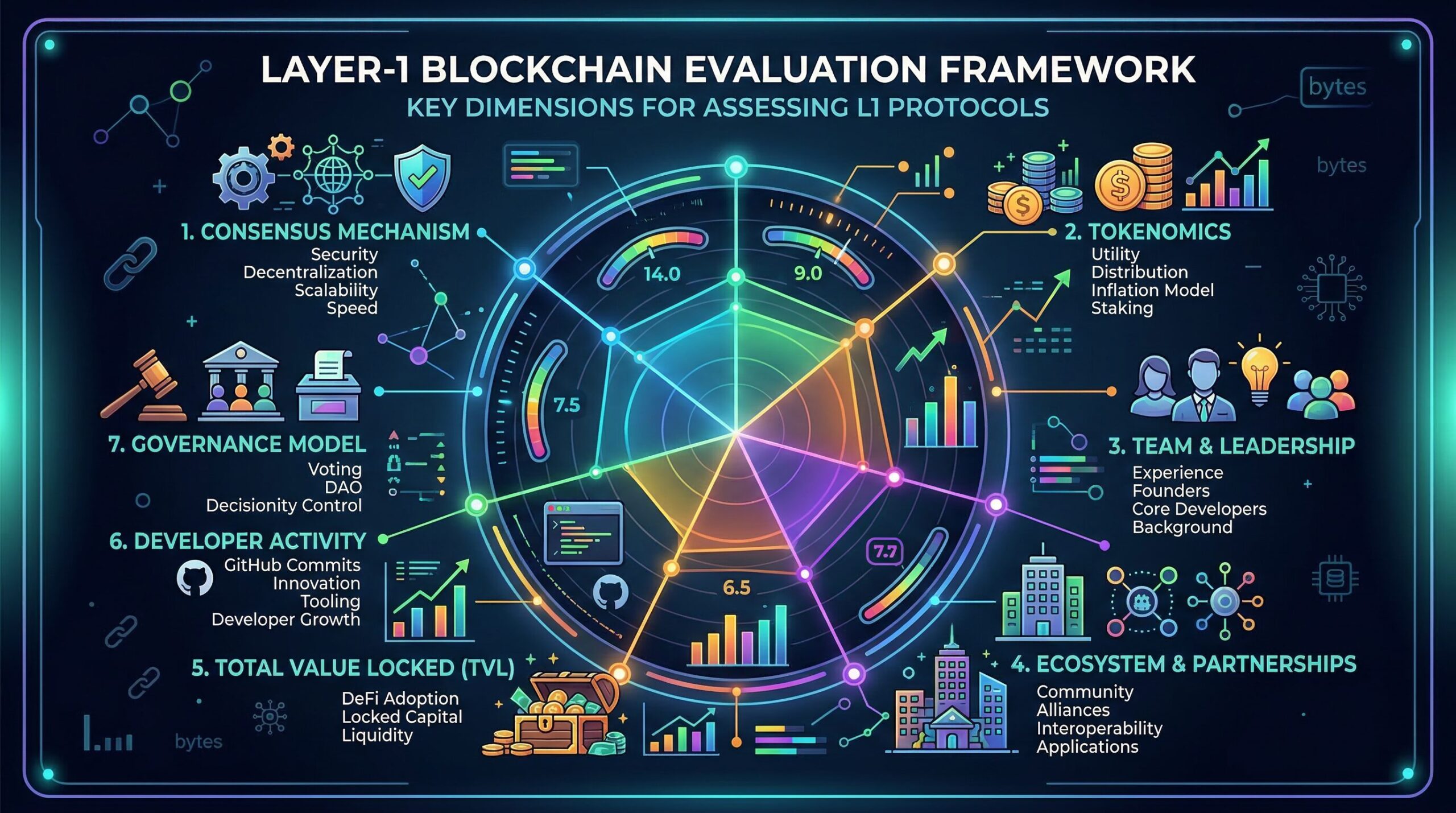
Separating genuinely promising Layer-1 projects from well-marketed failures requires a disciplined evaluation framework. This guide provides exactly that: a systematic, research-driven approach to assessing any new Layer-1 blockchain, illustrated with examples from projects active in 2026.
What Is a Layer-1 Blockchain?
A Layer-1 (L1) blockchain is a base-layer network that independently validates and records transactions without relying on another blockchain for security. It manages its own consensus mechanism, block production, and security model. The native cryptocurrency of an L1 (such as ETH on Ethereum, SOL on Solana, or ADA on Cardano) pays transaction fees and incentivizes validators or miners.
Layer-1 blockchains are the foundational infrastructure of the decentralized web. DeFi protocols, NFT marketplaces, games, stablecoins, and real-world asset tokenization platforms are built on top of L1s. The health of an L1 ecosystem directly determines the value of its native token and the sustainability of all applications running on it.
This is distinct from Layer-2 networks (like Optimism, Arbitrum, or Bitcoin‘s Lightning Network), which inherit security from an underlying L1 but process transactions more efficiently. Understanding this distinction is foundational before evaluating any project claiming to be “Layer-1.”
The Established Landscape in 2026
Before evaluating new entrants, it is worth understanding where the established L1 landscape stands, because any new project competes for developer attention, liquidity, and user adoption against these incumbents.
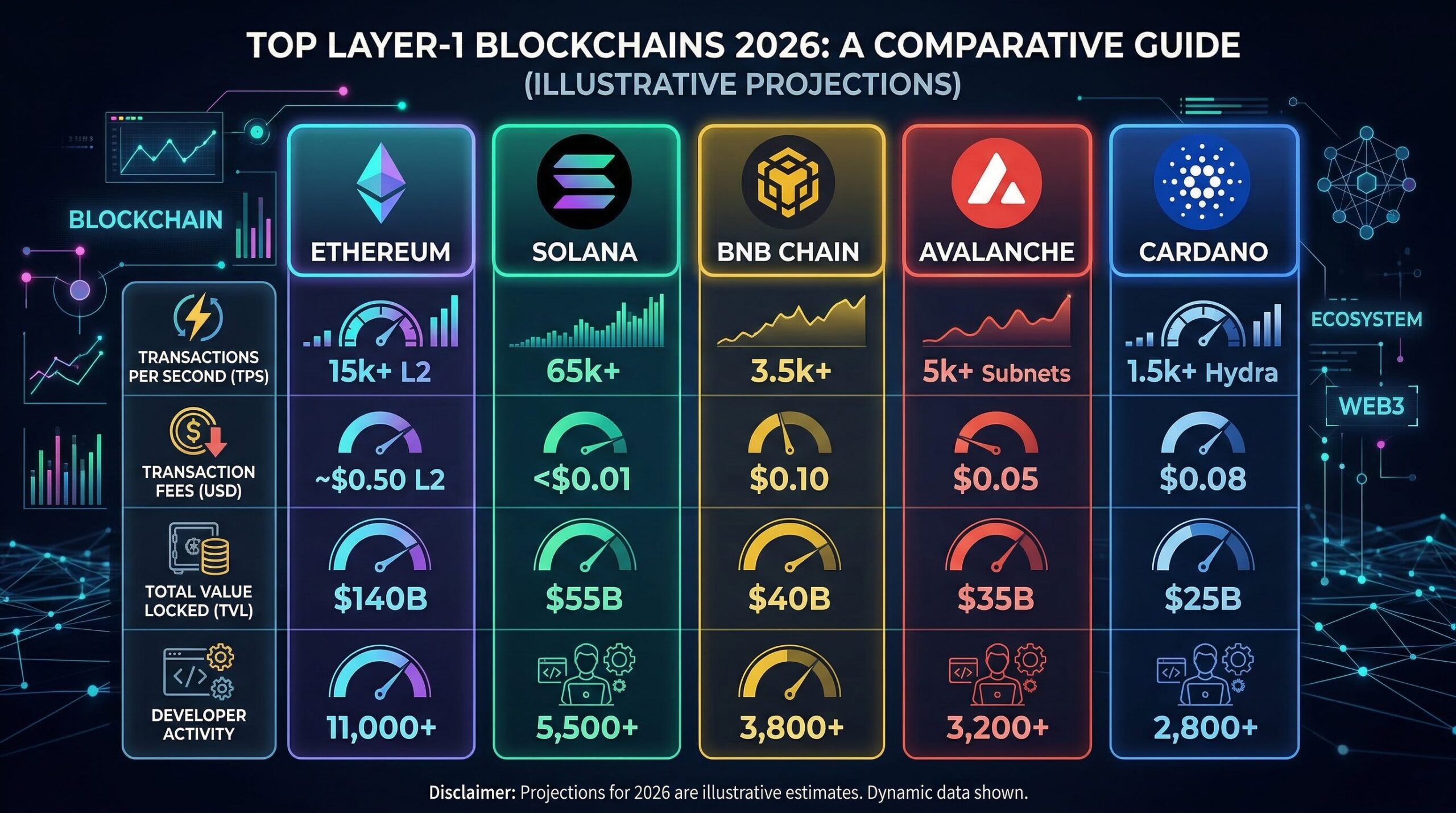
According to Phemex’s 2026 Layer-1 overview, the dominant L1 blockchains in 2026 by ecosystem traction are:
- Ethereum (ETH): The largest smart contract platform by total value locked (TVL) and developer activity. Remains the settlement layer for most institutional DeFi and the base for the majority of Layer-2 networks.
- Solana (SOL): The leading high-throughput L1, known for sub-second finality and a thriving ecosystem of DeFi, NFTs, and consumer apps. Won the AIBC Eurasia Best Layer-1 Blockchain 2026 award.
- BNB Chain (BNB): The highest-volume EVM-compatible chain by daily transactions in peak periods, with 40.5% TVL growth year-over-year and a 150% increase in daily transactions.
- Avalanche (AVAX), Cardano (ADA), Polkadot (DOT), NEAR Protocol, Sui: Established projects with meaningful developer ecosystems and specific technical differentiators.
Any new Layer-1 project launching in 2026 is not entering a vacuum — it is competing directly against this mature, well-capitalized field. The question is not just “is this technology interesting?” but “why would developers, users, and capital choose this over what already exists?”
A Case Study: Keeta (KTA)
Keeta (KTA) is a useful case study for this framework because it is a genuinely interesting project with real technical claims, a specific use-case niche, and meaningful development — but also carries significant risks and uncertainties that a rigorous evaluation reveals.
Keeta is a Layer-1 blockchain network architected specifically for high-performance payments and real-world asset (RWA) tokenization. Its headline technical claims include 10 million transactions per second (TPS) and 400ms settlement finality — performance benchmarks that, if achievable in production, would far exceed any existing public blockchain. The project uses Google Spanner technology as part of its infrastructure, and a 2022 stress test under the codename “Jaguar” reportedly achieved over 2 million TPS with sub-second finality.
Keeta has notable backers: former Google CEO Eric Schmidt is listed as an investor. In January 2026, Keeta announced plans to acquire a bank, allocating 35 million KTA tokens from strategic reserves for the acquisition — a move intended to create regulated fiat payment rails and deepen its integration with traditional finance.
As of March 2026, KTA trades around $0.15–$0.17 with a market cap of approximately $85 million. The token is ranked around #200–#300 by market cap, down significantly from earlier highs. KTA is down over 40% in the past 90 days, and approximately 60% of eligible airdrop wallets had not claimed their tokens as of September 2025 — a persistent supply overhang.
We will use Keeta throughout this guide to illustrate how the evaluation framework applies to a real project.
The Layer-1 Evaluation Framework
Dimension 1: Technology and Technical Claims
Technology is the foundation of any Layer-1 claim, but it is also the dimension most prone to marketing inflation. Evaluate the following:
Performance claims — verified versus claimed. Any new L1 will publish impressive TPS numbers. The critical question is: under what conditions were those numbers achieved? A controlled benchmark on private infrastructure with no contention looks nothing like a production network under real load. Look for:
- Independent third-party audits of performance claims
- Mainnet data, not testnet benchmarks
- Performance under adversarial conditions (spam transactions, network partitions)
- What happens to decentralization at claimed throughput levels?
Keeta example: Keeta’s 10M TPS claim is based on Google Spanner architecture, with a published 2022 stress test achieving 2M+ TPS. However, the gap between controlled stress test performance and production mainnet performance under real-world conditions has not been independently verified at scale. The 400ms finality claim is plausible given the architecture, but investors should demand ongoing mainnet metrics rather than relying on pre-launch benchmarks.
Consensus mechanism and security model. Proof of Work, Proof of Stake, Delegated Proof of Stake, Proof of History, BFT variants — each consensus mechanism involves different trade-offs between security, decentralization, and performance. Understand:
- How many validators secure the network? (Higher is generally more decentralized)
- What is the cost to attack the network? (The economic security budget)
- Has the consensus mechanism been formally verified or peer-reviewed?
- What are the known failure modes, and how does the network handle them?
Smart contract capability. Does the L1 support smart contracts? What language? Is it EVM-compatible (allowing Solidity developers to port Ethereum apps easily)? EVM compatibility dramatically lowers the barrier for developers and existing DeFi protocols to migrate.
Codebase maturity and auditability. Is the codebase open source? Has it been audited by reputable security firms (Trail of Bits, OpenZeppelin, Halborn, CertiK)? How long has the mainnet been running? A longer mainnet history without major security incidents is a meaningful signal of codebase quality.
Dimension 2: The Blockchain Trilemma and Trade-offs
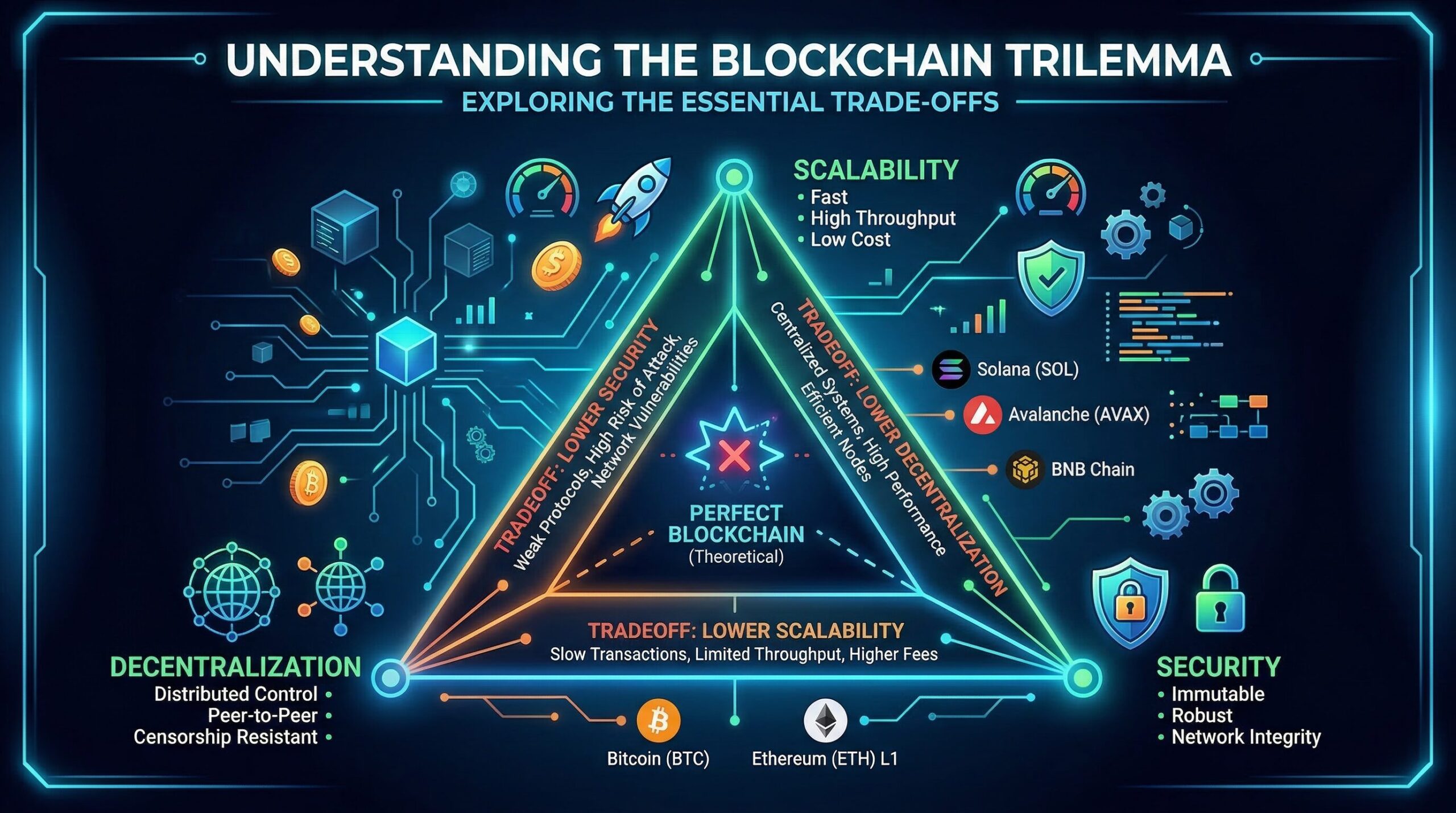
Vitalik Buterin’s blockchain trilemma states that a blockchain can only optimize for two of three properties simultaneously: scalability, security, and decentralization. Every Layer-1 makes trade-offs, and understanding where a project sits in this triangle is essential.
High throughput often comes at decentralization cost. Solana’s exceptional speed requires validators to run expensive hardware, limiting who can participate as a validator. BNB Chain uses a small validator set for efficiency. When a new L1 claims both extreme speed and maximum decentralization, the claim deserves deep scrutiny.
New consensus innovations are high-risk. Novel consensus mechanisms may claim to solve the trilemma, but they carry untested risk. Established mechanisms with years of mainnet operation provide more reliable security guarantees than theoretical improvements that have never faced real adversarial conditions.
Keeta example: Keeta’s architecture prioritizes performance (10M TPS, 400ms) and RWA compliance. Its use of Google Spanner-like infrastructure raises questions about centralization — Spanner is a distributed database designed for large-scale operations, and implementing blockchain consensus on similar infrastructure may involve more centralized components than typical PoS or PoW systems. The project’s roadmap toward bank acquisition and regulatory compliance further suggests a compliance-focused architecture that may prioritize permissioned elements over maximum decentralization.
Dimension 3: Tokenomics and Economic Design
Tokenomics — the economic design of the native token — is one of the most underanalyzed dimensions of L1 evaluation and one of the most important for long-term investors.
Token allocation and vesting schedules. How is the total token supply distributed? What percentage goes to founders, early investors, ecosystem development, and public holders? When do team and investor tokens unlock (vest)? Projects where insiders hold 50–70% of supply with short vesting periods present significant sell pressure risks as lockups expire.
Key questions to research:
- What is the total maximum supply?
- What percentage is currently circulating versus locked?
- When do founder and investor vesting periods end?
- What is the fully diluted valuation (FDV) versus current market cap?
Keeta example: KTA has a maximum supply of 1 billion tokens. As of March 2026, approximately 406–510 million tokens are in circulation (40–51% of maximum supply), with the remainder locked in team, investor, and ecosystem reserve wallets. The FDV is approximately $1.05 billion against a market cap of ~$85 million — meaning if all tokens were circulating at current prices, the total value would be over $1 billion. This FDV/market cap ratio (~12:1) implies significant potential future supply entering the market. Additionally, CoinMarketCap’s analysis noted that 60% of eligible airdrop wallets had not claimed tokens as of September 2025, representing additional unclaimed supply that could enter circulation.
Token utility and demand drivers. What actually creates demand for the token? Strong utility includes:
- Gas fees for network transactions (creates constant consumption demand)
- Staking requirements for validators (locks supply)
- Governance rights over protocol decisions
- Required for accessing specific network features
Weak utility includes: vague “ecosystem participation,” single-use case tokens, or scenarios where the network could function identically with a different token.
Inflation and supply schedule. Does the token have ongoing inflation (new tokens minted for staking rewards)? What is the annual inflation rate? High inflation dilutes holders over time unless the network creates sufficient demand to absorb new supply.
Dimension 4: Team and Organizational Credibility
In blockchain, team quality is a primary predictor of execution. Evaluate:
Track record. What have the founders and key developers built before? Have they shipped working blockchain infrastructure before, or is this their first attempt? A team of former protocol engineers from Ethereum, Solana, or Cosmos carries substantially more credibility for a new L1 than a team with primarily business or finance backgrounds.
Transparency and identifiability. Are team members publicly identifiable with verifiable professional histories? Anonymous or pseudonymous founding teams are higher risk — not because they cannot build good products, but because accountability is limited if the project fails or funds are misappropriated. For institutional-grade projects, full doxxing is standard.
Investor backing and advisors. Credible institutional investors (a16z crypto, Paradigm, Multicoin Capital, Binance Labs) provide not just capital but network access, technical review, and accountability. Named advisors with genuine industry reputations — people who would suffer reputational damage from association with a failure — are a positive signal.
Keeta example: Keeta’s backing from Eric Schmidt (former Google CEO) is a notable signal — Schmidt would not attach his name to an obvious scam. The Google Spanner architecture connection suggests deep technical expertise. The bank acquisition announcement implies existing regulatory relationships, which are difficult to fake. These are positive team/credibility signals. Investors should verify these claims directly through the project’s official documentation and press releases rather than accepting them at face value from any secondary source.
Dimension 5: Ecosystem Adoption and Developer Activity
Technology and tokenomics only matter if developers build on the L1 and users adopt it. Ecosystem traction is the hardest thing to fake and the most important predictor of long-term value.
Developer activity metrics.
- GitHub activity: commits, pull requests, contributors, repository stars
- Number of projects building on the network
- Developer documentation quality and completeness
- Hackathon participation and grant program activity
On-chain activity metrics.
- Daily active addresses
- Daily transaction count and volume
- Total value locked (TVL) in DeFi protocols
- Number of unique applications deployed
For early-stage L1s, these numbers will be small. The trajectory — is activity growing or declining? — matters more than absolute numbers at launch.
Genuine use cases versus artificial activity. Some projects inflate on-chain metrics through wash trading, internal transactions, or incentivized activity that disappears when incentives end. Authentic activity comes from real users solving real problems, not from farming rewards. Look for organic growth signals: developer forums with genuine problem-solving discussions, third-party applications built without project incentives, and community activity that exists outside of token speculation.
Keeta example: KTA’s primary value proposition — high-throughput payments and RWA tokenization — targets a real, growing market. The RWA tokenization sector is gaining institutional traction in 2026, with major financial institutions actively exploring blockchain-based settlement. Keeta’s bank acquisition plan, if successful, would provide a genuine regulatory moat. However, current on-chain activity metrics for Keeta are modest, the developer ecosystem is nascent, and the project must prove it can attract DeFi applications beyond its core payments use case.
Dimension 6: Competitive Differentiation
The single most important question for any new L1: Why would a developer choose this over Ethereum, Solana, or BNB Chain?
Credible answers to this question involve specific, verifiable advantages:
- Performance niche: “We handle 10M TPS, which no existing chain can match for high-frequency payment applications”
- Regulatory compliance by design: “We are built from the ground up for institutional compliance, with built-in KYC/AML capabilities and a licensed banking partner”
- Cost structure: “Our gas fees are 100x lower than Ethereum even after EIP-1559, making micropayments economically viable at scale”
- Specific ecosystem: “We are the only L1 with native gaming-optimized state channels and partnerships with the three largest gaming publishers”
Weak differentiation includes:
- Generic claims of being “faster, cheaper, and more decentralized”
- EVM compatibility as the primary value proposition (this is table stakes, not differentiation)
- “We’re building a blockchain for everything” (attempting to compete with Ethereum on all dimensions simultaneously)
- Differentiation based primarily on early-stage tokenomics rather than technology
Dimension 7: Regulatory and Legal Considerations
The regulatory environment for Layer-1 blockchains is evolving rapidly. In the US, the SEC and CFTC have established clearer frameworks for digital commodity classification in 2026, though significant ambiguity remains for newer projects. Evaluating regulatory risk involves:
Token classification risk. Is there a risk that regulators classify the native token as a security rather than a commodity? Security classification imposes registration requirements that most crypto projects are not equipped to handle, potentially restricting which exchanges can list the token and who can hold it.
Jurisdiction and legal entity. Where is the project’s legal entity registered? What regulatory frameworks govern it? Projects without clear legal entities or registered in jurisdictions with weak rule of law carry higher counterparty risk.
Compliance roadmap. For projects targeting institutional users or real-world asset use cases, regulatory compliance is not optional — it is a prerequisite. Projects that acknowledge regulatory requirements and have documented plans for meeting them are more credible than those that dismiss regulation entirely.
Keeta example: Keeta’s planned bank acquisition is explicitly a regulatory and compliance strategy. Acquiring a licensed bank would give Keeta direct access to regulated fiat settlement infrastructure — a significant competitive advantage for institutional payment use cases. The risk is that the acquisition process is lengthy and subject to regulatory approval; uncertainty about the timeline creates execution risk.
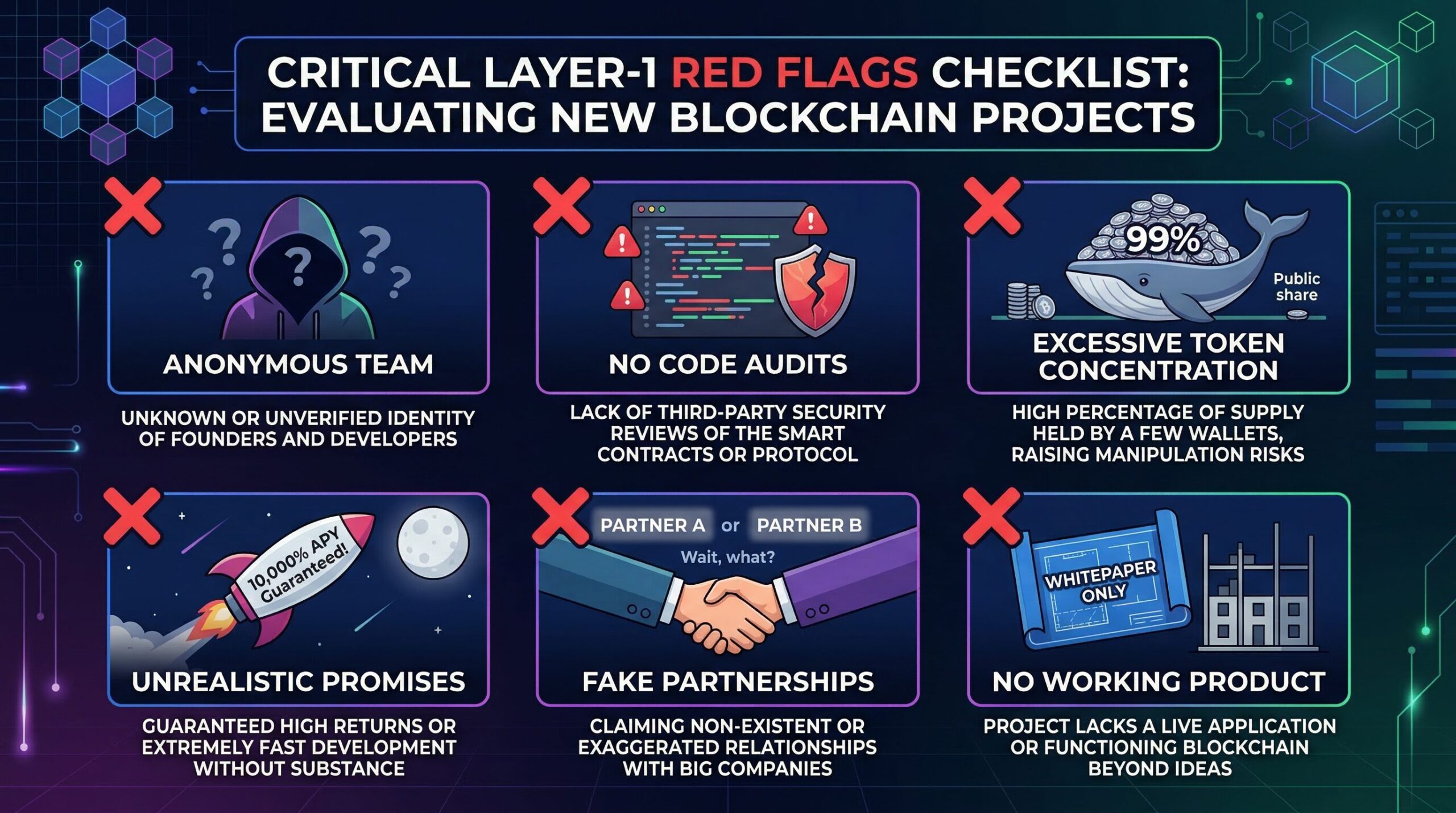
Red Flags: Warning Signs in Layer-1 Projects
Beyond the evaluation dimensions above, specific red flags should trigger heightened skepticism or outright avoidance:
Anonymous Teams with Outsized Token Allocations
An anonymous founding team holding 30–50% of total token supply with short vesting periods is a classic rug pull setup. While not all anonymous projects are scams, the combination of anonymity and disproportionate insider token allocation removes the primary accountability mechanism that protects investors.
Claims to Solve the Blockchain Trilemma Entirely
Every credible blockchain researcher acknowledges that the trilemma involves genuine trade-offs. Projects that claim to achieve maximum scalability, security, AND decentralization simultaneously are either misrepresenting their architecture or have not yet discovered the trade-offs their design involves. Claims of 1 million TPS with full decentralization and no security compromises deserve extreme skepticism.
Excessive Focus on Price Rather Than Technology
If the majority of a project’s marketing and community discussion revolves around price targets and return projections rather than technical development and use case adoption, this is a signal that the project is primarily a speculative instrument rather than a genuine infrastructure project. Genuine L1 teams are obsessed with developer adoption, TPS benchmarks, and ecosystem growth — not token price.
Vague or Missing Technical Documentation
Legitimate Layer-1 projects publish detailed technical whitepapers, academic-quality research on their consensus mechanisms, and comprehensive developer documentation. If a project claiming to be “the next Ethereum” does not have public technical documentation explaining its consensus mechanism in detail, that is a critical gap.
Artificial Urgency and FOMO Tactics
Time-limited token sales, “early adopter” benefits that expire imminently, and social media campaigns built around FOMO (“last chance to get in before institutions buy all the supply”) are manipulation tactics, not investment theses. Genuine long-term infrastructure projects do not need to manufacture urgency.
Paid Promotions Presented as Organic
Crypto influencer promotions, YouTube “reviews,” and Twitter endorsements are commonly paid advertisements in the blockchain space, often without clear disclosure. Distinguish between organic community discussion (people genuinely excited about the technology) and coordinated promotion campaigns (influencers posting simultaneously about the same project without disclosed sponsorship).
Practical Evaluation Process: A Step-by-Step Workflow
When you encounter a new Layer-1 project, here is a practical research workflow that typically takes 2–4 hours for a thorough initial assessment:
Step 1: Read the whitepaper or technical documentation (30–60 minutes). Not a summary or explainer video — the actual technical documentation. Identify the consensus mechanism, block architecture, and specific claims with quantitative benchmarks. Note any vague claims or areas where precision is deliberately avoided.
Step 2: Investigate the team (20–30 minutes). Search each named team member on LinkedIn. Verify their claimed previous roles at the companies listed. Look for GitHub activity from named developers. Check whether advisors have publicly confirmed their involvement (search “[advisor name] [project name]”).
Step 3: Analyze tokenomics (20–30 minutes). Find the token allocation breakdown (should be in whitepaper or tokenomics documentation). Calculate: what percentage do insiders hold? What is the FDV/market cap ratio? When do vesting periods end? Use CoinGecko or CoinMarketCap to verify current circulating supply against stated figures.
Step 4: Assess ecosystem activity (20–30 minutes). Check the GitHub repository for commit frequency and contributor count. Look for the project’s developer documentation and assess completeness. Search for third-party applications built on the network. Check DeFi analytics platforms (DefiLlama) for TVL data if the project has DeFi activity.
Step 5: Evaluate competitive positioning (15–20 minutes). Articulate in one paragraph why this project has a sustainable advantage over Ethereum, Solana, BNB Chain, and other relevant incumbents. If you cannot articulate a clear, specific, and verifiable answer, the differentiation is likely insufficient.
Step 6: Research community discussion (15–20 minutes). Look at the project’s Discord or Telegram. Is discussion focused on technical development or price speculation? Check Reddit and Twitter for critical analysis — not just positive coverage. Legitimate projects attract thoughtful critics as well as enthusiastic supporters.
Applying the Framework: Keeta (KTA) Summary Assessment
Applying the full framework to Keeta as of March 2026:
| Dimension | Assessment | Signal |
|---|---|---|
| Technology | Technically credible architecture (Google Spanner-based), 10M TPS claimed with partial verification, needs independent production audit | Cautiously Positive |
| Trilemma Position | Prioritizes performance and compliance; likely involves centralization trade-offs not fully disclosed | Neutral / Needs Clarity |
| Tokenomics | FDV/market cap ratio ~12:1; 60% airdrop tokens unclaimed; significant supply overhang risk | Cautionary |
| Team | Eric Schmidt backing notable; Google engineering heritage credible; bank acquisition shows regulatory seriousness | Positive |
| Ecosystem Adoption | Nascent; real use case niche (RWA payments); bank acquisition pending; developer ecosystem early-stage | Early / Unproven |
| Differentiation | Clear niche (ultra-high TPS for payments + RWA compliance + banking integration); credible if executed | Positive |
| Regulatory | Bank acquisition strategy shows regulatory engagement; but acquisition subject to multi-year approval process | Positive Long-Term / Uncertain Short-Term |
Summary: Keeta is a technically credible project with a specific, defensible niche and credible backing. It is not a scam — it has real technology, verifiable team members, and a coherent strategy. However, it faces meaningful execution risks (bank acquisition timeline, ecosystem growth, supply overhang), significant competition from established payments-focused chains (Ripple/XRP, Stellar), and its token currently reflects more speculative expectation than proven adoption. An investor who understands these risks and believes in Keeta’s payment/RWA thesis might find the current valuation interesting. An investor expecting a straightforward high-return trade in the near term should understand the supply dynamics and competition clearly before committing.
The Layer-1 Investment Thesis: What Actually Creates Long-Term Value
For investors thinking about Layer-1 blockchain exposure more broadly, understanding what creates durable long-term value helps distinguish between speculative cycles and genuine value creation.
The most valuable Layer-1 blockchains share a common pattern: they become indispensable infrastructure. Ethereum’s value is not primarily derived from its consensus mechanism — it is derived from the fact that billions of dollars in DeFi protocols, millions of users, and thousands of developers are already building on it, making switching costs enormous. Solana’s value is similarly driven by ecosystem lock-in.
New L1s that achieve genuine long-term value do so by capturing a specific niche that incumbents cannot efficiently serve, then expanding from that foothold. Solana began as “the chain for high-frequency trading” and expanded into a full-featured ecosystem. A new L1 targeting ultra-high-throughput payment infrastructure or regulated RWA tokenization could follow a similar trajectory if it executes on the technical and regulatory dimensions.
The path from “interesting new L1” to “indispensable infrastructure” typically takes 3–7 years and requires: consistent technical delivery, a growing and engaged developer community, real-world applications with genuine users, and either regulatory clarity or a regulatory strategy that keeps the project viable across changing legal environments.
Conclusion
Evaluating new Layer-1 blockchain projects requires patience, research, and the discipline to maintain standards even when market hype is generating FOMO. The seven-dimension framework — technology, trilemma trade-offs, tokenomics, team, ecosystem adoption, competitive differentiation, and regulatory positioning — provides a structured approach that filters out the majority of projects that will fail to deliver long-term value.
Applied to Keeta, this framework reveals a project with genuine technical credibility and a specific, defensible niche — but also meaningful execution risks and supply pressures that make it unsuitable for risk-averse investors. Applied to any new L1, it reveals the specific questions that distinguish promising early-stage projects from well-marketed failures.
The Layer-1 landscape in 2026 is more competitive than at any prior point in blockchain history. The projects that survive and compound value over the next decade will be those that solve real problems better than alternatives — not those with the most sophisticated marketing or the most aggressive token distributions.
This article is for educational purposes only and does not constitute investment advice. All cryptocurrency investments carry significant risk. Conduct thorough independent research and consult a qualified financial advisor before making any investment decisions.