
What Is PEPE Coin?
PEPE is an ERC-20 meme token built on the Ethereum blockchain, launched in April 2023. It takes its name and visual identity from Pepe the Frog, the iconic internet meme character created by artist Matt Furie in 2005. The project has no official affiliation with Furie, and the development team remains anonymous — a trait it shares with several other meme-centric tokens.
One critical fact every potential buyer must understand: PEPE cannot be mined. Unlike Bitcoin or Ethereum Classic, PEPE is not a proof-of-work coin. It is a token that runs on top of Ethereum, governed by a smart contract. All 420.69 trillion PEPE tokens were pre-minted at launch. There is no mining process, no block reward, and no way to earn PEPE by running computational hardware. The only way to acquire PEPE is to buy it on an exchange or earn it through decentralized finance (DeFi) activities such as providing liquidity.
Since its launch, PEPE has become one of the most traded meme tokens in crypto. At its all-time high in December 2024, PEPE reached approximately $0.0000282 per token, giving it a market capitalization of over $11 billion and a ranking inside the top 10 cryptocurrencies by market cap. As of March 2026, the price has pulled back to around $0.0000035, with a market cap near $1.4 billion, placing it around rank 47 in the broader crypto ecosystem.
Why Do People Buy PEPE?
PEPE fits into the broader category of meme coins — cryptocurrencies that derive value primarily from community sentiment, social media momentum, and speculative interest rather than from a specific technological utility. This is not inherently a flaw; it is the product’s design. The PEPE community has consistently ranked among the most active in crypto, driving spikes in trading volume that rival far larger assets.
Several factors attract buyers to PEPE in 2026:
- High liquidity: PEPE is listed on virtually every major centralized exchange and is one of the most actively traded ERC-20 tokens on decentralized exchanges (DEXs) like Uniswap.
- Cultural cachet: The Pepe the Frog meme has one of the longest and most recognized histories in internet culture, lending PEPE brand recognition that many newer meme coins lack.
- Fixed supply: With a maximum supply of 420.69 trillion tokens — all already circulating — there is no ongoing inflation from new token issuance.
- DeFi integration: PEPE holders can earn yield through liquidity pools on Uniswap and other DEXs, providing an alternative to simply holding.
That said, PEPE carries substantial risk. Its price is driven largely by sentiment and social media trends, which can shift rapidly. Investors should only allocate capital they can afford to lose entirely.
Where to Buy PEPE in 2026
PEPE is available on a wide range of both centralized exchanges (CEXs) and decentralized exchanges (DEXs). Here is a breakdown of the most reliable options as of 2026:
Centralized Exchanges (CEXs)
Centralized exchanges are the simplest entry point for most buyers. They allow you to purchase PEPE using fiat currency (USD, EUR, JPY, and others) and handle custody of your tokens unless you withdraw to a private wallet.
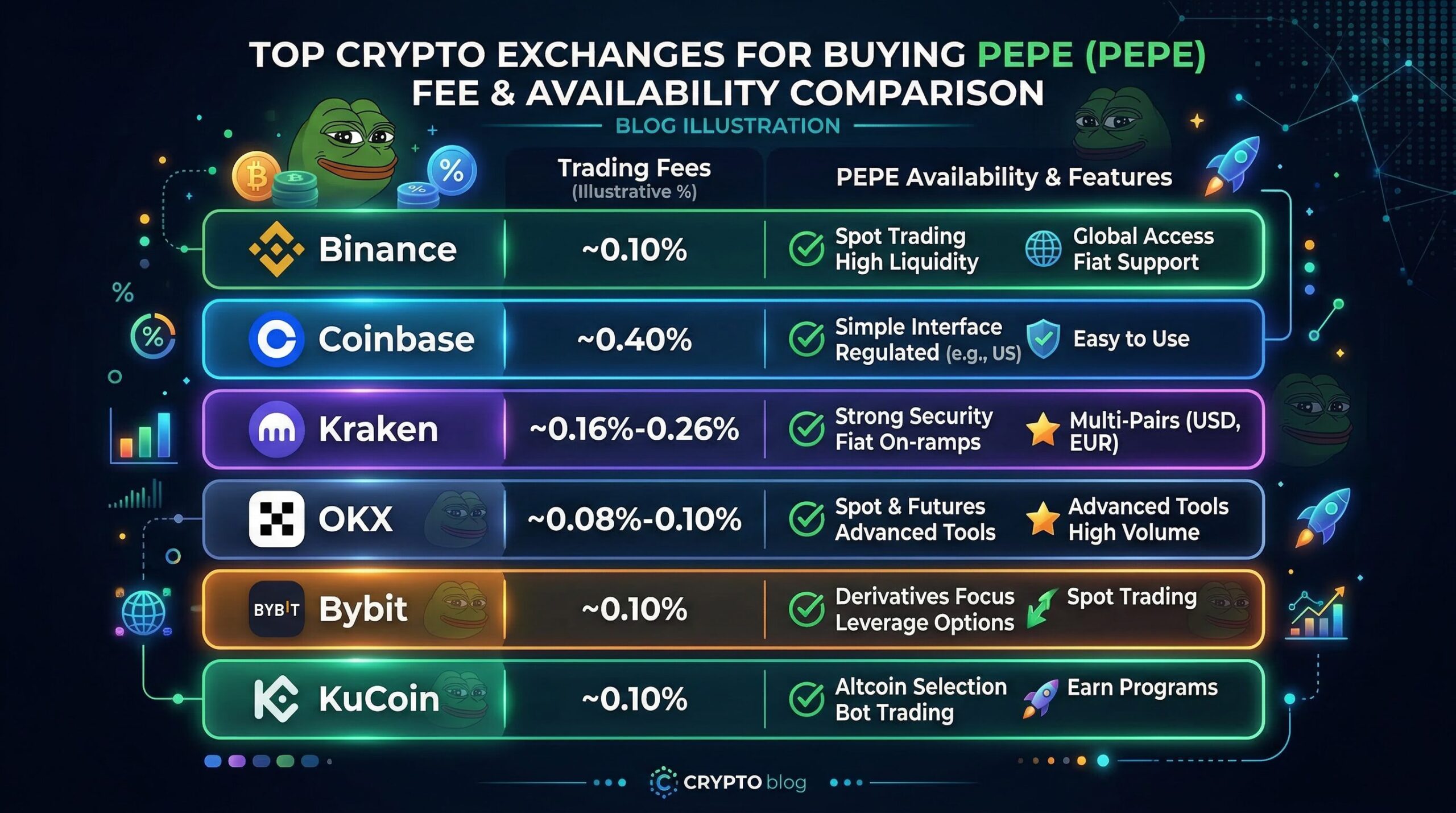
- Binance: The world’s largest crypto exchange by volume. Binance supports PEPE/USDT and PEPE/BTC trading pairs with deep liquidity. Standard maker/taker fees are 0.1%, reducible with BNB. Note: Binance is not available in the United States; US residents should use Coinbase or Kraken instead.
- Coinbase: The most regulated and accessible exchange for US-based investors. Coinbase lists PEPE and allows direct purchase with bank transfer, debit card, or wire. Fees are higher than most competitors, typically 0.5–2% depending on transaction size, but the interface is beginner-friendly.
- Kraken: One of the oldest and most security-focused exchanges in crypto. Kraken supports PEPE and is available to US customers. Trading fees start at 0.26% for takers and drop with volume.
- OKX: A major global exchange with a wide range of PEPE trading pairs. OKX is popular in Asia and Europe and offers competitive fees.
- Bybit: Known for derivatives trading, Bybit also offers spot PEPE purchases and has become a popular choice for yield products.
- KuCoin: Supports PEPE in multiple pairs including USDT, USDC, and KCS. Trading fees are 0.1% for both makers and takers.
- MEXC: Notable for charging 0% maker fees on spot trading, making it attractive for frequent buyers.
Decentralized Exchanges (DEXs)
Decentralized exchanges allow you to buy PEPE directly from other users via automated smart contracts, without creating an account or undergoing identity verification. The most important platform for PEPE is Uniswap (Ethereum mainnet), where PEPE has deep liquidity against WETH and USDC pairs.
To use a DEX, you will need an Ethereum-compatible wallet (MetaMask is the most widely used), some ETH to pay gas fees, and the correct PEPE contract address: 0x6982508145454ce325ddbe47a25d4ec3d2311933. Always verify the contract address from an official source like CoinMarketCap or CoinGecko to avoid purchasing counterfeit tokens.
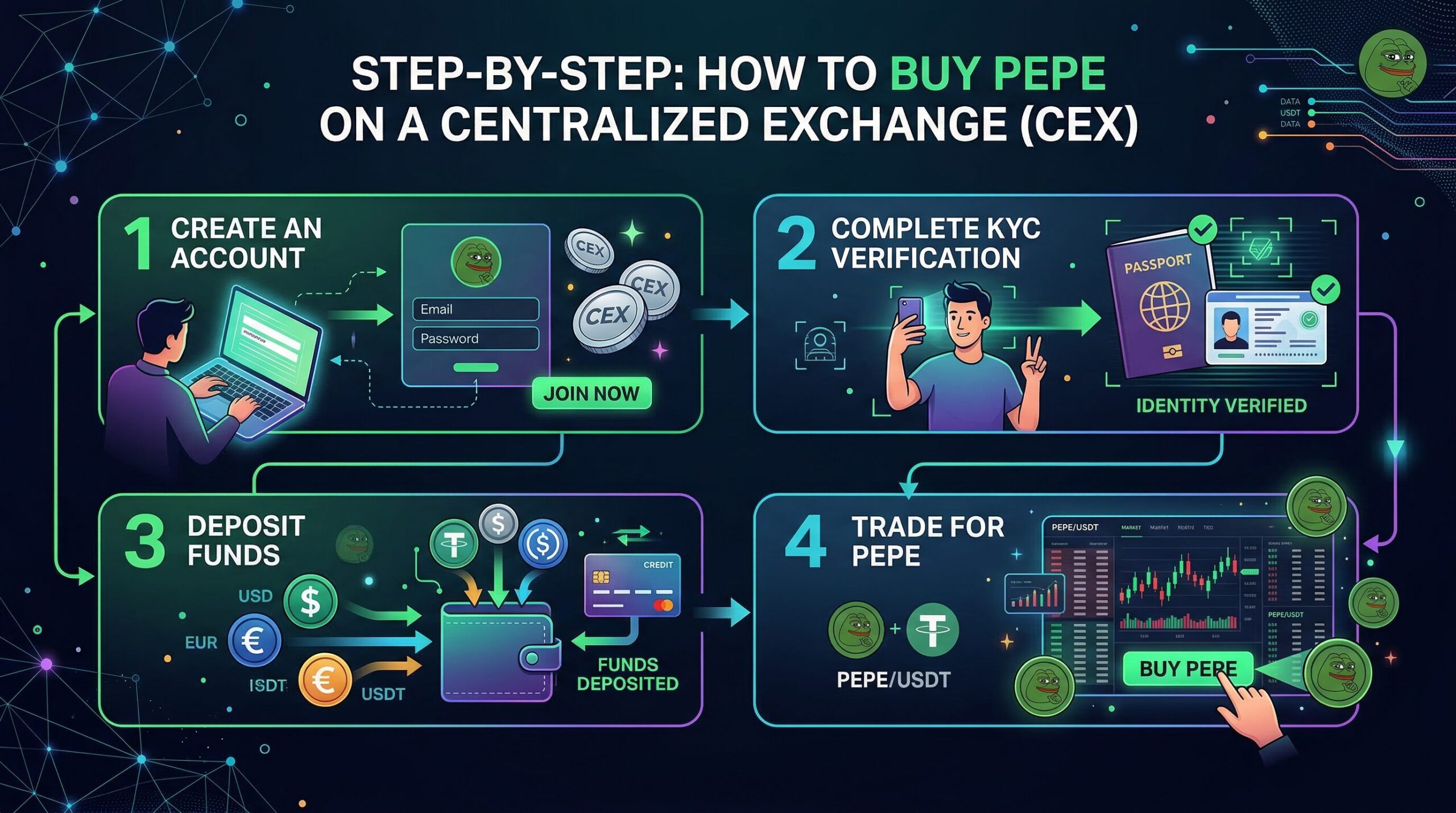
Step-by-Step: How to Buy PEPE on a Centralized Exchange
The following guide uses a major centralized exchange as the example. The process is similar across most platforms.
Step 1: Choose Your Exchange and Create an Account
Select an exchange that is available in your country, supports your preferred payment method, and has PEPE listed. Navigate to the exchange’s official website and click the registration button. You will typically need to provide:
- A valid email address
- A strong, unique password
- Phone number (for two-factor authentication)
After verifying your email, enable two-factor authentication (2FA) immediately. Use an authenticator app (Google Authenticator or Authy) rather than SMS for better security.
Step 2: Complete Identity Verification (KYC)
Most reputable exchanges require Know Your Customer (KYC) verification before you can deposit or withdraw funds. This involves submitting a government-issued ID (passport, driver’s license) and sometimes a selfie for facial recognition. KYC protects both the exchange and users by complying with anti-money laundering regulations. Verification typically completes within minutes to a few hours.
Step 3: Deposit Funds
Once verified, navigate to the deposit section. Your main options are:
- Bank transfer / ACH: Lowest fees (often free), but can take 1–5 business days to clear.
- Debit or credit card: Fast and convenient, but fees are typically 1.5–3.5%.
- Crypto deposit: If you already hold USDT or another stablecoin on another exchange, you can transfer it in to minimize fiat conversion fees.
Step 4: Find PEPE and Place Your Order
Use the exchange’s search bar to find PEPE. Look for the PEPE/USDT pair, which typically has the highest liquidity. You have two order types to choose from:
- Market order: Executes immediately at the current market price. Best for smaller purchases where price impact is minimal.
- Limit order: Executes only if PEPE reaches a price you specify. Useful if you want to buy at a lower price and are not in a rush.
Enter the amount of USD (or USDT) you want to spend, review the fee breakdown, and confirm your purchase.
Step 5: Decide Where to Store Your PEPE
Once purchased, your PEPE sits in your exchange account. For small amounts you may trade frequently, this is acceptable. For any significant holding, consider withdrawing to a personal wallet for greater security.
How to Buy PEPE on a Decentralized Exchange (Uniswap)
If you prefer non-custodial trading — meaning you retain control of your private keys at all times — you can buy PEPE directly on Uniswap without a centralized exchange account.
Step 1: Set Up a Web3 Wallet
Download and install MetaMask as a browser extension or mobile app. Create a new wallet and write down your 12-word seed phrase on paper. Store it in a secure location. Never store your seed phrase digitally or share it with anyone. This phrase is the master key to your funds.
Step 2: Fund Your Wallet with ETH
You need ETH to do two things: pay Ethereum network gas fees (typically $1–$10 per transaction in 2026, varying with network demand) and optionally convert ETH to PEPE. Purchase ETH on any major exchange and withdraw it to your MetaMask Ethereum address.
Step 3: Go to Uniswap and Connect Your Wallet
Navigate to app.uniswap.org. Click “Connect Wallet” and select MetaMask. Approve the connection in your MetaMask extension.
Step 4: Swap ETH (or USDC) for PEPE
In the swap interface, select ETH (or USDC) as your input token and PEPE as your output token. If PEPE does not appear automatically, paste the verified contract address: 0x6982508145454ce325ddbe47a25d4ec3d2311933. Enter the amount you want to swap, review the exchange rate and estimated price impact, and click “Swap.” Confirm the transaction in MetaMask.
Note: Uniswap charges a 0.3% fee on most PEPE pools, and you will also pay an ETH gas fee for the transaction itself. During peak network congestion, gas fees can be significantly higher.
Storing PEPE Safely
Since PEPE is an ERC-20 token, it can be stored in any Ethereum-compatible wallet. Here are the main options:
Software Wallets (Hot Wallets)
- MetaMask: The most widely used Ethereum wallet. Free, browser-based, and compatible with all Ethereum dApps and DEXs.
- Coinbase Wallet: A non-custodial wallet from Coinbase, separate from the Coinbase exchange. Supports PEPE and integrates easily with the Coinbase ecosystem.
- Trust Wallet: A mobile wallet with multi-chain support and a built-in DEX interface.
Hardware Wallets (Cold Storage)
For larger holdings, a hardware wallet is the gold standard for security. These devices store your private keys offline, making them immune to online hacks.
- Ledger Nano X / Nano S Plus: Support all ERC-20 tokens including PEPE. Can connect to MetaMask for DEX interactions while keeping keys offline.
- Trezor Model T / Model One: Open-source hardware wallets with full ERC-20 support.
Understanding PEPE’s Tokenomics
PEPE launched with a maximum supply of 420,690,000,000,000 (420.69 trillion) tokens, all minted at launch. At the time of launch, the development team sent 93.1% of the total supply to Uniswap liquidity and burned the liquidity pool (LP) tokens, meaning no one controls that liquidity. The remaining 6.9% was placed in a multi-signature wallet for exchange listings, bridges, and future use by the project’s team.
Because no new PEPE can ever be created, there is no inflation risk from new supply. However, the enormous total supply means each individual token is worth a fraction of a cent. This is entirely normal — PEPE is denominated in micro-units, similar to how Shiba Inu (SHIB) operates. When evaluating price performance, always use market capitalization as your benchmark, not price per individual token.
PEPE Price History and 2026 Market Overview
PEPE launched in April 2023 at a price of approximately $0.000000001 per token — essentially worthless. Within weeks, it had surged over 700%, driven by viral social media attention and speculative buying. By late April 2023, PEPE had reached a then-record high and briefly entered the top 50 cryptocurrencies by market cap, an extraordinary feat for a brand-new meme token.
The token experienced multiple cycles of boom and correction through 2023 and 2024, culminating in its all-time high of approximately $0.0000282 in December 2024, at which point it had achieved a market capitalization exceeding $11 billion. As of March 2026, PEPE trades around $0.0000035 with a market cap of approximately $1.4 billion, reflecting a significant pullback from those peak levels in a broader crypto market correction.
Trading volume remains substantial — daily volumes regularly exceed $200–500 million USD across all exchanges — confirming that PEPE retains an active and engaged market. With a circulating supply of 413.77 trillion PEPE, the token is one of the most liquid ERC-20 assets outside of the top 20.
Ways to Earn PEPE Beyond Buying
While buying on an exchange is the most direct method, there are several other ways to acquire or earn PEPE:
Liquidity Provision on Uniswap
By depositing PEPE and ETH (or USDC) into a Uniswap liquidity pool, you earn a share of the trading fees generated on that pair. Uniswap V3 allows concentrated liquidity, where you provide liquidity within a specified price range, potentially earning higher fee yields if PEPE trades within that range. Be aware of impermanent loss — if PEPE’s price moves significantly relative to ETH, you may end up with less value than if you had simply held the two assets separately.
Crypto Earn Programs on Exchanges
Some centralized exchanges offer “Earn” products where you can lend or lock up your PEPE for a yield. These programs vary by exchange and availability and typically offer modest APYs compared to more established DeFi options.
Participating in Airdrops and Community Events
The PEPE community occasionally organizes community campaigns, contests, and small airdrops. Following official PEPE social channels can surface these opportunities. Always verify the authenticity of any airdrop before connecting your wallet — scams impersonating PEPE are common.
Key Risks to Understand Before Buying PEPE
No article about how to buy PEPE would be complete without an honest discussion of the risks involved:
- Extreme volatility: PEPE has experienced single-day price drops exceeding 30%. Its price can fall dramatically with little warning if market sentiment shifts.
- No underlying utility: Unlike Ethereum or Solana, PEPE has no technical use case. Its value is entirely sentiment-driven.
- Anonymous team: The PEPE developers are unknown. While the initial liquidity was locked and burned, this does not eliminate all risks associated with anonymous projects.
- Scam tokens: Dozens of fake “PEPE” tokens exist on various blockchains. Always verify the official contract address (
0x6982508145454ce325ddbe47a25d4ec3d2311933on Ethereum) before any transaction. - Regulatory risk: Crypto regulations continue to evolve globally in 2026. Meme tokens could face additional scrutiny as regulators seek to protect retail investors.
- Tax obligations: In most jurisdictions, selling crypto — including meme coins like PEPE — is a taxable event. Consult a tax professional familiar with cryptocurrency in your country.
Is PEPE a Good Investment in 2026?
This depends entirely on your risk tolerance, investment goals, and time horizon. PEPE is not a stable store of value, a productive asset like staked ETH, or a technology infrastructure token. It is a speculative bet on community momentum and broader meme-coin market sentiment.
Some analysts note that PEPE’s established brand recognition, massive liquidity, and proven trading history give it a durability that many newer meme coins lack. It has survived two significant market cycle corrections and maintains consistent trading volume. For investors who understand and accept the speculative nature of meme tokens and size their position accordingly, PEPE may warrant a small allocation as part of a diversified crypto portfolio.
For investors seeking fundamentals-driven exposure to the crypto market, PEPE is not the appropriate vehicle. Consider assets like ETH, BTC, or established Layer 1 tokens with clear utility and growing ecosystems.
Frequently Asked Questions
Can I mine PEPE coin?
No. PEPE is an ERC-20 token on Ethereum and cannot be mined. All 420.69 trillion tokens were created at launch. Mining hardware will not generate any PEPE. The only way to acquire PEPE is to buy it on an exchange or earn it through DeFi liquidity provision.
What is the minimum amount of PEPE I can buy?
Most exchanges allow PEPE purchases starting from $1–$10 USD. On DEXs like Uniswap, the minimum is effectively determined by Ethereum gas fees — it rarely makes economic sense to buy less than $20–$50 worth of PEPE on Uniswap due to gas costs.
Is PEPE safe to buy?
Buying PEPE on reputable exchanges like Coinbase, Kraken, or Binance is technically safe. The risk lies in PEPE’s price volatility and speculative nature, not in the mechanics of purchasing it. Never buy PEPE from unofficial websites or connect your wallet to unverified platforms.
Does PEPE have any real-world use cases?
As of 2026, PEPE does not have a significant real-world use case beyond speculative trading and community participation. It functions as a cultural artifact and speculative token. Some merchants accept PEPE as a novelty payment, but this is minimal and not a primary driver of value.
What wallet should I use to store PEPE?
MetaMask is the most widely compatible option for ERC-20 tokens including PEPE. For larger amounts, a Ledger or Trezor hardware wallet connected to MetaMask provides the best security combination.