
Introduction: Why Bitcoin Changed Everything
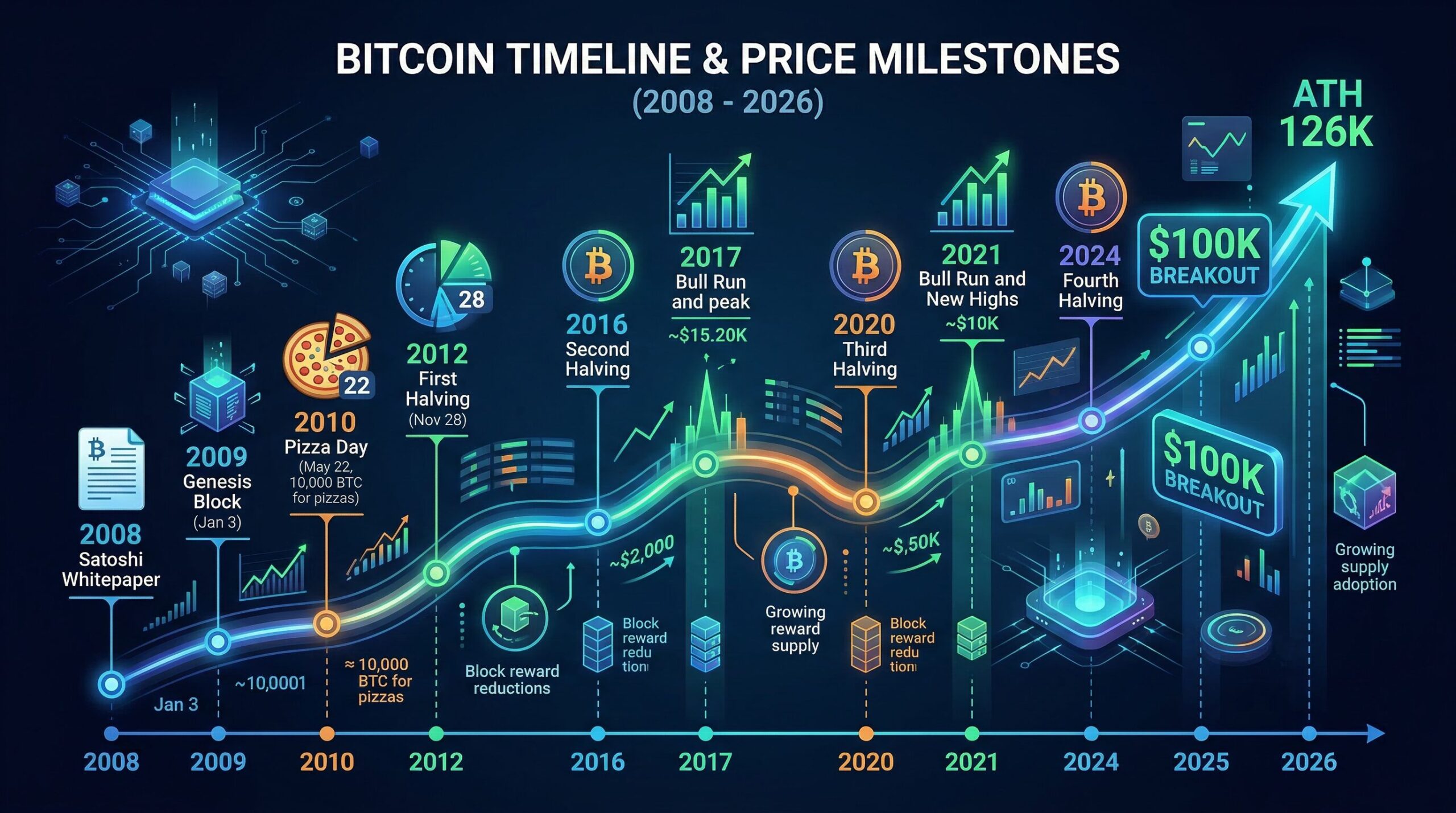
Bitcoin is the world’s first decentralized digital currency, and its story is inseparable from one of the most turbulent moments in modern financial history. Born out of distrust in traditional banking systems, it has grown from a cryptographic experiment into a multi-trillion-dollar asset class held by governments, institutions, and tens of millions of individuals worldwide. Understanding how Bitcoin came to be — and how it has evolved over nearly two decades — is essential for anyone serious about digital finance in 2026.
This comprehensive guide traces Bitcoin’s journey from its philosophical roots and technical creation through every major milestone, up to its current role as the world’s seventh-largest asset by market capitalization.
The Crisis That Sparked a Revolution: 2007–2008
To understand Bitcoin, you must first understand the world it was designed to fix. Between 2007 and 2008, the global financial system teetered on the edge of collapse. Major banks — including Lehman Brothers, Bear Stearns, and Washington Mutual — failed catastrophically, wiping out savings accounts, retirement funds, and livelihoods overnight. Governments responded by bailing out the same institutions whose reckless practices caused the crisis, using taxpayer money to rescue entities that had privatized profits while socializing losses.
This deeply unjust outcome exposed three fundamental flaws in the traditional financial system: the concentration of trust in a small number of intermediaries, the ability of those intermediaries to take excessive risks with other people’s money, and the power of central banks to inflate the money supply at will — effectively diluting the savings of ordinary citizens.
It was in this environment that an anonymous individual or group using the pseudonym Satoshi Nakamoto published a document that would change the world.
The Bitcoin Whitepaper: October 31, 2008
On October 31, 2008 — Halloween — Satoshi Nakamoto published a nine-page document titled Bitcoin: A Peer-to-Peer Electronic Cash System to a cryptography mailing list. This whitepaper introduced a solution to the long-standing double-spend problem in digital cash: how to prevent someone from spending the same digital token twice without relying on a central authority to verify transactions.
Satoshi’s solution was elegant. Rather than trusting a single institution to maintain a ledger of transactions, Bitcoin distributes that ledger across thousands of computers worldwide in a structure called a blockchain. Every transaction is cryptographically verified and added to a permanent, immutable chain of records that anyone can audit but no single party can alter. The mechanism incentivizing participants to maintain the network honestly — a process called proof-of-work mining — uses computational power to make fraudulent record-keeping economically irrational.
The whitepaper described a system with a fixed supply cap of 21 million coins, a property designed to protect against inflation. This finite supply — enforced by mathematical rules, not human institutions — was a direct repudiation of central bank monetary policy.
Genesis Block: January 3, 2009
On January 3, 2009, Satoshi Nakamoto mined the first-ever Bitcoin block — known as the genesis block, or Block 0. The block reward was 50 BTC. Embedded within the block’s code was a message that made Satoshi’s intentions unmistakably clear:
The Times 03/Jan/2009 Chancellor on brink of second bailout for banks.
This was a headline from that day’s edition of The Times of London, and its inclusion was deliberate: a timestamp confirming the block had not been pre-mined, and a political statement about the broken system Bitcoin was designed to replace. The genesis block cannot be spent — it is a permanent monument to Bitcoin’s founding philosophy.
Six days later, on January 9, 2009, Satoshi released Bitcoin version 0.1 software, making the network available to the public. On January 12, 2009, the first-ever Bitcoin transaction took place between Satoshi Nakamoto and computer scientist Hal Finney, who received 10 BTC.
From Experiment to Currency: 2009–2011
In Bitcoin’s earliest days, the currency had no established market price. It was traded informally on forums, primarily among cryptographers and cypherpunks who understood the underlying technology. The first known exchange rate — approximately 1,309 BTC per US dollar — was established in October 2009 by the New Liberty Standard, based on the cost of electricity required to mine one Bitcoin.
The most famous early transaction occurred on May 22, 2010, when programmer Laszlo Hanyecz paid 10,000 BTC for two Papa John’s pizzas — the first known commercial transaction using Bitcoin. At Bitcoin’s all-time high of $126,198 in October 2025, those two pizzas would have been worth over $1.26 billion. May 22 is now celebrated annually as Bitcoin Pizza Day.
By mid-2010, the first dedicated Bitcoin exchange — Mt. Gox — launched, enabling price discovery and broader participation. The first major security incident also occurred in 2010, when a vulnerability briefly allowed the creation of 184 billion bitcoins in a single transaction. Satoshi patched the bug within hours, and the network was restored. This incident demonstrated both Bitcoin’s vulnerability to bugs and its resilience through community response.
In 2011, Satoshi Nakamoto made their last known communication to the Bitcoin community, handing over project maintenance to lead developer Gavin Andresen. The identity of Satoshi Nakamoto remains unknown to this day — one of the great mysteries of the digital age. Various individuals have claimed to be Satoshi, but none have been conclusively verified.

The First Boom and Bust Cycles: 2011–2016
Bitcoin’s price history is characterized by dramatic boom-and-bust cycles, each one larger than the last. The first significant rally occurred in 2011, when Bitcoin reached $31 before crashing back to $2 — an 85% decline. This pattern would repeat throughout Bitcoin’s history, testing the conviction of holders and eliminating those who could not stomach extreme volatility.
The Mt. Gox era defined much of Bitcoin’s early growth. At its peak, the Tokyo-based exchange handled over 70% of all global Bitcoin trading. In February 2014, Mt. Gox collapsed after revealing that 850,000 BTC had been stolen — approximately $450 million at the time. It remains one of the largest theft events in cryptocurrency history and a defining lesson about exchange custody risk.
Despite the Mt. Gox collapse, Bitcoin recovered. The 2016 Bitcoin halving — an automatic reduction in the block reward from 25 BTC to 12.5 BTC, programmed into Bitcoin’s code — reduced new supply entering the market and set the stage for the 2017 bull market. Understanding halving events is critical to understanding Bitcoin’s price cycles.
The Halving Mechanism: Bitcoin’s Built-In Scarcity Engine
Every 210,000 blocks — approximately every four years — Bitcoin’s protocol automatically halves the reward paid to miners for processing transactions. This mechanism is the cornerstone of Bitcoin’s deflationary monetary policy and a key driver of its price cycles.
The four halvings to date:
- Halving 1 — November 2012: Block reward reduced from 50 BTC to 25 BTC. Bitcoin subsequently rose from ~$12 to over $1,000 in 2013.
- Halving 2 — July 2016: Block reward reduced from 25 BTC to 12.5 BTC. Bitcoin rose from ~$650 to nearly $20,000 in late 2017.
- Halving 3 — May 2020: Block reward reduced from 12.5 BTC to 6.25 BTC. Bitcoin ultimately rose from ~$8,700 to $69,000 by November 2021.
- Halving 4 — April 19, 2024: Block reward reduced from 6.25 BTC to 3.125 BTC. Bitcoin went on to reach an all-time high of $126,198 in October 2025.
The next halving is expected in April 2028, when the block reward will drop to 1.5625 BTC. At that point, approximately 97% of all Bitcoin that will ever exist will already have been mined. This increasing scarcity — combined with growing demand — is the structural force many analysts believe underpins Bitcoin’s long-term price trajectory.
Mainstream Attention: 2017 and the First Global Bull Market
2017 was Bitcoin’s breakout year with mainstream audiences. Bitcoin’s price surged from under $1,000 at the start of the year to nearly $20,000 by December — a 2,000% gain that captured global media attention and introduced millions of new investors to cryptocurrency. The broader altcoin market exploded alongside Bitcoin, with hundreds of new tokens launching through initial coin offerings (ICOs).
This period also brought serious regulatory scrutiny. China banned ICOs and domestic cryptocurrency exchanges. The US Securities and Exchange Commission issued guidance suggesting many ICO tokens were unregistered securities. These interventions triggered a market crash that wiped over 80% from Bitcoin’s price between early 2018 and late 2018, from $20,000 to under $4,000.
Yet the infrastructure built during this period — professional trading platforms, institutional custody solutions, derivatives markets — laid the groundwork for the next phase of Bitcoin’s development.
Institutional Entry: 2020–2022
The 2020–2022 cycle marked Bitcoin’s transition from speculative asset to institutional consideration. Several landmark events defined this period:
MicroStrategy’s Treasury Move (August 2020): Business intelligence company MicroStrategy, led by CEO Michael Saylor, announced it had converted its corporate treasury to Bitcoin as a hedge against currency debasement. The company has since accumulated over 500,000 BTC, becoming the world’s largest corporate Bitcoin holder.
Tesla’s Bitcoin Investment (February 2021): Elon Musk’s Tesla announced a $1.5 billion Bitcoin purchase and briefly accepted BTC as payment for vehicles, signaling mainstream corporate acceptance.
El Salvador’s Legal Tender Adoption (June 2021): El Salvador became the first nation to adopt Bitcoin as legal tender, under President Nayib Bukele. The move attracted both praise for financial inclusion and criticism from the International Monetary Fund.
Bitcoin reached its then-all-time high of $69,000 in November 2021 before entering a prolonged bear market. By November 2022, following the collapse of the FTX exchange — which had misappropriated billions in customer funds — Bitcoin had fallen to approximately $16,000, a 77% decline from its peak. FTX founder Sam Bankman-Fried was later convicted of multiple counts of fraud and sentenced to 25 years in prison.
The ETF Era: 2024 and the Institutional Floodgates Open
On January 10, 2024, the US Securities and Exchange Commission approved 11 spot Bitcoin exchange-traded funds (ETFs), including products from BlackRock, Fidelity, and Invesco. This decision — which the SEC had resisted for over a decade — was a watershed moment for Bitcoin’s legitimacy as an asset class.
The market response was immediate. Bitcoin ETFs attracted over $12 billion in net inflows within their first quarter of trading. BlackRock’s iShares Bitcoin Trust (IBIT) accumulated over $50 billion in assets under management, making it one of the fastest-growing ETFs in financial history. By Q4 2024, institutional investors holding over $100 million in assets under management held $27.4 billion in Bitcoin ETFs — a 114% increase from the previous quarter.
Ethereum spot ETFs received SEC approval in July 2024, further expanding the regulated digital asset product landscape. Bitcoin broke the $100,000 milestone on December 5, 2024, fulfilling a prediction many in the industry had long anticipated.
Bitcoin’s Record Year: 2025
2025 was Bitcoin’s most consequential year yet. The April 2024 halving — reducing block rewards to 3.125 BTC — filtered through the market, and combined with unprecedented institutional and governmental interest, drove Bitcoin to an all-time high of $126,198 on October 6, 2025.
Several major developments accelerated Bitcoin’s mainstream integration:
Trump’s Executive Order (January 23, 2025): President Donald Trump signed an executive order titled Strengthening American Leadership in Digital Financial Technology, establishing a Presidential Working Group on Digital Asset Markets and rescinding SAB 121, the accounting rule that had prevented banks from offering crypto custody services.
US Strategic Bitcoin Reserve (March 6, 2025): President Trump signed an executive order establishing a Strategic Bitcoin Reserve, funded by government-seized Bitcoin. The US government holds over 207,000 BTC in this reserve — treating Bitcoin with the same strategic significance as gold or oil. The announcement confirmed the United States’ ambition to be the crypto capital of the world.
GENIUS Act (July 18, 2025): The first major piece of US federal cryptocurrency legislation — establishing a regulatory framework for stablecoins — was signed into law with bipartisan support (68-30 in the Senate; 308-122 in the House). The GENIUS Act brought stablecoin issuers under Bank Secrecy Act obligations and required 100% reserve backing.
Abu Dhabi Sovereign Bitcoin Exposure: The Emirate of Abu Dhabi’s sovereign wealth fund filed for a $439 million position in Bitcoin ETFs — the first sovereign wealth fund to disclose Bitcoin ETF ownership through regulatory filings.
Bitcoin in 2026: Current State and Outlook
As of March 2026, Bitcoin trades at approximately $70,000, having corrected roughly 45% from its October 2025 all-time high of $126,198. This correction is broadly consistent with historical post-halving cycle patterns. Bitcoin’s market capitalization stands at approximately $1.33 trillion, making it the world’s seventh-largest asset — larger than most major corporations and comparable to the GDP of mid-sized nations.
The regulatory landscape in 2026 is markedly clearer than in prior years. In the United States, the SEC and CFTC issued a joint interpretation on March 17, 2026, clarifying how federal securities laws apply to crypto assets and establishing a taxonomy distinguishing digital commodities, digital securities, stablecoins, and digital collectibles. The CLARITY Act — which would assign explicit regulatory jurisdiction between the SEC and CFTC for a wide range of digital assets — passed the US House in July 2025 and awaits Senate action.
Globally, Bitcoin benefits from increasingly favorable infrastructure: Japan is considering reclassifying crypto assets as financial instruments under its Financial Instruments and Exchange Act; Hong Kong has approved regulated futures trading on Bitcoin via MiFID-compliant entities; and the EU’s MiCA regulation entered full effect in December 2024, creating a unified licensing framework for crypto-asset service providers across all 27 member states.
The Philosophy That Still Drives Bitcoin
Beyond price charts and regulatory milestones, Bitcoin’s enduring power lies in its founding philosophy. The principles Satoshi Nakamoto encoded into the protocol in 2008 remain intact today:
Fixed supply: There will never be more than 21 million Bitcoin. This mathematical guarantee of scarcity stands in direct contrast to fiat currency systems, where central banks can expand the money supply indefinitely.
Decentralization: No single entity controls the Bitcoin network. Thousands of nodes spread across dozens of countries process and validate transactions. This makes Bitcoin uniquely resistant to censorship, seizure, or politically motivated manipulation.
Trustlessness: Bitcoin transactions do not require trust in a third party — bank, government, or payment processor. The protocol enforces the rules mathematically, eliminating counterparty risk at the protocol level.
Transparency: The Bitcoin blockchain is a fully public, auditable ledger. Anyone can verify any transaction in history, back to the genesis block. This level of transparency is unmatched by any traditional financial system.
Permissionless access: Anyone with internet access can receive, send, and store Bitcoin. No bank account is required. No government authorization is needed. This property makes Bitcoin particularly significant for the 1.4 billion adults worldwide who remain unbanked.
Key Milestones: Bitcoin Timeline
- October 31, 2008: Satoshi Nakamoto publishes the Bitcoin whitepaper
- January 3, 2009: Genesis block mined; Bitcoin network goes live
- January 12, 2009: First Bitcoin transaction (Satoshi to Hal Finney, 10 BTC)
- May 22, 2010: Bitcoin Pizza Day — 10,000 BTC traded for two pizzas
- 2011: Bitcoin reaches $31; Mt. Gox becomes dominant exchange
- February 2014: Mt. Gox collapses; 850,000 BTC stolen
- November 2012: First halving — reward drops to 25 BTC
- July 2016: Second halving — reward drops to 12.5 BTC
- December 2017: Bitcoin reaches ~$20,000 for the first time
- May 2020: Third halving — reward drops to 6.25 BTC
- November 2021: Bitcoin reaches $69,000 all-time high
- November 2022: FTX collapse; Bitcoin drops to ~$16,000
- January 2024: SEC approves spot Bitcoin ETFs; BlackRock, Fidelity launch products
- April 2024: Fourth halving — reward drops to 3.125 BTC
- December 2024: Bitcoin breaks $100,000 for the first time
- January 2025: Trump executive order on digital asset leadership
- March 2025: US Strategic Bitcoin Reserve established by executive order
- July 2025: GENIUS Act signed into law — first US federal crypto legislation
- October 2025: Bitcoin reaches all-time high of $126,198
- March 2026: SEC/CFTC joint interpretation clarifies crypto asset taxonomy
Frequently Asked Questions
Who created Bitcoin?
Bitcoin was created by an individual or group using the pseudonym Satoshi Nakamoto. Nakamoto published the Bitcoin whitepaper on October 31, 2008, launched the network on January 3, 2009, and made their last known public communication in 2011. Their true identity has never been confirmed.
How many Bitcoin will ever exist?
The Bitcoin protocol permanently caps total supply at 21 million coins. As of 2026, approximately 19.8 million Bitcoin have been mined. The remaining supply will be released gradually until approximately the year 2140, when the last Bitcoin is projected to be mined.
What is the Bitcoin halving?
Every 210,000 blocks (roughly every four years), Bitcoin automatically halves the reward paid to miners for validating transactions. This mechanism reduces the rate of new Bitcoin supply entering circulation, creating deflationary pressure. The most recent halving occurred in April 2024, reducing block rewards to 3.125 BTC. The next halving is expected in April 2028.
Is Bitcoin a good investment?
Bitcoin is a high-volatility asset with a history of dramatic price swings, including multiple corrections exceeding 70% from peak values. It has also delivered extraordinary long-term returns — transforming from fractions of a cent in 2009 to over $126,000 in 2025. Whether Bitcoin is appropriate for any individual investor depends on their risk tolerance, time horizon, and overall financial situation. This article is informational and does not constitute financial advice.
What is the US Strategic Bitcoin Reserve?
In March 2025, President Trump signed an executive order establishing a Strategic Bitcoin Reserve — a permanent government-held stockpile of Bitcoin seized through criminal and civil forfeiture proceedings. The US government currently holds over 207,000 BTC in this reserve and has committed not to sell the coins. The reserve treats Bitcoin as a strategic asset comparable to gold.
Conclusion: Bitcoin at 17 Years Old
Bitcoin has completed the journey its creator described in 2008: it has become a functional peer-to-peer payment system, a recognized store of value, a legitimate institutional asset class, and a catalyst for a global rethinking of money itself. From a nine-page whitepaper published to a cryptography mailing list during a financial crisis, it has grown into a $1.33 trillion asset held by sovereign wealth funds, Fortune 500 companies, and national governments.
Its challenges remain real: price volatility continues; energy consumption draws criticism; regulatory frameworks are still evolving in many jurisdictions; and the anonymity of its creator leaves open philosophical questions about decentralized governance. But the core innovation Satoshi Nakamoto introduced — a trustless, decentralized, mathematically scarce digital currency — has proven robust across 17 years of stress tests, market cycles, exchange collapses, and regulatory battles.
In 2026, the question is no longer whether Bitcoin is legitimate. It is how deeply embedded it will become in the global financial system over the decades ahead.