
In my view, Hedera solving ticket fraud at this scale highlights practical blockchain utility#Hedera #Mingo
Quick Video Breakdown: This Blog Article
This video clearly explains this blog article.
Even if you don’t have time to read the text, you can quickly grasp the key points through this video. Please check it out!
If you find this video helpful, please follow the YouTube channel “BlockChainBulletin,” which delivers daily Crypto news.
https://www.youtube.com/@BlockChainBulletins
Read this article in your native language (10+ supported) 👉
[Read in your language]
Mingo Secures Exclusive 54-Country Ticketing Deal on Hedera: A Blockchain Breakthrough?
Jon: Hey Lila, have you seen the latest buzz in the Web3 space? Mingo just announced an exclusive deal to handle ticketing across 54 countries, all powered by the Hedera network. It’s being touted as a big step for blockchain in real-world applications, specifically in event ticketing. The press release dropped today, and it’s already making waves.
Lila: Oh, interesting! I caught a glimpse of that on my feed. So, Mingo is some kind of ticketing platform, and they’re using Hedera’s blockchain? What’s the high-level scoop here? And why should someone like me, who’s still wrapping their head around crypto basics, care about this?
Jon: Exactly. Mingo is a digital wallet and messaging app that’s evolving into a broader platform, and this deal positions them as the go-to for ticketing in these 54 countries. Hedera, for those unfamiliar, is a distributed ledger technology—think of it as a super-efficient blockchain alternative using something called hashgraph consensus. The key here is that it’s not just hype; it’s about solving real pain points in ticketing, like fraud, scalping, and high fees. According to the announcement, this could handle everything from concerts to sports events, leveraging Hedera’s speed and low costs. They mentioned integrating with Stripe for payments, which adds a layer of mainstream accessibility.
Lila: Okay, that sounds practical. But why does this matter? Is it just another crypto partnership, or is there something bigger at play?
Jon: It matters because ticketing is a massive industry—global event ticketing was worth over $50 billion pre-pandemic, and it’s rebounding strong. Traditional systems are plagued by issues like fake tickets and opaque pricing. Blockchain can bring transparency and security. This deal shows Hedera gaining traction in enterprise use cases, potentially driving adoption. But remember, it’s early days; risks like regulatory hurdles remain. Worth watching how it unfolds, though.
Lila: Fair point. So, before we dive deeper, what’s the core problem this is trying to fix? I mean, why not just stick with good old Ticketmaster?
Jon: Ah, the problem. Let’s break it down. Traditional ticketing is like a centralized fortress: one company controls everything, from sales to verification. This leads to monopolies, high fees—sometimes 20-30% per ticket—and vulnerability to hacks or scalpers who buy in bulk and resell at insane markups. Fans end up paying more, artists get less, and fraud runs rampant because tickets can be duplicated or faked easily.
Lila: That makes sense, but can you give me a real-world analogy? I’m picturing something chaotic.
Jon: Sure, think of it like traffic in a busy city without traffic lights. Cars (tickets) zoom around, but there’s constant gridlock (high fees), accidents (fraud), and no fair way to manage flow. Scalpers are like toll booths that pop up randomly, charging extra. Blockchain, in this case Hedera, acts like a smart traffic system: decentralized signals ensure smooth flow, verify each car’s (ticket’s) authenticity in real-time, and cut out unnecessary middlemen. No more fake tickets crashing the party.
Lila: Haha, I like that—tickets as reckless drivers. So, centralized systems create bottlenecks and trust issues. Got it. Now, how does Mingo on Hedera actually solve this?
Under the Hood: How it Works
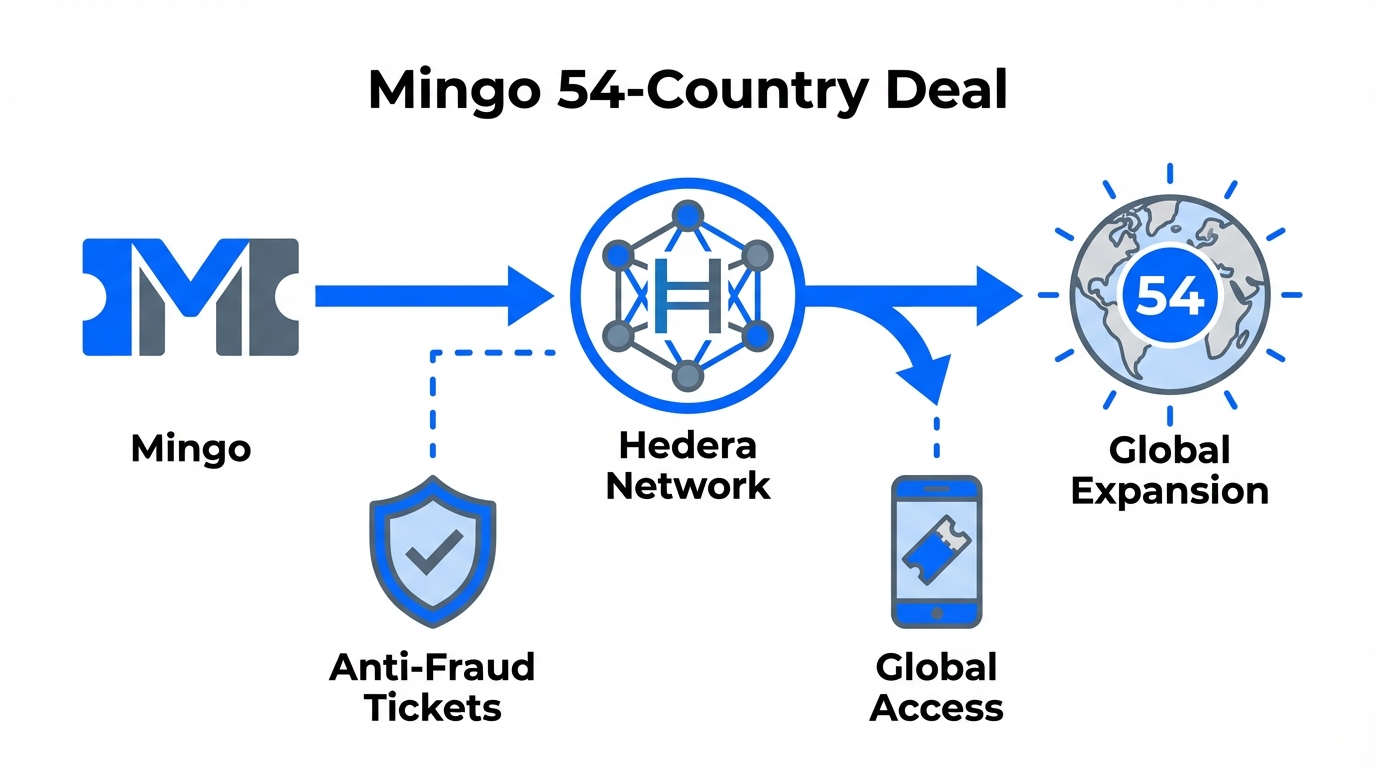
Jon: Alright, let’s get technical but keep it digestible. Hedera isn’t your typical blockchain; it uses hashgraph, a consensus algorithm that’s like gossip protocol on steroids. Instead of slow, energy-hungry proof-of-work like Bitcoin, hashgraph spreads information virally across nodes, achieving consensus super fast—up to 10,000 transactions per second with finality in seconds. For Mingo’s ticketing, this means tickets are minted as NFTs or tokens on the Hedera network, each with unique, immutable metadata like event details, owner history, and anti-scalping rules baked in.
Lila: Whoa, slow down. Consensus algorithm? That’s the way the network agrees on what’s true, right? And hashgraph— is it different from regular blockchains like Ethereum?
Jon: Spot on. Consensus is how distributed systems decide on a single version of truth without a central boss. Hashgraph differs by using virtual voting and gossip—nodes share info pairwise, building a directed acyclic graph (DAG) of events. It’s more efficient than Ethereum’s proof-of-stake, with lower fees (fractions of a cent) and carbon-neutral operations. In ticketing, when you buy a ticket via Mingo, it’s tokenized on Hedera. Smart contracts—Hedera calls them smart contracts too—can enforce rules like no reselling above face value or instant refunds if an event cancels.
Lila: Okay, that sounds powerful. So, to confirm, the token mechanics mean each ticket is a digital asset that’s trackable and tamper-proof?
Jon: Precisely. HBAR is Hedera’s native token, used for fees and staking. But for users, it’s seamless—Mingo handles the wallet side. Let’s compare it to traditional systems to make it clearer.
| Aspect | Traditional Ticketing | Mingo on Hedera |
|---|---|---|
| Speed | Slow processing, delays in verification | Near-instant transactions with finality |
| Fees | High (10-30% per ticket) | Micro-fees (under $0.01) |
| Fraud Prevention | Relies on barcodes, easy to fake | Immutable blockchain records, NFTs for uniqueness |
| Scalability | Limited to central servers | Handles 10k+ TPS, enterprise-grade |
| User Control | Platform owns data | Users own tokens, transferable with rules |
Lila: That table really drives it home. Low fees and high speed could be game-changers. So who actually uses this? I mean, beyond the press release, what are the real applications?
Jon: Great question. On the user side, think fans at concerts or sports games— they get secure, digital tickets in their Mingo wallet, verifiable via app scan. No more paper waste or lost stubs. For artists and organizers, it means direct revenue without hefty cuts, plus data on fan engagement. Developers can build on this: imagine integrating VR concerts, like that NEXST platform with KISS OF LIFE, where tickets unlock virtual experiences. Enterprises in those 54 countries—spanning Europe, Asia, and beyond—could use it for everything from festivals to conferences. The technical benefit is provenance: every ticket’s history is auditable, reducing disputes.
Lila: Developers building on top? That sounds intriguing. And for everyday folks, it’s about fair access, right?
Jon: Yep, exactly. It democratizes ticketing without the gatekeepers. Now, if you’re curious about dipping your toes in, let’s talk an educational action plan. No buying or investing here—just learning.
Lila: Love that. Start with the basics?
Jon: Level 1: Research and Observation. Head to Hedera’s official docs at hedera.com—read the whitepaper on hashgraph. It’s beginner-friendly with diagrams. Use explorers like HashScan to watch real-time transactions; search for Mingo-related tokens. Follow their GitHub for open-source code. Track metrics on dashboards like Messari or CoinGecko for HBAR, but focus on understanding transaction volumes, not prices. This builds context without any risk.
Lila: Cool, passive learning. What about hands-on? How do I try this safely?
Jon: Level 2: Testnet Experimentation. Hedera has a testnet—free to use. Create a wallet via Mingo’s app (they have a test mode) or Hedera’s portal. Mint sample tokens mimicking tickets, transfer them, and see consensus in action. Use tools like Mirror Node APIs to query data. It’s all simulated—no real money involved. If you’re into coding, deploy a simple smart contract on the testnet using JavaScript SDK. Emphasize: this is for education; real networks have fees and risks like volatility.
Lila: Perfect, low-stakes way to learn. Wrapping up, Jon—what’s the bigpicture outlook?
Jon: In summary, Mingo’s 54-country deal on Hedera highlights blockchain’s potential for efficient, fraud-resistant ticketing. The architecture is solid, with fast consensus and low costs offering real technical advantages. Limitations? Adoption depends on user education, regulatory approval in those countries, and integration challenges. It’s a step toward mainstream Web3, but not a silver bullet—scalability in peak events will be tested.
Lila: Absolutely. And remember, crypto is volatile; tech evolves fast, so approach with curiosity, not expectations. This could be worth watching as blockchain meets everyday apps.
Jon: Well said. Let’s see what 2026 brings—maybe more deals like this.
—
Author Profile
Jon is a Web3 researcher and practitioner with over a decade in distributed systems. Lila is a developer advocate focused on making tech accessible.
—
References
- Mingo Secures Exclusive 54-Country Ticketing Deal on Hedera
- Official Hedera Website
- Mingo Secures Exclusive 54-Country Ticketing Deal On Hedera – Blockchain Reporter
- Mingo Secures Exclusive 54-Country Ticketing Deal on Hedera – The Daily Hodl
▼ AI tools to streamline research and content production (free tiers may be available)
Free AI search & fact-checking
👉 Genspark
Recommended use: Quickly verify key claims and track down primary sources before publishing
Ultra-fast slides & pitch decks (free trial may be available)
👉 Gamma
Recommended use: Turn your article outline into a clean slide deck for sharing and repurposing
Auto-convert trending articles into short-form videos (free trial may be available)
👉 Revid.ai
Recommended use: Generate short-video scripts and visuals from your headline/section structure
Faceless explainer video generation (free creation may be available)
👉 Nolang
Recommended use: Create narrated explainer videos from bullet points or simple diagrams
Full task automation (start from a free plan)
👉 Make.com
Recommended use: Automate your workflow from publishing → social posting → logging → next-task creation
※Links may include affiliate tracking, and free tiers/features can change; please check each official site for the latest details.