Why Pro Traders Choose Crypto Prop Firms
👋 Hello Crypto Natives! In the wild west of 2025’s crypto markets, where volatility is the norm and fortunes flip faster than a memecoin pump, professional traders are ditching solo acts for something smarter: cryptocurrency proprietary trading firms. These aren’t your grandma’s stock brokerages—these are high-octane outfits that arm traders with firm capital, cutting-edge tools, and profit splits that can hit 90%. But why the shift? Buckle up as we dissect the trends, history, and mechanics driving this boom. We’ll cut through the hype to reveal why pros are flocking here, from liquidity crunches to algorithmic edges.
John: Listen, I’ve been knee-deep in trading code since Bitcoin was a pizza payment. Prop firms? They’re the engineering upgrade crypto needed. No more risking your life savings on a bad trade— these firms evaluate your skills, hand you their money, and let you keep most of the wins. Recent trends show a surge in popularity, with firms like those listed in Global Gurus’ top 5 offering funded accounts up to $300,000.
Lila: For beginners, think of prop firms like a talent agency for traders. You audition (pass an evaluation), get the gig (firm’s capital), and perform without fronting your own cash. It’s democratizing high-stakes trading in a market that’s evolved from 2017’s ICO madness to 2025’s regulated, algo-driven beast.
Historically, prop trading roots trace back to traditional finance in the 1980s, where firms like Jane Street traded equities with in-house capital. Crypto’s twist? It exploded post-2020 DeFi boom, as spot trading gave way to derivatives and perpetuals. By 2025, with Bitcoin hitting all-time highs and Ethereum’s layer-2 scaling, prop firms have adapted: integrating TradingView for real-time charts, offering crypto-specific challenges, and focusing on fast-payout models. Industry analysts predict this sector could manage $10B+ in funded accounts by 2026, per FXStreet insights.
The Problem: The Trading Trilemma
John: Ah, the trading trilemma—my roast on the classic blockchain scalability trilemma, but for traders: balancing capital access, risk management, and profit potential. Too much personal capital? You’re exposed to wipeouts. Strict risk rules? Profits get capped. High rewards? Often means high leverage disasters.
Lila: Analogy time: Imagine trading as driving a race car. Solo traders supply their own vehicle (capital), fuel (risk tolerance), and track (market access). Hit a pothole? You’re totaled. Prop firms provide the car, safety gear, and a pit crew— you just drive. In crypto’s 24/7 volatility (think 30% swings in hours), this solves the ‘why’ without the wipeout.
The challenge amps up in 2025: Regulatory crackdowns post-FTX collapse (2022) made solo trading riskier, while DeFi’s rise demands precision. Prop firms mitigate this by enforcing drawdown limits (e.g., 10% max loss) and providing liquidity pools that traditional brokers can’t match.
How Crypto Prop Firms Actually Work
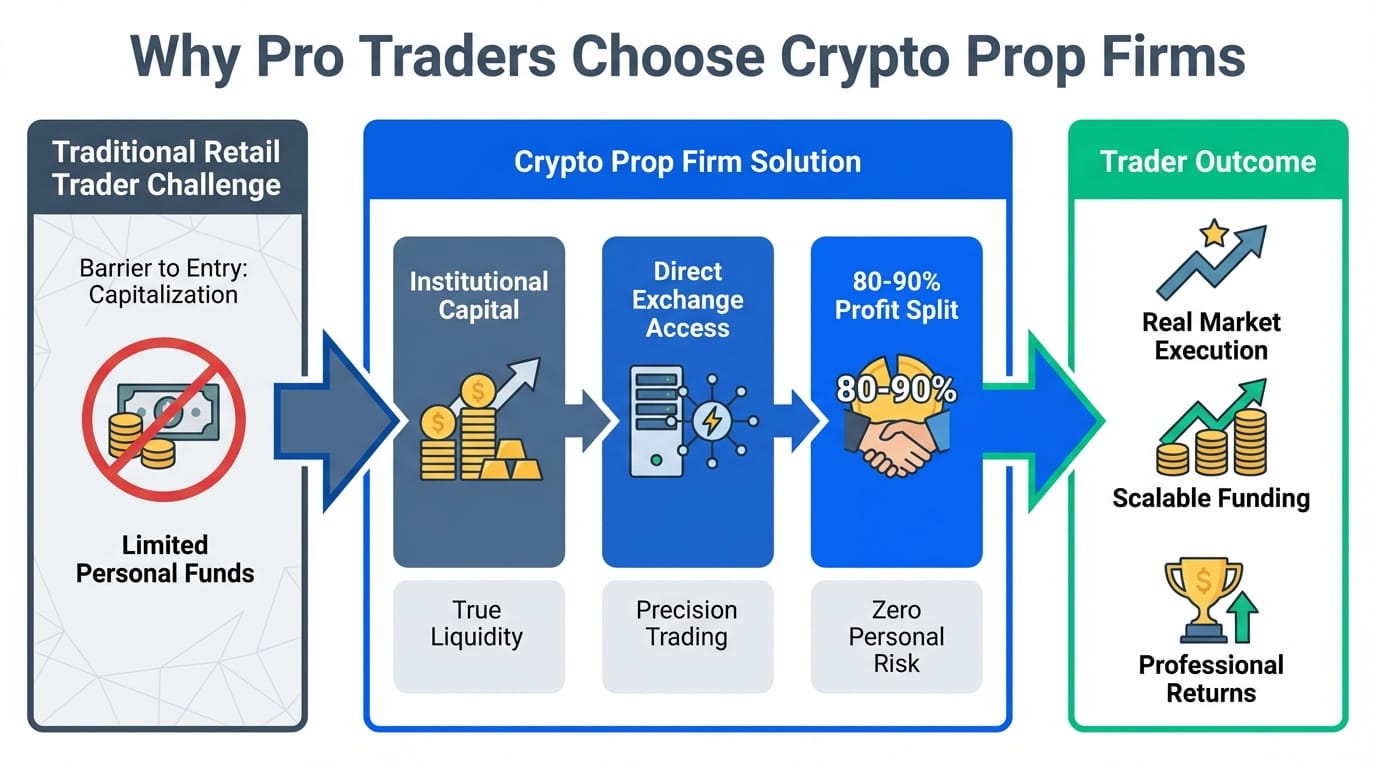
John: Under the hood, these firms aren’t magic—they’re engineered systems. Step 1: Evaluation Phase. Traders simulate trades on a demo account, proving consistency with rules like 5% daily loss limits. Pass? Unlock funded status.
Step 2: Capital Allocation. Firms like Akuna Capital use in-house algorithms (think quantized models for market prediction, shrinking neural nets for speed) to assign capital— from $5,000 starters to $1M+ for elites.
Step 3: Trading Execution. Integrate with platforms via APIs (e.g., Binance or Bybit). No real consensus mechanism like PoS here, but firms mimic it with proprietary “validation nodes”—algo checks for rule compliance before trades execute.
Step 4: Profit Split & Payouts. You keep 70-90% of gains; firm takes the rest. Updates in 2025? Instant payouts via stablecoins, per CoinCodeCap reviews.
Lila: For newbies, it’s like LEGO blocks: Evaluation is building your base, funding is adding the tower, trading is playtime with safeguards.
Protocol & Tokenomics: The Economic Engine
John: Prop firms aren’t blockchains, but some (like those with native tokens) have tokenomics echoing DeFi. Consensus? It’s centralized: Firm’s risk engine acts as “proof-of-performance,” validating trades against metrics. Step-by-step: 1) Trader submits strategy. 2) Algo simulates (using tools like vLLM for fast inference). 3) Validation: If profit targets hit without breaching rules, approve. 4) Execution on live markets.
Tokenomics vary— some firms issue utility tokens for fee discounts or staking rewards. Historical shift: Pre-2023, pure fiat models; now, crypto-native with up to 100x leverage on alts. Economics: Fees fund the pot, traders’ wins draw from it, ensuring sustainability.
Lila: Analogy: Like a casino where you’re the house-approved gambler, not the sucker.
| Aspect | Traditional Trading | Crypto Prop Firms (2025) |
|---|---|---|
| Capital Required | Your own, high risk | Firm’s, evaluation-based |
| Profit Split | 100% yours, but all losses too | 70-90% yours, firm absorbs some risk |
| Tools & Tech | Basic brokers | Algo models, TradingView integration |
| Trends Impact | Vulnerable to volatility | Thrives on 24/7 crypto opportunities |
Actionable Use Cases
John: For Traders: Scale up without personal risk. Example: Use a firm’s $100K account to trade BTC perps, pocketing 80% of a $10K win.
For Developers: Build custom bots on firm APIs. Integrate LangChain for AI-driven strategies, testing on sim accounts before live deployment.
For Investors: Indirect exposure—invest in firm tokens or funds, betting on collective trader performance amid 2025’s bull run.
Lila: Beginners: Start with free challenges on platforms like RebelsFunding to dip toes without commitment.
Due Diligence Resources
John: Dive deep: Check official sites for whitepapers (e.g., Akuna Capital’s strategy docs). Verify contract addresses if token-involved via Etherscan. GitHub repos for open-source tools? Hugging Face has models for trading algos.
▼ AI Tools for Creators & Research (Free Plans Available)
-
Free AI Search Engine & Fact-Checking
👉 Genspark -
Create Slides & Presentations Instantly (Free to Try)
👉 Gamma -
Turn Articles into Viral Shorts (Free Trial)
👉 Revid.ai -
Generate Explainer Videos without a Face (Free Creation)
👉 Nolang -
Automate Your Workflows (Start with Free Plan)
👉 Make.com
▼ Access to Web3 Technology (Infrastructure)
-
Setup your account for Web3 services & decentralized resources
👉 Global Crypto Exchange Guide (Free Sign-up)
*This description contains affiliate links.
*Free plans and features are subject to change. Please check official websites.
*Please use these tools at your own discretion.
References & Further Reading
- Why Pro Traders Choose Crypto Prop Firms – CryptoSlate
- Akuna Capital Review: Technology, Strategy and Global Market Operations – CoinCodeCap
- Why Top Traders are Adding Crypto Props to their Strategy in 2025/2026 – FXStreet
- Top 5 Crypto Prop Trading Firms to Watch in 2025 – Global Gurus
- 10 Best Crypto Prop Trading Firms (November 2025) – CoinCodeCap
Not Financial Advice (DYOR): This post is for informational purposes only. Trading involves risks; do your own research before engaging with any firms or strategies.