
Decentralized Physical Infrastructure Networks — DePIN — represent one of the most consequential applications of blockchain technology to emerge in the past decade. Rather than building and owning infrastructure the traditional way, through massive capital expenditures by a single company or government, DePIN networks crowdsource real-world hardware from individuals around the world and coordinate contributions through on-chain token incentives.
As of early 2026, the DePIN ecosystem has grown to encompass a market capitalization exceeding $16 billion, spanning sectors from wireless connectivity and decentralized storage to GPU compute, mapping, and renewable energy. What was once a theoretical proposition has become operating infrastructure: hundreds of thousands of hotspots, millions of GPU hours, and exabytes of distributed storage are being deployed and managed without a single corporate headquarters in charge.
This guide explains what DePIN is, how it works, and covers in detail the leading projects defining the space in 2026.
What Is DePIN? The Core Concept Explained
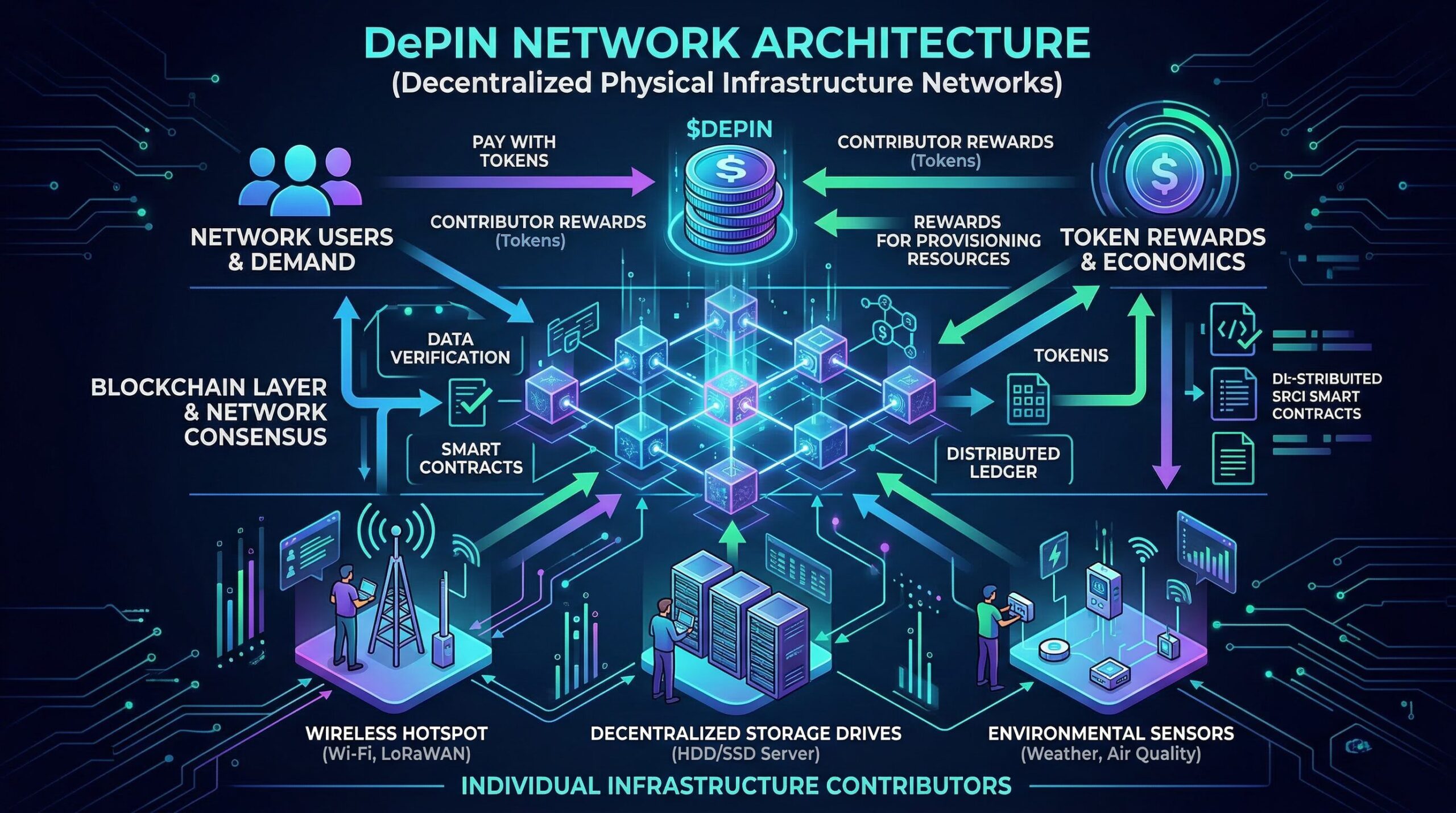
DePIN stands for Decentralized Physical Infrastructure Network. The term was popularized by the crypto research firm Messari in 2022 to describe a growing category of blockchain projects that incentivize people to deploy and operate physical hardware — things that exist in the real world, not just on-chain — in exchange for token rewards.
DePIN inverts this model. Instead of one company spending $10 billion to build a network, DePIN protocols enable 100,000 individuals to each spend $100 to $1,000 on hardware and collectively build something equivalent — or better — while earning tokens as compensation for their contribution.
How DePIN Token Incentives Work
The mechanism that makes DePIN possible is blockchain-based token incentives. Contributors deploy hardware (a wireless hotspot, a GPU, a storage drive, a dashcam) and connect it to the network’s protocol. The protocol verifies the contribution through cryptographic proofs — often called Proof of Coverage, Proof of Storage, or Proof of Compute — and issues tokens proportional to the value the contributor provides.
These tokens have real economic value because they are required by businesses and users to pay for the services the network provides. A mapping company that wants access to Hivemapper’s street-level imagery must purchase HONEY tokens to do so. A VFX studio that wants to render a scene on Render Network must purchase RENDER tokens. This creates a closed-loop economy: hardware contributors earn tokens, and service buyers purchase those tokens, which funds the contributors.
The key insight is that this model can bootstrap real infrastructure faster and more cheaply than traditional approaches, because the capital cost is distributed across thousands of independent contributors who are motivated by the financial upside of early participation in a growing network.
DePIN Subsectors: The Five Major Categories
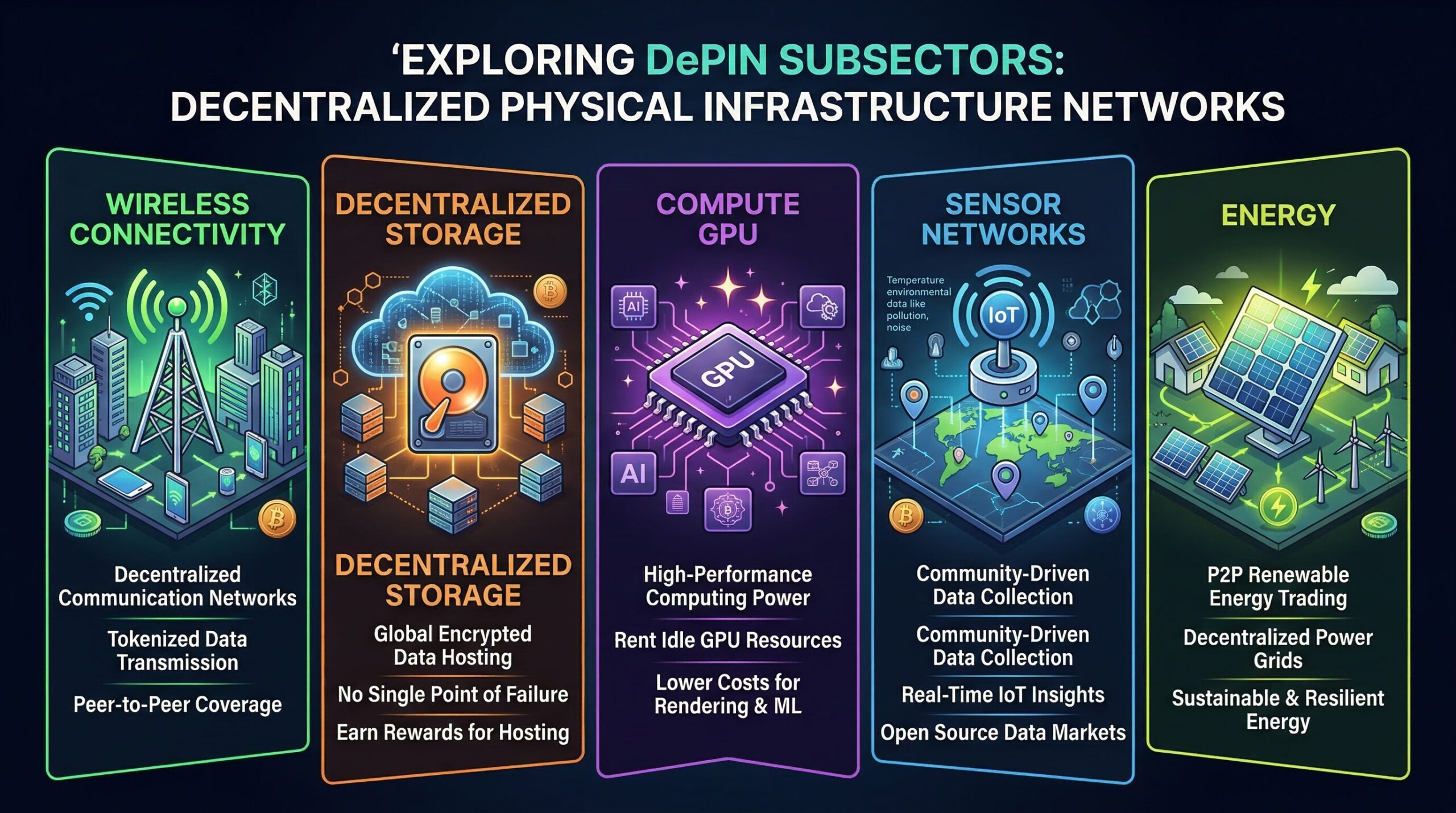
The DePIN ecosystem in 2026 spans five main subsectors, each targeting a different type of physical infrastructure:
1. Wireless and Connectivity Networks
These networks deploy hotspots, antennas, and access points to create decentralized wireless coverage. The leading example is Helium, which operates the world’s largest decentralized LoRaWAN and 5G network. Wireless DePIN networks are particularly powerful in areas underserved by traditional carriers, where the economics of building conventional infrastructure are unfavorable.
2. Decentralized Storage
Storage DePIN networks aggregate hard drive capacity from individual contributors and rent it out to businesses and developers. Filecoin is the dominant player, having grown to become the world’s largest decentralized storage network with exabyte-scale capacity. Storj and Arweave are also notable participants in this category.
3. Decentralized Compute (GPU Networks)
As AI and machine learning workloads drive explosive demand for GPU compute, decentralized compute networks aggregate idle GPU capacity from gaming rigs, data centers, and specialized hardware. Render Network and io.net are the two leading projects in this category, offering GPU rendering and general-purpose AI compute at 50–70% lower cost than AWS or Azure.
4. Mapping and Mobility Data
Mapping DePIN networks reward individuals for collecting geospatial data. Hivemapper equips drivers with dashcams that capture street-level imagery and automatically contributes it to a decentralized mapping network, with contributors earning HONEY tokens. GEODNET rewards operators of high-precision GPS receivers, creating an alternative to expensive RTK positioning services.
5. Energy and Environmental Sensors
Emerging DePIN projects are targeting energy infrastructure — both contributing to renewable energy grids and monitoring environmental conditions. WePower and similar projects tokenize clean energy production and trade, while networks like WeatherXM deploy community-operated weather stations to create hyperlocal meteorological data sets.
Major DePIN Projects in 2026: A Comprehensive Guide
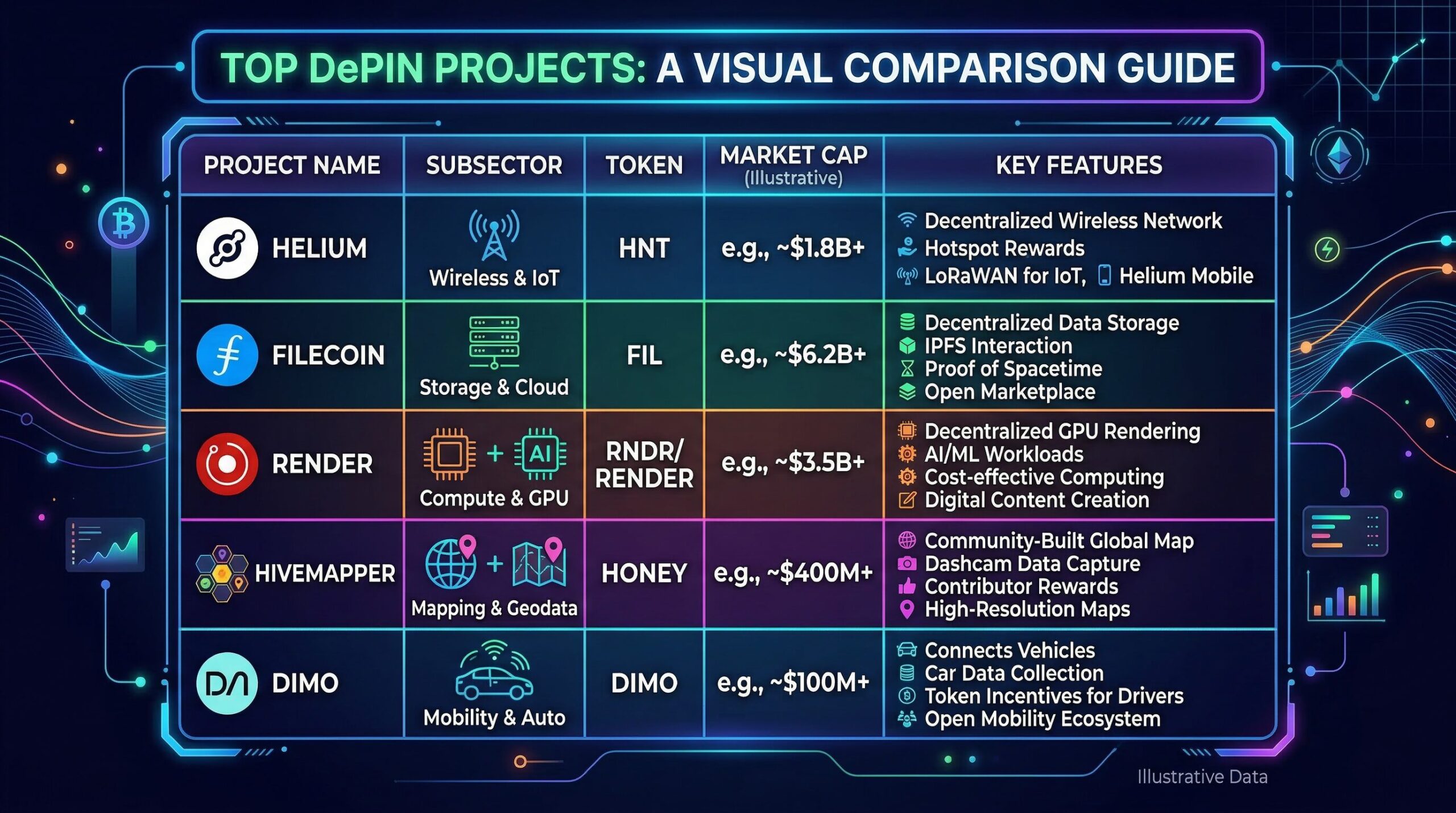
Helium (HNT / MOBILE / IOT): Decentralized Wireless
Helium is the most well-known and longest-running DePIN project. Originally launched in 2019 as a LoRaWAN IoT network, Helium has since expanded to encompass a 5G mobile network and consumer mobile service under the Helium Mobile brand.
In February 2026, Helium Mobile crossed 120,000 active paying subscribers — a dramatic increase from approximately 8,000 when the phone plan launched in late 2024. This makes Helium Mobile one of the fastest-growing Mobile Virtual Network Operators (MVNOs) in the United States. The company offers two plans: a $15 Air Plan (10GB data) and a $30 Infinity Plan (unlimited data), both significantly undercutting legacy carriers.
The network’s economics were strengthened materially in August 2025, when Helium’s third halving reduced new HNT emissions from 15 million to 7.5 million tokens annually. Simultaneously, Helium committed to using 100% of subscriber revenue — approximately $3.4 million in October 2025 alone — to buy and burn HNT, creating a direct deflationary mechanism tied to real consumer adoption.
Helium Plus, launched July 2025, allows businesses to expand the network by contributing existing Wi-Fi routers, removing the hardware barrier for network participation. The network reported over 400,000 active hotspots globally, with expansion into Mexico and Brazil underway in 2026.
HNT traded near $1.50 in early 2026, reflecting a market cap of approximately $282 million. The token’s long-term value is tied directly to subscriber growth — each new subscriber contributes to monthly revenue that burns HNT, tightening supply as demand grows.
Filecoin (FIL): The World’s Largest Decentralized Storage Network
Filecoin launched in 2020 and has grown to become the preeminent decentralized storage network. As of 2026, the network hosts exabyte-scale storage capacity distributed across thousands of independent storage providers worldwide. The 2026 strategy published by the Filecoin Foundation marks a pivotal shift: having successfully built supply-side infrastructure, the ecosystem is now focused exclusively on driving paid, on-chain demand.
The 2025 development cycle delivered four major protocol upgrades (NV24 through NV27), implementing core improvements including FVM optimization, simplified storage provider economics, and reduced gas costs. The Fil+ system distributed over 780 PiB of DataCap cumulatively during 2025.
A major 2025 milestone was the launch of Filecoin Onchain Cloud (FOC), which expanded the network from simple storage provision to a verifiable, programmable cloud services platform. FOC modules include Warm Storage Service, Filecoin Pay (on-chain payment layer), Filecoin Pin (IPFS-compatible storage), and Filecoin Beam (high-speed transfer). The Synapse SDK for developers attracted 17,900 downloads on release.
In 2026, Filecoin is targeting five high-value enterprise verticals: AI agents, DePIN, chain data, real-world assets, and enterprise infrastructure. The intersection of AI compute demand and decentralized storage positions Filecoin as critical infrastructure for the emerging AI-native internet, where training datasets, model archiving, and agent memory layers require verifiable, low-cost persistent storage at scale.
Render Network (RENDER): Decentralized GPU Rendering and AI Compute
Render Network is the world’s first decentralized GPU rendering platform, connecting 3D artists, VFX studios, game developers, and AI labs with idle GPU capacity from a global network of node operators. Since inception, the network has accumulated over 5,600 active GPU nodes worldwide and processed more than 68 million rendered frames — with approximately 35% of all-time frames completed in 2025 alone.
The platform supports industry-leading GPU render engines including OctaneRender, Redshift, and Blender Cycles, alongside integrations with generative AI tools from Runway, Black Forest Labs, Luma Labs, and Stability AI. Monthly throughput reached approximately 1.5 million rendered frames in early 2026.
Render’s migration to the Solana blockchain significantly reduced transaction costs and increased throughput, making smaller rendering jobs economically viable. The network’s expansion into AI inference workloads — beyond traditional rendering — positions it at the intersection of the two fastest-growing compute demand categories of 2026.
Analysts project Render could target $20 per token in 2026 from its ~$3 trading range in early March, based on expanding enterprise adoption and the growing market for GPU cloud services. Gartner projected the GPU cloud market to exceed $90 billion by 2028, a market Render competes in with a decentralized model offering substantially lower costs than AWS or Google Cloud.
io.net (IO): Decentralized AI Compute Infrastructure
io.net positions itself as the decentralized alternative to hyperscaler GPU compute for AI workloads. The network aggregates idle GPU capacity from data centers, crypto miners, and independent operators across 138 countries, providing AI startups and enterprises with instant access to H100, H200, B200, A100, and MI300X GPU clusters at 50–70% lower cost than AWS or GCP on-demand rates.
In 2026, io.net reported more than 320,000 GPUs across its network in 138 countries, over 20 million compute hours delivered, and more than $20 million in annualized on-chain revenue — demonstrating real economic activity beyond speculative token trading. The network uses zkTFLOPs (Proof-of-Contribution) to verify all hardware contributions, ensuring quality assurance before GPU capacity is offered to paying customers.
A key differentiator for io.net in 2026’s AI infrastructure landscape is availability: while hyperscalers maintain 6-month waitlists for NVIDIA Blackwell chips, io.net offers immediate access to equivalent or superior configurations. The network’s hardware versatility — spanning NVIDIA chips and high-VRAM AMD MI300X clusters with 192GB memory — accommodates large-scale Mixture-of-Experts (MoE) training workloads increasingly common in frontier AI development.
Hivemapper (HONEY): Crowdsourced Global Street Mapping
Hivemapper has built one of the most ambitious crowdsourced mapping networks in history. Contributors mount Hivemapper dashcams in their vehicles, which automatically capture street-level imagery as they drive. This data is processed and integrated into the Hivemapper Network’s global map, with contributors earning HONEY tokens proportional to their contribution and the freshness of the data they provide.
The Hivemapper website displays a real-time counter tracking total road kilometers mapped and unique road kilometers mapped. As of early 2026, the network has mapped streets across dozens of countries, providing an alternative to proprietary mapping services for businesses that require fresh, independently verifiable geospatial data.
The key value proposition for enterprise buyers is data freshness: traditional mapping services update imagery infrequently due to the cost of deploying mapping vehicles. Hivemapper’s contributor-driven model enables continuous updates, as contributors drive the same roads repeatedly and upload fresh imagery each time.
HONEY token trades at approximately $0.003 in early 2026, reflecting a small-cap market position appropriate to the project’s stage. The economic model rewards high-frequency contributors in high-traffic urban zones most generously, creating natural incentives for coverage density in the most commercially valuable areas.
Akash Network (AKT): Decentralized Cloud Compute
Akash Network operates as a decentralized marketplace for cloud computing resources, enabling providers to list spare compute capacity and users to bid on it through a reverse auction model. The network runs on the Cosmos blockchain and supports containerized workloads through Kubernetes-compatible deployments.
Akash experienced accelerated growth in 2025 as AI developers sought alternatives to oversubscribed cloud infrastructure. The network’s ability to host machine learning inference workloads, web services, and development environments at costs well below AWS pricing has attracted a growing developer community.
Peaq: The Blockchain for the Machine Economy
Peaq describes itself as the blockchain for the machine economy, providing the infrastructure layer for DePIN applications to launch and scale. Rather than competing with individual DePIN networks, Peaq provides shared services — identity management, access control, payment settlement — that DePIN projects can build on top of. The network hosts over 6 million machine and human addresses and processes over 18 billion data points weekly, reflecting its position as core infrastructure for multiple DePIN verticals.
DePIN Market Size and Investment Landscape in 2026
The DePIN sector exceeded $16 billion in total market capitalization by late 2025, representing substantial growth from a near-zero baseline at the category’s inception. Solana-based DePIN projects hold approximately $3.5 billion in combined market cap, slightly surpassing Ethereum-based DePINs — reflecting Solana’s scalability advantages for real-world data-heavy applications.
Venture capital interest in DePIN has intensified as the sector transitions from concept to demonstrated utility. Projects with measurable real-world metrics — paying subscribers, compute hours delivered, storage deals closed — command premium valuations relative to pure speculation. The maturation of the sector is evidenced by the emergence of vertical-specific DePIN projects targeting precise market niches: high-precision GPS (GEODNET), broadband internet (Dawn Internet), and confidential AI computing (Cocoon).
The investment thesis for DePIN aligns with a broader macro trend: the global infrastructure gap. Traditional infrastructure cannot scale fast enough to meet the demands of AI compute, connected devices, and digital services. DePIN’s crowdsourced model provides a mechanism for deploying global infrastructure at a speed and cost that centralized models cannot match.
How DePIN Compares to Traditional Infrastructure Models
The critical advantage of DePIN over traditional infrastructure is the distribution of capital costs. When AWS builds a new data center region, it makes a multi-billion-dollar bet that demand will materialize. If it doesn’t, the capital is stranded. When io.net or Filecoin onboards new storage providers and GPU contributors, each contributor makes a small independent bet on the network’s growth. The protocol aggregates these small bets into large infrastructure without bearing the capital risk itself.
This model has weaknesses too. DePIN networks must solve the “chicken and egg” problem: contributors won’t join without buyers, and buyers won’t come without contributors. Token incentives bridge this gap in the early stages by subsidizing contributor earnings before organic demand materializes. If demand doesn’t arrive before the subsidies run out, networks can fail. Evaluating whether a DePIN project has genuine demand-side traction — not just speculative token buying — is the central analytical challenge for anyone evaluating these projects.
Quality and Consistency Challenges
Traditional infrastructure providers guarantee service-level agreements backed by contracts, redundancy, and institutional accountability. DePIN networks must replicate this reliability using cryptographic proofs and economic incentives rather than legal agreements. Projects like io.net have addressed this through hardware verification systems that validate GPU performance before onboarding contributors. Filecoin uses Proof of Spacetime to continuously verify that storage providers are actually retaining committed data. These mechanisms work, but require sophisticated protocol design that is still maturing across the sector.
Regulatory Considerations for DePIN in 2026
DePIN projects operate at the intersection of several regulatory domains. Their tokens are subject to securities law scrutiny in many jurisdictions. The hardware contributors may face questions about whether they are operating unlicensed telecommunications services (particularly in the wireless sector). And the data collected by mapping and sensor networks is subject to privacy regulations including GDPR in Europe and various state-level frameworks in the United States.
Regulatory clarity around token classification has improved materially in the United States following legislative progress in 2025, with the distinction between commodity tokens and security tokens becoming more established. This has reduced legal uncertainty for DePIN projects that can demonstrate genuine utility rather than purely investment return characteristics.
In the wireless sector, Helium’s partnership model — combining community hotspots with traditional carrier coverage — has navigated regulatory requirements by operating as a licensed MVNO rather than an unlicensed spectrum operator, a model that has served as a template for other wireless DePIN projects.
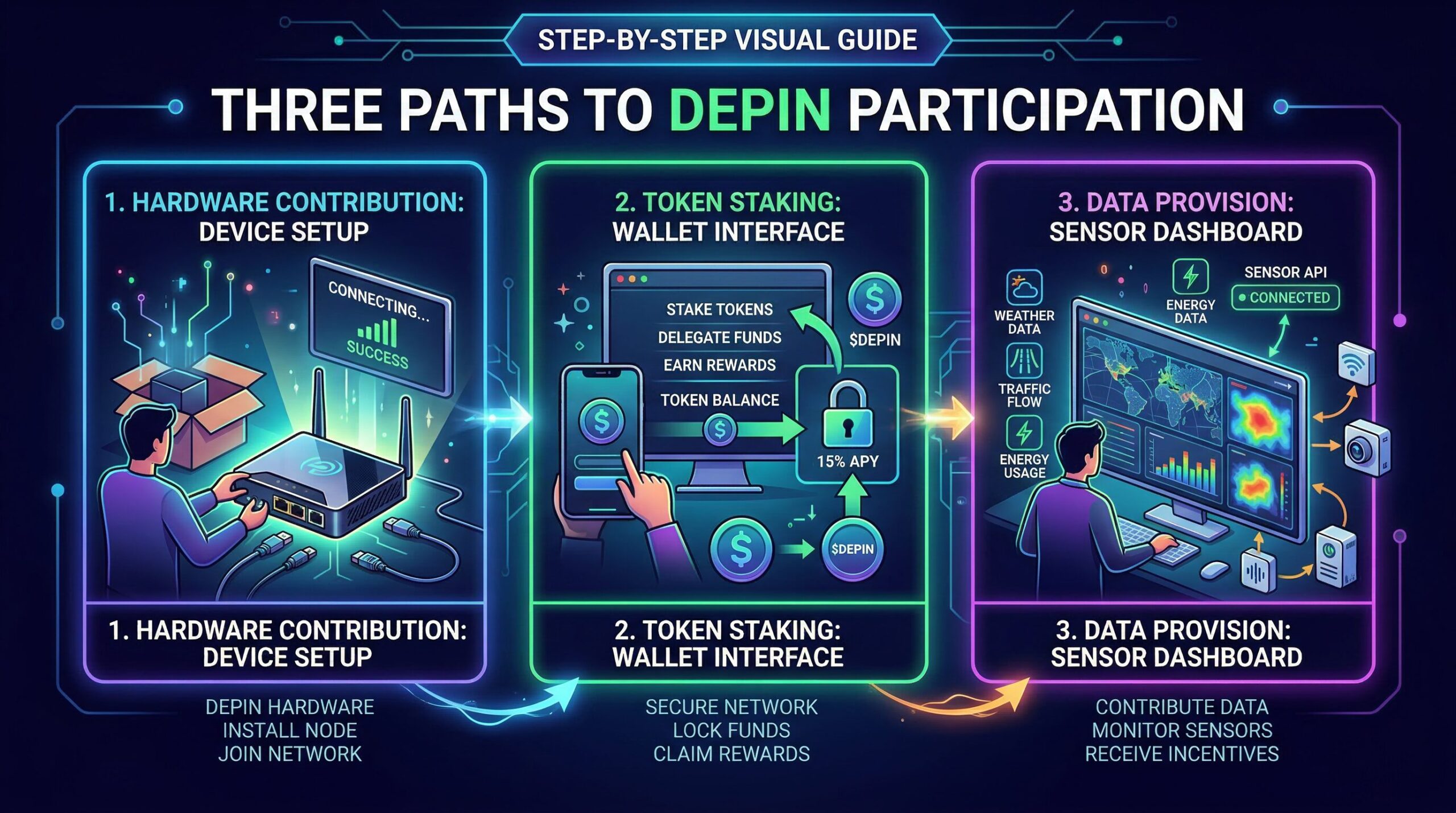
How to Participate in DePIN Networks
As a Hardware Contributor
The most direct way to participate in DePIN is to deploy hardware and earn tokens. Each network has its own hardware requirements and earning dynamics:
- Helium Mobile: Deploy a 5G hotspot in a high-traffic coverage gap. Earnings range from $20–$50 per month in HNT/MOBILE rewards in optimal locations. Check coverage maps before purchasing hardware to identify deployment opportunities.
- Filecoin/Storj: Contribute unused hard drive capacity. Storj has lower entry requirements than Filecoin, making it more accessible for individual contributors with consumer-grade hardware.
- Hivemapper: Purchase a Hivemapper dashcam and drive normally. The dashcam handles all data capture and upload automatically. HONEY earnings depend on road coverage gaps in your area and your driving frequency.
- io.net / Render: Contribute idle GPU capacity from a gaming rig or workstation. ROI depends on GPU model, electricity costs, and network demand. High-VRAM GPUs command premium rates.
As a Token Investor
DePIN tokens can be purchased on major centralized exchanges including Coinbase, Binance, Bybit, and OKX. Key tokens include HNT (Helium), FIL (Filecoin), RENDER (Render Network), IO (io.net), HONEY (Hivemapper), and AKT (Akash Network). These tokens carry the full spectrum of cryptocurrency investment risk and should be evaluated based on network fundamentals — real usage metrics, paying customer counts, revenue growth — rather than speculative narratives alone.
As a Service Buyer
Businesses can consume DePIN services directly. Render Network provides GPU rendering at materially lower cost than traditional cloud providers. Filecoin offers decentralized storage with verifiable data integrity. io.net provides AI compute clusters on demand. Hivemapper provides fresh global street-level imagery through an API. Each service has its own onboarding process, and several support stablecoin payments to insulate buyers from token price volatility.
The Road Ahead: DePIN’s Trajectory Through 2026 and Beyond
The DePIN sector’s fundamental question in 2026 is whether real commercial demand will scale alongside infrastructure supply. The answer is becoming clearer: Helium Mobile’s subscriber growth, Filecoin’s enterprise storage adoption campaign, and io.net’s $20 million in annualized on-chain revenue all represent genuine demand metrics — not just speculative token activity.
The most significant tailwind for DePIN is the AI compute supercycle. The explosive growth of large language models, multimodal AI systems, and autonomous AI agents is creating unprecedented demand for compute, storage, and data infrastructure. Every major AI use case — training models on clean data, running inference at scale, storing model weights and training datasets — maps directly onto DePIN capabilities.
Projects that successfully bridge the gap between crypto-native infrastructure and enterprise-grade reliability will emerge as enduring participants in the global infrastructure landscape. Those that rely on speculative token incentives without building genuine service demand will consolidate or disappear. The sector’s maturation is underway, and the leading projects of 2026 are increasingly distinguished by real metrics, not just roadmap promises.
Frequently Asked Questions About DePIN
What does DePIN stand for?
DePIN stands for Decentralized Physical Infrastructure Network. It refers to blockchain networks that incentivize individuals to deploy and operate real-world hardware — wireless hotspots, storage drives, GPUs, cameras — in exchange for token rewards.
Is DePIN a good investment in 2026?
DePIN tokens carry the same risks as any cryptocurrency investment, plus hardware-specific risks. The strongest investment cases are built on networks with demonstrable real demand: paying subscribers, enterprise service buyers, and measurable usage metrics. Evaluate each project independently based on its fundamentals.
What is the largest DePIN network by market cap?
Filecoin (FIL) is typically the largest DePIN network by market capitalization, followed by Render Network (RENDER) and Helium (HNT). Rankings shift with market cycles, so check current data on CoinMarketCap or CoinGecko for the latest figures.
Can I earn passive income from DePIN?
Yes, hardware contributors earn token rewards for providing capacity to DePIN networks. However, earnings are not truly passive — they require hardware investment, setup, maintenance, and ongoing management. Profitability depends on hardware costs, electricity rates, network demand, and token prices, all of which fluctuate.
What blockchain do most DePIN projects run on?
Solana hosts the largest share of DePIN projects by market capitalization, driven by its low transaction costs and high throughput. Helium migrated to Solana in 2023. Cosmos, Ethereum, and purpose-built DePIN chains (like Peaq) also host significant projects.