
Did the 30% crypto market dip signal a new era? Uncover if it’s just volatility or a fundamental shift to maturity.#CryptoMarket #Blockchain #MarketAnalysis
Quick Video Breakdown: This Blog Article
This video clearly explains this blog article.
Even if you don’t have time to read the text, you can quickly grasp the key points through this video. Please check it out!
If you find this video helpful, please follow the YouTube channel “BlockChainBulletin,” which delivers daily Crypto news.
https://www.youtube.com/@BlockChainBulletins
Read this article in your native language (10+ supported) 👉
[Read in your language]
Autumn Stress Test for the Crypto Market: A Correction or a New Market Paradigm?
Jon: Hey Lila, I came across this intriguing piece on CryptoSlate about the autumn stress test hitting the crypto market. It’s titled “Autumn stress test for the crypto market: A correction or a new market paradigm,” and it’s penned by Volodymyr Nosov from WhiteBIT. Essentially, it dives into the recent market dip— we’re talking a nearly 30% correction since early October, wiping out about $1.2 trillion in market cap. The big question is whether this is just a temporary pullback or the start of a fundamental shift in how the crypto market operates.
Lila: Whoa, that sounds intense. A 30% drop? I’ve seen crypto volatility before, but this feels like more than the usual rollercoaster. Why does this matter, Jon? Is it something investors—er, observers—should be worried about?
Jon: Great question, Lila. It matters because crypto isn’t just about quick gains anymore; it’s evolving into a more mature ecosystem. This “stress test” is like the market shaking off excesses from the post-halving hype. Bitcoin hit highs around $125,000, but now it’s retracing, testing structural supports. Nosov argues it could signal a new paradigm where fundamentals like adoption and regulation take center stage over speculation. No hype here—it’s a reminder that markets cycle, and understanding the why helps in navigating them objectively.
Lila: Okay, that makes sense. But let’s break it down further. What’s the core problem this stress test is exposing?
Jon: At its heart, the problem is the tension between rapid growth and sustainability in crypto. We’ve seen explosive rallies driven by ETF approvals, institutional inflows, and tech advancements, but without solid foundations, it leads to overvaluation. This autumn dip is stressing the market’s resilience—think of it like a bridge under heavy traffic. If the structure is weak, cracks appear. In crypto terms, that’s high leverage, meme coin frenzies, and uneven liquidity causing cascading sell-offs.
Lila: Bridge under traffic? I get that—too much weight without reinforcements, and it buckles. But can you clarify how this applies to crypto specifically? Is it just about prices dropping, or something deeper?
Jon: Deeper, definitely. Imagine the crypto market as a bustling highway system. During bull runs, traffic (investor money) surges, but if the roads (infrastructure like exchanges, blockchains, and regulations) aren’t upgraded, jams and accidents happen. This correction is exposing bottlenecks: over-leveraged positions getting liquidated, ETF redemptions spiking, and even blockchain scalability issues under load. It’s not doom and gloom; it’s a test of whether the market has matured beyond the wild west phase. For instance, Bitcoin’s retrace from $125K is hitting prior support zones, forcing a reevaluation of long-term demand versus short-term hype.
Lila: Ah, so it’s like checking if the highway can handle rush hour without collapsing. That analogy helps—it’s about structural integrity, not just speed.
Under the Hood: How it Works
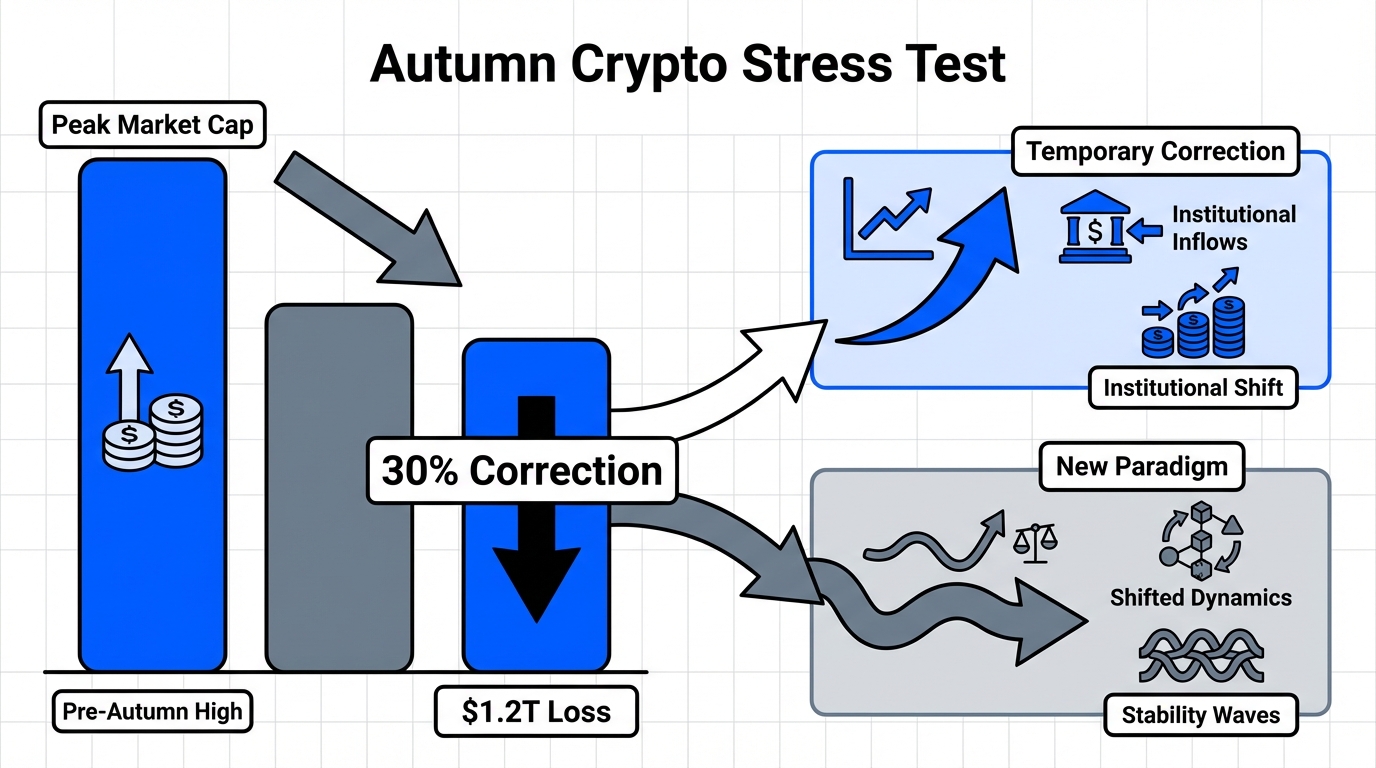
Jon: Exactly, Lila. Now, let’s peel back the layers on how this market stress test actually plays out mechanically. At the core, crypto markets operate on supply-demand dynamics amplified by blockchain tech and decentralized finance (DeFi). This correction isn’t random; it’s a response to macro factors like interest rates, regulatory shifts, and on-chain metrics. For example, Bitcoin’s halving cycles historically lead to bull runs, but post-2024 halving, we’re seeing a “structural stress test” where price retraces test key levels, like the $85K support mentioned in recent analyses.
Lila: On-chain metrics? That’s jargon—break it down for me. Like, how does the blockchain itself reveal if this is a correction or a paradigm shift?
Jon: Sure thing. On-chain metrics are data points directly from the blockchain, such as transaction volumes, active addresses, and hash rates. In a correction, you might see short-term sell pressure from profit-taking, but if long-term holders (HODLers) stay put, it signals strength. A new paradigm would involve shifts like increased institutional adoption or regulatory clarity, making crypto more like traditional finance. Think of it as upgrading from a dirt road to a paved highway—smoother, but still prone to potholes.
Lila: Got it. So, to compare, how does this stack up against past crypto cycles?
Jon: Good point. Let’s table that out for clarity.
| Aspect | Past Corrections (e.g., 2018, 2022) | 2025 Autumn Stress Test |
|---|---|---|
| Trigger | ICO busts, regulatory crackdowns, overhyping | Post-halving hype fade, ETF outflows, macro economic pressures |
| Market Cap Drop | 80-90% from peaks | Around 30% so far, more contained |
| Recovery Signs | Halving events, tech innovations | Structural maturity, institutional inflows, on-chain demand |
| Potential Outcome | Prolonged bear markets | Shift to new paradigm with stabilized volatility |
Jon: As you can see, this 2025 dip feels different—less catastrophic, more like a maturation phase. Under the hood, mechanisms like Bitcoin’s proof-of-work consensus ensure network security during stress, while Ethereum‘s upgrades (like Dencun) improve scalability, potentially reducing future volatility.
Lila: That table really helps visualize it. So, it’s not all bad; it could be building a stronger foundation.
Jon: Precisely. Now, extending that, the token mechanics in play here involve things like supply halvings and burning mechanisms in altcoins, which can act as shock absorbers.
Lila: Shock absorbers—nice. Like in a car, softening the bumps.
Jon: Yep. For Bitcoin, the halving reduces new supply, theoretically supporting prices long-term. In a stress test, if demand holds (via metrics like realized cap), it points to a paradigm where crypto is valued for utility over speculation.
Lila: So who actually uses this? I mean, beyond traders, what are the real-world applications emerging from this stress test?
Jon: Fair question. On the developer side, this environment is pushing for robust DeFi protocols that withstand volatility—think lending platforms like Aave, where users can borrow against crypto assets with minimized liquidation risks. Technically, it benefits from smart contracts that automate interest rates based on supply-demand, providing stability.
Lila: So developers build more resilient apps?
Jon: Yes, and for users, it’s about everyday applications like cross-border payments via stablecoins, which remain steady even in market dips. Institutions are using it for treasury management, hedging against fiat inflation. The technical benefit is decentralization— no single point of failure, unlike traditional banks during financial crises.
Lila: That sounds practical. Not just hype, but actual utility.
Jon: Exactly. Another use case: blockchain in supply chains, where transparency helps during economic stress. Companies like IBM’s Food Trust use it to track goods, reducing fraud and inefficiencies.
Lila: Cool. So if someone’s interested in learning more without jumping in headfirst, what’s a good action plan?
Jon: Let’s structure that. Start with Level 1: Research and Observation. Dive into whitepapers—Bitcoin’s is a classic read for understanding halvings. Use explorers like Blockchain.com to track on-chain data, or dashboards on Dune Analytics for market metrics. It’s about observing patterns, like how holder behavior changes during corrections.
Lila: That seems low-risk. What about hands-on? Level 2?
Jon: For Level 2, experiment on testnets. Ethereum’s Sepolia testnet lets you simulate transactions without real money—great for understanding gas fees and smart contracts during simulated stress. Tools like Remix IDE allow coding simple contracts. Emphasize: this is for learning mechanics, not speculation. Risks remain in real networks, so stick to test environments.
Lila: Perfect—safe way to get a feel for it.
Jon: To wrap up, this autumn stress test could indeed mark a shift to a new market paradigm, where crypto’s value stems from real adoption and tech maturity. Limitations persist—volatility, regulatory uncertainties, and scalability hurdles.
Lila: Yeah, and remember, markets are unpredictable. Volatility is inherent, so approach with caution and continuous learning.
Jon: Well said. It’s an evolving space worth watching thoughtfully.