
Crypto market dips affecting your portfolio? Unpack Bitcoin, Ethereum, and NFT declines. Learn about options expiry and key regulations.
—#CryptoNews #BlockchainMarket #MarketAnalysis
—
Quick Video Breakdown: This Blog Article
This video clearly explains this blog article.
Even if you don’t have time to read the text, you can quickly grasp the key points through this video. Please check it out!
If you find this video helpful, please follow the YouTube channel “BlockChainBulletin,” which delivers daily Crypto news.
https://www.youtube.com/@BlockChainBulletins
Read this article in your native language (10+ supported) 👉
[Read in your language]
Understanding Today’s Crypto and Blockchain News: Impacts on Technology and Regulation
Jon: Today’s developments in the crypto and blockchain space highlight ongoing challenges in market stability and infrastructure, especially during periods of low activity like holidays. These events matter for society because they reveal how blockchain networks handle volatility, influencing trust in decentralized systems for real-world applications like payments or data storage. It’s a reminder of the importance of robust regulations to protect users from excessive risks.
Lila: That makes sense, Jon. As someone new to this, I’m concerned about how these dips affect everyday people or developers building on these platforms. Can you break it down without the hype?
Bitcoin Dips Below $88K Amid Broad Market Pullback and Thin Holiday Trading
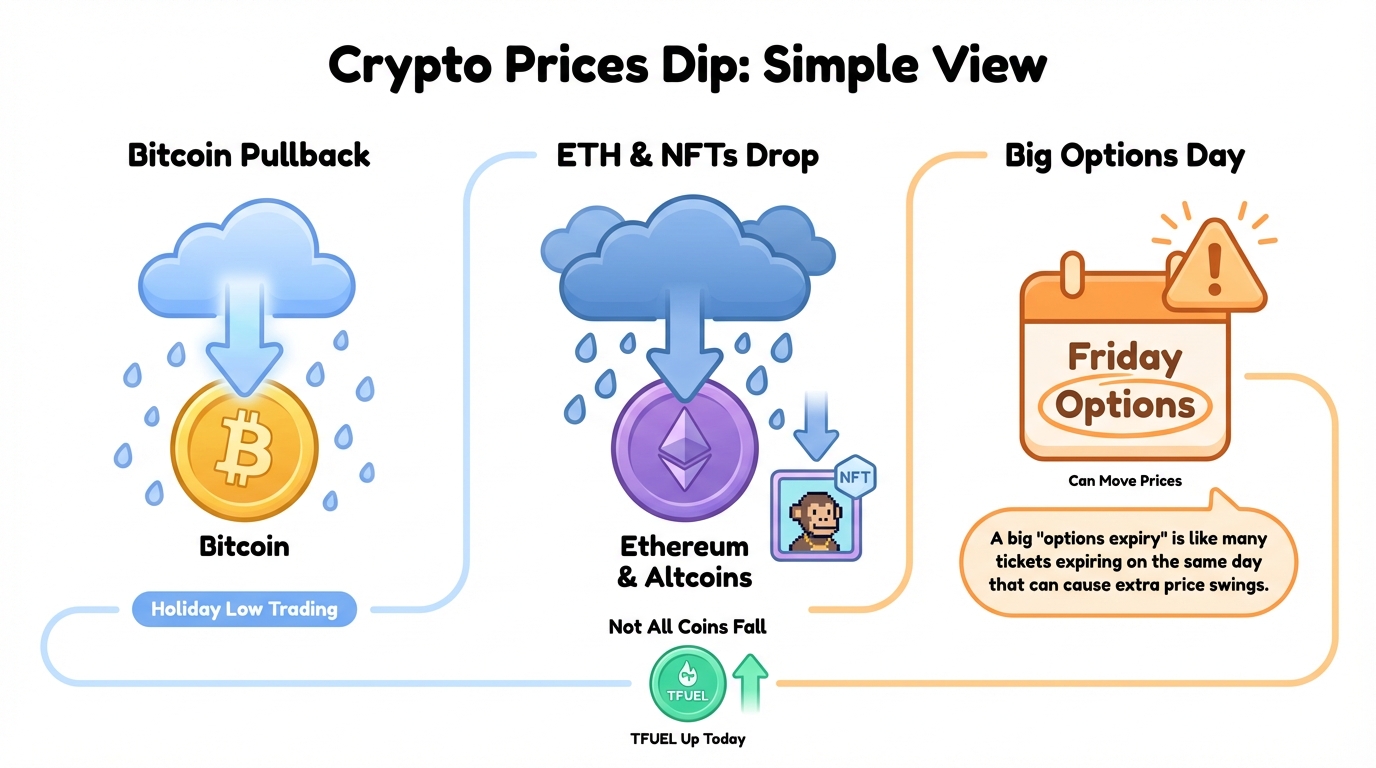
Jon: Based on recent reports, Bitcoin has dipped below $88,000, trading around $87,000 after a roughly 1% decline over the past 24 hours. This is part of a broader market pullback, with the total cryptocurrency market capitalization now at about $3.06 trillion, down 2.4%. Fact-checking against current sources like CoinDesk and CryptoNews, this aligns with reduced trading volumes during the holiday season, where lower liquidity can amplify price movements. Bitcoin operates on a proof-of-work consensus mechanism, where miners solve complex puzzles to validate transactions and secure the network. It’s a layer-1 blockchain, meaning it’s the base layer without relying on others for scaling.
Lila: Proof-of-work sounds energy-intensive. So, is this dip just a short-term thing due to holidays, or does it point to bigger issues?
Jon: It’s largely tied to thin trading volumes, which make the market more volatile without changing Bitcoin’s core fundamentals, like its fixed supply of 21 million coins. From a governance perspective, Bitcoin’s decentralized nature means no central authority controls it, but regulatory scrutiny increases during volatility, as governments monitor for potential market manipulation. For users, this could mean higher risks in transactions during low-liquidity periods; developers might see it as a test of network resilience. Societally, it underscores the need for better education on blockchain’s volatility risks, which are significant and uncertain.
Lila: In plain terms, if I’m a user sending Bitcoin, does this change anything right now?
Jon: Not fundamentally—the network still processes transactions securely. But with lower volumes, fees might fluctuate, and price swings could affect value transfer. Important: Cryptocurrency involves significant risks, including volatility and potential loss. This doesn’t alter Bitcoin’s long-term infrastructure for digital scarcity, but it highlights the importance of regulatory frameworks to ensure fair markets.
Ethereum and Altcoins Lead Declines, NFT Sector Down Over 9%
Jon: Ethereum has dropped about 1.5% to around $2,930, leading declines among altcoins, with the NFT sector seeing over 9% losses. Tokens like certain meme coins have fallen sharply, up to 12% or more. Verifying with sources like CryptoNews and Yahoo Finance, this reflects a market-wide correction, not isolated issues. Ethereum uses a proof-of-stake consensus, where validators stake coins to secure the network, making it more energy-efficient than proof-of-work. It’s a layer-1 blockchain but relies heavily on layer-2 solutions like Arbitrum or Optimism, which are secondary networks built on top to improve speed and reduce costs.
Lila: NFTs are non-fungible tokens, right? Like unique digital collectibles on the blockchain. Why are they hit harder?
Jon: Yes, NFTs represent ownership of unique items, stored on blockchains like Ethereum. The steeper decline might stem from their speculative nature and lower liquidity. Governance-wise, Ethereum’s community-driven upgrades, like the recent proof-of-stake shift, aim for better scalability, but regulatory bodies are watching NFTs for issues like intellectual property rights. For users, this could mean reduced activity in digital art or gaming ecosystems; developers face challenges in building scalable apps during downturns. Societally, it raises questions about the real-world utility of NFTs beyond speculation, emphasizing risks and the need for clear regulations.
Lila: So, what changes for someone exploring DeFi on Ethereum? DeFi is decentralized finance, like lending without banks.
Jon: DeFi protocols on Ethereum might see lower total value locked due to caution, but the underlying tech remains intact. Important: Always remember, these systems carry technical and financial uncertainties. This event tests Ethereum’s layer-2 integrations, potentially pushing for more adoption of efficient scaling to benefit users and developers long-term.
Record $28B Bitcoin and ETH Options Expiry Looms Friday, Adding Caution
Jon: A record $28.5 billion in Bitcoin and Ethereum options are set to expire on December 26, 2025, on platforms like Deribit. This is contributing to current market caution, as per CoinDesk reports. Options are derivatives allowing bets on price without owning the asset. Bitcoin’s proof-of-work and Ethereum’s proof-of-stake aren’t directly affected, but these centralized exchanges highlight contrasts with decentralized finance options. Both are layer-1 chains, but this event involves off-chain trading.
Lila: Options expiry sounds like a deadline for contracts. How does this tie into blockchain tech?
Jon: It can cause volatility as traders adjust positions, indirectly impacting spot markets. Governance implications include regulatory oversight of derivatives to prevent systemic risks, similar to traditional finance rules. For users, it might mean temporary price swings affecting wallet values; developers could see increased interest in on-chain derivatives for more transparency. Societally, it illustrates the growing intersection of crypto with financial systems, underscoring the need for robust regulations to mitigate uncertainties.
Lila: Does this change how people should approach crypto during holidays?
Jon: It adds a layer of caution due to potential volatility spikes. Important: Such events highlight the inherent risks in crypto markets. Overall, it doesn’t alter the blockchains’ core functions but tests market infrastructure resilience.
Top Gainers Emerge: Theta Fuel Up 8.76% Amid Bear Dominance
Jon: Amid widespread declines, Theta Fuel (TFUEL) rose about 8.76%, per CoinCodex. Theta Network is a blockchain for video streaming, using proof-of-stake. It’s a layer-1 with a focus on decentralized content delivery. TFUEL handles payments for resources like bandwidth.
Lila: So, while most are down, this one is up. What’s the consensus mechanism here?
Jon: Proof-of-stake, where users stake tokens to participate in validation. Governance is community-led, with potential regulatory focus on its utility in media. For users, it could mean better access to decentralized video; developers benefit from specialized infrastructure. Societally, it shows blockchain’s potential for real-world utility in content distribution, but risks remain high.
Lila: What does this change practically?
Jon: It highlights selective resilience, encouraging exploration of niche blockchains. Important: Always approach with caution due to market uncertainties.
| Topic | Impact | Relevance |
|---|---|---|
| Bitcoin Dip Below $88K | Tests network resilience in low liquidity | Highlights volatility risks and regulatory needs for stable digital infrastructure |
| Ethereum and Altcoins Declines | Affects ecosystem activity, especially NFTs | Emphasizes scaling solutions and governance for broader adoption |
| $28B Options Expiry | Potential for increased volatility | Shows integration with finance, calling for regulatory oversight |
| Theta Fuel Gain | Demonstrates niche utility resilience | Points to blockchain’s role in media, with focus on real-world applications |
Jon: Overall, these stories point to a trend of market caution amid holidays, testing blockchain infrastructures without major protocol changes. Long-term, they emphasize the need for stronger regulations and technological improvements for sustainable adoption.
Lila: Thanks, Jon. This reinforces why we should learn about these technologies responsibly and do our own research, aware of the risks and regulations.
👨💻 Author: SnowJon
A researcher sharing practical insights on Web3 and AI based on academic study and real-world observation.
His focus is on translating complex technologies into clear, responsible explanations for a general audience.
*AI tools may assist drafting, but all factual verification and editorial judgment are performed by the author.*
⚠️ Risk & Education Notice
Cryptocurrency and blockchain technologies involve legal, technical, and financial risks.
This article is provided strictly for educational and informational purposes and does not constitute financial advice.
Readers are encouraged to conduct independent research and comply with local laws and regulations.