
Wondering about crypto‘s wild ride? Market dips hit BTC & ETH, but major regulatory wins are reshaping its future in finance.#CryptoMarket #BlockchainNews #CryptoRegulation
Quick Video Breakdown: This Blog Article
This video clearly explains this blog article.
Even if you don’t have time to read the text, you can quickly grasp the key points through this video. Please check it out!
If you find this video helpful, please follow the YouTube channel “BlockChainBulletin,” which delivers daily Crypto news.
https://www.youtube.com/@BlockChainBulletins
Read this article in your native language (10+ supported) 👉
[Read in your language]
Daily Crypto Update: Navigating Market Shifts and Regulatory Wins in a Volatile World
Hey there, curious minds! Imagine waking up to find that the digital money world, which powers everything from online payments to futuristic finance, is buzzing with changes that could affect how we all handle money in the future. Today’s big trend? A mix of market dips driven by global economic vibes and a major regulatory nod that’s bringing crypto closer to traditional banking. Why does this matter to you? Well, as more everyday folks dip their toes into digital assets for things like faster payments or secure savings, understanding these shifts can help you see how tech is reshaping finance—without the hype. Remember, though, cryptocurrency involves high risks, including potential losses due to volatility. If you’re researching projects, tools like Genspark can help summarize the latest info quickly.
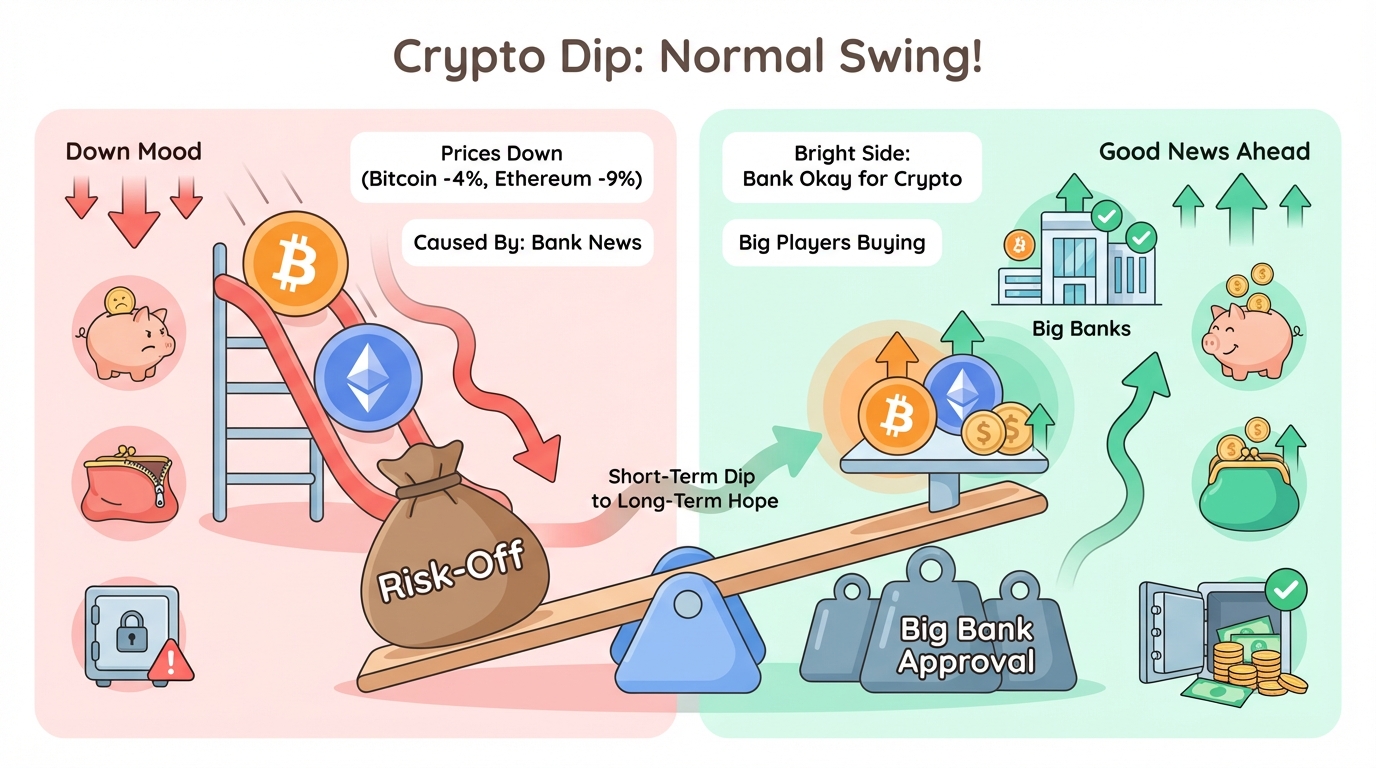
Bitcoin and Ethereum Lead Sharp Market Pullback as Risk-Off Mood Returns
Jon: Hey Lila, let’s break down this recent market dip in crypto. Overnight, we saw Bitcoin slide about 4-5%, dipping below $90,000, while Ethereum dropped closer to 9-10%, hitting the low $3,100s. This pulled a lot of other digital assets down too. It’s not some big crypto-specific drama; it feels more like a reaction to broader economic worries, like jitters in tech stocks and upcoming central bank decisions.
Lila: Whoa, that sounds intense for beginners like me. So, why is this happening now? And what does it mean for the tech behind these coins?
Jon: Great questions! Think of it like a stock market ripple affecting everything. No single event in crypto caused this—it’s macro stuff, like concerns over AI profits dragging down tech stocks, which crypto often mirrors. Bitcoin’s still secured by its proof-of-work system, where computers solve puzzles to validate transactions, keeping the network strong with hash rates near all-time highs. That core tech hasn’t changed; it’s the short-term trading that’s volatile. For Ethereum, which uses proof-of-stake (where holders ‘stake’ coins to secure the network instead of mining), the validator count keeps growing, showing more adoption. But price-wise, $3,000 is becoming a key level traders watch—it’s like a psychological line in the sand.
Lila: Okay, proof-of-work and proof-of-stake sound like different ways to keep the blockchain honest. But how does this affect real people or adoption?
Jon: Exactly! These mechanisms ensure transactions are secure and decentralized, which is huge for utility—like using Bitcoin for cross-border payments without banks, or Ethereum for smart contracts that automate agreements. The dip ties into central banks like the ECB, Bank of Japan, and Bank of England having meetings soon. If they signal tighter policies, it could mean less money flowing into risky assets like crypto. We’ve seen outflows from Bitcoin and Ethereum ETFs (exchange-traded funds that let people invest without holding the coins directly), while Solana ETFs are seeing inflows, hinting at institutions eyeing it for its fast, low-cost blockchain tech.
Lila: So, even in a dip, some smart players are buying? That’s interesting. Is there on-chain data showing this?
Jon: Yep, on-chain metrics (data directly from the blockchain) show long-term holders staying put, while short-term traders are selling. For Ethereum, big ‘whale’ addresses are accumulating more, which could support prices long-term due to its utility in DeFi (decentralized finance, like lending without banks) and restaking for yields. But remember, this volatility highlights the high risks—prices can swing wildly. If you’re curious about coding smart contracts on Ethereum, check out Nolang for an AI tutor to learn basics.
Lila: Got it. So, the ‘so what’ is that while prices fluctuate, the underlying tech for security and adoption keeps advancing?
Jon: Spot on. Watch levels like Bitcoin at $95,000 support and Ethereum at $3,000. This isn’t about speculating; it’s about how these networks could integrate into everyday finance, but always with caution due to risks.
U.S. OCC’s Conditional Banking Green Light for Ripple, Circle, Paxos, BitGo and Fidelity Reshapes the Regulatory Map
Jon: Shifting gears, Lila, this is a game-changer on the regulation front. The U.S. Office of the Comptroller of the Currency (OCC) just gave conditional banking approval to big names like Ripple, Circle, Paxos, BitGo, and Fidelity’s crypto arm. This pulls crypto infrastructure into the traditional banking world, potentially boosting trust and adoption.
Lila: Banking approval for crypto companies? That sounds like blending old-school finance with new tech. What does it actually mean?
Jon: Think of it as crypto getting a ‘grown-up’ license. These firms handle things like stablecoins (digital dollars pegged 1:1 to real USD, like USDC from Circle) or custody (safely storing assets, like BitGo does for Bitcoin). Now, they’ll operate under banking rules—strict oversight on reserves, risks, and operations. Ripple’s XRP, which uses a federated consensus (a way multiple nodes agree on transactions without full mining), can now integrate better with payment systems. Fidelity brings brokerage services, making it easier for institutions to handle crypto.
Lila: So, no change to the blockchain tech itself, but more rules to build trust?
Jon: Precisely. The tech stays the same—stablecoins are still ERC-20 tokens on Ethereum (a standard for fungible assets), secured by proof-of-stake. But now, they’re backed by bank-like standards, which could mean easier adoption for things like tokenized real-world assets (RWAs), like turning bonds into digital tokens for faster trading. This narrows the gap between crypto and banks, reducing regulatory arbitrage where some players skirt rules.
Lila: Any pushback? And how does this impact utility?
Jon: Yeah, traditional banks are wary, especially with Ripple, fearing it blurs lines on what’s a security vs. a payment tool. Meanwhile, enforcement is cracking down on scams, like recent charges in a big Ponzi scheme. For utility, this could speed up tokenization—imagine tokenized Treasuries on blockchain for efficient yields. Winners are compliant players; losers are unregulated ones. If you’re documenting this for a whitepaper or report, Gamma can help create quick presentations.
Lila: Cool, so regulation is key for mainstream adoption, but still risky?
Jon: Absolutely. It confirms tokenization as core plumbing for future finance, but crypto’s volatility and regulatory changes add high risks. This could lead to a two-tier system: regulated, KYC’d (know-your-customer) finance and permissionless innovation.
| Top Story | Key Highlight | Impact Focus |
|---|---|---|
| Market Pullback in Bitcoin & Ethereum | Prices dipped to below $90K (BTC) and $3,100s (ETH) due to macro factors. | Highlights network security and adoption trends amid volatility risks. |
| OCC Banking Approvals | Green light for Ripple, Circle, etc., integrating crypto with banking oversight. | Boosts trust, utility in payments and tokenization, but with regulatory scrutiny. |
In wrapping up, today’s news shows crypto’s evolving landscape—market dips remind us of the high risks tied to global economics, while regulatory wins pave the way for safer adoption in tech like blockchains and stablecoins. It’s all about utility and innovation, but always do your own research (DYOR) to understand these technologies. For automating your learning workflows, like setting up news alerts, try Make.com.

👨💻 Author: SnowJon (Web3 & AI Practitioner / Investor)
A researcher who leverages knowledge gained from the University of Tokyo Blockchain Innovation Program to share practical insights on Web3 and AI technologies. While working as a salaried professional, he operates 8 blog media outlets, 9 YouTube channels, and over 10 social media accounts, while actively investing in cryptocurrency and AI projects.
His motto is to translate complex technologies into forms that anyone can use, fusing academic knowledge with practical experience.
*This article utilizes AI for drafting and structuring, but all technical verification and final editing are performed by the human author.
⚠️ IMPORTANT RISK WARNING
Cryptocurrency investments are highly volatile and high-risk. You could lose your entire investment. Past performance is not indicative of future results. This content is for educational and informational purposes only and does NOT constitute financial advice. Always do your own research (DYOR) before making any decisions.
🛑 Affiliate Disclaimer
This article contains affiliate links. Tools mentioned are based on current information. Use at your own discretion.
▼ Recommended Tools for Research & Productivity
- 🔍 Genspark: An AI agent that saves you research time by summarizing search results.
- 📊 Gamma: Create beautiful presentations and docs in seconds just by typing.
- 🎥 Revid.ai: Turn your text or blogs into viral short videos instantly.
- 👨💻 Nolang: Learn coding or any topic by chatting with an AI tutor.
- ⚙️ Make.com: Automate boring tasks by connecting your favorite apps.