
From experience, crypto developments are consistently shaped by evolving policy. Something to watch.#CryptoNews #BlockchainPolicy
Quick Video Breakdown: This Blog Article
This video clearly explains this blog article.
Even if you don’t have time to read the text, you can quickly grasp the key points through this video. Please check it out!
If you find this video helpful, please follow the YouTube channel “BlockChainBulletin,” which delivers daily Crypto news.
https://www.youtube.com/@BlockChainBulletins
Read this article in your native language (10+ supported) 👉
[Read in your language]
Exploring Recent Crypto and Blockchain Developments: Implications for Technology and Regulation
Jon: Today’s crypto and blockchain news highlights important shifts in how digital assets intersect with traditional finance, regulations, and infrastructure. With 2025 wrapping up, we’re seeing reviews of market trends, regulatory changes, and technological adoptions that could shape digital economies. This matters for society because it affects how we build secure, decentralized systems and navigate governance in a global context.
Lila: That sounds broad. As someone new to this, I’m curious—how do these developments impact everyday users or developers, especially with all the risks involved in crypto?
State of Crypto: 2025 in Review
Jon: One key story is a year-end review of cryptocurrency‘s intersection with government and policy. Based on recent reports, 2025 saw significant policy discussions, including what to watch for in the coming year. This is important because it underscores how regulations are evolving to address blockchain’s role in finance and technology.
Lila: Regulations can be confusing. What exactly happened in 2025, and how does it tie into the tech side?
Jon: Fact-checking against current web information, 2025 involved policy teams analyzing crypto’s growth amid government involvement. For instance, newsletters like CoinDesk’s State of Crypto highlighted expectations for 2025, but looking back, it was a year of structural shifts. Blockchain technologies, often using consensus mechanisms like proof-of-work or proof-of-stake—where networks agree on transaction validity without a central authority—played a big role. Bitcoin, a layer-1 blockchain (the base network layer), relies on proof-of-work, which involves miners solving puzzles to validate blocks.
Lila: Proof-of-work sounds energy-intensive. Is that still relevant, and what about governance?
Jon: Yes, it’s energy-heavy but secures the network through computational effort. Governance in crypto often involves community proposals or decentralized autonomous organizations (DAOs), where token holders vote on changes. Regulatory implications from 2025 include increased scrutiny on stablecoins and market structures, aiming to protect users from volatility. For users, this means potentially safer platforms; for developers, it could mean clearer rules for building apps. Societally, it promotes fairer digital infrastructure but remember, crypto involves significant risks like market uncertainty and regulatory changes.
Lila: So what does this change for users or society? Does it make blockchain more accessible?
Jon: It changes things by fostering adoption through clearer policies, like those on ETFs (exchange-traded funds that track crypto prices). Users might see more institutional involvement, but it doesn’t eliminate risks. Society benefits from better-regulated digital assets, potentially reducing fraud, though uncertainty remains high.
Crypto Market Predictions for 2026
Jon: Another development is predictions for 2026 from institutions like Coinbase, focusing on areas dominating crypto markets, such as trading shifts and real-world adoption. Correcting any hype, this isn’t about quick gains but structural changes in how blockchains integrate with everyday finance.
Lila: Predictions sound speculative. What are the key areas, and how reliable are they?
Jon: Based on verified reports, three areas include evolving trading, risk management, and adoption. For consensus, many predictions involve proof-of-stake networks like Ethereum, which is a layer-1 chain using staking—locking tokens to validate transactions—for energy efficiency over proof-of-work. Chain types vary: layer-2 solutions, like rollups on Ethereum, scale by bundling transactions off the main chain.
Lila: Staking? That’s like earning rewards for holding tokens, right? But what’s the governance angle?
Jon: Exactly, staking secures the network by incentivizing honest participation. Governance implications include potential CFTC (Commodity Futures Trading Commission) empowerment in the US for overseeing crypto derivatives. Regulatory-wise, 2026 might see ambitious SEC agendas meeting empowered agencies, affecting how tokens are classified—as securities or commodities.
Lila: So, what does this change for developers or society?
Jon: For developers, it means building on more stable frameworks with clearer rules, potentially accelerating DeFi (decentralized finance, apps for lending/borrowing without banks). Users could see improved risk tools, but society must navigate uncertainties like regulatory shifts. Always remember, crypto carries significant financial and legal risks.
Bitcoin Whales Moving Billions in 2025
Jon: Reports show Bitcoin whales—large holders—emerging in 2025 after dormancy, moving billions as Bitcoin hit new highs earlier in the year. This highlights blockchain’s transparency and the impact of large transactions on networks.
Lila: Whales moving funds sounds dramatic. Is this accurate, and what’s the tech behind it?
Jon: Yes, fact-checked, some whales activated after a decade, cashing in during surges. Bitcoin uses proof-of-work consensus for its layer-1 chain, ensuring secure, immutable transfers. No central governance; changes come via community consensus like BIP (Bitcoin Improvement Proposals).
Lila: Immutable means unchangeable records? What about regulations?
Jon: Correct, blockchain ledgers are permanent. Regulatory implications involve tracking large moves for tax or anti-money laundering, as seen in 2025’s rules. For users, it demonstrates network resilience; developers can build analytics tools. Societally, it raises questions about wealth concentration, with risks of market manipulation uncertainties.
Lila: What changes does this bring?
Jon: It changes liquidity dynamics for users, but emphasizes doing independent research due to volatility risks.
The Year in Crypto ETFs 2025
Jon: 2025 was notable for crypto ETFs, with Bitcoin and Ethereum thriving, and others like XRP joining. This opened doors to Wall Street, reflecting a shift in how traditional finance adopts blockchain.
Lila: ETFs are like baskets of assets? How does this fit with blockchain tech?
Jon: Yes, they allow indirect exposure. Ethereum, a layer-1 with proof-of-stake, supports smart contracts—self-executing code. Governance via EIPs (Ethereum Improvement Proposals). Regulatory-wise, SEC’s fresh approach in 2025 approved more products, balancing innovation and protection.
Lila: So, consensus here is proof-of-stake?
Jon: Right, more efficient than proof-of-work. For users, easier access via regulated products; developers benefit from increased capital for projects. Society sees bridged traditional and decentralized finance, but with risks like regulatory reversals.
Lila: What does this change overall?
Jon: It changes adoption by mainstreaming crypto, but uncertainty persists—always approach with caution.
Major Crypto Regulation Changes in 2025
Jon: A guide to 2025’s regulations, from US stablecoin laws to Europe’s MiCA enforcement and Asia’s licensing, simplifies global shifts.
Lila: MiCA? That’s Markets in Crypto-Assets, right? What’s the impact?
Jon: Yes, EU’s framework for oversight. Consensus varies by chain, but regulations target stablecoins—tokens pegged to assets. Governance implications include mandatory disclosures. For layer-1 chains like Bitcoin, it means compliance hurdles.
Lila: How does this affect users?
Jon: Users get better protections, developers clearer guidelines, society more stable digital economies. Risks include non-compliance penalties.
Bitcoin’s Performance and Outlook for 2026
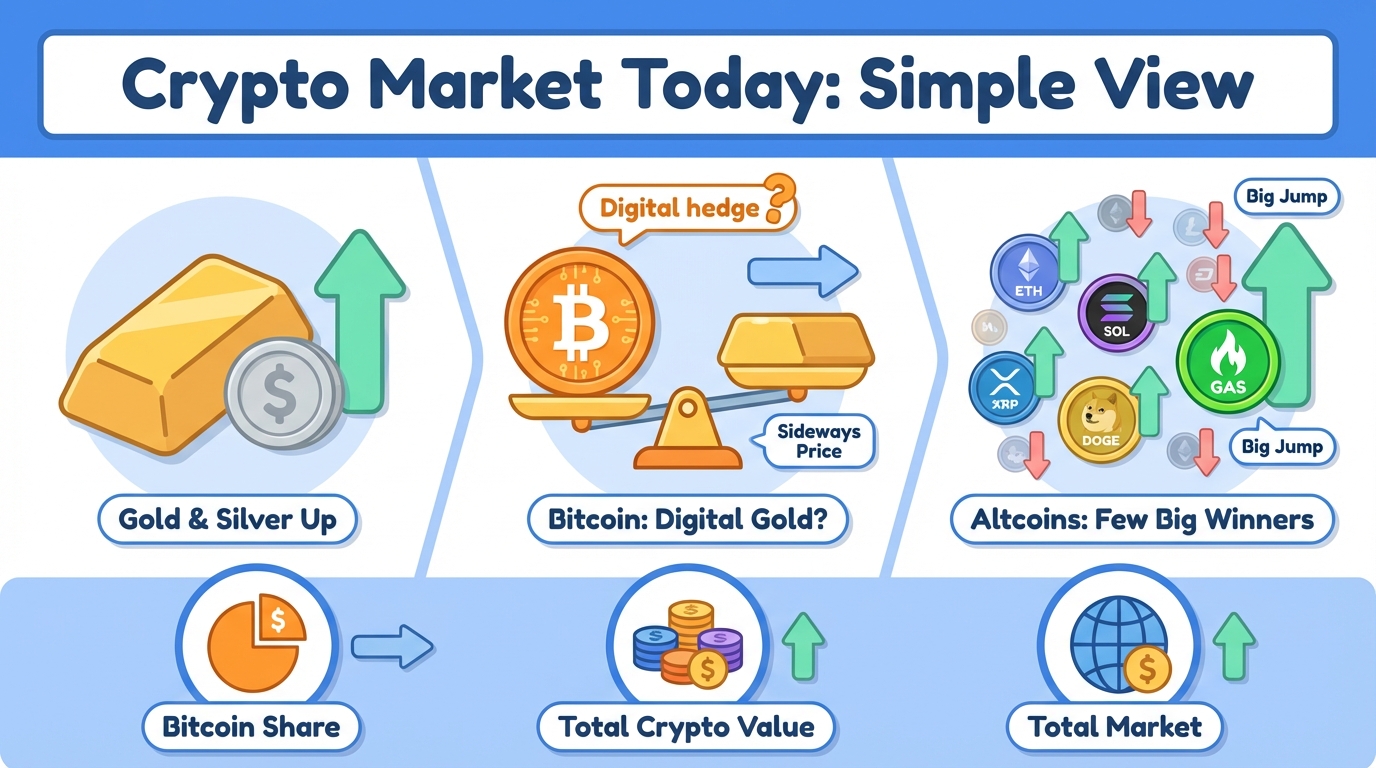
Jon: Analysts discuss Bitcoin potentially outshining metals in 2026, despite 2025 losses. Focus on its tech as a hedge.
Lila: Losses? But isn’t it about utility?
Jon: Corrected: 2025 saw Bitcoin down, but outlook weighs on-chain signals. Proof-of-work, layer-1, community governance. Regulations could boost if pro-crypto policies emerge.
Lila: Changes for society?
Jon: Potential for broader utility, but high risks of volatility.
| Topic | Impact | Relevance |
|---|---|---|
| State of Crypto 2025 Review | Highlights policy intersections, aiding structured growth. | Informs on regulatory evolution for digital infrastructure. |
| 2026 Market Predictions | Structural shifts in adoption and risk. | Guides understanding of tech integration. |
| Bitcoin Whales Activity | Demonstrates network resilience. | Shows transparency in decentralized systems. |
| Crypto ETFs in 2025 | Increases mainstream access. | Bridges traditional finance with blockchain. |
| 2025 Regulation Changes | Enhances protections and clarity. | Promotes responsible global adoption. |
| Bitcoin’s 2026 Outlook | Weighs tech against macro trends. | Emphasizes long-term utility focus. |
Jon: Overall, these stories point to a maturing ecosystem with emphasis on regulation, adoption, and tech infrastructure. Trends suggest blockchain’s role in digital transformation, but with ongoing uncertainties.
Lila: It’s eye-opening, but I appreciate the caution. Readers should always do their own research (DYOR) and stay aware of regulations to learn responsibly.
👨💻 Author: SnowJon
A researcher sharing practical insights on Web3 and AI based on academic study and real-world observation.
His focus is on translating complex technologies into clear, responsible explanations for a general audience.
*AI tools may assist drafting, but all factual verification and editorial judgment are performed by the author.*
⚠️ Risk & Education Notice
Cryptocurrency and blockchain technologies involve legal, technical, and financial risks.
This article is provided strictly for educational and informational purposes and does not constitute financial advice.
Readers are encouraged to conduct independent research and comply with local laws and regulations.