Personally, the rise in crypto crime proves we need stronger off-ramp security protocols.#CryptoCrime #BlockchainSecurity
Quick Video Breakdown: This Blog Article
This video clearly explains this blog article.
Even if you don’t have time to read the text, you can quickly grasp the key points through this video. Please check it out!
If you find this video helpful, please follow the YouTube channel “BlockChainBulletin,” which delivers daily Crypto news.
https://www.youtube.com/@BlockChainBulletins
Read this article in your native language (10+ supported) 👉
[Read in your language]
Crypto Crime Soared to $154 Billion in 2025 as Russia, North Korea, and Iran Exploit Blockchain Tech
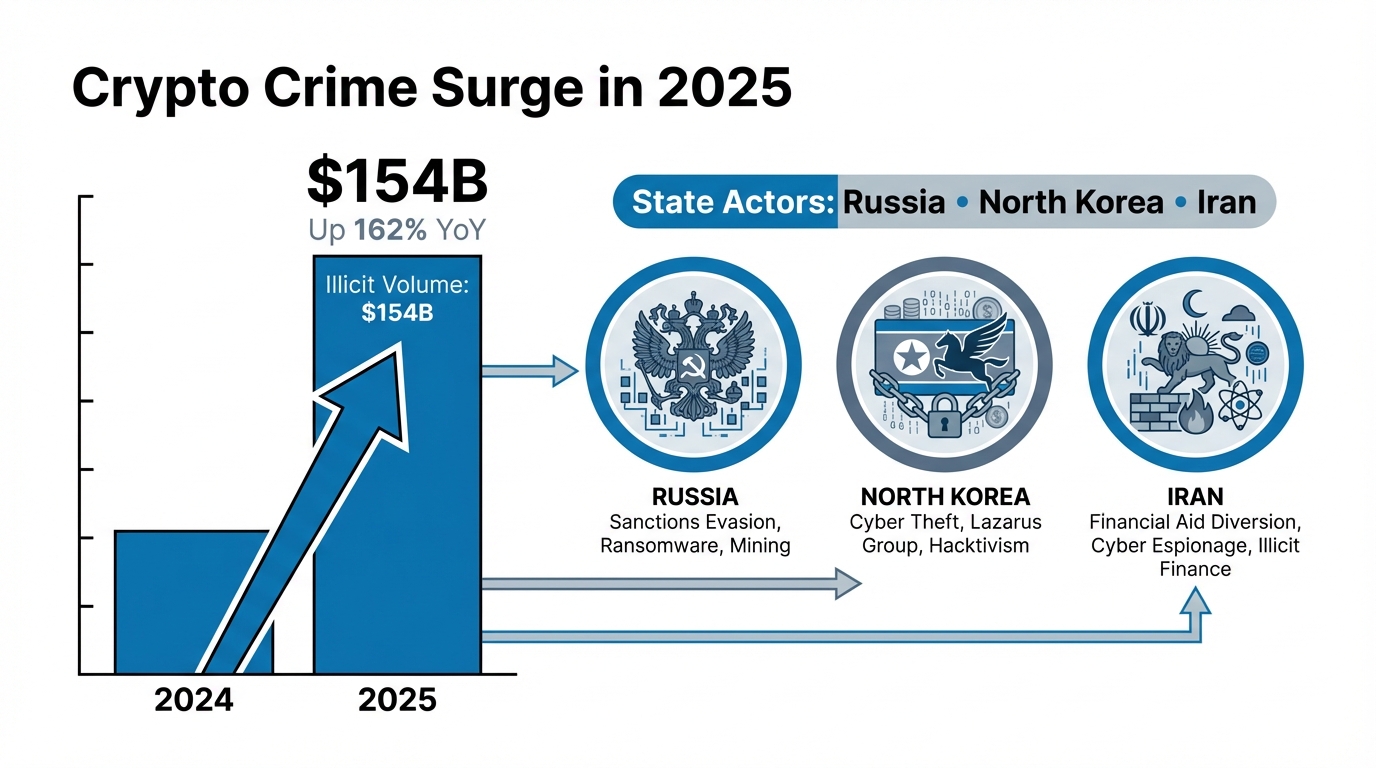
Jon: Hey Lila, I just came across this eye-opening report from Bitcoin Magazine. It turns out crypto crime hit a staggering $154 billion in 2025, up 162% from the previous year. Nations like Russia, North Korea, and Iran are increasingly exploiting blockchain technology for illicit activities, from hacking to sanctions evasion.
Lila: Whoa, that’s a massive number. It sounds alarming—I’ve been hearing more about crypto’s dark side lately. Can you break it down a bit? What’s the high-level story here?
Jon: Absolutely. According to the report, illicit addresses received at least that $154 billion, driven largely by state actors. North Korean hackers alone stole over $2 billion in crypto, using sophisticated methods to fund their operations. Russia and Iran are turning to stablecoins for evading sanctions, with a 694% increase in crypto flows to sanctioned entities. It’s not just petty theft; it’s professionalized crime networks offering “laundering-as-a-service” on the blockchain.
Lila: Why does this matter? Beyond the headlines, what’s the bigger picture for everyday users or the crypto ecosystem?
Jon: Great question. This surge highlights blockchain’s double-edged sword: its transparency and pseudonymity make it a tool for innovation, but also for exploitation. It matters because it could lead to stricter regulations, affect adoption, and underscore the need for better security practices. Plus, understanding these exploits helps us appreciate the tech’s vulnerabilities without the hype. It’s a reminder that while blockchain promises decentralization, bad actors are always innovating too—witty, isn’t it? Like thieves using the bank’s own vault to hide their loot.
Jon: The core problem here is how blockchain’s inherent features—immutability, pseudonymity, and global accessibility—are being weaponized. State actors like those from North Korea are hacking centralized exchanges, stealing funds, and then laundering them through mixers or stablecoins. Russia and Iran use crypto to bypass traditional financial sanctions, moving value across borders without oversight.
Lila: That makes sense, but can you clarify how that’s even possible? Isn’t blockchain supposed to be secure?
Jon: It is secure in many ways, but the weak links are often the human or centralized elements. Think of it like a city’s plumbing system: the pipes (blockchain) are sturdy and transparent, but if someone tampers with the access points (exchanges or wallets), they can divert the flow. For instance, North Korean hackers target centralized services with massive breaches, like the $1.4 billion Bybit hack, then use on-chain tools to obscure the trail. It’s not the blockchain breaking; it’s the off-ramps and entry points being exploited.
Lila: Okay, the plumbing analogy helps—it’s about the connections, not the core tech. So, why are stablecoins becoming the go-to for this?
Jon: Stablecoins like USDT and USDC offer stability and liquidity, making them perfect for cross-border crime. They’re like digital cash in a global economy—easy to move, hard to trace without advanced analytics. Reports show they’re now powering most illicit activities, eclipsing Bitcoin.
Under the Hood: How it Works
Jon: Let’s dive into the mechanics. At its core, blockchain exploitation often involves hacking into systems to steal crypto, then using on-chain techniques to launder it. For example, North Korean groups use advanced phishing or malware to breach exchanges, extract private keys, and transfer funds to controlled wallets. From there, they employ mixers—services that pool and redistribute coins to break traceability—or bridge to other chains for added obscurity.
Lila: So, it’s like shuffling cards in a deck to hide the ace? But how do stablecoins fit in technically?
Jon: Exactly. Stablecoins are pegged to fiat like the USD, issued on blockchains like Ethereum or Tron. Criminals convert stolen volatile crypto into stablecoins for stability, then use them for payments or sanctions evasion. Architecturally, this exploits blockchain’s smart contracts and decentralized exchanges (DEXs), where trades happen without KYC.
Lila: Got it. To confirm, is this different from traditional money laundering?
Jon: Yes, and here’s a quick comparison to make it clear.
| Aspect | Traditional Money Laundering | Blockchain Exploitation |
|---|---|---|
| Speed | Slow, involves banks and physical assets | Near-instant transfers across borders |
| Traceability | Relies on paper trails and oversight | Pseudonymous but analyzable; mixers obscure |
| Actors | Mostly individuals or cartels | State-sponsored groups like North Korea |
| Tools | Shell companies, cash businesses | Stablecoins, DEXs, cross-chain bridges |
| Detection | AML regulations in banks | Chain analysis tools like Chainalysis |
Jon: As you can see, blockchain adds efficiency for criminals, but it also provides a permanent ledger for investigators.
Lila: So who actually uses this? I mean, beyond the bad actors—who benefits from understanding these mechanics in a positive way?
Jon: Fair point. On the flip side, developers and security experts use this knowledge to build better defenses. For instance, blockchain analytics firms like Chainalysis track illicit flows, helping law enforcement recover funds. Users can apply it to secure their own wallets—think multi-signature setups or hardware devices to prevent hacks. Technically, it’s about leveraging the same transparency: explorers like Etherscan let anyone monitor transactions, which is great for auditing DeFi protocols or verifying supply chains.
Lila: That sounds practical. Are there enterprise use cases?
Jon: Absolutely. Governments and banks are exploring blockchain for secure, traceable international payments to counter evasion tactics. Developers might integrate on-chain monitoring in apps for fraud detection. The key benefit is resilience—understanding exploits leads to stronger protocols, like zero-knowledge proofs for privacy without enabling crime.
Jon: If you’re interested in learning more without risks, start with Level 1: Research and Observation. Dive into reports from sources like Chainalysis or 38 North. Use blockchain explorers like Blockchair or Etherscan to observe transaction patterns—search for known illicit addresses and see how funds move. Read whitepapers on stablecoins (e.g., Tether’s docs) to understand their mechanics objectively.
Lila: That seems straightforward. What about hands-on? How can someone try this safely?
Jon: For Level 2: Testnet and Hands-on Learning, experiment on testnets. For example, use Ethereum’s Sepolia testnet to simulate transactions with fake ETH. Tools like Remix IDE let you deploy simple smart contracts to see how bridges or mixers work in theory. Focus on learning security—practice with wallets like MetaMask on testnets to understand private key management. Remember, this is for education; always prioritize safety and never use real funds for experiments.
Lila: Good advice—keeps it low-risk.
Jon: To wrap up, this $154 billion surge in crypto crime underscores blockchain’s potential and pitfalls. It’s an opportunity to innovate in security and regulation, but limitations like evolving exploits and geopolitical tensions remain.
Lila: True, and let’s not forget the volatility and uncertainty in crypto. It’s fascinating tech, but approach with caution and continuous learning.
Jon: Exactly—stay informed, stay secure.
References & Further Reading
- Crypto Crime Soared to $154 Billion in 2025 as Russia, North Korea, and Iran Exploit Blockchain Tech
- 2026 Crypto Crime Report Introduction – Chainalysis
- From Digital Kleptocracy to Rogue Crypto-Superpower – 38 North
- Russia and Iran Turning to Crypto Stablecoins for Sanctions Evasion – Fortune
▼ AI tools to streamline research and content production (free tiers may be available)
Free AI search & fact-checking
👉 Genspark
Recommended use: Quickly verify key claims and track down primary sources before publishing
Ultra-fast slides & pitch decks (free trial may be available)
👉 Gamma
Recommended use: Turn your article outline into a clean slide deck for sharing and repurposing
Auto-convert trending articles into short-form videos (free trial may be available)
👉 Revid.ai
Recommended use: Generate short-video scripts and visuals from your headline/section structure
Faceless explainer video generation (free creation may be available)
👉 Nolang
Recommended use: Create narrated explainer videos from bullet points or simple diagrams
Full task automation (start from a free plan)
👉 Make.com
Recommended use: Automate your workflow from publishing → social posting → logging → next-task creation
※Links may include affiliate tracking, and free tiers/features can change; please check each official site for the latest details.