
Personally, CME futures for altcoins signals a major shift in institutional access and maturity.#CME #CryptoDerivatives
Quick Video Breakdown: This Blog Article
This video clearly explains this blog article.
Even if you don’t have time to read the text, you can quickly grasp the key points through this video. Please check it out!
If you find this video helpful, please follow the YouTube channel “BlockChainBulletin,” which delivers daily Crypto news.
https://www.youtube.com/@BlockChainBulletins
Read this article in your native language (10+ supported) 👉
[Read in your language]
Crypto Futures Legitimized by CME with Cardano, Chainlink, and Stellar Addition, but Retail Traders Face a Massive Catch
Jon: Hey Lila, have you seen the latest from CME Group? They’re expanding their crypto derivatives lineup by adding futures for Cardano (ADA), Chainlink (LINK), and Stellar (XLM). It’s set to launch on February 9, 2026, pending regulatory approval. This comes right after a surge in crypto trading volumes at CME, with daily contracts hitting around 278,300. It’s a big step for institutional access to these altcoins.
Lila: Oh, interesting. I’ve been following crypto news, but CME futures sound like a finance thing. What’s the high-level scoop here? And why Cardano, Chainlink, and Stellar specifically?
Jon: Exactly. CME Group is the world’s largest derivatives exchange, known for regulated products like Bitcoin and Ether futures. Now, they’re bringing in ADA, LINK, and XLM in both standard and micro sizes. This means institutions can hedge or speculate on these assets in a compliant way, without directly holding the coins. It’s like betting on the price without owning the underlying asset. For context, Chainlink’s been steady in the oracle space, Cardano focuses on scalable blockchain research, and Stellar is all about cross-border payments. But here’s the witty part: while this “legitimizes” them for big players, retail traders might hit a wall—high barriers like account minimums and complex regulations could keep everyday folks on the sidelines.
Lila: Why does this matter? Is it just another way for Wall Street to dip into crypto, or is there more to it for the broader ecosystem?
Jon: Great question. It matters because futures can bring liquidity and price discovery to these tokens. For instance, when Bitcoin futures launched on CME back in 2017, it signaled mainstream acceptance. Now, with these altcoins, it could attract more institutional money, potentially stabilizing prices over time. But the “massive catch” for retail? These products are geared toward pros—think minimum contract sizes that might be too hefty for small investors. It’s educational to note that while spot trading on exchanges is accessible, futures add layers of leverage and risk. Worth watching how this evolves, but always remember, crypto’s volatile nature means risks remain high.
Lila: Okay, that sets the stage. But let’s dig into the problem this addresses. What’s the underlying issue in crypto that makes something like CME futures a big deal?
Jon: The core problem in crypto is the gap between unregulated, wild-west spot markets and the need for regulated, institutional-grade tools. Many altcoins like ADA, LINK, and XLM trade on decentralized exchanges or platforms with varying oversight, leading to price manipulation risks, low liquidity for big trades, and barriers for traditional finance players. Institutions want to participate without the hassles of custody, security, or compliance headaches. Enter CME futures: they provide a bridge, but not without trade-offs.
Lila: That sounds abstract. Can you break it down with an analogy? Like, how does this “gap” play out in real terms?
Jon: Sure, think of it like traffic in a bustling city. The spot crypto markets are like chaotic downtown streets—full of scooters (retail traders), bikes (day traders), and occasional trucks (whales) zipping around without much regulation. Accidents happen, traffic jams form due to low liquidity, and it’s hard for big delivery vans (institutions) to navigate without causing a scene. CME futures are like building a high-speed highway alongside it: regulated lanes with speed limits, tolls, and safety barriers. Institutions can cruise efficiently, hedging risks or speculating, but retail drivers might find the tolls too expensive or the on-ramps too complex. It smooths flow for big players, potentially reducing overall congestion, but doesn’t fix the downtown chaos entirely. Wittily put, it’s legitimizing the crypto commute, but don’t expect free parking for everyone.
Lila: Haha, that analogy clicks—crypto’s downtown is exciting but risky. So, how do these futures actually solve or address that gap technically?
Under the Hood: How it Works
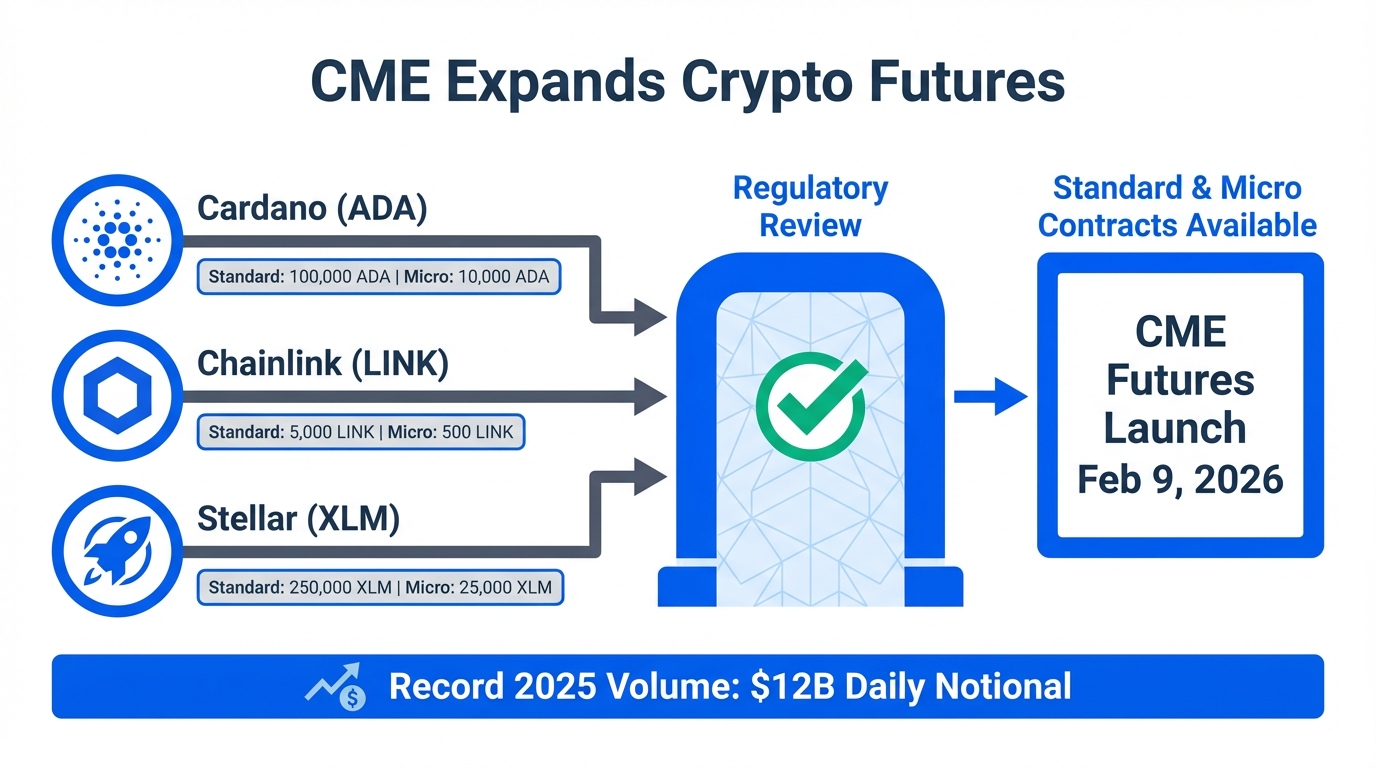
Jon: Alright, let’s peel back the layers. At its core, a futures contract is an agreement to buy or sell an asset at a predetermined price on a future date. For these crypto ones, CME bases them on reference rates—like the CME CF Cardano-Dollar Reference Rate for ADA—which aggregate prices from major exchanges to prevent manipulation. No actual tokens are exchanged; it’s cash-settled, meaning profits or losses are paid in fiat. This is key for institutions avoiding direct crypto custody. Cardano’s futures tie into its proof-of-stake blockchain, where ADA is used for staking and governance. Chainlink provides decentralized oracles for real-world data feeds, so LINK futures could hedge against oracle network volatility. Stellar, with XLM, focuses on fast, low-cost transactions, making its futures appealing for payment-focused hedging.
Lila: Got it, so it’s not about owning the crypto but betting on its price. Can you rephrase the mechanics for someone new to derivatives?
Jon: Absolutely. Imagine you’re a farmer (institution) promising to sell wheat (crypto price exposure) at a fixed price later. If the market price rises, you might lose out, but it locks in certainty. CME offers standard contracts (e.g., 1,000 ADA per contract) and micro ones (smaller lots for finer control). Trading happens 24/7 on their platform, with margins required—say, 50% of the contract value upfront. The witty twist: while this adds legitimacy, it’s like giving crypto a suit and tie, but the underlying volatility is still there, ready to spill coffee on it.
Lila: Makes sense. How do these compare to existing crypto futures, like Bitcoin’s?
Jon: Good point. Let’s compare them side by side to highlight differences.
| Aspect | Bitcoin/Ether CME Futures | New ADA/LINK/XLM CME Futures |
|---|---|---|
| Launch Maturity | Established since 2017/2021, high liquidity | New in 2026, building liquidity |
| Underlying Focus | Store of value (BTC), smart contracts (ETH) | Scalable PoS (ADA), oracles (LINK), payments (XLM) |
| Contract Sizes | Standard and micro available | Standard and micro, e.g., Micro LINK at 0.1 LINK |
| Retail Accessibility | Limited by regs and costs | Even more gated for retail due to altcoin niche |
| Risk Profile | High volatility, leveraged | Similar, plus altcoin-specific risks like adoption |
Jon: As you can see, the new futures build on the BTC/ETH model but cater to specialized ecosystems. It’s not revolutionary architecture-wise, but it integrates crypto into traditional finance plumbing.
Lila: So who actually uses this? I mean, beyond institutions, what’s the real-world application?
Jon: Fair question. Primarily, hedge funds and asset managers use these for portfolio diversification—hedging against price swings in DeFi or payment protocols. Developers building on Cardano might watch ADA futures to gauge market sentiment for their dApps. For Chainlink, oracles are crucial for smart contracts needing external data, so LINK futures could help oracle providers manage token volatility. Stellar’s focus on remittances means banks or fintechs could use XLM futures to lock in rates for cross-border flows. Technically, this enhances price discovery, making it easier to build reliable financial products on these chains. The benefit is stability for ecosystems, not quick profits—think long-term infrastructure over short-term hype.
Lila: That emphasizes the tech side. If someone’s interested in learning more without jumping into trading, what’s a good action plan?
Jon: Let’s structure it educationally. Start with Level 1: Research and Observation. Dive into official docs—Cardano’s whitepaper explains Ouroboros proof-of-stake, Chainlink’s site details decentralized oracle networks, and Stellar’s developer portal covers its consensus protocol. Use explorers like CardanoScan or StellarExpert to observe real-time transactions without any commitment. Track price charts on CME’s website to understand how futures reference rates work. It’s all about building knowledge passively.
Lila: Sounds safe. What about Level 2—something hands-on but low-risk?
Jon: For hands-on learning, experiment on testnets. Cardano has a public testnet where you can stake fake ADA and build simple smart contracts using tools like Plutus. Chainlink offers testnet oracles to simulate data feeds in your code. Stellar’s testnet lets you play with payment simulations. Emphasize: this is for understanding mechanics, like testing a car’s engine in a garage before hitting the road. No real money involved, so risks are minimal—perfect for grasping how these tokens function in their native environments.
Lila: Helpful. Wrapping up, what’s the big picture here?
Jon: In summary, CME’s addition of ADA, LINK, and XLM futures is a nod to crypto’s maturation, offering regulated tools that could boost adoption. It highlights the strengths of these projects—scalability for Cardano, data reliability for Chainlink, efficient payments for Stellar. Limitations? Volatility persists, regulatory hurdles for retail, and it’s not a guarantee of success. Worth watching as it unfolds in 2026.
Lila: Totally. Remember, crypto prices can swing wildly, and nothing’s certain. Approach with curiosity, not expectations.
Jon: Well said. Let’s keep exploring thoughtfully.
References & Further Reading
- Crypto futures legitimized by CME with Cardano, Chainlink, and Stellar addition, but retail traders face a massive catch
- CME Group Official Site
- Cardano Official Site
- Chainlink Official Site
- Stellar Official Site
▼ AI tools to streamline research and content production (free tiers may be available)
Free AI search & fact-checking
👉 Genspark
Recommended use: Quickly verify key claims and track down primary sources before publishing
Ultra-fast slides & pitch decks (free trial may be available)
👉 Gamma
Recommended use: Turn your article outline into a clean slide deck for sharing and repurposing
Auto-convert trending articles into short-form videos (free trial may be available)
👉 Revid.ai
Recommended use: Generate short-video scripts and visuals from your headline/section structure
Faceless explainer video generation (free creation may be available)
👉 Nolang
Recommended use: Create narrated explainer videos from bullet points or simple diagrams
Full task automation (start from a free plan)
👉 Make.com
Recommended use: Automate your workflow from publishing → social posting → logging → next-task creation
※Links may include affiliate tracking, and free tiers/features can change; please check each official site for the latest details.