
Personally the CLARITY Act seeks to unify fragmented rules under a single federal framework.#CLARITYAct #DeFi
Quick Video Breakdown: This Blog Article
This video clearly explains this blog article.
Even if you don’t have time to read the text, you can quickly grasp the key points through this video. Please check it out!
If you find this video helpful, please follow the YouTube channel “BlockChainBulletin,” which delivers daily Crypto news.
https://www.youtube.com/@BlockChainBulletins
Read this article in your native language (10+ supported) 👉
[Read in your language]
Decoding the CLARITY Act: Washington’s Push to Reshape Crypto Regulation
Jon: Hey Lila, have you caught wind of this new crypto bill making waves in Washington? It’s called the CLARITY Act, and it’s heading for a markup in January 2026. The headline from CryptoSlate puts it bluntly: it would strip states of some regulatory power and essentially ban certain oversight that targets front-end manipulation in crypto projects.
Lila: Morning, Jon. Yeah, I saw that article pop up in my feed. It sounds big, but I’m not entirely sure what it means for the average person in Web3. Can you break it down at a high level?
Jon: Sure thing. At its core, the CLARITY Act is a proposed federal bill aimed at creating a clearer regulatory framework for cryptocurrencies and decentralized finance (DeFi). Right now, crypto operates in a patchwork of rules where federal agencies like the SEC and CFTC overlap with state-level regulations. This bill would preempt some state powers, meaning the feds take the lead, especially in areas like DeFi. It carves out exemptions for decentralized protocols, potentially making it harder for states to crack down on things like manipulative user interfaces in apps. According to reports, it’s set to limit state oversight that often catches front-end tricks—think misleading UI designs that could deceive users without touching the underlying blockchain code.
Lila: Why does this matter? Isn’t more regulation a good thing for protecting users?
Jon: It matters because the crypto space has been stuck in regulatory limbo for years. Developers and projects face uncertainty—will a token be deemed a security? Can states sue over a DEX’s interface? The CLARITY Act aims to provide, well, clarity, by shifting more control to federal bodies like the CFTC for spot markets and adding anti-manipulation rules. But it’s not all smooth sailing; critics worry it might let some shady practices slip through by banning state-level checks on front-ends. On the flip side, it could boost innovation in DeFi by reducing the fear of fragmented state lawsuits. As of early 2026, with the bill delayed from last year, it’s gaining bipartisan momentum, but hard questions remain unresolved, like how to handle DeFi governance risks.
Lila: Okay, that high-level view helps. But let’s dig into the problem this is trying to solve. What’s the real issue with the current setup?
Jon: The problem boils down to regulatory overlap and inconsistency. Imagine the crypto world as a busy highway system where states set their own speed limits and road rules, while the federal government tries to enforce overarching traffic laws. A DeFi project might comply with federal securities rules but get hit with a state lawsuit over how its app displays information—say, a “front-end manipulation” where the interface hides risks or exaggerates rewards. This creates a chilling effect: developers hesitate to innovate because one state’s attorney general could shut them down. The CLARITY Act proposes to streamline this by preempting state authority in certain areas, focusing oversight on the backend code and core mechanics rather than user-facing designs.
Lila: That analogy makes sense—like having national highways where local towns can’t randomly add tolls. But can you clarify what “front-end manipulation” really means here? Is it just bad UI, or something more sinister?
Jon: Exactly, good catch. Front-end manipulation refers to tactics where the user interface of a crypto app or platform might mislead users—for instance, burying fee disclosures or making risky trades look like sure bets. States have used consumer protection laws to target these, but the bill would legally ban such oversight in favor of federal rules. It’s like shifting from local plumbing inspectors checking every faucet to a national standard that only cares about the main pipes. The upside? More freedom for DeFi to experiment. The downside? Potential for more user-facing scams if federal enforcement lags.
Lila: Got it. So, this is addressing a structural mess in regulation. Now, how does the CLARITY Act actually propose to fix it?
Under the Hood: How it Works
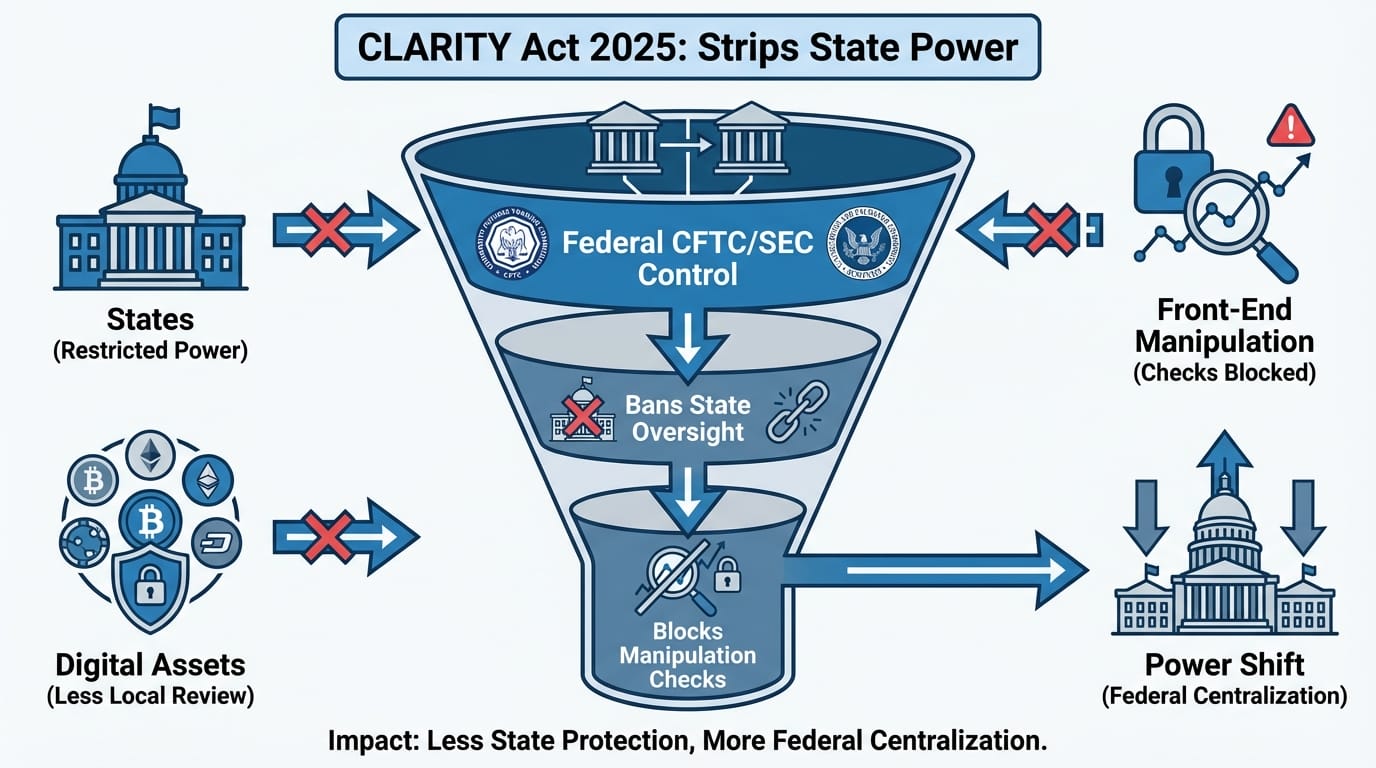
Jon: Alright, let’s peel back the layers. The CLARITY Act isn’t just a bill; it’s a comprehensive attempt to redefine crypto market structure. At its heart, it divides oversight between the SEC for securities-like tokens and the CFTC for commodities-like spot markets. For DeFi, there’s a carve-out: if a protocol is truly decentralized—meaning no central control over the smart contracts—states can’t interfere with front-end aspects. This means things like UI hosts or apps built on top of the protocol get more leeway, as long as the underlying blockchain isn’t manipulated.
Lila: So, it’s like separating the engine (blockchain) from the dashboard (UI). But how does that play out in practice?
Jon: Precisely. The bill introduces anti-manipulation provisions for secondary markets, requiring disclosures for trust-building, but it delays some rulemaking, creating uncertainty. For example, launching a DEX today might require state filings and UI compliance checks. Under CLARITY, you’d focus on code integrity, with liquidity pools remaining permissionless. However, if insiders control governance, risks persist. To illustrate the shifts, here’s a comparison of the current landscape versus what the Act proposes.
| Aspect | Current Regulation | CLARITY Act Proposal |
|---|---|---|
| State Oversight | States can enforce rules on front-ends, filings, and consumer protections, leading to patchwork enforcement. | Preempts state power; bans oversight on front-end manipulation, shifting to federal level. |
| DeFi Carve-Out | Limited; states may treat DeFi like traditional finance, requiring licenses. | Exempts truly decentralized protocols, boosting permissionless innovation. |
| Anti-Manipulation | Handled variably by states and feds, with gaps in spot markets. | CFTC oversight on spots, with required disclosures, but delays in rulemaking. |
| Risks | Innovation stifled by uncertainty and lawsuits. | Potential for unchecked front-end tricks; governance risks if not truly decentralized. |
Lila: That table really clarifies the differences. It seems like a trade-off between freedom and protection. So, who actually uses this? I mean, beyond lawmakers, what are the real-world applications?
Jon: Great question. On the developer side, this could empower builders of DeFi protocols. Think about creating a decentralized exchange (DEX) or lending platform—the technical benefit is reduced legal overhead, allowing focus on smart contract security and token mechanics rather than navigating 50 state regulations. For users, it means potentially safer secondary markets with federal anti-fraud measures, making it easier to participate in liquidity pools or yield farming without fearing arbitrary state interventions. Institutions might see it as a green light for broader adoption, like integrating crypto into traditional finance without state-by-state hurdles. Overall, it’s about enabling scalable, permissionless systems where the blockchain’s immutability shines, but always with the caveat that risks remain.
Lila: Makes sense—technical efficiency over bureaucratic red tape. If someone’s interested in learning more, what’s a good action plan? Start with research?
Jon: Absolutely, let’s break it into levels for hands-on education. Level 1: Research and Observation. Dive into the bill’s text on official sites like Congress.gov—read the summaries and track amendments during the January markup. Use blockchain explorers like Etherscan to observe real DeFi protocols and see how they might benefit. Check dashboards on Dune Analytics for data on DEX volumes to understand market impacts. No rush; it’s about building context.
Lila: Sounds low-risk. And for Level 2, how can someone try this safely, like on a testnet?
Jon: Level 2: Testnet and Hands-on Learning. Experiment with DeFi on testnets—platforms like Ethereum‘s Sepolia let you deploy mock smart contracts without real funds. Build a simple DEX interface using tools like Solidity and Remix IDE to see how front-end and backend interact. This way, you grasp the mechanics safely, emphasizing experimentation over any real stakes. Remember, it’s for learning the architecture, not speculating.
Lila: Perfect, keeps it educational.
Jon: To wrap up, the CLARITY Act represents a pivotal opportunity for crypto to mature with clearer rules, potentially unlocking DeFi’s full potential while addressing some fraud risks. But it’s not perfect—unresolved issues like rulemaking delays and governance could lead to bumps.
Lila: Right, and let’s not forget the volatility and uncertainty in this space. Regulations can shift, so stay informed and approach with caution.
Jon: Well said. It’s an evolving landscape worth watching thoughtfully.
—
Author Profiles
Jon is a Web3 researcher with years of experience in blockchain architecture.
Lila is a developer focused on making tech accessible to newcomers.
References
- Washington’s new crypto bill would strip states of power – legally bans oversight that catches front-end manipulation
- Official U.S. Congress Site for Bill Tracking
- CLARITY Act: Washington’s Crypto Bill Set to Limit State Oversight and Boost DeFi Freedom – Blockmanity
- U.S Crypto Regulation in Focus as CLARITY Act Shapes Market Outlook for 2026 – Coinpedia