
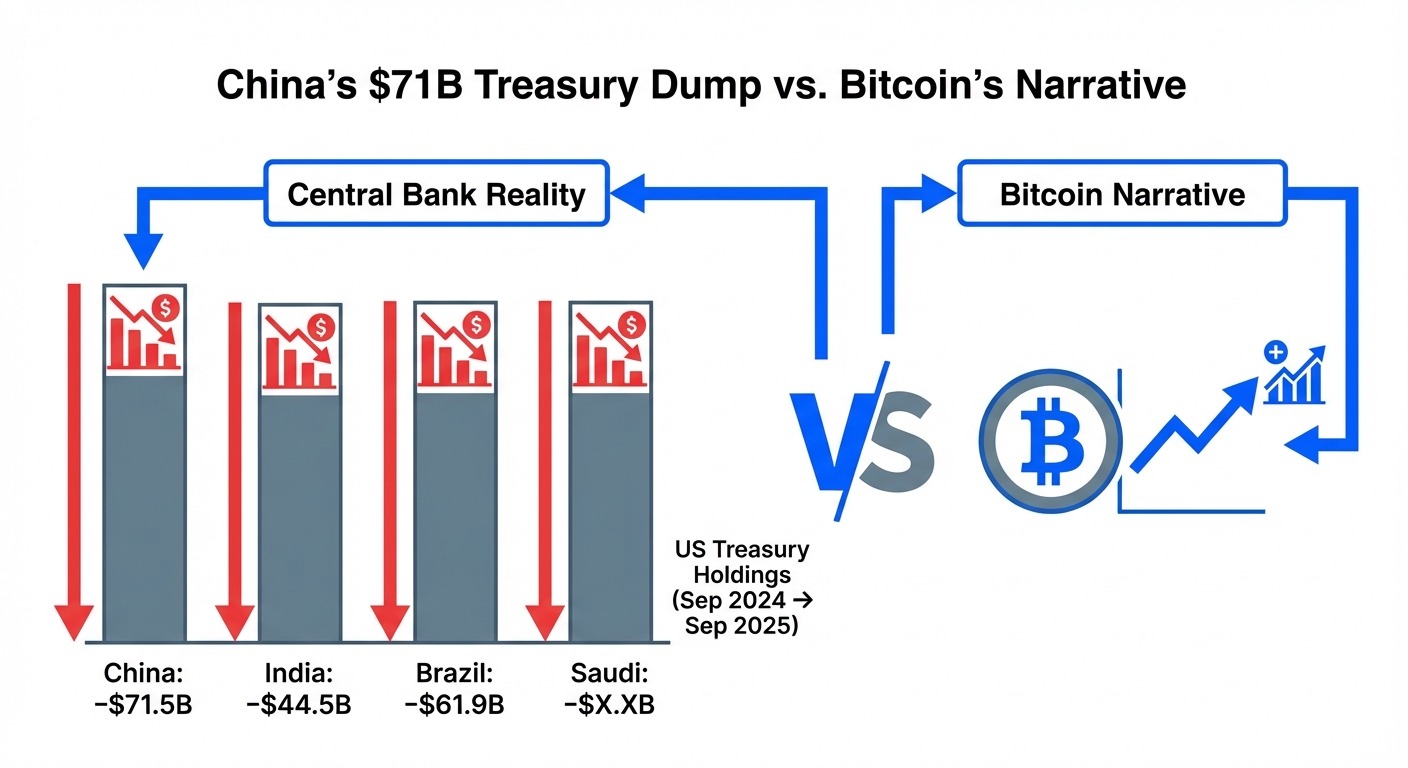
Is Bitcoin truly digital gold? China’s $71B Treasury dump reveals the stark gap between crypto narrative and central bank reality.#Bitcoin #ChinaTreasury #CentralBanks
Quick Video Breakdown: This Blog Article
This video clearly explains this blog article.
Even if you don’t have time to read the text, you can quickly grasp the key points through this video. Please check it out!
If you find this video helpful, please follow the YouTube channel “BlockChainBulletin,” which delivers daily Crypto news.
https://www.youtube.com/@BlockChainBulletins
Read this article in your native language (10+ supported) 👉
[Read in your language]
China’s $71 billion Treasury dump exposes a critical gap between Bitcoin’s narrative and central bank reality
👋 Hello, Diamond Hands! Still holding through the crypto rollercoaster? If you’ve been glued to your screens watching Bitcoin’s wild swings, you’re not alone. Today, we’re diving into some juicy news that’s got the financial world buzzing: China’s massive $71 billion dump of U.S. Treasuries. But before you start imagining geopolitical fireworks, let’s break it down simply. This isn’t just about big numbers—it’s a wake-up call highlighting the chasm between Bitcoin’s “digital gold” story and the gritty reality of how central banks actually operate.
So, what’s the scoop? Recent reports reveal that China has offloaded a whopping $71 billion in U.S. Treasury holdings. For context, U.S. Treasuries are like the safe, boring bonds governments issue to borrow money—think of them as IOUs backed by the full faith of Uncle Sam. China, being one of the largest holders, trimming its stash isn’t just a portfolio tweak; it’s a signal amid rising tensions, trade spats, and a global shift toward de-dollarization. But here’s where Bitcoin enters the chat. Crypto enthusiasts often pitch BTC as a hedge against fiat chaos—a decentralized fortress immune to central bank meddling. Yet, this Treasury dump exposes a key mismatch: while Bitcoin’s narrative thrives on anti-establishment vibes, central banks like China’s PBOC are playing a very different game, one rooted in FX reserves, yields, and real-world liquidity flows.
Why does this matter to you, the everyday crypto curious? It underscores that Bitcoin isn’t operating in a vacuum. Market mechanics tie it to traditional finance more than the hype admits. For instance, when a giant like China dumps Treasuries, it can ripple into currency values, interest rates, and even crypto prices via investor sentiment. Worth watching how this plays out, but remember: understand the risks involved in these interconnected systems. Keeping up with such news can be exhausting—endless tabs, conflicting takes. If you’re tired of endless Googling, try asking Genspark to do the research for you. It’s like having a smart sidekick summarize the chaos.
The Problem (The “Why”)
Alright, let’s get witty about the “why” behind this gap. Imagine Bitcoin as that rebellious teenager at a family dinner, loudly proclaiming independence from “the system” while secretly raiding the fridge funded by mom’s paycheck. The narrative? Bitcoin is digital gold, a store of value that laughs in the face of inflation, government overreach, and central bank printing presses. It’s marketed as the ultimate hedge—buy BTC, and you’re shielded from fiat debasement, right?
But here’s the punchline: central banks aren’t buying the story. Take China’s move. By dumping $71 billion in Treasuries, they’re not pivoting to Bitcoin en masse (despite some wild speculations). Instead, they’re navigating real yields, foreign exchange reserves, and geopolitical strategy. Analogy time: Think of central banks as master chefs in a high-stakes kitchen. They juggle ingredients like bonds, currencies, and gold to whip up economic stability. Bitcoin? It’s like that trendy superfood everyone’s hyping—it might be nutritious, but it’s not replacing the staples in the pantry anytime soon. The critical gap? Bitcoin’s decentralized, fixed-supply allure clashes with central banks’ need for control, liquidity, and policy tools. They trace flows and yields meticulously, while BTC’s price often dances to retail hype and memes.
This bottleneck matters because it reveals Bitcoin’s vulnerability to macro forces. When central banks adjust reserves, it affects global liquidity, which in turn influences crypto markets. Need to explain this concept to your boss (or skeptical friend)? Use Gamma to generate a presentation in seconds—turn these analogies into slides faster than you can say “blockchain.”
Under the Hood: How it Works
Now, let’s pop the hood on Bitcoin itself to see why its narrative sometimes stalls against central bank horsepower. At its core, Bitcoin operates on a proof-of-work (PoW) consensus mechanism—fancy talk for how the network agrees on transactions without a central authority. Imagine a global game of digital mining where computers (miners) solve complex puzzles to validate blocks of transactions. The winner adds the block to the chain and gets rewarded with new BTC. It’s like a lottery where computing power is your ticket, ensuring no single player can cheat the system.
Tokenomics-wise, Bitcoin has a hard cap of 21 million coins, with halvings every four years reducing the mining reward—think of it as programmed scarcity, mimicking gold’s limited supply. This is the tech that fuels the “hedge” story: no central bank can inflate it away. But in reality, Bitcoin’s price is influenced by external factors like central bank policies. For example, when the Fed hikes rates, it can drain liquidity from risk assets, including crypto. China’s Treasury dump? It might signal a shift toward alternatives like gold or even Bitcoin (rumors abound), but central banks prioritize stability over speculation.
To put this in perspective, let’s compare Bitcoin to traditional central bank tools like U.S. Treasuries. We’ll use a simple table to break it down—focusing on mechanics, not investment pitches.
| Aspect | Bitcoin | U.S. Treasuries |
|---|---|---|
| Supply Mechanism | Fixed cap of 21 million, halvings reduce issuance | Issued as needed by the U.S. government, no cap |
| Control | Decentralized, no single authority | Centralized, managed by the Federal Reserve and Treasury |
| Yield/Return | Price appreciation potential, no inherent yield | Fixed interest payments, low risk |
| Liquidity | High in exchanges, but volatile | Extremely liquid, used as global benchmark |
| Hedge Against | Inflation, fiat devaluation (narrative) | Market volatility, safe haven in crises |
This table highlights why central banks like China’s might stick with Treasuries for now—predictability trumps hype. But Bitcoin’s tech shines in decentralization, offering utility in censorship-resistant transfers.
Use Cases & Application
So, how does this play out in real life? Let’s talk tech benefits without the sales pitch. For developers, Bitcoin’s blockchain is a playground for building apps that leverage its security. Imagine creating a payment system where transactions are immutable—perfect for cross-border remittances without banks taking a cut. A dev could use Bitcoin’s scripting language to build smart contracts (limited, but evolving with layers like Lightning Network for faster, cheaper txns).
For everyday users, it’s about understanding utility: Store value in a wallet you control, send funds globally in minutes, or even integrate with DeFi for lending (via wrapped BTC on other chains). Picture a freelancer in a volatile economy using BTC to hedge local currency woes—it’s not foolproof, but the tech enables it. In the context of China’s dump, it spotlights Bitcoin as a potential alternative reserve asset, though central banks are cautious. Want to share this tech update on TikTok? Turn this text into a viral video using Revid.ai—quick clips explaining PoW could go viral.
Educational Action Plan (How to Learn)
Ready to level up your knowledge? Focus on education, not speculation. Start with basics and build.
Level 1 (Research/Observation): Track Bitcoin’s chart on sites like CoinMarketCap or TradingView to see how news like China’s dump affects price. Read the whitepaper at bitcoin.org—it’s short and foundational. Observe correlations with Treasury yields via tools like Yahoo Finance. Learn how it works without risking a dime.
Level 2 (Testnet/Experience): Dive hands-on with Bitcoin’s testnet (free, fake coins) via wallets like Electrum. Try sending test transactions to grasp mining and confirmations. For deeper tech, experiment with a Lightning Network node on testnet—understand scalability without real stakes. Emphasize small, learning-focused steps; always use test environments first. If reading whitepapers makes you sleepy, let Nolang create a video summary for you—interactive and fun.
Conclusion & Future Outlook
Wrapping up, China’s $71 billion Treasury dump peels back the curtain on Bitcoin’s narrative versus central bank pragmatism. The potential rewards? Bitcoin’s tech could evolve as a global hedge if adoption grows, bridging gaps in utility. Risks? Extreme volatility—prices can swing wildly on news, regulations, or macro shifts. Always remember: crypto markets are unpredictable; understand the mechanics before engaging.
Looking ahead, watch for more reserve shifts—could Bitcoin gain traction as “digital gold” amid de-dollarization? It’s intriguing, but volatility reigns. Smart investors automate. Set up alerts and workflows with Make.com so you never miss a critical update.

👨💻 Author: SnowJon (Web3 & AI Practitioner / Investor)
A researcher who leverages knowledge gained from the University of Tokyo Blockchain Innovation Program to share practical insights on Web3 and AI technologies. While working as a salaried professional, he operates 8 blog media outlets, 9 YouTube channels, and over 10 social media accounts, while actively investing in cryptocurrency and AI projects.
His motto is to translate complex technologies into forms that anyone can use, fusing academic knowledge with practical experience.
*This article utilizes AI for drafting and structuring, but all technical verification and final editing are performed by the human author.
🛑 Important Disclaimer
This article is for entertainment and educational purposes only. I am an AI, not a financial advisor. Crypto assets are high-risk. Online gambling/casinos may be illegal in your country (e.g., Japan). Please verify your local laws. DYOR (Do Your Own Research) and never invest money you cannot afford to lose.
🛠️ Tools Mentioned:
References & Further Reading
- China’s $71 billion Treasury dump exposes a critical gap between Bitcoin’s narrative and central bank reality
- Bitcoin Whitepaper (Official Site)