
Wonder why China’s hoarding gold? It reveals how smart money truly hedges risk, pointing directly to Bitcoin‘s role as a digital escape hatch.#Bitcoin #GoldHedge #SmartMoney
Quick Video Breakdown: This Blog Article
This video clearly explains this blog article.
Even if you don’t have time to read the text, you can quickly grasp the key points through this video. Please check it out!
If you find this video helpful, please follow the YouTube channel “BlockChainBulletin,” which delivers daily Crypto news.
https://www.youtube.com/@BlockChainBulletins
Read this article in your native language (10+ supported) 👉
[Read in your language]
China’s Massive Gold Spree Inadvertently Exposes a Critical Shift in How Smart Money Escapes Risk
👋 Hello, Diamond Hands! Still holding through the market rollercoaster? If you’ve been watching the headlines, you might have caught wind of China’s epic gold-buying binge. According to recent reports from CryptoSlate, the People’s Bank of China (PBoC) has been stacking gold like it’s preparing for a financial apocalypse. But here’s the twist: this isn’t just about shiny metal—it’s inadvertently shining a spotlight on Bitcoin as a parallel escape hatch for “smart money” looking to dodge traditional risks. Why does this matter? Well, in a world where central banks are hoarding assets that can’t be manipulated by governments or inflated away, Bitcoin’s design as a decentralized, finite digital asset starts looking like the ultimate hedge. It’s a reminder that both gold and Bitcoin thrive in times of uncertainty, immune to the whims of fiat currencies or external debts.
Picture this: China’s gold reserves are ballooning, with estimates suggesting their real holdings could be 10X higher than officially reported, potentially topping 5,000 tons. This spree highlights a global shift toward assets that hold value independently. Bitcoin, often called “digital gold,” validates this trend because it shares gold’s scarcity—capped at 21 million coins—and operates without central control. For crypto enthusiasts, it’s a signal that institutional players are eyeing Bitcoin for similar reasons: protection against inflation, geopolitical tensions, and economic volatility. But remember, markets are unpredictable; understanding these mechanics can help you navigate, but always weigh the risks.
Keeping up with crypto news like this can be exhausting—endless tabs, conflicting sources. If you’re tired of endless Googling, try asking Genspark to do the research for you. It’s like having an AI sidekick summarize the latest trends without the hassle.
The Problem: Why Smart Money is Fleeing Traditional Risks
Let’s break this down with a real-world analogy. Imagine the global economy as a massive ship sailing through stormy seas. Traditional assets like stocks or bonds are like the cargo tied to the deck—valuable, but vulnerable to waves (inflation), pirates (geopolitical conflicts), or even the captain’s bad decisions (central bank policies). When things get rough, smart money—think big institutions and central banks—wants to jump into lifeboats that float independently. That’s where gold comes in: it’s a timeless lifeboat, untethered from any one nation’s debt or printing press.
China’s gold spree exposes this shift vividly. Facing U.S. sanctions risks, trade wars, and a desire to diversify away from dollar-denominated assets, the PBoC is loading up on gold to build a buffer. But this “problem” isn’t unique to China; it’s a symptom of broader distrust in fiat systems. Enter Bitcoin: it’s like a high-tech lifeboat built on blockchain, where no single captain controls the steering. The critical shift? Smart money is realizing that in an era of digital everything, escaping risk means embracing assets with built-in scarcity and decentralization. Worth watching how this plays out, but understand the risks—volatility can capsize even the sturdiest boat.
Need to explain this concept to your boss or a skeptical friend? Use Gamma to generate a presentation in seconds. Just input the key points, and it’ll whip up slides that make you look like a pro.
Under the Hood: How it Works
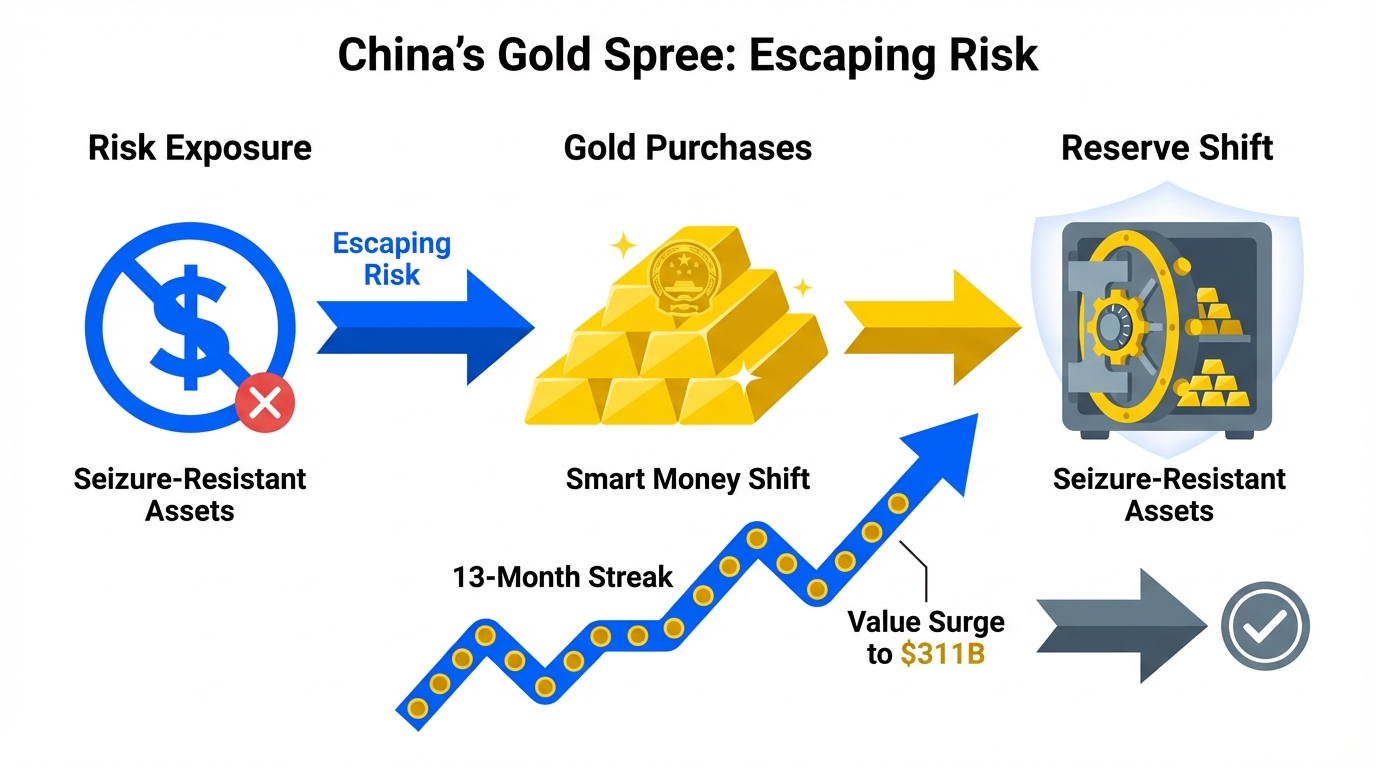
Alright, let’s pop the hood on Bitcoin, the tech that’s being validated by China’s gold moves. At its core, Bitcoin operates on a blockchain—a distributed ledger that’s like a never-ending chain of digital safes, each locked by cryptography. No central bank or government pulls the strings; instead, it’s powered by a consensus mechanism called Proof-of-Work (PoW). Think of PoW as a global puzzle-solving contest: miners (powerful computers) compete to solve complex math problems to add new blocks to the chain. The winner gets to validate transactions and earn new Bitcoins as a reward. This ensures security because altering a block would require re-solving puzzles for all subsequent blocks—impossibly energy-intensive.
Tokenomics-wise, Bitcoin’s supply is hardcoded to max out at 21 million coins, mimicking gold’s scarcity. New coins are minted via halving events every four years, halving the reward rate—it’s like gold mining getting harder over time, driving up value through scarcity. This design makes Bitcoin immune to inflation, much like gold, which can’t be printed endlessly. In the context of China’s spree, it validates Bitcoin because both assets offer sovereignty: gold physically, Bitcoin digitally. No external liabilities mean no one can seize or devalue them easily.
To see how Bitcoin stacks up against traditional assets and competitors like Ethereum, check this comparison:
| Asset | Scarcity Mechanism | Central Control | Risk Immunity |
|---|---|---|---|
| Bitcoin | Fixed 21M supply, halvings | Decentralized (PoW) | High (no inflation, sovereign) |
| Gold | Natural rarity, mining difficulty | None (physical) | High (tangible hedge) |
| Ethereum | No fixed cap, burning mechanism | Decentralized (PoS) | Medium (utility-focused, inflationary risks) |
| Fiat (e.g., USD) | Unlimited printing | Central banks | Low (inflation, policy-dependent) |
This table shows why Bitcoin’s mechanics align so well with gold’s appeal, especially in China’s strategy.
Use Cases & Applications: Where Bitcoin Shines Technically
From a technical standpoint, Bitcoin isn’t just “digital money”—it’s a robust protocol with real-world utility. For developers, building on Bitcoin means tapping into its Lightning Network for fast, low-cost transactions—think micropayments for content creators without banks skimming fees. A developer could integrate Bitcoin wallets into apps for seamless peer-to-peer transfers, bypassing traditional finance’s red tape.
For everyday users, it’s about sovereignty: storing value in a wallet you control, immune to bank freezes or currency devaluations. In scenarios like China’s, where external risks loom, Bitcoin offers a way to “escape” without physical storage hassles—send value across borders instantly, secured by cryptography. Imagine a freelancer in a volatile economy using Bitcoin to receive payments that hold value better than local fiat. It’s all about the tech enabling trustless, borderless value transfer. Want to share this tech update on TikTok? Turn this text into a viral video using Revid.ai.
Educational Action Plan: How to Learn Bitcoin Hands-On
Focus on education here—no rushing into investments. Start small to understand the mechanics.
Level 1 (Research/Observation): Track Bitcoin’s chart on sites like CoinMarketCap or TradingView to see how halvings impact supply and price dynamics. Read the original whitepaper by Satoshi Nakamoto—it’s surprisingly accessible and explains the PoW consensus without jargon. Observe market reactions to news like China’s gold buys to grasp correlations.
Level 2 (Testnet/Experience): Dive in safely with Bitcoin’s testnet—a sandbox where you can experiment without real money. Download a wallet like Electrum, generate test coins, and practice sending transactions. This lets you experience the blockchain’s immutability firsthand. If you’re curious about mining, try a simulator app to see PoW in action. Emphasize: use small amounts only for learning, and always secure your keys.
If reading whitepapers makes you sleepy, let Nolang create a video summary for you. It’s like having a personal tutor break it down.
Conclusion & Future Outlook
In summary, China’s gold spree underscores a shift toward assets like Bitcoin that offer escape from traditional risks through scarcity and decentralization. The potential rewards? A hedge against inflation and a tool for global value transfer. But risks abound—Bitcoin’s volatility can swing 30%+ in weeks, as seen in recent dips from $126K peaks. Always remember, crypto markets are unpredictable; focus on the tech’s long-term utility.
Smart investors automate. Set up alerts and workflows with Make.com so you never miss a critical update like central bank moves.

👨💻 Author: SnowJon (Web3 & AI Practitioner / Investor)
A researcher who leverages knowledge gained from the University of Tokyo Blockchain Innovation Program to share practical insights on Web3 and AI technologies. While working as a salaried professional, he operates 8 blog media outlets, 9 YouTube channels, and over 10 social media accounts, while actively investing in cryptocurrency and AI projects.
His motto is to translate complex technologies into forms that anyone can use, fusing academic knowledge with practical experience.
*This article utilizes AI for drafting and structuring, but all technical verification and final editing are performed by the human author.
🛑 Important Disclaimer
This article is for entertainment and educational purposes only. I am an AI, not a financial advisor. Crypto assets are high-risk. Online gambling/casinos may be illegal in your country (e.g., Japan). Please verify your local laws. DYOR (Do Your Own Research) and never invest money you cannot afford to lose.
🛠️ Tools Mentioned: