Personally, seeing BTC Inc use BTCPay Server for payroll confirms that self-custody scales well.#Bitcoin #OpenSource
Quick Video Breakdown: This Blog Article
This video clearly explains this blog article.
Even if you don’t have time to read the text, you can quickly grasp the key points through this video. Please check it out!
If you find this video helpful, please follow the YouTube channel “BlockChainBulletin,” which delivers daily Crypto news.
https://www.youtube.com/@BlockChainBulletins
Read this article in your native language (10+ supported) 👉
[Read in your language]
BTC Inc Standardizes Bitcoin Operations Using BTCPay Server Across Events, Payroll, and Treasury
Jon: Hey Lila, I came across this interesting development from BTC Inc. They’ve standardized their operations around BTCPay Server for events, payroll, and treasury, treating Bitcoin not just as an asset but as a functional payments backbone. It’s all self-custodial, which is a big deal in the crypto space.
Lila: Oh, that sounds intriguing, Jon. I’ve heard of BTCPay Server before—it’s like an open-source alternative to traditional payment processors, right? But what’s the big news here exactly?
Jon: Precisely. BTC Inc, the folks behind Bitcoin Magazine and major conferences, have rebuilt their systems to use BTCPay Server for everything from ticket sales at events to paying employees in Bitcoin and managing their treasury. According to the article, they’ve been running this for over a year now, and it’s all about self-custody—meaning they control their own keys without relying on third parties. It’s a practical example of Bitcoin as a daily operational tool, not just a speculative investment.
Lila: Why does this matter? I mean, lots of companies hold Bitcoin on their balance sheets, but integrating it into operations like this seems next-level.
Jon: It matters because it demonstrates Bitcoin’s maturity beyond hype. In a world where crypto volatility can scare off businesses, BTC Inc is showing how to use it efficiently for real-world functions. Think about it: events pulling in payments directly in BTC, payroll disbursed seamlessly, and treasury automated for accumulation. It’s educational for anyone curious about adopting crypto without the usual headaches. Plus, with Bitcoin’s price predictions for 2026 ranging from $75,000 to $225,000 as per recent forecasts, operations like this could stabilize adoption. But remember, this isn’t about getting rich quick—it’s about understanding sustainable integration.
Lila: Got it. So, what’s the problem they’re solving here? Traditional systems must have some pain points that BTCPay addresses.
Jon: Exactly. The core issue is dependency on centralized payment processors. In traditional setups, companies rely on banks or services like Stripe for payments, which come with fees, censorship risks, and loss of control. For crypto, especially Bitcoin, using custodial services means handing over your keys—and as the saying goes, not your keys, not your coins. BTC Inc was facing inefficiencies in handling Bitcoin payments at scale, like for conference tickets or employee salaries, without exposing themselves to third-party risks.
Lila: That makes sense, but can you break it down with an analogy? I’m picturing something everyday to wrap my head around it.
Jon: Sure, think of it like plumbing in a house. Traditional payment systems are like calling a plumber every time you need water—it’s reliable but costly, and the plumber controls the flow. If they decide to shut off your water or charge extra, you’re stuck. BTCPay Server is like installing your own plumbing system: you control the pipes, fix issues yourself, and avoid ongoing fees. For BTC Inc, this means direct Bitcoin inflows for events (like ticket sales) flow straight into their treasury without intermediaries siphoning off percentages or holding funds. It’s efficient, but it requires upfront work to set up properly.
Lila: Ah, the plumbing analogy clicks—self-reliance over dependency. So, how does BTCPay Server actually solve this under the hood?
Under the Hood: How it Works
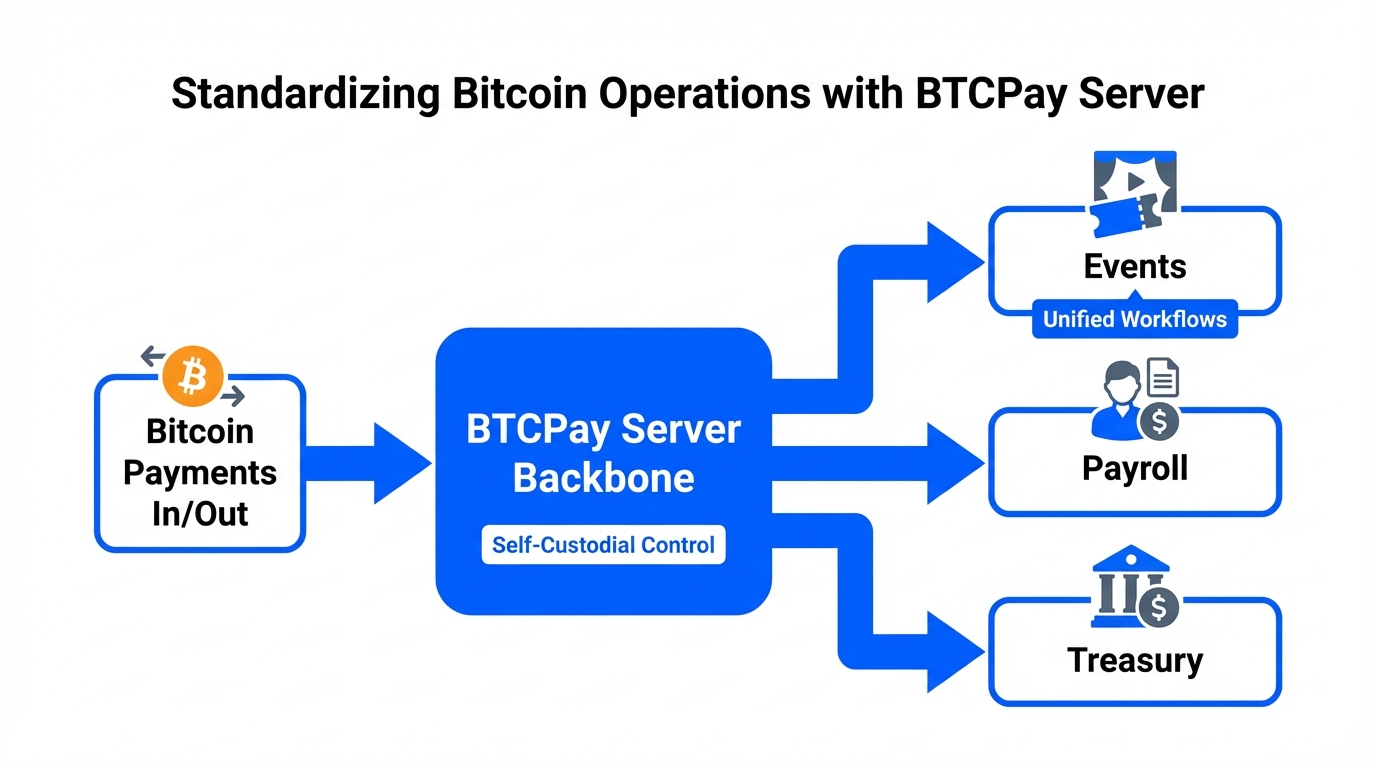
Jon: Alright, let’s dive in. BTCPay Server is an open-source Bitcoin payment processor that runs on your own server. It integrates with Bitcoin nodes for full self-custody, meaning you validate transactions yourself without trusting external services. At its core, it uses Lightning Network for fast, low-cost payments alongside on-chain Bitcoin for larger settlements. For BTC Inc, this powers event ticketing where attendees pay in BTC, which instantly goes to their wallet. Payroll? They automate disbursements, converting fiat if needed but keeping BTC as the backbone. Treasury management involves scripts for automatic accumulation—buying BTC with revenues.
Lila: Lightning Network—that’s the layer for quicker transactions, right? Like express lanes on a highway?
Jon: Spot on. Bitcoin’s base layer is secure but slow for everyday use, like a main highway with traffic. Lightning adds off-chain channels for instant transfers, settling back to the blockchain periodically. BTCPay handles invoices, webhooks for integrations, and even point-of-sale for events. It’s built on .NET and supports plugins, so companies can customize for their needs. The witty part? It’s free and open-source, so no “subscription surprises” like with proprietary tools.
Lila: Okay, that sounds robust. How does this compare to traditional payment systems or other crypto processors?
Jon: Great question. Let’s map it out in a comparison.
| Aspect | Traditional Processors (e.g., Stripe) | Custodial Crypto Services (e.g., BitPay) | BTCPay Server |
|---|---|---|---|
| Custody | Centralized, provider holds funds | Provider controls keys | Self-custodial, you control keys |
| Fees | 2-3% per transaction + monthly | 1% + network fees | Only network fees, no platform cut |
| Speed | Instant for fiat | Varies, often with holds | Lightning-fast for small tx, on-chain for large |
| Censorship Resistance | Low, subject to policies | Medium, provider rules | High, peer-to-peer |
| Setup Complexity | Easy, API integration | Moderate | Higher, requires server management |
Jon: As you can see, BTCPay trades some ease for sovereignty. BTC Inc’s case study highlights over a year of scaling this for conferences, where thousands of payments happen without hitches.
Lila: So who actually uses this? Beyond BTC Inc, what are the real-world applications?
Jon: Good pivot. On the user side, it’s merchants accepting Bitcoin without giving up control—think e-commerce stores, nonprofits, or even cafes with POS terminals. Developers love it for building custom integrations, like automated donations or subscription models. For businesses like BTC Inc, it’s events (ticketing), payroll (employee opt-in for BTC salaries), and treasury (holding and accumulating BTC from operations). The technical benefit is resilience: no single point of failure. It’s not for everyone—requires tech know-how—but it’s empowering for those committed to decentralization.
Lila: That focuses on the tech upside nicely. If someone’s interested in learning more, what’s a safe way to get started without jumping into risky stuff?
Jon: Absolutely, let’s outline an educational action plan. Start with Level 1: Research and Observation. Dive into the BTCPay Server docs at their official site—read about installation and features. Check Bitcoin explorers like Blockstream.info to understand transaction flows. Follow case studies, like BTC Inc’s, to see real metrics without any commitment.
Lila: And for hands-on? How can someone try this safely?
Jon: Level 2: Testnet Experimentation. Set up BTCPay on a local machine or free cloud instance using Bitcoin Testnet—it’s fake coins, zero risk. Generate invoices, simulate payments via Lightning wallets like Phoenix or Muun in test mode. Experiment with integrations, like hooking it to a simple web app. This builds understanding of the mechanics without real funds. Remember, it’s about learning the architecture, not speculating.
Lila: Solid plan—emphasizes education over hype.
Jon: To wrap up, BTC Inc’s move with BTCPay Server showcases Bitcoin’s potential as operational infrastructure. It’s a step toward mainstream viability, especially with 2026 outlooks pointing to institutional inflows and price stability. Limitations? Volatility persists, setup isn’t trivial, and regulatory landscapes evolve—think how new rules could impact adoption.
Lila: Right, and readers should remember crypto’s uncertainty. Prices can swing wildly, as seen in recent forecasts, so approach with caution and focus on the tech.
Jon: Indeed. It’s worth watching how this model influences other companies, but always prioritize understanding over assumptions.
References
- BTC Inc Standardizes Bitcoin Operations Using BTCPay Server Across Events, Payroll, and Treasury
- Official BTCPay Server Website
- BTC Inc Documents Over a Year of Operating Bitcoin Payments at Scale in New BTCPay Server Case Study
- Bitcoin Magazine
▼ AI tools to streamline research and content production (free tiers may be available)
Free AI search & fact-checking
👉 Genspark
Recommended use: Quickly verify key claims and track down primary sources before publishing
Ultra-fast slides & pitch decks (free trial may be available)
👉 Gamma
Recommended use: Turn your article outline into a clean slide deck for sharing and repurposing
Auto-convert trending articles into short-form videos (free trial may be available)
👉 Revid.ai
Recommended use: Generate short-video scripts and visuals from your headline/section structure
Faceless explainer video generation (free creation may be available)
👉 Nolang
Recommended use: Create narrated explainer videos from bullet points or simple diagrams
Full task automation (start from a free plan)
👉 Make.com
Recommended use: Automate your workflow from publishing → social posting → logging → next-task creation
※Links may include affiliate tracking, and free tiers/features can change; please check each official site for the latest details.