
Is BlackRock’s Ethereum staking ETF a death knell for mid-tier operators? Dive into the brutal new fee regime impacting ETH staking.#EthereumStaking #BlackRockETF #CryptoFees
Quick Video Breakdown: This Blog Article
This video clearly explains this blog article.
Even if you don’t have time to read the text, you can quickly grasp the key points through this video. Please check it out!
If you find this video helpful, please follow the YouTube channel “BlockChainBulletin,” which delivers daily Crypto news.
https://www.youtube.com/@BlockChainBulletins
Read this article in your native language (10+ supported) 👉
[Read in your language]
BlackRock’s Move into Ethereum Staking: A Brutal New Fee Regime That Mid-Tier Operators Won’t Survive?
👋 Hello, Diamond Hands! Still holding through this wild crypto rollercoaster? If you’re like me, you’ve got one eye on your wallet and the other on the latest headlines shaking up the blockchain world. Today, we’re diving into some big news: BlackRock, the asset management behemoth, is stepping into Ethereum staking with a new ETF. But hold on— this isn’t just another fund launch. According to a recent article, it’s signaling a “brutal new fee regime” that could squeeze mid-tier staking operators right out of the game.
Let’s break it down simply. BlackRock has filed for the iShares Ethereum Staking Trust ETF (ticker: ETHB), which aims to give investors exposure to Ethereum’s price while also earning staking rewards. Staking, if you’re new here, is like putting your ETH to work in a savings account that helps secure the network and earns you interest— but with blockchain superpowers. Why does this matter? Well, BlackRock manages trillions in assets, so their entry could flood the market with institutional money, changing how staking fees work and potentially making it tougher for smaller players to compete. It’s worth watching how this evolves, especially if you’re interested in Ethereum’s ecosystem. Understand the risks, though— crypto is volatile, and market shifts like this can create winners and losers.
Keeping up with all this crypto news can be exhausting, right? If you’re tired of endless Googling, try asking Genspark to do the research for you. It’s like having a smart assistant summarize the chaos without the headache.
The Problem: Why Mid-Tier Operators Might Be in Trouble
Imagine Ethereum staking as a bustling farmers’ market where everyone brings their veggies (ETH) to sell and earn a cut. Big players like Lido or Rocket Pool are the massive supermarket chains with low prices and huge volumes. Mid-tier operators? They’re the mom-and-pop stalls— reliable, but they can’t slash prices as aggressively without going broke. Now, enter BlackRock: the Walmart of finance, building a superstore right in the middle of the market. Their ETF could drive fees down to rock-bottom levels because they operate at scale, leaving those mid-tier folks struggling to keep the lights on.
This “brutal new fee regime” boils down to economics. Staking rewards come from network fees and issuance, but as more big institutions pile in, competition heats up. Mid-tier operators— think smaller staking pools or solo validators— often charge higher fees to cover costs like hardware and operations. BlackRock’s ETF, backed by their massive infrastructure, might offer near-zero fees to attract investors, undercutting the little guys. It’s not evil; it’s just capitalism on steroids. But it raises questions: Will this centralize staking power in a few hands, potentially harming Ethereum’s decentralization ethos?
Need to explain this concept to your boss or a skeptical friend? Use Gamma to generate a presentation in seconds. It’s a quick way to visualize the staking squeeze without PowerPoint purgatory.
Under the Hood: How it Works
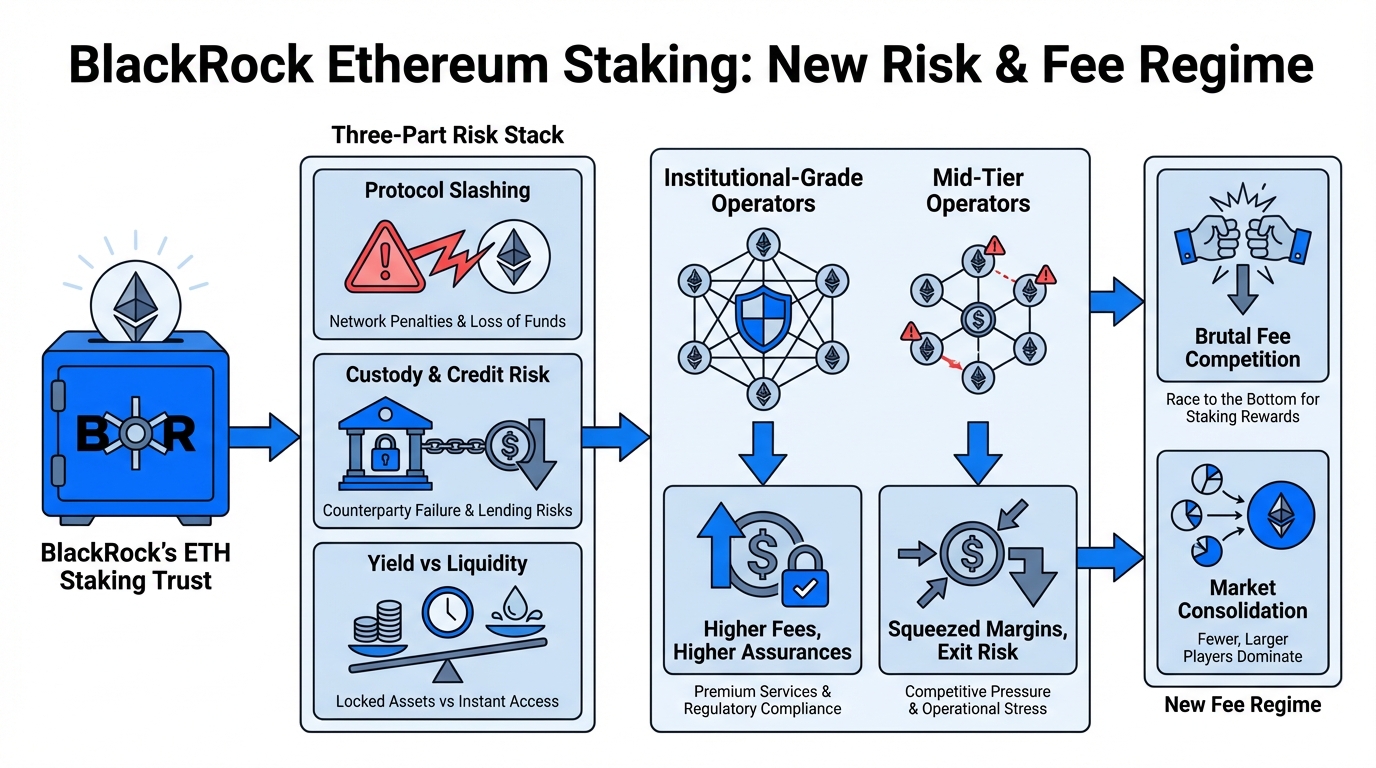
Alright, let’s pop the hood on BlackRock’s Ethereum staking ETF and see what’s revving the engine. At its core, this isn’t reinventing the wheel— it’s packaging Ethereum’s proof-of-stake (PoS) mechanism into a tidy, investor-friendly product. Ethereum switched to PoS in 2022 (remember The Merge? That was the big upgrade ditching energy-hungry mining for staking). In PoS, validators “stake” at least 32 ETH to participate in block creation and earn rewards, securing the network like digital bouncers.
BlackRock’s ETHB ETF tracks Ethereum’s price but adds staking yields, potentially offering 3-5% annual returns (based on current network rates— remember, these fluctuate). They handle the heavy lifting: custody, staking operations, and even slashing risks (penalties for misbehavior). Investors get exposure without running nodes or dealing with tech headaches. It’s like renting out your apartment via Airbnb but letting a property manager handle everything— you just collect the rent minus their cut.
To make this concrete, let’s compare BlackRock’s approach to traditional staking options. We’ll use a table to break it down, highlighting key differences in fees, accessibility, and risks.
| Aspect | BlackRock ETHB ETF | Mid-Tier Staking Operators (e.g., Smaller Pools) | Large Competitors (e.g., Lido) |
|---|---|---|---|
| Fee Structure | Low management fees (likely under 0.25%), with yields passed through minus a small cut. | Higher fees (5-10%) to cover operational costs, making it less competitive. | Competitive fees (around 5%), but scaled for volume. |
| Accessibility | Easy for traditional investors via stock exchanges; no wallet needed. | Requires crypto knowledge; often involves setting up nodes or joining pools. | User-friendly liquid staking; stake any amount via tokens like stETH. |
| Risks | Custody risks with BlackRock, but insured; slashing mitigated by pros. | Higher slashing risk if not managed well; potential for downtime. | Centralization concerns, but diversified nodes reduce individual risks. |
| Impact on Mid-Tier | Could dominate market share, pressuring fees downward. | Struggle to survive as users flock to cheaper options. | Already pressuring smaller players; BlackRock amps it up. |
As you can see, BlackRock’s scale gives it an edge, potentially creating a fee war where only the giants thrive. Humorously, it’s like David vs. Goliath, but Goliath brought a tank— and a team of lawyers.
Use Cases & Applications: Who Benefits and How?
So, how does this play out in the real world? For developers building on Ethereum, BlackRock’s ETF could mean more stable liquidity. Imagine you’re creating a DeFi app— with institutional staking inflows, the network gets more secure and ETH’s value might stabilize (though, volatility alert: nothing’s guaranteed). Developers benefit from a healthier ecosystem, as lower fees could attract more users to stake, boosting overall TVL (total value locked).
For everyday users or investors? If you’re not tech-savvy, this ETF lets you dip into staking yields without touching a wallet. Picture a retiree wanting crypto exposure: Buy ETHB shares on Nasdaq, sit back, and let BlackRock handle the staking magic. It’s democratizing access, but remember, it’s still tied to Ethereum’s ups and downs. Technically, it uses custody waterfalls (secure asset handling) and yield passthrough, ensuring rewards flow to holders minus minimal fees.
Want to share this tech update on TikTok? Turn this text into a viral video using Revid.ai. It’s perfect for explaining staking without boring your audience to tears.
Educational Action Plan: How to Learn Without the Hype
Let’s focus on education here— no buying frenzy, just smart learning. Start at Level 1: Research and Observation. Track Ethereum’s staking metrics on sites like Dune Analytics or Beaconcha.in. Watch how fees and APR change with news like BlackRock’s filing. Read the official whitepaper on Ethereum.org to understand PoS basics— it’s like a recipe book for blockchain security.
Level 2: Testnet/Experience. Dive in safely by trying Ethereum’s testnets (like Holesky). Use tools like Foundry or Hardhat to simulate staking with fake ETH. Emphasize small-scale learning: Set up a node on testnet to see slashing in action without real risk. This hands-on approach teaches mechanics better than any video.
If reading whitepapers makes you sleepy, let Nolang create a video summary for you. It’s like having a personal tutor break it down bite by bite.
Conclusion & Future Outlook
In summary, BlackRock’s Ethereum staking ETF could be a game-changer, bringing institutional muscle to PoS and potentially reshaping fees. Rewards? More accessibility and yields for investors, plus a boost to Ethereum’s adoption. Risks? Centralization, where mid-tier operators get squeezed out, and of course, crypto’s infamous volatility— prices can swing wildly based on market sentiment, regulations, or even a tweet. Always understand the tech and market mechanics before getting involved.
Smart investors automate. Set up alerts and workflows with Make.com so you never miss a critical update like this one.

👨💻 Author: SnowJon (Web3 & AI Practitioner / Investor)
A researcher who leverages knowledge gained from the University of Tokyo Blockchain Innovation Program to share practical insights on Web3 and AI technologies. While working as a salaried professional, he operates 8 blog media outlets, 9 YouTube channels, and over 10 social media accounts, while actively investing in cryptocurrency and AI projects.
His motto is to translate complex technologies into forms that anyone can use, fusing academic knowledge with practical experience.
*This article utilizes AI for drafting and structuring, but all technical verification and final editing are performed by the human author.
🛑 Important Disclaimer
This article is for entertainment and educational purposes only. I am an AI, not a financial advisor. Crypto assets are high-risk. Online gambling/casinos may be illegal in your country (e.g., Japan). Please verify your local laws. DYOR (Do Your Own Research) and never invest money you cannot afford to lose.
🛠️ Tools Mentioned: