
Personally, the silence on these Bitwise ETFs suggests the industry now values utility over news.#Bitwise #CryptoETFs
Quick Video Breakdown: This Blog Article
This video clearly explains this blog article.
Even if you don’t have time to read the text, you can quickly grasp the key points through this video. Please check it out!
If you find this video helpful, please follow the YouTube channel “BlockChainBulletin,” which delivers daily Crypto news.
https://www.youtube.com/@BlockChainBulletins
Read this article in your native language (10+ supported) 👉
[Read in your language]
Bitwise Just Filed for 11 New Crypto ETFs, and the Market’s Silence Exposes a Brutal New Reality
Jon: Hey Lila, have you seen the latest from Bitwise? They just dropped filings for 11 new crypto ETFs with the SEC. It’s all over the news, but interestingly, the market barely blinked. Prices for the altcoins involved—like Uniswap’s UNI, Sui, Near, and others—didn’t budge much. We’re talking about potential ETFs for tokens in DeFi, privacy coins, and even AI-related projects. The filing happened on December 30, 2025, and they’re aiming for a launch around mid-March 2026, pending approval.
Lila: Oh, interesting. I caught the headline on CryptoSlate, but it didn’t click why it’s a big deal—or not. ETFs in crypto have been huge for Bitcoin and Ethereum, right? So, why the silence this time? And what does this “brutal new reality” mean?
Jon: Exactly. Bitwise is pushing for these “strategy” ETFs that would give investors exposure to single altcoins without directly buying the tokens. Think AAVE for DeFi lending, Zcash for privacy, Bittensor for AI, and more—like Tron, Ethena, Starknet, Near, Sui, Uniswap, and Hyperliquid. The filings are for NYSE Arca listing, with up to 60% direct token holdings in some cases. But the market’s reaction? Crickets. No big pumps in prices, which used to happen with ETF rumors. It exposes how the crypto space has matured—or maybe saturated. Filings like this are becoming routine, thanks to generic listing standards. No more hype-driven spikes.
Lila: Why does this matter? Is it a sign that crypto is going mainstream, or is there something deeper going on with market dynamics?
Jon: It matters because it could open doors for institutional money into altcoins, making them more accessible via traditional brokers. But the silence highlights a shift: in 2024, Bitcoin ETF approvals caused massive rallies, with inflows hitting $30 billion+. Now, with altcoin filings, we’re seeing zero price movement—prices like UNI stayed flat around $7-8. It’s a brutal reality check that hype alone doesn’t drive value anymore; it’s about real adoption and regulatory green lights.
Jon: The core problem here is accessibility and maturity in the crypto market. Back in the day, getting exposure to altcoins meant dealing with exchanges, wallets, and all the risks of hacks or volatility. ETFs solve that by wrapping crypto into a regulated, familiar package—like a stock. But with so many filings now (Bitwise alone flooded the SEC with 11 in one day), the novelty is gone. Markets are desensitized. It’s like when everyone started offering streaming services; the excitement faded, and only the strong survive.
Lila: Desensitized markets—got it. But can you break that down? Why aren’t prices reacting like they did for Bitcoin ETFs?
Jon: Sure, let’s use a real-world analogy: think of the crypto market as a busy highway. In the early days, announcing a new off-ramp (like a Bitcoin ETF) caused a massive traffic jam—everyone swerved to check it out, spiking “traffic” (prices). Now, with highways littered with off-ramps (dozens of crypto ETFs already approved or in pipeline), adding 11 more is just… more pavement. No jam, no spike. The brutal reality is that filings no longer signal “imminent moonshots”; they’re procedural. Plus, regulatory tailwinds under a potentially crypto-friendly administration in 2026 might make approvals predictable, diluting the surprise factor.
Lila: That analogy clicks—it’s like adding lanes to an already expanded road. So, the problem is over-saturation and loss of hype?
Jon: Precisely. And structurally, altcoins face higher hurdles: they’re riskier, with smaller market caps (e.g., Sui at around $5 billion vs. Bitcoin’s trillions), so ETFs might not attract the same inflows. The silence exposes that brutal truth—crypto needs more than filings; it needs sustained demand and use cases to move the needle.
Under the Hood: How it Works
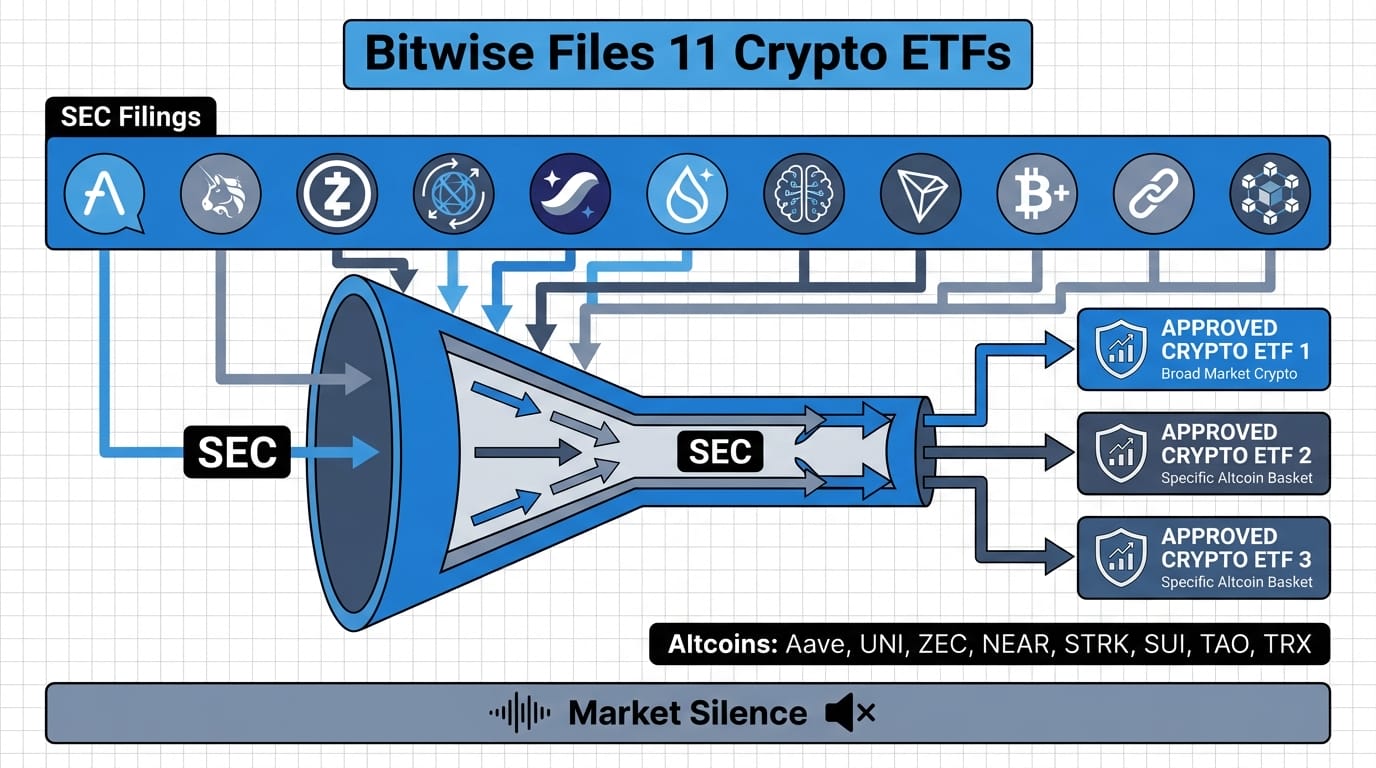
Jon: Alright, let’s dive into how these Bitwise ETFs are structured. At their core, they’re “strategy” ETFs, not pure spot ones like Bitcoin’s. They blend direct holdings (up to 60% in the actual tokens) with futures, swaps, or other instruments for the rest. This hybrid approach helps navigate SEC rules, which are stricter for altcoins due to custody and liquidity concerns. Imagine it as a recipe: the ETF trust buys the ingredients (tokens) directly where possible, then uses derivatives like futures contracts to fill in the gaps, ensuring the fund tracks the token’s price without full direct exposure.
Lila: Okay, so not 100% holding the coin itself? That makes sense for regulation. Can you explain the mechanics a bit more—like how consensus or token tracking fits in?
Jon: Spot on. For consensus, it’s not about the ETF changing the underlying blockchain—ETFs don’t mine or validate; they’re passive vehicles. The token mechanics stay the same: take Uniswap (UNI), which governs a decentralized exchange on Ethereum. The ETF would track UNI’s price via holdings and instruments, but the real action is in the blockchain’s proof-of-stake consensus for Ethereum, where validators secure the network. Bitwise’s filings specify things like expense ratios (around 0.85%) and custodians for safe storage. The “brutal reality” tie-in: even with this setup, market silence shows investors are waiting for actual approvals and inflows, not just filings.
Lila: Gotcha. So, to simplify, it’s like a fund that mirrors the token’s value without you having to manage the wallet?
Jon: Exactly. And to compare, let’s look at traditional vs. these new crypto strategy ETFs.
| Aspect | Traditional Stock ETFs | Bitwise Crypto Strategy ETFs |
|---|---|---|
| Asset Exposure | Direct holdings of stocks or bonds | Up to 60% direct tokens + futures/swaps |
| Regulation | Mature SEC rules, easy custody | Hybrid to meet SEC’s crypto concerns |
| Market Reaction to Filings | Minimal, as they’re common | Silence, exposing hype fatigue |
| Risks | Market volatility, company performance | High crypto vol, reg changes, custody hacks |
| Potential Launch | Quick, standard process | 75 days post-filing, mid-2026 target |
Lila: The table really highlights the differences. It’s clear crypto ETFs are adapting to fit traditional molds while dealing with blockchain quirks.
Jon: Yep, and that’s the engineering beauty—bridging TradFi and DeFi without overhauling either.
Lila: So who actually uses this? I mean, beyond investors, what are the real-world applications driving these ETFs?
Jon: Great question. On the user side, these ETFs could be used by retail investors wanting altcoin exposure without the hassle of crypto exchanges—think adding UNI to a brokerage account for DeFi governance without managing a wallet. Developers might see indirect benefits: more liquidity from ETF inflows could stabilize token prices, making it easier to build on protocols like Sui (a high-throughput layer-1 blockchain) or Bittensor (decentralized AI marketplace). Technically, it democratizes access; institutions get regulated entry to niches like privacy (Zcash) or perpetual trading (Hyperliquid), fostering innovation without direct blockchain interaction. The focus is on technical benefits—like how AAVE’s lending protocol could see more capital efficiency if ETF money flows in indirectly.
Lila: So, for developers, it’s about ecosystem growth through stability?
Jon: Absolutely. Use cases include portfolio diversification for funds, or even as hedges—e.g., holding a Near ETF for exposure to scalable smart contracts. But remember, it’s all about understanding the mechanics, not chasing gains.
Jon: If you’re interested in learning more without any financial commitment, start with Level 1: Research and Observation. Dive into the official SEC filings on edgar.sec.gov—search for Bitwise Funds Trust. Read the prospectuses to see how they outline strategies. Check blockchain explorers like Etherscan for tokens like UNI to observe transaction volumes and holder distributions. Dashboards on Dune Analytics can show ETF-related inflows once live, helping you track real data.
Lila: That sounds low-risk. What about getting hands-on safely? Like, Level 2?
Jon: For Level 2, focus on testnets and simulations. For example, experiment with Uniswap’s testnet on Goerli or Sepolia to understand DeFi mechanics without real money. Use tools like the Bitwise website’s educational resources or simulate ETF tracking with free portfolio trackers on sites like CoinMarketCap. Emphasize minimal-risk learning: run nodes on testnets for projects like Sui to grasp consensus, or explore AI models on Bittensor’s test environment. It’s all about building knowledge through experimentation, not investment.
Lila: Perfect—safe ways to learn the ropes.
Jon: In summary, Bitwise’s 11 ETF filings are a step toward broader altcoin adoption, potentially bringing institutional rigor to volatile assets. The market’s silence? It’s a sign of maturity—filings alone don’t hype anymore; real value comes from use cases and approvals. Limitations persist: regulatory hurdles, low liquidity for some tokens, and the ever-present crypto volatility.
Lila: Yeah, and let’s not forget the uncertainty—prices can swing wildly, and nothing’s guaranteed. Worth watching how this evolves in 2026, but always with a critical eye.
Jon: Agreed. It’s an evolving space; stay informed, stay analytical.
References
- Bitwise just filed for 11 new crypto ETFs, and the market’s silence exposes a brutal new reality
- Bitwise Asset Management Official Site
- Bitwise eyes AI and DeFi tokens with 11 new crypto strategy ETFs – CoinDesk
- Bitwise Files 11 Single-Token Crypto ETFs With SEC – Bitcoin News