Personally, seeing this level of Ethereum Staking confirms network maturity is accelerating.#Ethereum #Blockchain
Quick Video Breakdown: This Blog Article
This video clearly explains this blog article.
Even if you don’t have time to read the text, you can quickly grasp the key points through this video. Please check it out!
If you find this video helpful, please follow the YouTube channel “BlockChainBulletin,” which delivers daily Crypto news.
https://www.youtube.com/@BlockChainBulletins
Read this article in your native language (10+ supported) 👉
[Read in your language]
BitMine Stakes $1B in Ethereum as Tom Lee Outlines $7K–$9K Price Range
Jon: Hey Lila, have you seen the latest buzz in the crypto world? BitMine Immersion, that big player in the mining and staking space, just staked a whopping $1 billion worth of Ethereum in just two days. And their chairman, Tom Lee—a well-known Wall Street strategist—outlined a price prediction for Ethereum hitting between $7,000 and $9,000 by 2026. It’s based on growing institutional demand and things like tokenization on the blockchain. Interesting move, right?
Lila: Wow, Jon, that’s a huge number—both the stake and the prediction. I’ve heard of Ethereum staking before, but what’s the big deal here? Is this just another hype cycle, or is there something substantial going on?
Jon: Fair question. Let’s break it down without the fluff. BitMine staked about 342,560 ETH, which at current prices equates to around $1 billion. This isn’t just parking money; it’s locking it into Ethereum’s proof-of-stake system to help secure the network and earn rewards. Tom Lee’s prediction ties into broader trends like Wall Street tokenizing assets—think stocks and bonds on blockchain—which could drive more Ethereum usage. But remember, predictions are educated guesses, not guarantees.
Lila: Okay, that sounds intriguing. But why does this matter? For someone like me who’s curious about crypto but not diving in headfirst, what’s the real significance?
Jon: It matters because it signals shifting dynamics in the crypto ecosystem. Ethereum isn’t just digital money; it’s a platform for decentralized apps. When a major firm like BitMine stakes this much, it reduces the circulating supply of ETH, which could influence market tightness. Lee’s outlook points to real-world adoption, like faster settlements in finance. But let’s not get ahead—crypto’s volatile, and this is one data point among many.
Lila: Got it. So, before we geek out on the details, can you explain the underlying problem this addresses? Like, why stake ETH in the first place?
Jon: Absolutely. The “problem” here is how blockchains like Ethereum maintain security and efficiency without wasting massive energy like the old proof-of-work mining did. Remember Bitcoin’s energy-guzzling mines? Ethereum switched to proof-of-stake in 2022 to fix that. But with growing adoption, there’s a need for more validators to keep the network robust—especially as institutions pile in.
Lila: Proof-of-stake? I’ve heard the term, but can you clarify? It sounds less like digging for gold and more like… what?
Jon: Think of it like a traffic system. In proof-of-work (old Ethereum or Bitcoin), miners are like competitive drivers racing to solve puzzles, burning fuel (energy) to add blocks to the chain. It’s chaotic and wasteful. Proof-of-stake is more like a cooperative highway where drivers (validators) put up a stake—say, locking their car in a garage—as collateral. They get to direct traffic (validate transactions) based on their stake, and if they misbehave, they lose it. BitMine’s massive stake is like a big trucking company adding fleets to the highway, making it smoother and more secure. But it also means they’re betting on the system’s long-term health.
Lila: That analogy helps—less racing, more staking responsibility. So, how does this tie into Tom Lee’s price range? Is it just optimism, or is there mechanics behind it?
Jon: Lee’s pointing to fundamentals: as more assets get tokenized on Ethereum (like real estate or bonds turned into digital tokens), the network’s usage spikes, potentially increasing ETH’s value through demand for gas fees and staking rewards. But it’s not magic—supply squeezes from staking can play a role, though markets are unpredictable.
Under the Hood: How it Works
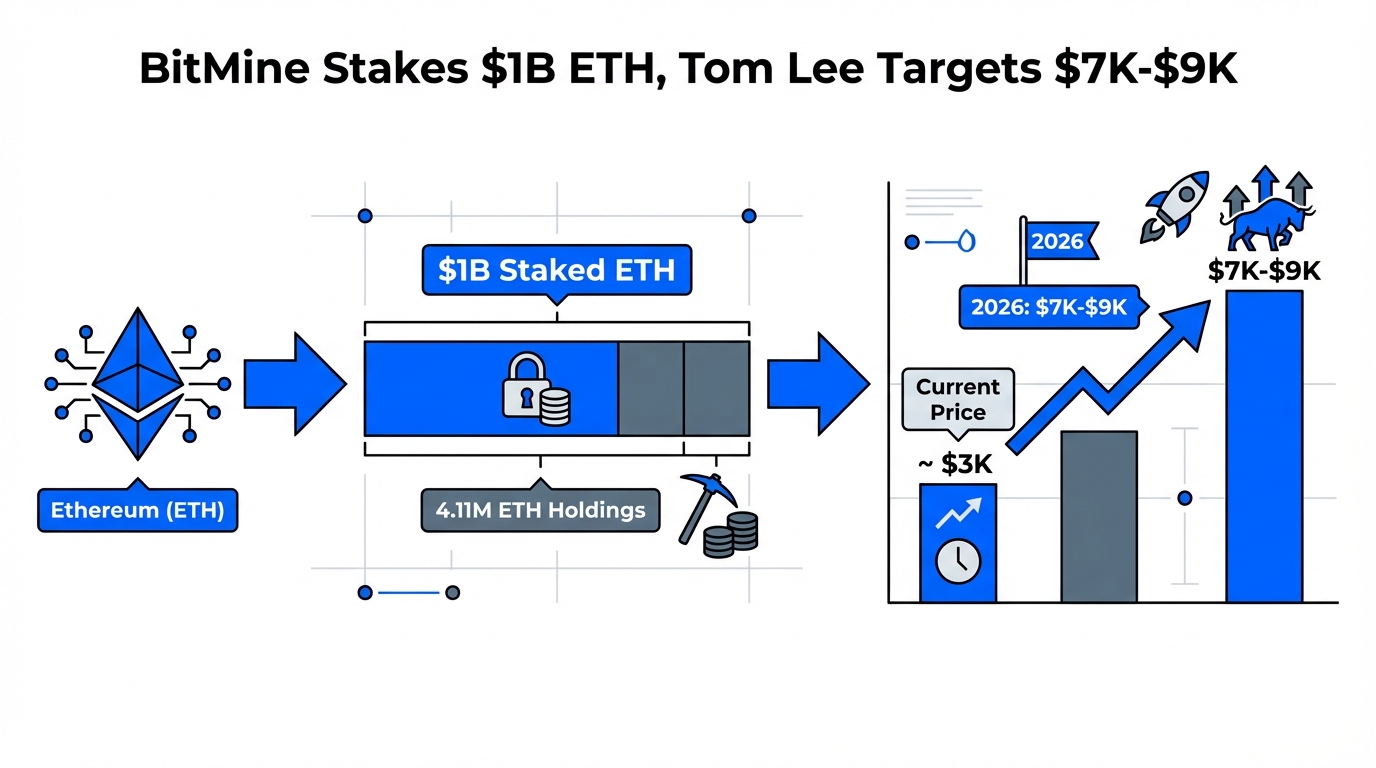
Jon: Alright, let’s pop the hood on Ethereum staking. At its core, Ethereum uses proof-of-stake to achieve consensus—agreeing on the state of the blockchain without central authority. Validators stake at least 32 ETH to participate, running nodes that propose and attest to blocks. Rewards come from transaction fees and new ETH issuance, but slashing (penalties) happens for downtime or malice.
Lila: So, BitMine staked over 342,000 ETH—that’s a lot. Does that mean they’re running thousands of validators?
Jon: Exactly. With 32 ETH per validator, that’s potentially over 10,000 validators added to the queue. This tightens ETH supply since staked tokens are locked (with a withdrawal queue). Tom Lee’s prediction factors in this: less liquid ETH plus rising demand from tokenization could push prices up. But let’s compare proof-of-stake to proof-of-work for clarity.
| Aspect | Proof-of-Work (e.g., Old Ethereum) | Proof-of-Stake (Current Ethereum) |
|---|---|---|
| Security Mechanism | Computational puzzles requiring energy-intensive hardware. | Economic stake as collateral; validators risk losing ETH. |
| Energy Efficiency | High consumption, like running data centers non-stop. | Low; just needs standard servers. |
| Entry Barrier | Expensive hardware and electricity. | 32 ETH stake; pooling options available. |
| Rewards | Block rewards plus fees; highly variable. | Staking yields around 3-5% APR, plus fees. |
| Scalability Impact | Limited by energy and hardware scaling. | Easier to scale with more stakers; supports sharding upgrades. |
Jon: See? Proof-of-stake makes Ethereum more sustainable. BitMine’s move amplifies this by adding institutional weight, potentially stabilizing the network. Lee’s $7K-$9K range assumes tokenization boom, where Ethereum handles real assets, increasing transaction volume.
Lila: That table really clarifies the differences—proof-of-stake seems like a smarter evolution. But tokenization? Is that like digitizing stocks?
Jon: Spot on. It’s converting traditional assets into blockchain tokens for faster trading and settlement. Ethereum’s smart contracts enable this without intermediaries.
Lila: So who actually uses this? I mean, beyond big firms like BitMine, what’s the practical application for developers or everyday users?
Jon: Great pivot. For developers, Ethereum staking underpins DeFi apps—think lending platforms like Aave or DEXes like Uniswap, where secure consensus ensures transactions don’t fail. Users benefit from lower fees in high-adoption scenarios, as more validators speed up the network. Institutionally, it’s for yield: BitMine’s staking earns rewards while supporting the ecosystem. On a user level, anyone can stake via pools like Lido for fractional participation, learning about decentralized finance without huge upfront costs. Technically, it enhances network resilience against attacks, as more stake means higher attack costs.
Lila: So, it’s not just for whales—smaller players can join pools. That democratizes it a bit. But how about real-world examples? Like, in tokenization?
Jon: Exactly. Wall Street firms are experimenting with tokenizing bonds on Ethereum for instant settlements—cutting days to seconds. Developers build dApps for NFTs, gaming, or supply chain tracking, all relying on staked security. The technical benefit is decentralization: no single point of failure, unlike traditional banks.
Lila: Alright, this is getting me interested in learning more hands-on. But safely—how can someone like me start exploring without risks?
Jon: Smart approach. Let’s outline an educational action plan. Start with Level 1: Research and Observation. Dive into Ethereum’s official docs at ethereum.org—they explain staking mechanics clearly. Use block explorers like Etherscan to track transactions and validator queues. Watch dashboards on Dune Analytics for staking stats; it’s like peeking into the engine room without touching anything.
Lila: That sounds beginner-friendly. What about getting hands-on? Level 2, maybe?
Jon: For Level 2: Testnet Experimentation. Ethereum has testnets like Sepolia or Holesky—free sandboxes with fake ETH. Set up a wallet like MetaMask, get test ETH from faucets, and practice deploying simple smart contracts or simulating staking via tools like Foundry. It’s zero-risk learning: understand gas fees, transaction flows, and even basic validator setup without real money. Emphasize: this is for education, not production—testnets mimic the real thing to build skills.
Lila: Perfect—no real stakes involved, pun intended. So, wrapping up, what’s the future outlook here?
Jon: In summary, BitMine’s $1B stake and Lee’s prediction highlight Ethereum’s maturing role in finance, with staking as the backbone. Opportunities lie in scalability upgrades like Danksharding, potentially handling more tokenization. Limitations? Centralization risks if too few big stakers dominate, plus regulatory hurdles. It’s worth watching for tech evolution.
Lila: Totally. But remember, folks—crypto’s volatile. Prices can swing wildly, and predictions like $7K-$9K are just that: predictions. Do your own research, understand the risks, and approach with caution. Uncertainty is part of the game.
Jon: Well said, Lila. It’s about learning the mechanics, not chasing highs. Stay curious, stay informed.
About the Authors
Jon is a seasoned Web3 researcher with over a decade in blockchain architecture. Lila brings a fresh perspective as a developer passionate about making tech accessible.
References
- BitMine Stakes $1B in Ethereum as Tom Lee Outlines $7K–$9K Price Range
- Official Ethereum Website
- Tom Lee Sees Ethereum at $7K–$9K by 2026 as BitMine Stakes $1B ETH
- Tom Lee’s BitMine Stakes $1 Billion in Ethereum