
Are quantum computers a threat to your Bitcoin? We break down why BTC‘s security isn’t what you think and why the FUD is overblown.#Bitcoin #QuantumComputing #CryptoSecurity
Quick Video Breakdown: This Blog Article
This video clearly explains this blog article.
Even if you don’t have time to read the text, you can quickly grasp the key points through this video. Please check it out!
If you find this video helpful, please follow the YouTube channel “BlockChainBulletin,” which delivers daily Crypto news.
https://www.youtube.com/@BlockChainBulletins
Read this article in your native language (10+ supported) 👉
[Read in your language]
Bitcoin Encryption Isn’t at Risk from Quantum Computers for One Simple Reason: It Doesn’t Actually Exist
👋 Hello, crypto curious! Whether you’re a newbie dipping your toes into blockchain or a seasoned HODLer who’s seen a few market cycles, you’ve probably heard the buzz about quantum computers potentially cracking Bitcoin like a digital nut. But hold on—before you panic-sell your sats or start hoarding quantum-resistant altcoins, let’s unpack this. The title of this post comes straight from a recent CryptoSlate article that’s making waves, and it’s worth diving into because it cuts through the hype with some cold, hard facts. Why does this matter? Well, in a world where Bitcoin’s security is its biggest selling point, understanding threats (real or imagined) helps you navigate the space smarter. Spoiler: Quantum doomsday for BTC isn’t knocking on the door just yet. Stick around as we break it down with humor, analogies, and zero fluff—because knowledge is your best wallet protection.
In the last few days (as of December 2025), the crypto community has been abuzz with debates sparked by experts like Adam Back and Michael Saylor. Some warn of a potential 30% Bitcoin supply at risk if quantum tech advances unchecked, while others dismiss it as overblown FUD. Markets even dipped slightly amid the chatter, with BTC hovering around volatile levels. But the core insight? Bitcoin doesn’t rely on traditional “encryption” for its on-chain magic—it’s all about digital signatures and hashes. This isn’t just semantics; it’s the reason quantum computers aren’t the Bitcoin killer they’re hyped to be. We’ll explore why, how it works, and what you can do to stay informed—without a single “buy the dip” nudge.
The Problem (The “Why”)
Imagine you’re at a massive party, and the only way to prove you own the fancy coat in the coatroom is by showing a ticket stub that matches a lock on the hanger. Now, suppose some super-smart party crasher invents a machine that can pick any lock in seconds. Scary, right? That’s the quantum computing fear in a nutshell—except, in Bitcoin’s case, there aren’t really “locks” (encryption) holding secret treasures on the blockchain. The panic stems from misunderstandings about how Bitcoin secures ownership.
Quantum computers excel at solving problems that stump classical machines, like factoring huge numbers quickly. This could break certain encryption schemes, such as those used in online banking or secure communications. In crypto circles, folks worry this means quantum tech could “decrypt” Bitcoin wallets, stealing funds en masse. But here’s the witty twist: Bitcoin doesn’t store encrypted secrets on-chain. Ownership isn’t hidden behind ciphertext; it’s proven through digital signatures (like signing a check) and hash-based commitments (think tamper-proof fingerprints). If quantum computers “break” anything, it’s the authorization process, not some mythical encryption vault. Analogize it to a public library: The books aren’t locked in encrypted safes; you just need the right library card to check them out. No card forgery? No problem. But if someone forges cards at scale? That’s the real (distant) risk.
Under the Hood: How it Works
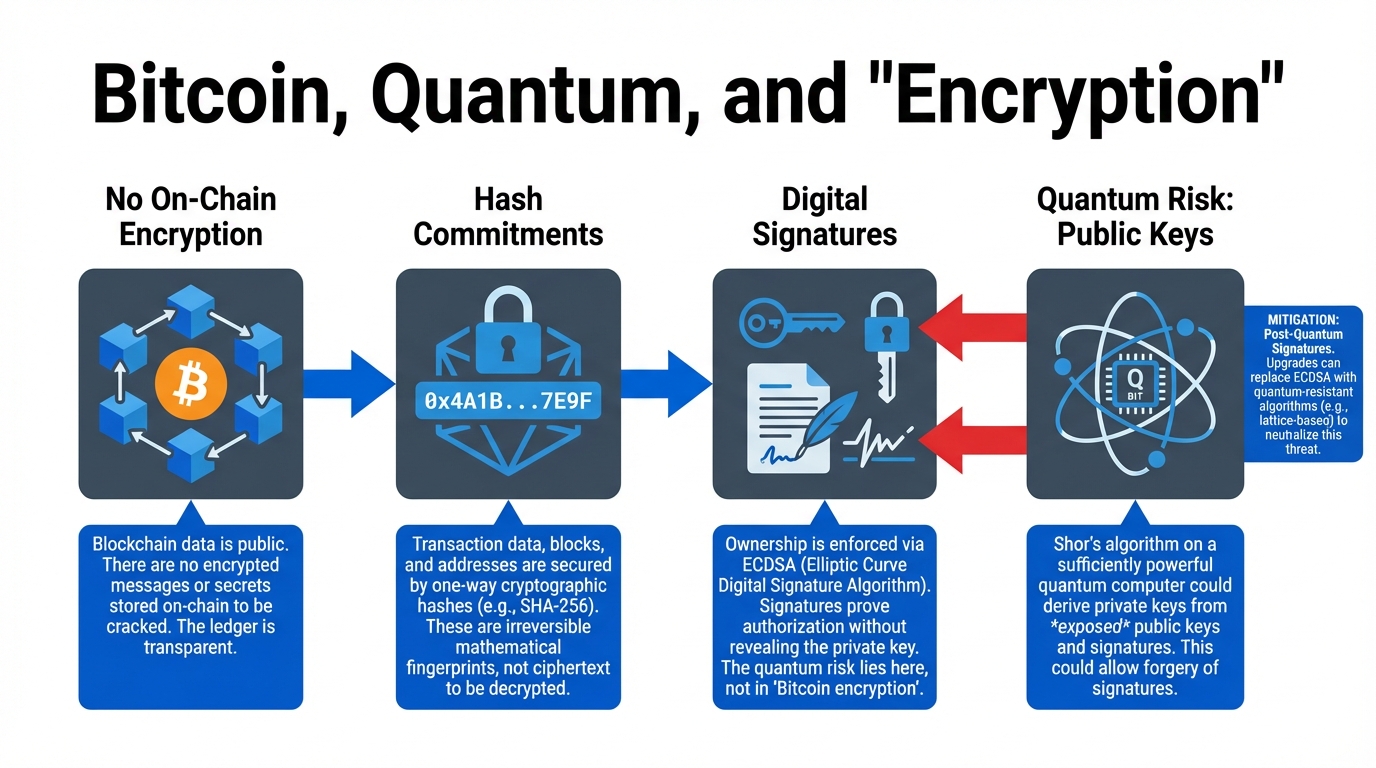
Alright, let’s get technical but keep it conversational—like chatting over coffee with a tech-savvy friend. Bitcoin’s security isn’t built on encryption (which hides data) but on cryptographic primitives like ECDSA (Elliptic Curve Digital Signature Algorithm) for signing transactions and SHA-256 hashing for creating unbreakable fingerprints of data. When you “own” Bitcoin, your wallet holds private keys that generate signatures proving you control those coins. The blockchain records these proofs publicly—no secrets encrypted there.
Quantum computers threaten this via algorithms like Shor’s, which could factor the math behind ECDSA, potentially forging signatures for exposed public keys (like in reused addresses). But here’s the punchline: Most Bitcoin addresses use Pay-to-Script-Hash (P2SH) or newer formats that don’t reveal public keys until spent, shielding them from quantum attacks. Plus, hashes like SHA-256 are quantum-resistant for now—Grover’s algorithm might speed up brute-forcing, but it’s like upgrading from a bicycle to a motorcycle for crossing an ocean; still impractical.
To make this crystal clear, think of Bitcoin’s consensus as a global game of telephone where everyone verifies the message without needing to decrypt hidden parts. Miners use Proof-of-Work (PoW) to add blocks, ensuring the chain’s integrity through computational effort. Tokenomics? Bitcoin has a fixed supply of 21 million coins, halvings every four years, and transaction fees that incentivize security. No fancy token burns or yields here—just pure, decentralized scarcity.
| Aspect | Bitcoin | Ethereum (Post-Merge) | Quantum-Resistant Altcoins (e.g., QRL) |
|---|---|---|---|
| Consensus Mechanism | Proof-of-Work (PoW) – Energy-intensive but battle-tested security. | Proof-of-Stake (PoS) – Energy-efficient, but relies on staked validators. | Post-Quantum PoW – Uses lattice-based crypto to resist quantum attacks from day one. |
| Quantum Vulnerability | Low immediate risk; signatures at risk only if public keys exposed, hashes remain strong. | Similar to BTC; ongoing upgrades like BLS signatures add some resistance. | Designed quantum-resistant; uses XMSS signatures immune to Shor’s algorithm. |
| Adoption Level | High – Institutional backing, $1T+ market cap. | High – DeFi and NFTs hub, but gas fees can bite. | Low – Niche appeal for quantum worriers, smaller ecosystem. |
| Upgrade Path | Soft forks possible (e.g., BIP-360 for post-quantum sigs); community-driven. | Hard forks common; quantum upgrades in roadmap. | Built-in resistance; no major overhauls needed. |
This table highlights how Bitcoin stacks up—it’s not invincible, but its simplicity is a strength. Experts like Adam Back argue quantum threats are “decades away,” with tech like error-corrected qubits still in infancy. Michael Saylor even flips the script, suggesting quantum fears could “burn” lost coins, tighten supply, and boost value. Humor aside, if quantum computers ever factor small numbers like 21 reliably (they can’t yet), Bitcoin devs have proposals like BIP-360 ready to pivot to post-quantum signatures.
Use Cases & Applications
From a developer’s lens, Bitcoin’s quantum-resilient design means you can build apps without immediate doomsday prep. Imagine coding a payment gateway: You rely on signatures for secure transfers, not decryptable data. Users benefit too—think everyday folks using BTC as digital gold. In a quantum era, protocols like Taproot (usage dipped to 20% recently amid debates) enhance privacy without exposing vulnerabilities. Real-world apps? Lightning Network for fast payments sidesteps on-chain risks, or Ordinals for NFTs, where ownership proofs stay quantum-safe. Technically, this setup allows scalable, trustless systems—developers can fork and experiment, while users enjoy censorship-resistant value storage. Just remember, it’s not foolproof; best practices like address reuse avoidance keep you ahead.
Educational Action Plan (How to Learn)
Want to level up your understanding without risking a dime? Here’s a step-by-step plan focused purely on education.
Level 1 (Research/Observation): Start by tracking Bitcoin’s on-chain metrics. Use free tools like Blockchain.com explorers to view transaction hashes and signatures—see how they’re not “encrypted” but publicly verifiable. Read the original Bitcoin whitepaper (it’s only 9 pages!) to grasp the basics. Follow debates on platforms like Twitter or Reddit’s r/Bitcoin; search for “quantum Bitcoin” to see expert takes from folks like Adam Back. Track price charts on CoinMarketCap to observe how news (like quantum FUD) impacts volatility—understand the mechanics, not the bets.
Level 2 (Testnet/Experience): Dive hands-on with Bitcoin’s testnet (a sandbox version of the blockchain). Download a wallet like Electrum, generate testnet addresses, and practice signing transactions. Experiment with libraries like BitcoinJS to code simple scripts—verify how hashes and signatures work without real funds. For quantum angles, explore post-quantum crypto sims on GitHub (e.g., libsodium forks). Emphasize: Use tiny test amounts or simulations only; this is about learning the tech, not live trading.
Conclusion & Future Outlook
In summary, the quantum scare for Bitcoin is more hype than imminent horror—its “encryption” myth busts the biggest fears, but real risks to signatures loom if (big if) quantum tech matures in 10-30 years. Rewards? A robust, evolving protocol that could adapt and thrive, potentially tightening supply as Saylor suggests. Risks? Volatility reigns supreme; markets overreact to news, and unforeseen tech leaps could accelerate threats. Always diversify knowledge, understand the volatility, and focus on long-term utility. Worth watching how devs like those proposing BIP-360 steer the ship—crypto’s future is as unpredictable as it is exciting.

👨💻 Author: SnowJon (Web3 & AI Practitioner / Investor)
A researcher who leverages knowledge gained from the University of Tokyo Blockchain Innovation Program to share practical insights on Web3 and AI technologies. While working as a salaried professional, he shares research-driven insights and real-world experimentation across Web3 and AI.
His motto is to translate complex technologies into forms that anyone can use, fusing academic knowledge with practical experience.
*This article utilizes AI for drafting and structuring, but all technical verification and final editing are performed by the human author.
References
- Bitcoin encryption isn’t at risk from quantum computers for one simple reason: it doesn’t actually exist
- Official Bitcoin Website
- Bitcoin’s quantum debate is resurfacing, and markets are starting to notice (CoinDesk)
- Quantum Computing Will Trigger A Bitcoin Supply Shock: Saylor (Bitcoinist)
- Quantum Panic or Real Risk? Bitcoin Divided on Security (BitDegree)