
Did Bitcoin skip its year-end rally? Pomp says yes, forecasting Q1 2026 stability and avoiding past crashes. Understand the shift!#Bitcoin #CryptoOutlook #MarketStability
Quick Video Breakdown: This Blog Article
This video clearly explains this blog article.
Even if you don’t have time to read the text, you can quickly grasp the key points through this video. Please check it out!
If you find this video helpful, please follow the YouTube channel “BlockChainBulletin,” which delivers daily Crypto news.
https://www.youtube.com/@BlockChainBulletins
Read this article in your native language (10+ supported) 👉
[Read in your language]
Bitcoin Avoids Traditional Year-End Rally, Setting Stage for Q1 Stability According to Anthony Pompliano
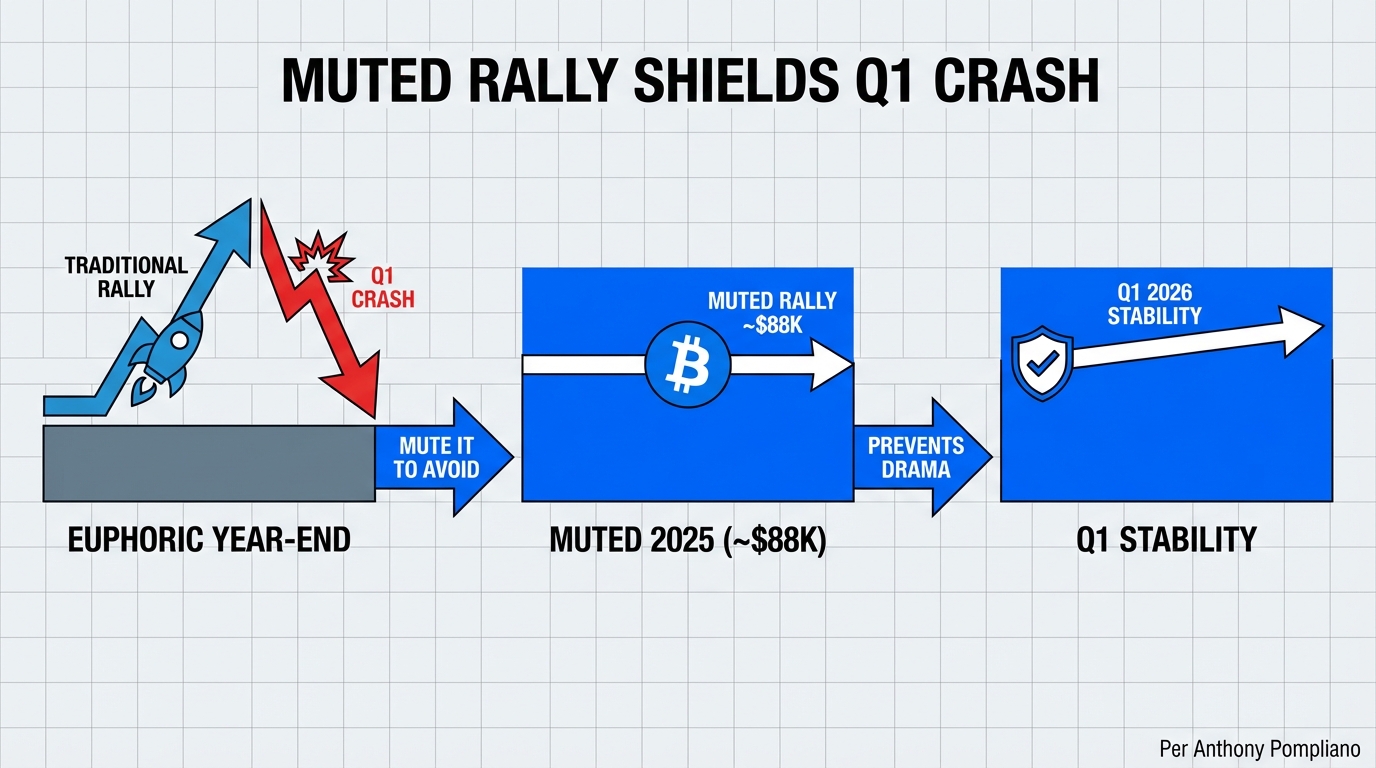
Jon: Hey Lila, I came across this interesting take from Anthony Pompliano on Bitcoin’s behavior wrapping up 2025. Unlike past years where we’d see these wild year-end rallies, Bitcoin has been unusually calm this time around. No massive pump, just steady trading. Pomp suggests this could actually set the stage for more stability heading into Q1 of 2026, with less risk of those brutal drawdowns we’ve seen before.
Lila: Oh, that’s intriguing. I’ve heard about Bitcoin’s historical patterns—big ups at year-end, then crashes in the new year. But why is this lack of a rally a good thing? And who is Anthony Pompliano, anyway?
Jon: Fair questions. Pompliano, or “Pomp” as he’s known, is a prominent investor and commentator in the crypto space—founder of Pomp Investments and a big Bitcoin advocate. He’s been analyzing market cycles for years. The key here is volatility. In previous cycles, Bitcoin would skyrocket toward December, like in 2017 or 2021, with gains over 100% in a short span, only to plummet 70-80% in the following quarter. This year, ending around $90,000 or so based on recent data, it’s up about 100% over two years but without the explosive finish. Pomp argues that this “compressed volatility” means less overhype, potentially avoiding a big crash.
Lila: Why does this matter? For someone new to crypto, it sounds like just another prediction. What’s the bigger picture?
Jon: It matters because understanding these patterns helps demystify Bitcoin’s price swings, which aren’t random—they tie into market maturity, institutional adoption, and global events. If Pomp is right, Q1 2026 could be more predictable, which is huge for the ecosystem. But remember, this is analysis, not a crystal ball. Let’s dive deeper into why these rallies happen and why skipping one might be a breather.
Jon: So, the core problem here is Bitcoin’s historical cycle of boom and bust, especially around year-end. Traditionally, as the year closes, retail investors pile in, driven by FOMO—fear of missing out—pushing prices to absurd highs. Then, come January, profit-taking, regulatory news, or just exhaustion leads to sharp corrections. It’s like a structural flaw in an immature market: too much speculation without enough stabilizing forces.
Lila: That makes sense, but can you break it down? Why does this pattern repeat, and what’s different now?
Jon: Absolutely. Think of it like holiday shopping traffic. Normally, malls get jammed in December with everyone rushing for deals, causing chaos and long lines. But if the crowds are spread out evenly throughout the year, there’s no massive jam—or in this case, no massive crash afterward. Bitcoin’s “traffic” is investor capital. In past cycles, halving events (which cut mining rewards every four years) and hype cycles amplified year-end rallies. Now, with more institutions like ETFs holding steady, the flow is smoother, reducing those peaks and valleys. Pomp points out that Bitcoin’s volatility has compressed, meaning daily swings are smaller, which historically correlates with fewer extreme drawdowns.
Lila: Okay, the traffic analogy helps. So the “problem” is overhyping leading to instability?
Jon: Precisely. And without that traditional rally, we’re not building up the same bubble pressure for a pop in Q1.
Under the Hood: How it Works
Jon: Alright, let’s get into the mechanics of Bitcoin’s price cycles and why this stability might hold. At its core, Bitcoin operates on a proof-of-work consensus mechanism—miners compete to solve cryptographic puzzles to add blocks to the chain, securing the network and earning rewards. But price isn’t directly tied to that; it’s influenced by supply-demand dynamics, halvings, and market sentiment.
Lila: Consensus mechanism? Like, how the network agrees on transactions?
Jon: Exactly. Proof-of-work is like a decentralized lottery where computational power determines who validates the next block. This underpins Bitcoin’s scarcity—only 21 million will ever exist, with halvings every 210,000 blocks (about four years) reducing new supply. In past cycles, post-halving hype led to rallies, peaking at year-end. Now, with Bitcoin’s market cap over a trillion dollars and tools like spot ETFs, it’s behaving more like a mature asset. Pomp’s theory: lower volatility (measured by tools like the Bitcoin Volatility Index) means the price is “suppressed” in a healthy way, avoiding 80% drops.
Lila: So, it’s like Bitcoin is growing up?
Jon: Witty way to put it. Yes, and to illustrate differences, here’s a quick comparison of past cycles versus the current one.
| Aspect | Past Cycles (e.g., 2017, 2021) | Current Cycle (2025-2026) |
|---|---|---|
| Year-End Rally | Explosive, often +100% in Q4 due to retail FOMO | Muted, with steady gains but no “crazy” surge |
| Q1 Volatility | High, leading to 70-80% drawdowns | Compressed, potentially stable as per Pomp |
| Key Drivers | Speculation, halving hype | Institutional adoption, ETFs, maturity |
| Risk of Crash | Very high post-rally | Lower, due to reduced volatility |
Jon: See how the table highlights the shift? This isn’t just theory; data from sources like Cointelegraph backs it up.
Lila: So who actually uses this? I mean, beyond traders staring at charts, what’s the real-world application of Bitcoin in this stable phase?
Jon: Great pivot. Bitcoin’s primary use cases revolve around its technical strengths: as a decentralized store of value, like digital gold, and for peer-to-peer transactions without intermediaries. Developers build on it via layers like Lightning Network for faster, cheaper payments—think micropayments for content creators or cross-border remittances. Institutions use it for hedging inflation, as seen with companies like MicroStrategy holding billions. Users in volatile economies, like in Argentina or Nigeria, leverage it for financial sovereignty. The stability Pomp predicts could make these uses more reliable, encouraging more apps without the fear of wild swings disrupting everything.
Lila: That sounds practical. For payments, it’s like a global Venmo without banks?
Jon: Spot on, but with the added benefit of censorship resistance. No one can freeze your Bitcoin wallet arbitrarily.
Jon: If you’re curious to learn more without any risks, start with Level 1: Research and Observation. Dive into the Bitcoin whitepaper by Satoshi Nakamoto—it’s a short read explaining the basics. Use blockchain explorers like Blockchain.com to watch real-time transactions and block data. Track metrics on sites like Glassnode for volatility trends, which align with Pomp’s views.
Lila: Cool, that’s accessible. What about hands-on? How can I try this safely?
Jon: Level 2: Testnet Experimentation. Bitcoin has a testnet where you can get free test BTC to practice sending transactions. Set up a wallet like Electrum on testnet mode, experiment with addresses and signatures. It’s like a sandbox—no real money involved, perfect for understanding mechanics without exposure. Remember, this is for education; always verify sources.
Jon: Wrapping up, Pompliano’s insight on Bitcoin’s muted 2025 close potentially leading to Q1 2026 stability highlights the asset’s maturation. It’s a reminder that crypto isn’t just about hype—it’s about building resilient systems. Limitations persist, like scalability issues, but the reduced volatility could foster more adoption.
Lila: True, but let’s not forget the volatility and uncertainty in crypto. Markets can surprise, so approach with caution and continuous learning.
Jon: Well said. Worth watching how this plays out.
References
- Bitcoin Avoids Traditional Year-End Rally, Setting Stage for Q1 Stability According to Anthony Pompliano
- Official Bitcoin Website
- Bitcoin Stability May Signal No Drawdown In 2026: Pomp – Cointelegraph
- Analysts’ Bitcoin Price Predictions for Q1 2026 – AMBCrypto