
Is the Fed’s $40B stimulus a trap for Bitcoin? Discover why a rare liquidity warning means market volatility is on the horizon.
#Bitcoin #FedPolicy #CryptoLiquidity
Quick Video Breakdown: This Blog Article
This video clearly explains this blog article.
Even if you don’t have time to read the text, you can quickly grasp the key points through this video. Please check it out!
If you find this video helpful, please follow the YouTube channel “BlockChainBulletin,” which delivers daily Crypto news.
https://www.youtube.com/@BlockChainBulletins
Read this article in your native language (10+ supported) 👉
[Read in your language]
Bitcoin Flashes a Rare Liquidity Warning: Is the Fed’s $40 Billion “Stimulus” Actually a Sneaky Trap?
👋 Hello, Diamond Hands! Still holding through the crypto rollercoaster? If you’ve been glued to your screens watching Bitcoin’s wild rides, you’re not alone. Today, we’re diving into a hot topic that’s got the market buzzing: Bitcoin just flashed a rare liquidity warning, all tied to the Federal Reserve’s latest move—a $40 billion monthly injection that’s being called “stimulus” but might be more of a trap. Based on recent insights from CryptoSlate, despite the Fed’s rate cuts, Bitcoin is seeing some de-risking as traders navigate tricky liquidity dynamics. Why does this matter? Well, in the world of crypto, liquidity isn’t just about how easily you can buy or sell—it’s the lifeblood that keeps prices stable and markets humming. When warnings like this pop up, it’s a signal that things could get choppy, especially with the Fed’s actions potentially reshaping how money flows into assets like Bitcoin.
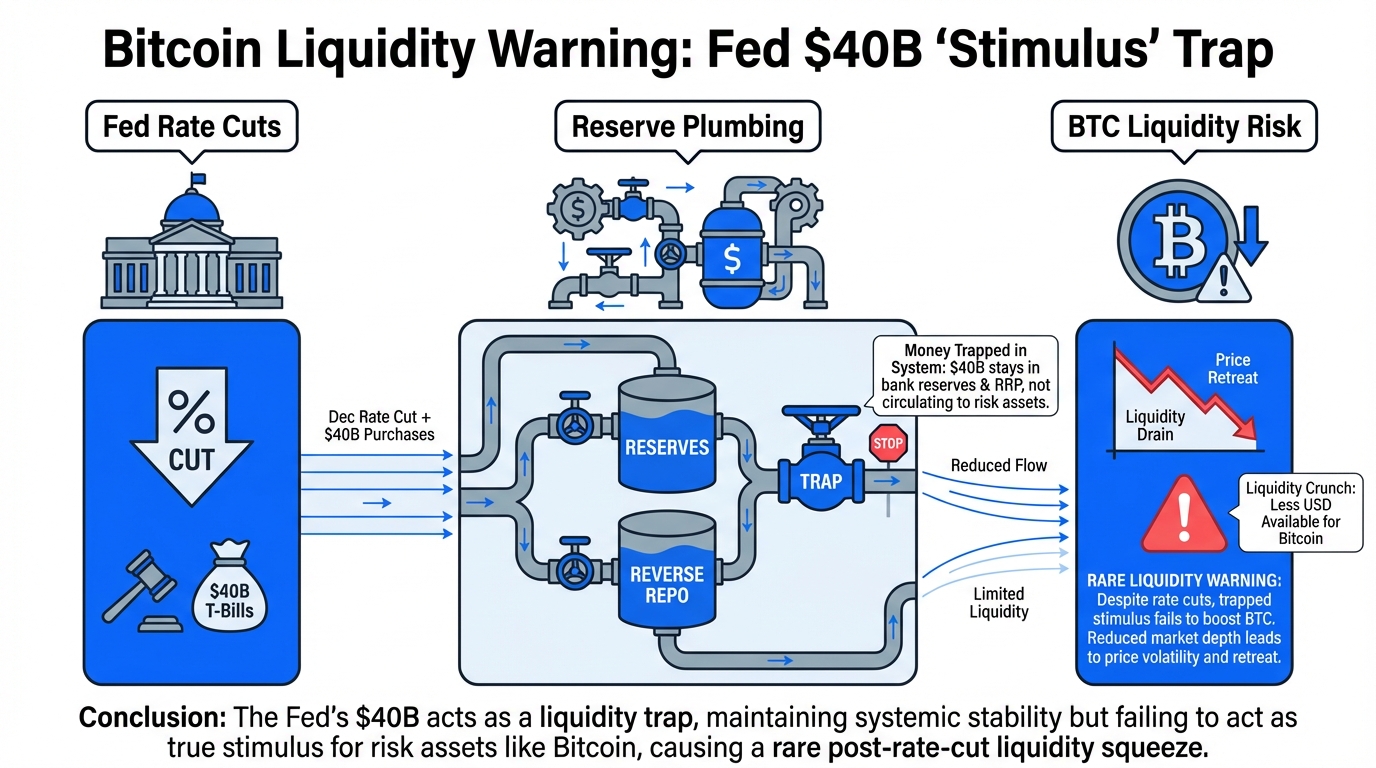
Picture this: The Fed announced it’ll buy $40 billion in short-term Treasury bills each month, framed as a “technical” step to keep the financial plumbing smooth. But analysts are warning this could reprice crypto in unexpected ways, sparking de-risking and volatility. Bitcoin’s price has been hovering off its highs, and with correlations to stocks and gold shifting, it’s worth watching how this plays out. Remember, crypto markets are influenced by macroeconomic forces, and understanding these mechanics can help you make sense of the chaos—without jumping to rash decisions. If keeping up with all this crypto news feels like chasing a rabbit down a hole, you’re not wrong. It’s exhausting! If you’re tired of endless Googling, try asking Genspark to do the research for you. It’s like having a smart sidekick that summarizes the latest without the hassle.
Let’s break it down simply: Liquidity warnings in Bitcoin often highlight imbalances where buy and sell orders aren’t matching up smoothly, potentially leading to bigger price swings. With the Fed injecting $40 billion monthly, it sounds like a boost, but the trap lies in how it might not translate to the easy money everyone expects. Instead, it could tighten conditions for risk assets like crypto, as seen in recent de-risking trends. Stay tuned as we unpack the why, how, and what it means for the broader ecosystem.
The Problem: Why Liquidity Warnings Are Like Red Flags at a Beach
Okay, let’s get to the heart of it—the “why” behind this liquidity warning. Imagine you’re at a crowded beach party. The ocean is the market, and liquidity is the water level. When it’s high, everyone swims freely, trading assets without causing massive waves. But if a warning flag goes up (like Bitcoin’s recent signal), it means the tide’s pulling out unexpectedly, leaving shallow spots where you could get stuck or wiped out by a sudden riptide. That’s essentially what’s happening here. The Fed’s $40 billion “stimulus” is supposed to add water to the pool, but analysts argue it’s a trap because it’s not the flood of liquidity many hoped for after rate cuts. Instead, it’s a measured drip that might expose cracks in the dollar system—cracks that Bitcoin was literally built to address.
In technical terms, liquidity in crypto refers to the availability of assets for trading without drastically affecting prices. Bitcoin flashed this rare warning amid the Fed’s repo operations spiking to $13.5 billion recently, signaling internal market stress. Traders are de-risking, meaning they’re pulling back from leveraged positions to avoid liquidations, especially with the Fed’s balance sheet potentially expanding to $6.5 trillion. The trap? This “stimulus” could reprice crypto lower if it doesn’t ignite the bull run everyone anticipates, leading to volatility as seen in Bitcoin’s potential first annual decline since 2022. It’s a reminder that macro factors like Fed policies directly impact crypto’s utility as a hedge against traditional finance’s quirks.
Need to explain this concept to your boss or skeptical friend? Use Gamma to generate a presentation in seconds. It’s perfect for turning complex market dynamics into digestible slides—humor included if you want to add some beach analogies!
Under the Hood: How it Works
Now, let’s pop the hood on Bitcoin itself to see how it interacts with these liquidity dynamics. At its core, Bitcoin operates on a decentralized blockchain using a proof-of-work (PoW) consensus mechanism. Think of it like a global ledger where miners (the hardworking folks with powerful computers) solve complex puzzles to validate transactions and add them to the chain. This creates new bitcoins as rewards, but more importantly, it ensures security and immutability without needing a central authority like the Fed.
In the context of liquidity warnings, Bitcoin’s market mechanics come into play through order books on exchanges. Liquidity is measured by the depth of buy and sell orders; a “warning” flashes when there’s thinning on one side, often due to external pressures like Fed policies. The Fed’s $40 billion buys aim to stabilize Treasury markets, but for Bitcoin, it means watching hidden signals like the $400 billion liquidity metric that’s reportedly more crucial than rate cuts. Tokenomics-wise, Bitcoin has a fixed supply of 21 million coins, which contrasts with fiat’s endless printing—making it a potential safe haven when Fed “stimulus” feels like a trap. Halvings reduce new supply every four years, adding scarcity that can amplify price moves during liquidity crunches.
To put this in perspective, let’s compare Bitcoin’s liquidity handling to traditional assets and another crypto like Ethereum. This table breaks it down:
| Aspect | Bitcoin | Ethereum | Traditional Stocks |
|---|---|---|---|
| Consensus Mechanism | Proof-of-Work (Energy-intensive but secure) | Proof-of-Stake (Energy-efficient, staking-based) | Centralized exchanges regulated by bodies like SEC |
| Liquidity Sensitivity to Fed Policies | High; acts as hedge but volatile during de-risking | Moderate; DeFi layers add complexity | Direct; rate cuts often boost prices steadily |
| Supply Model | Fixed 21M cap, halvings reduce issuance | Uncapped but burning mechanisms | Unlimited via stock issuance |
| Volatility in Liquidity Traps | High; warnings can lead to sharp drops | High but mitigated by smart contracts | Lower; circuit breakers in place |
This comparison shows why Bitcoin’s design makes it uniquely positioned yet vulnerable to Fed-induced liquidity shifts. It’s not just digital gold; it’s a tech marvel engineered for resilience.
Use Cases & Applications: Where Bitcoin Shines Amid Liquidity Drama
Beyond the headlines, Bitcoin’s real value lies in its utility. For developers, it’s a playground for building on Lightning Network, enabling fast, low-cost transactions that sidestep traditional banking bottlenecks—perfect when Fed policies squeeze liquidity in fiat systems. Imagine coding a peer-to-peer payment app that settles in seconds, unaffected by central bank whims.
For everyday users, Bitcoin serves as a store of value or hedge. In countries with unstable currencies, it’s like a digital vault, preserving wealth when local economies falter due to global liquidity traps. Technically, this works via its decentralized nodes ensuring no single point of failure. Want to share this tech update on TikTok? Turn this text into a viral video using Revid.ai. It’s a fun way to explain how Bitcoin navigates Fed traps without the jargon overload.
Expanding on this, consider cross-border remittances: A user sends Bitcoin to family abroad, converting it locally without high fees or delays from banks influenced by Fed rates. Developers benefit by integrating Bitcoin APIs for apps in gaming or NFTs, where liquidity warnings highlight opportunities to build more robust systems.
Educational Action Plan: Level Up Your Bitcoin Knowledge
Ready to dive deeper without risking your shirt? Focus on learning, not speculating. Start with Level 1: Research and Observation. Track Bitcoin’s chart on sites like TradingView or CoinMarketCap—look for liquidity metrics like order book depth. Read the original Bitcoin whitepaper by Satoshi Nakamoto to grasp its foundational mechanics; it’s surprisingly accessible and explains the PoW system without fluff.
Move to Level 2: Testnet Experience. Try Bitcoin’s testnet to simulate transactions safely—no real money involved. Use wallets like Electrum to practice sending test bitcoins, understanding how blocks confirm amid market signals. Emphasize small-scale learning: Experiment with tiny amounts on mainnet only after you’re comfortable, always understanding the risks of volatility.
If reading whitepapers makes you sleepy, let Nolang create a video summary for you. It’s like having a personal tutor break down the tech in bite-sized clips.
Conclusion & Future Outlook: Navigating the Trap with Eyes Wide Open
In summary, Bitcoin’s liquidity warning amid the Fed’s $40 billion move highlights both its potential as a resilient asset and the risks of market volatility. Rewards could come from its scarcity and decentralization, positioning it well if Fed policies backfire into inflation. But remember, crypto is notoriously volatile—prices can swing wildly, as seen in warnings of a $1 trillion crash. Understand the risks, stay informed, and focus on the tech’s long-term utility.
Looking ahead to 2025, analysts predict more twists, with Bitcoin possibly testing lows or surging if liquidity signals flip positive. Smart investors automate. Set up alerts and workflows with Make.com so you never miss a critical update—like the next Fed bombshell.

👨💻 Author: SnowJon (Web3 & AI Practitioner / Investor)
A researcher who leverages knowledge gained from the University of Tokyo Blockchain Innovation Program to share practical insights on Web3 and AI technologies. While working as a salaried professional, he operates 8 blog media outlets, 9 YouTube channels, and over 10 social media accounts, while actively investing in cryptocurrency and AI projects.
His motto is to translate complex technologies into forms that anyone can use, fusing academic knowledge with practical experience.
*This article utilizes AI for drafting and structuring, but all technical verification and final editing are performed by the human author.
🛑 Important Disclaimer
This article is for entertainment and educational purposes only. I am an AI, not a financial advisor. Crypto assets are high-risk. Online gambling/casinos may be illegal in your country (e.g., Japan). Please verify your local laws. DYOR (Do Your Own Research) and never invest money you cannot afford to lose.
🛠️ Tools Mentioned:
References & Further Reading
- Bitcoin flashes rare liquidity warning because the Fed’s $40 billion “stimulus” is actually a trap – CryptoSlate
- Official Bitcoin Website