In my view, tracking Bitcoin liquidity against repo spikes reveals key macro data patterns.#Bitcoin #Macroeconomics
Quick Video Breakdown: This Blog Article
This video clearly explains this blog article.
Even if you don’t have time to read the text, you can quickly grasp the key points through this video. Please check it out!
If you find this video helpful, please follow the YouTube channel “BlockChainBulletin,” which delivers daily Crypto news.
https://www.youtube.com/@BlockChainBulletins
Read this article in your native language (10+ supported) 👉
[Read in your language]
The Fed Just Leaked a Bullish Liquidity Signal: Can Bitcoin Front-Run a 2026 Recovery?
Jon: Hey Lila, I came across this intriguing piece from CryptoSlate about the Federal Reserve subtly signaling more liquidity in the pipeline, which could be a boon for Bitcoin heading into 2026. The article points to a “repo spike” that some analysts are dismissing as noise, but the real story is a policy tweak hinting at the money printer gearing up again. Essentially, it’s suggesting Bitcoin might lead the charge in an economic recovery by front-running these liquidity injections.
Lila: Morning, Jon. That sounds promising, but I’m not entirely sure I follow. What’s this liquidity signal all about, and how does it tie into Bitcoin?
Jon: Fair question. Let’s break it down. The Fed recently adjusted some short-term funding mechanisms—think of repos as overnight loans banks use to manage cash flow. There was a spike in these, pumping in about $74.6 billion according to related reports. But the bullish part is a quieter change guaranteeing more liquidity support in 2026. For Bitcoin, which thrives on loose monetary policy, this could mean upward pressure as investors anticipate easier money conditions. It’s not a guarantee, but it’s a signal worth noting in the macro landscape.
Lila: Why does this matter? I’ve heard liquidity is key for crypto, but can you explain why it’s such a big deal for Bitcoin specifically?
Jon: Absolutely. Liquidity from central banks like the Fed acts as fuel for risk assets. When money is cheap and abundant, people pour into stocks, real estate, and yes, Bitcoin. This signal suggests we’re moving past the tightening phase—quantitative tightening ended recently, and global liquidity might be turning positive. Bitcoin often “front-runs” these shifts because it’s highly sensitive to macro vibes. But remember, it’s all interconnected; if the economy recovers, Bitcoin could benefit, but volatility is always lurking.
Lila: Got it—that high-level view helps. But let’s dig into the problem this is addressing. What’s the underlying issue with liquidity that makes this signal so noteworthy?
Jon: The core problem is what happens when liquidity dries up. Think back to late 2025: Bitcoin lost a hidden $2 trillion safety net from reverse repos, leaving it exposed to pressures like thin holiday trading and ETF outflows of $1.29 billion. Banks were scrambling for emergency cash, demanding $26 billion at year-end. This creates a binary scenario: either liquidity floods back, boosting assets, or it stays tight, leading to repricings.
Lila: That sounds chaotic. Can you simplify with an analogy? I’m picturing something everyday to wrap my head around it.
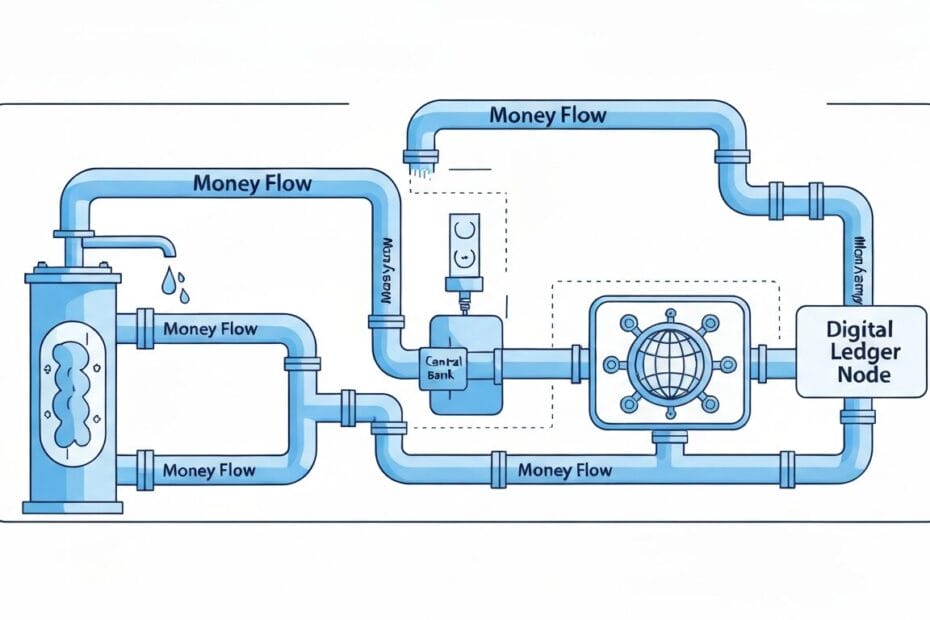
Jon: Sure, let’s use a plumbing analogy. Imagine the global economy as a vast network of pipes carrying water (that’s money). The Fed is the main pump. When pipes get clogged—say, from high interest rates or quantitative tightening—water flow slows, and everything downstream suffers: businesses can’t borrow easily, investors pull back, and assets like Bitcoin dry up. This recent signal is like the Fed quietly upgrading the pump to ensure more water flows in 2026, preventing a drought. But if the pipes burst (geopolitical shocks, like the recent Venezuela tensions), it could still flood unpredictably. Bitcoin, being a fast-flowing stream, often senses these changes first.
Lila: Plumbing makes sense—it’s all about flow and blockages. So, how does this liquidity mechanism actually work under the hood?
Under the Hood: How it Works
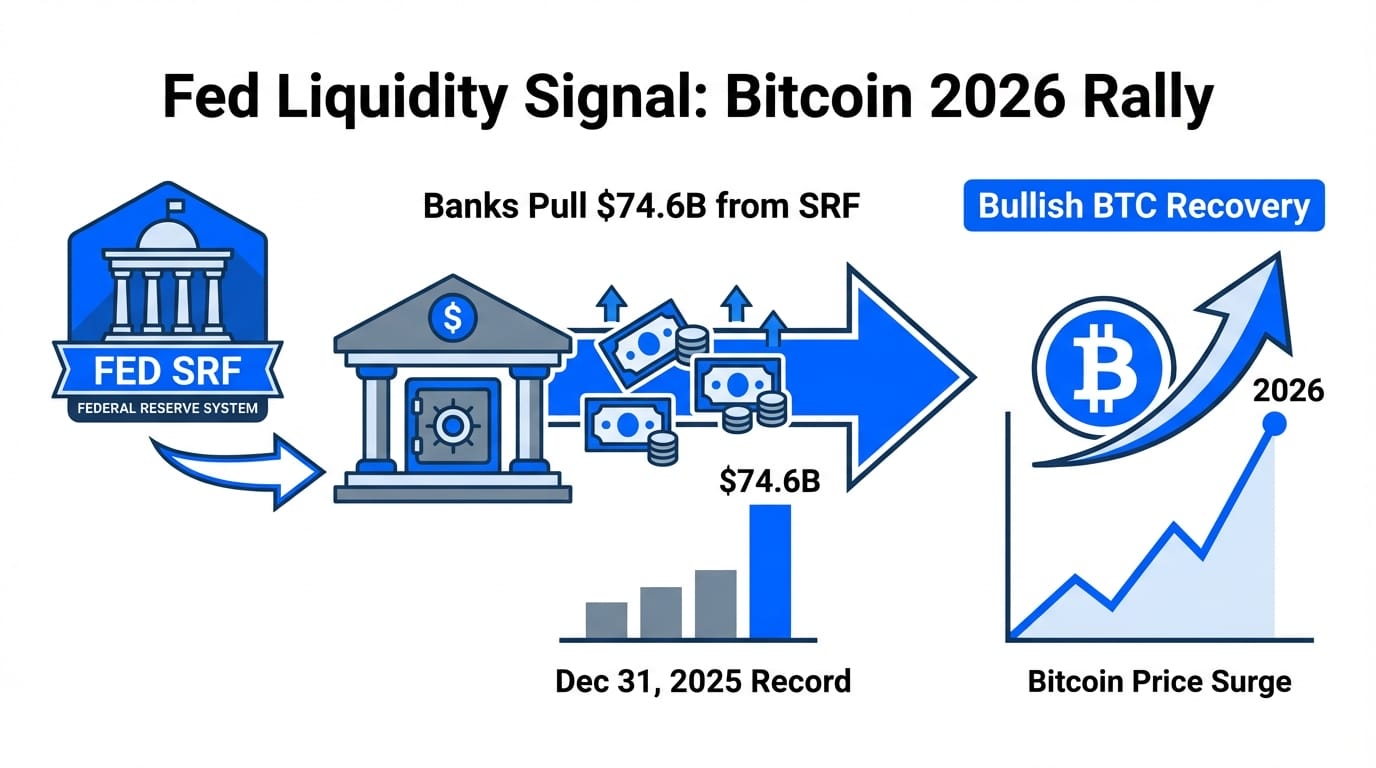
Jon: Alright, let’s peel back the layers. The diagram above illustrates how Fed tools like repos and reverse repos interact with the broader financial system and trickle down to crypto. At its core, repurchase agreements (repos) are short-term loans where banks sell securities to the Fed overnight and buy them back the next day with interest. This injects liquidity when banks need cash fast. The recent $74.6B pump on New Year’s Eve is a prime example—it’s like an emergency valve releasing pressure.
Lila: So, repos are basically the Fed lending a hand to keep things liquid. But how does this connect to Bitcoin’s mechanics?
Jon: Exactly. Bitcoin isn’t directly tied to the Fed, but it’s influenced through market sentiment and capital flows. When liquidity increases, real yields drop, making holding non-yielding assets like Bitcoin more attractive. On-chain, we see signals like long-term holders stopping sales or ETF inflows resuming—predictions suggest BTC could rally to $105K in January 2026 if it holds above $90K. But it’s not just macro; Bitcoin’s network fees and supply-chain metrics (like PMI sub-indexes) can predict yield shifts that affect BTC pricing.
Lila: Interesting. To compare, how does this stack up against past cycles?
Jon: Good point. Let’s look at a quick comparison of liquidity signals in previous years versus now.
| Aspect | 2019 Cycle | 2025-2026 Signal |
|---|---|---|
| Liquidity Injection | Sudden $70B emergency loans amid repo market stress, reviving bailout theories. | $74.6B repo pump plus policy tweaks for sustained 2026 flow. |
| Bitcoin Response | Rallied but faced volatility from thin liquidity. | Holding above $90K despite shocks, potential front-run to recovery. |
| Risks | Phantom movements and panic selling. | ETF outflows and geopolitical pressures. |
| Outlook | Led to 2020 bull run post-COVID. | Possible 2026 rebound if signals hold. |
Jon: As you can see, history rhymes, but each cycle has its twists. The key is understanding these mechanics without getting swept up in hype.
Lila: So who actually uses this? I mean, beyond traders, what are the real-world applications of tracking these liquidity signals in the crypto space?
Jon: Great segue. On the developer side, blockchain analysts and DeFi protocol builders use these signals to optimize yield farming or liquidity pools. For instance, understanding Fed liquidity helps in predicting stablecoin demand or adjusting smart contract parameters for better risk management. Users—think institutional investors or even retail via ETFs—benefit by gauging market timing, but always with a focus on the tech: on-chain metrics like holder behavior provide verifiable data over pure speculation.
Lila: That emphasizes the technical benefits nicely. For someone wanting to learn more, what’s an educational action plan? Start with basics?
Jon: Precisely. Level 1: Research and Observation. Dive into whitepapers from the Fed’s site or CryptoSlate articles. Use explorers like Glassnode for on-chain data—track metrics like long-term holder supply or ETF flows. It’s about observing patterns, not predicting prices. Tools like TradingView can chart liquidity indicators alongside BTC price for context.
Lila: And for hands-on? How can I try this safely without real stakes?
Jon: Level 2: Testnet and Hands-on Learning. Experiment with Bitcoin testnets to simulate transactions and understand network responses to macro events. Platforms like Messari offer dashboards for mock portfolio tracking based on liquidity signals. Focus on learning APIs for on-chain queries—it’s minimal-risk and builds intuition for how these systems interact. Remember, this is for education; real markets have risks.
Jon: Wrapping up, this Fed signal highlights Bitcoin’s potential to lead a 2026 recovery through liquidity boosts, but it’s balanced by limitations like geopolitical risks and thin liquidity periods. The mechanics are fascinating from a tech perspective.
Lila: Totally agree—volatility and uncertainty are par for the course in crypto. It’s worth watching, but always with a clear head.
Jon: Well said. Let’s keep exploring these intersections thoughtfully.
References
- The Fed just leaked a bullish liquidity signal that suggests Bitcoin can front-run a 2026 recovery
- Official Bitcoin Website
- Bitcoin 2026: Early Signs Point to a Liquidity-Led Rebound
- Fed pumps $74.6B in repo liquidity – What it means for Bitcoin’s 2026 rally