
Could 100+ crypto ETFs by 2026 create a single point of failure, freezing 85% of global assets? Dive into the hidden risks.#BitcoinETFs #CryptoRisk #SPOF
Quick Video Breakdown: This Blog Article
This video clearly explains this blog article.
Even if you don’t have time to read the text, you can quickly grasp the key points through this video. Please check it out!
If you find this video helpful, please follow the YouTube channel “BlockChainBulletin,” which delivers daily Crypto news.
https://www.youtube.com/@BlockChainBulletins
Read this article in your native language (10+ supported) 👉
[Read in your language]
Bitcoin ETFs: The Terrifying “Single Point of Failure” That Could Freeze 85% of Global Assets?
👋 Hello, Diamond Hands! Still holding through the crypto winters and summers alike? If you’re here, you’re probably no stranger to the wild ride of Bitcoin and its ecosystem. Today, we’re diving into a hot topic that’s buzzing in the crypto world: the potential pitfalls of the exploding Bitcoin ETF market. Based on recent insights from industry reports, we’re looking at how the flood of new crypto ETFs—potentially over 100 by 2026—could introduce a scary “single point of failure” that might impact a massive chunk of global assets.
Let’s break it down simply. Back in 2024, spot Bitcoin ETFs burst onto the scene in the US, allowing everyday investors to get exposure to Bitcoin’s price without dealing with wallets, keys, or the hassle of exchanges. Fast-forward to now (late 2025), and the SEC has greenlit generic listing standards, slashing launch times and paving the way for a deluge of these products. Analysts predict this “ETF palooza” could cover Bitcoin, Ethereum, Solana, and beyond. But here’s the twist: while this sounds like a win for accessibility, there’s a lurking risk. Many of these ETFs might rely on the same underlying infrastructure—like custody providers or authorized participants (APs)—creating a bottleneck. If that shared system hiccups, it could theoretically “freeze” up to 85% of global assets tied to these funds, according to some projections. Why does this matter? It highlights how even “safe” traditional finance tools can inherit crypto’s decentralized quirks… or lack thereof. Stick around as we unpack this with humor, analogies, and zero hype—just the tech facts to help you understand the mechanics and risks.
The Problem (The “Why”)
Imagine you’re at a massive music festival with thousands of fans all funneling through one tiny entrance gate. Everything’s fine until a storm hits, the gate jams, and suddenly, nobody can get in or out. Chaos ensues—people are stuck, the show grinds to a halt, and your plans for the night? Toast. That’s essentially the “single point of failure” we’re talking about with Bitcoin ETFs.
In the world of ETFs, this gate is often the custody system or the authorized participants (APs). APs are the big players—like major banks or financial firms—that create and redeem ETF shares by swapping actual Bitcoin for fund units. Custody, meanwhile, is the secure storage of the underlying crypto assets, handled by specialized firms. With the SEC’s new rules speeding up approvals, we’re expecting a flood of 100+ crypto ETFs by 2026. But here’s the witty (and worrying) part: many of these will likely share the same handful of APs and custodians. Why? Because not every issuer wants to build their own vault from scratch—it’s expensive, regulated, and a regulatory nightmare.
Think of it like all the pizza delivery services in your city relying on the same one highway to get to your door. If that highway gets blocked (say, by a regulatory crackdown, a cyber attack, or even operational overload), deliveries stop. In ETF terms, this could mean halted redemptions, frozen trading, or worse—systemic ripples across global markets. Reports suggest this shared “plumbing” (APs, custody, borrowing mechanisms, and spreads) could expose 85% of assets if things go south. It’s not just Bitcoin; Ethereum and Solana ETFs are in the mix too. Humor aside, this isn’t fear-mongering—it’s a call to understand the tech backbone before the party gets too crowded.
Under the Hood: How it Works
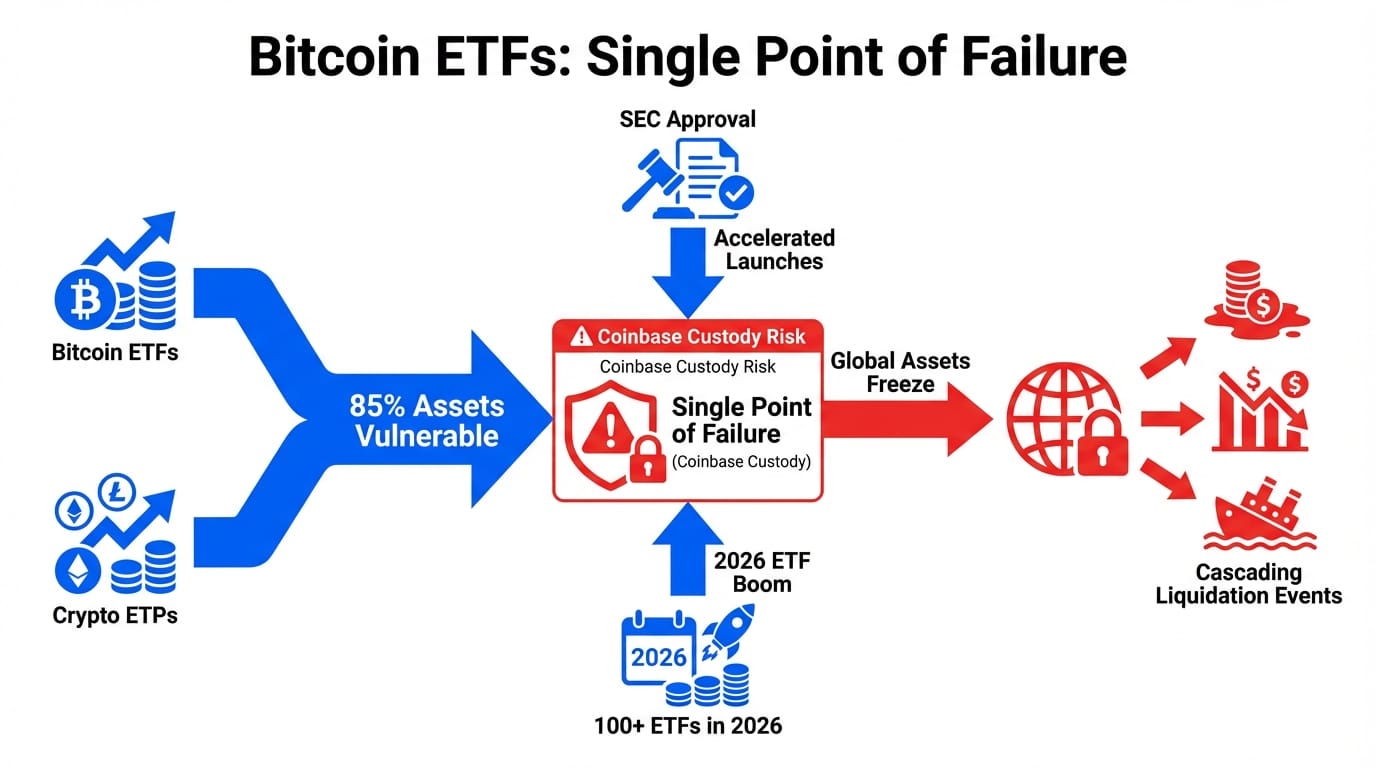
Alright, let’s pop the hood on Bitcoin ETFs and see what’s really driving this machine. At their core, spot Bitcoin ETFs are like a bridge between the wild west of crypto and the buttoned-up world of traditional finance. Unlike futures-based ETFs (which bet on price predictions without holding the actual asset), spot ETFs actually own Bitcoin. They track its price in real-time by holding the crypto in secure custody.
Here’s the breakdown, step by step, with a dash of analogy to keep it fun. Picture an ETF as a vending machine: you put in your cash (buy shares), and it dispenses Bitcoin exposure without you ever touching the coins. The magic happens through a few key players:
- Issuers: Companies like BlackRock or Fidelity create the ETF. They’re the chefs deciding the recipe.
- Authorized Participants (APs): These are the behind-the-scenes heroes (or potential villains in our failure scenario). APs, often big banks like Morgan Stanley or Goldman Sachs, handle the creation and redemption of shares. They deliver Bitcoin to the ETF in exchange for shares (creation) or vice versa (redemption). It’s like trading ingredients for a finished pizza—keeps the ETF’s price in line with Bitcoin’s actual value.
- Custodians: Firms like Coinbase Custody or Gemini store the Bitcoin securely. This is the vault where the real assets live, protected by multi-signature wallets, cold storage, and insurance. But remember our festival gate analogy? If most ETFs use the same custodian, one breach or outage could cascade.
- Tokenomics and Mechanics: There’s no fancy consensus mechanism like Proof-of-Work here (that’s Bitcoin’s blockchain job). Instead, it’s all about market mechanics. The ETF’s net asset value (NAV) is calculated daily based on Bitcoin’s spot price. Borrowing and spreads come into play for liquidity—APs might borrow crypto to facilitate trades, and tight spreads ensure the ETF price doesn’t stray far from NAV. In 2025, with new SEC rules, banks can even “control” private keys via paperwork, not physical possession, which adds another layer of risk.
To make it educational and witty: If Bitcoin’s blockchain is a decentralized party where everyone votes on the music (via miners), ETFs are the VIP lounge—exclusive access, but reliant on a few bouncers (APs and custodians). The single point of failure? Those bouncers. If they’re overwhelmed or compromised, the lounge shuts down. Recent analyses predict that by 2026, ETF demand could consume over 100% of new Bitcoin supply, amplifying these risks. But hey, understanding this plumbing helps you spot the leaks before they flood the basement.
| Aspect | Bitcoin ETFs | Traditional Stock ETFs | Direct Crypto Holding |
|---|---|---|---|
| Underlying Asset | Actual Bitcoin held in custody | Stocks or bonds, easily custodied | Direct ownership of BTC via wallets |
| Single Point of Failure Risk | High; shared APs/custodians could freeze operations | Low; diverse infrastructure | Minimal; decentralized network |
| Accessibility | Easy via brokerage accounts | Very easy, regulated | Requires tech savvy (wallets, security) |
| Volatility Exposure | Direct to BTC price swings | Varies by holdings | Full, unfiltered |
| Regulatory Oversight | Evolving; SEC-approved but crypto-specific risks | Mature and stable | Limited; self-regulated |
Use Cases & Applications
So, how does this all play out in the real world? For developers and users, Bitcoin ETFs aren’t just about price speculation—they’re a technical gateway to integrating crypto into broader systems. Let’s explore some scenarios objectively.
For Developers: If you’re building fintech apps or DeFi platforms, ETFs offer a standardized way to plug into Bitcoin’s liquidity without reinventing the wheel. Imagine coding a portfolio tracker app: instead of handling raw blockchain data (which requires nodes, APIs, and constant uptime), you can pull ETF data from stock exchanges. This reduces complexity—your app queries familiar APIs like those from NYSE or Nasdaq. Plus, with index ETFs on the horizon (blending BTC, ETH, and SOL), devs can create diversified tools for risk management, like automated rebalancing scripts. The catch? That single point of failure means your app could go dark if custody issues arise, so building redundancies (e.g., fallback to direct chain queries) is key.
For Users (Enthusiasts or Institutions): On the user side, think of ETFs as a “crypto lite” experience. A beginner user benefits by gaining exposure through a retirement account, avoiding the tech hurdles of seed phrases and gas fees. Institutions? They love the regulatory wrapper—ETFs fit neatly into compliance frameworks, enabling pension funds to allocate without direct crypto handling. Real-world application: During market volatility, users can hedge via ETF options, borrowing mechanisms allowing short positions. But remember the analogy— if the shared plumbing clogs, redemptions could halt, affecting everything from personal portfolios to global liquidity. Worth watching how this evolves, especially as crypto vanishes from government “vulnerability” lists, signaling more institutional adoption.
To add some humor: It’s like ordering takeout instead of cooking—convenient, but if the restaurant’s kitchen (custody) catches fire, everyone’s dinner is delayed. Technically, this setup democratizes access, but it centralizes risks in ways pure blockchain avoids.
Educational Action Plan (How to Learn)
Knowledge is power in crypto, so let’s focus on learning without any push toward investing. This is about building understanding—volatility is real, and markets can swing wildly. Start small and educate yourself step by step.
Level 1 (Research/Observation): Begin by tracking ETF performance and mechanics. Head to free sites like Yahoo Finance or Bloomberg to monitor tickers (e.g., IBIT for BlackRock’s Bitcoin ETF). Watch how the price tracks Bitcoin’s spot value—note any premiums or discounts, which highlight AP efficiency. Dive into prospectuses (available on issuer sites like fidelity.com)—these are like whitepapers for ETFs, explaining custody, fees, and risks. Search for terms like “authorized participant” to grasp the plumbing. Pro tip: Use tools like Google Alerts for “Bitcoin ETF news” to stay updated on flows and predictions, such as weakening inflows potentially dragging prices to $60k support levels. This builds intuition without any commitment.
Level 2 (Testnet/Experience): To get hands-on, simulate the experience safely. Many brokerage platforms offer paper trading accounts—sign up for a demo on TD Ameritrade or Interactive Brokers to “trade” ETF shares with fake money. Experiment with buying/selling during market hours to see how liquidity works (or doesn’t) under stress. For a deeper tech angle, explore blockchain explorers like Etherscan (for ETH-related ETFs) or Blockchair for Bitcoin—trace custody wallet addresses mentioned in ETF filings. If you’re developer-inclined, build a simple script using Python and APIs from CoinGecko to compare ETF NAV vs. direct crypto prices. Emphasize: Use small, educational amounts or test environments only—never real funds for learning. This way, you understand the single point of failure firsthand, like testing a bridge’s weight limit with toy cars before the real traffic.
Conclusion & Future Outlook
Wrapping this up: Bitcoin ETFs are a fascinating evolution, blending crypto’s innovation with finance’s structure, but that “terrifying single point of failure” in shared custody and APs is a real eye-opener. On the reward side, they could drive massive adoption, with predictions of ETFs consuming over 100% of new supply by 2026, potentially stabilizing prices through institutional inflows. Risks? Volatility remains king—Bitcoin could dip to brutal supports amid macro uncertainty, and a failure in the plumbing might cascade, freezing assets as warned. Always remember, crypto markets are unpredictable; understand the tech, weigh the trade-offs, and stay informed.

👨💻 Author: SnowJon (Web3 & AI Practitioner / Investor)
A researcher who leverages knowledge gained from the University of Tokyo Blockchain Innovation Program to share practical insights on Web3 and AI technologies. While working as a salaried professional, he shares research-driven insights and real-world experimentation across Web3 and AI.
His motto is to translate complex technologies into forms that anyone can use, fusing academic knowledge with practical experience.
*This article utilizes AI for drafting and structuring, but all technical verification and final editing are performed by the human author.
References
- Bitcoin ETFs share a terrifying “single point of failure” that could freeze 85% of global assets
- 100 new crypto ETFs in 2026 will share a terrifying “single point of failure” that could freeze 85% of global assets | Bitget News
- Bitwise Says Over 100 Crypto-Linked ETFs Set to Launch
- Bitcoin’s Evolving Risk Profile and Institutional Readiness: A Strategic Diversifier in 2026