Bitcoin Cash (BCH) is one of the most consequential forks in cryptocurrency history — a blockchain born from a fundamental disagreement about what Bitcoin was supposed to be. Nearly a decade after its creation in 2017, BCH continues to pursue a clear mission: fast, low-cost, peer-to-peer electronic cash for everyday use. As of March 2026, BCH trades around $470, holds a top-15 market ranking, and is preparing for its most significant network upgrade in years: the Layla hard fork scheduled for May 2026.
This guide covers everything you need to know about Bitcoin Cash — its origins, technical architecture, use cases, how it compares to Bitcoin, and what the 2026 upgrade means for its future.
What Is Bitcoin Cash?
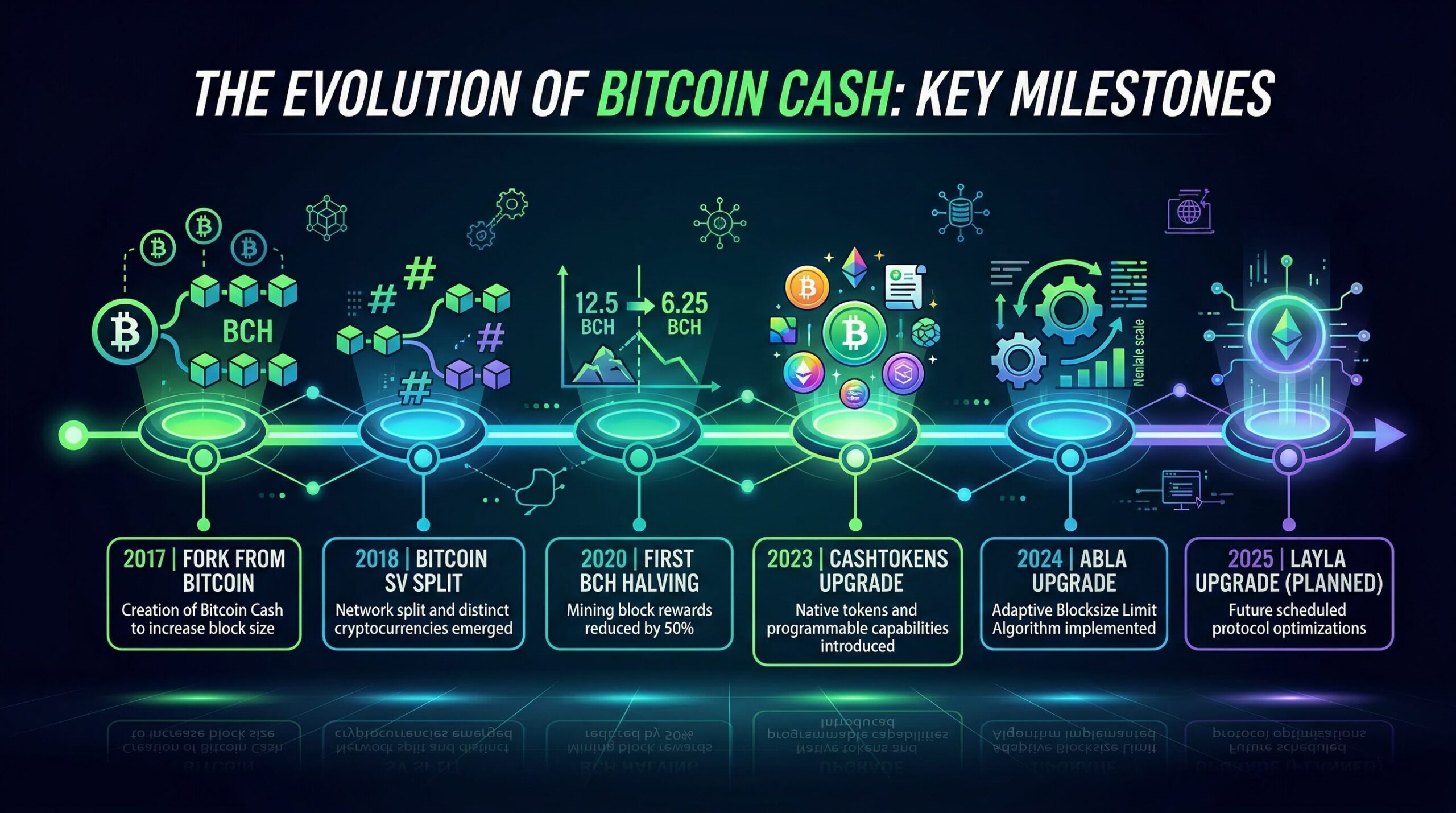
Bitcoin Cash is an independent blockchain and cryptocurrency that shares its early history with Bitcoin. It was created on August 1, 2017, through a process called a hard fork — a permanent split in the blockchain where a portion of the network adopted a new set of rules. The central issue was block size: how much transaction data each block could contain, and by extension, how many transactions the network could process per second.
The result is a cryptocurrency that prioritizes on-chain transaction throughput and low fees. While Bitcoin has evolved primarily into a store of value (often called “digital gold”), Bitcoin Cash positions itself as digital cash — a medium for everyday payments, remittances, and microtransactions. The BCH token has a fixed maximum supply of 21 million coins, identical to Bitcoin, and uses the same Proof of Work (SHA-256) consensus mechanism.
Key Facts at a Glance (March 2026)
- Current price: Approximately $470 USD
- Market capitalization: Approximately $9.4 billion USD
- Market rank: #12–15 by market cap
- Circulating supply: ~20.01 million BCH
- Maximum supply: 21 million BCH
- Block size: 32 MB (versus 1 MB for Bitcoin)
- Transaction speed: Up to 200 transactions per second (on-chain)
- Average transaction fee: Fractions of a cent
- Consensus mechanism: Proof of Work (SHA-256)
- Next major upgrade: Layla (CashVM) — May 15, 2026
The Origins of Bitcoin Cash: The 2017 Scaling Wars
To understand Bitcoin Cash, you need to understand the “block size debate” — one of the most contentious disputes in cryptocurrency history. By 2016 and 2017, Bitcoin’s popularity had created a scalability problem. With blocks limited to 1 MB, the network could handle only about 3–7 transactions per second. As demand surged, users faced long confirmation times and fees that sometimes reached $50 or more per transaction. For small everyday payments, Bitcoin had become impractical.
Two camps emerged. One side — which would become the Bitcoin Cash movement — argued that the most straightforward fix was to increase the block size, allowing more transactions per block and restoring Bitcoin’s utility as payment infrastructure. The other side worried that larger blocks would increase the cost of running full nodes, potentially centralizing the network among fewer powerful operators. This group favored off-chain solutions like the Lightning Network.
The hard fork occurred on August 1, 2017, when the Bitcoin Cash blockchain split from Bitcoin at block height 478,558. Bitcoin Cash launched with an 8 MB block size limit, immediately providing substantially more transaction capacity. The initial block size was later expanded to 32 MB in 2018.
The Fork’s Key Figures
The development of what became Bitcoin Cash began as early as 2016, driven by developer Amaury Séchet (known as deadalnix) and freetrader (Gavin Andresen’s codebase contributions were also influential). Prominent early supporter Roger Ver — sometimes called “Bitcoin Jesus” for his early advocacy of Bitcoin — became BCH’s most visible public champion. Mining conglomerate Bitmain, led by Jihan Wu, also backed the fork with significant hash power.
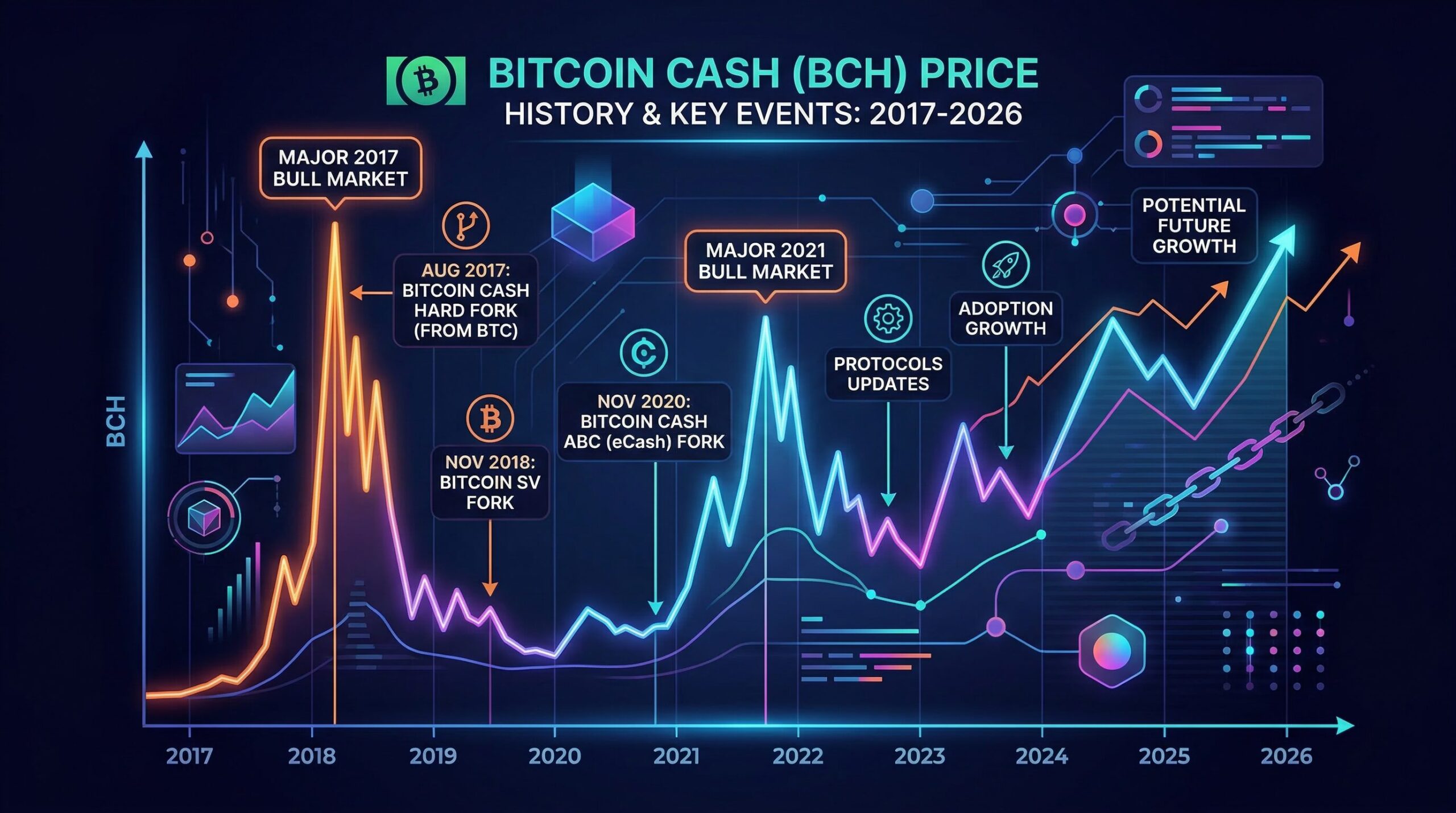
It’s worth noting that Bitcoin Cash itself underwent further forks. In November 2018, a contentious split produced Bitcoin SV (BSV), championed by Craig Wright. Then in 2020, another fork created Bitcoin Cash ABC (now called eCash/XEC). The Bitcoin Cash network that exists today is the primary continuation of the 2017 fork, maintained by the Bitcoin Cash Node (BCHN) and Bitcoin ABC development teams.
How Bitcoin Cash Works: The Technology
Block Size and Transaction Throughput
The defining technical difference between Bitcoin and Bitcoin Cash is block size. Bitcoin maintains its 1 MB limit (with SegWit enabling slightly more effective capacity), while Bitcoin Cash allows blocks up to 32 MB. In practice, most BCH blocks are not filled to capacity, but the ceiling provides room for large transaction volumes when needed.
With 32 MB blocks and 10-minute block intervals (same as Bitcoin), BCH can theoretically handle around 200 transactions per second on-chain. By comparison, Bitcoin’s on-chain throughput is approximately 3–7 TPS without Lightning Network. For a payment system targeting everyday retail and remittance use cases, this difference is significant.
Proof of Work and Mining
Bitcoin Cash uses the same SHA-256 hashing algorithm as Bitcoin, meaning the same mining hardware (ASICs) can mine both chains. This creates a dynamic where miners can and do switch between BTC and BCH based on profitability. BCH implemented an Emergency Difficulty Adjustment (EDA) algorithm at launch to prevent the network from stalling if miners left, later replaced by a more sophisticated Difficulty Adjustment Algorithm (DAA) that recalibrates with each block.
As of early 2026, BCH mining offers a roughly 5.1% profitability premium over Bitcoin in certain periods, attracting a dedicated mining community. The BCH hashrate, while significantly lower than Bitcoin’s, remains sufficiently distributed to maintain network security.
Transaction Fees and Speed
One of BCH’s primary selling points is its fee structure. While Bitcoin transaction fees have historically ranged from cents to tens of dollars depending on network congestion, BCH fees typically cost a fraction of a cent — often $0.001 or less. This makes BCH viable for micropayments, small retail transactions, and cross-border remittances where per-transaction cost sensitivity matters.
BCH also supports zero-confirmation (0-conf) transactions for trusted merchants, where a payment is considered received almost instantly. This feature is particularly useful in point-of-sale retail environments where customers cannot wait 10 minutes for block confirmation.
CashTokens: Smart Contract Capabilities
A significant 2023 upgrade called CashTokens brought fungible and non-fungible token capabilities directly to the BCH base layer. Unlike many blockchain token standards that rely on complex smart contract architectures, CashTokens are built natively into BCH’s UTXO model. This enables decentralized finance (DeFi) applications, token issuance, and NFT creation on BCH with the same security guarantees as BCH transactions themselves.
The CashTokens standard enables developers to create tokens that can be transferred in the same transaction as BCH, with minimal overhead. Several DEXs (decentralized exchanges) and DeFi protocols have launched on BCH leveraging CashTokens, including Cauldron DEX and others in the growing BCH DeFi ecosystem.
The Layla Upgrade: What’s Coming in May 2026
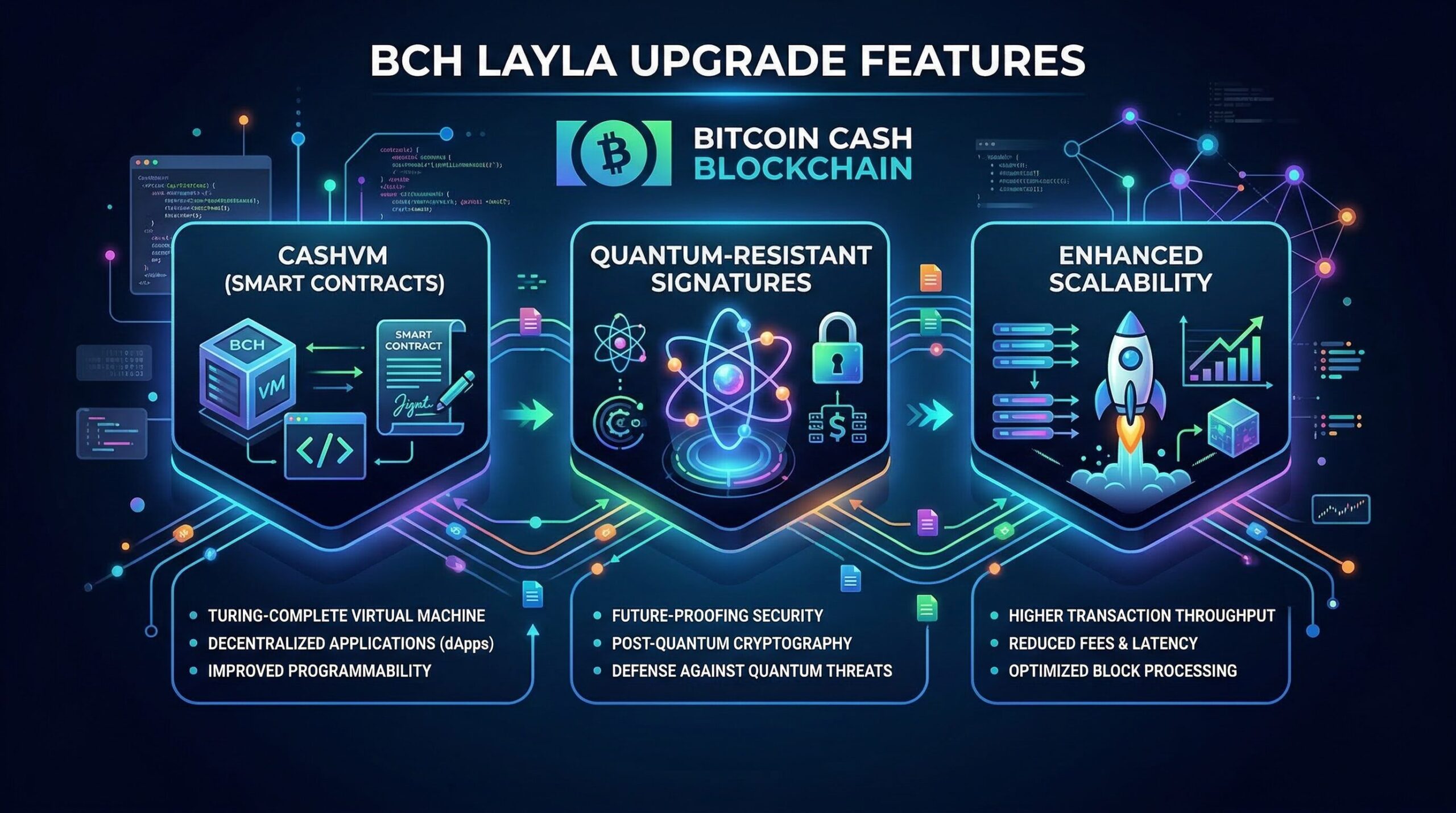
The most significant development in BCH’s 2026 roadmap is the Layla network upgrade, scheduled for activation on May 15, 2026. This hard fork represents a major evolution of Bitcoin Cash’s capabilities, moving the network from a primarily payments-focused chain toward a more programmable platform.
CashVM: Enhanced Smart Contracts
The centerpiece of the Layla upgrade is CashVM — an enhanced virtual machine environment that brings full Bitcoin Script functionality back to BCH and introduces new capabilities including loops and functions. The current Bitcoin Script language, shared with BTC, is intentionally limited (non-Turing-complete) to prevent certain security risks. CashVM removes these restrictions in a controlled way, enabling more complex decentralized applications while maintaining BCH’s security model.
With CashVM, BCH developers will be able to build smart contracts with looping logic, making it possible to implement DeFi protocols, automated market makers, and other applications previously requiring Layer 2 solutions or EVM-compatible chains. This is a direct competitive push toward Ethereum and Solana’s smart contract ecosystems.
Quantum-Resistant Security Features
The Layla upgrade also introduces quantum-resistant cryptographic options for BCH addresses. As quantum computing research advances, the cryptographic algorithms underlying most current blockchains (including Bitcoin and BCH’s elliptic curve signatures) face potential long-term risks. The Layla upgrade proactively adds post-quantum cryptographic schemes — providing 256-bit classical security — giving users the option to protect their funds against future quantum threats.
This makes BCH one of the first major proof-of-work cryptocurrencies to integrate quantum-resistant security as a native network option rather than a theoretical future consideration.
Regulatory Tailwinds
In March 2026, the SEC and CFTC jointly classified Bitcoin Cash as a digital commodity — not a security. This regulatory clarity removes a significant legal overhang that had discouraged some institutional participants from engaging with BCH. The classification aligns BCH with Bitcoin and Ethereum in terms of regulatory treatment, potentially opening doors to institutional products, custody services, and exchange listings in regulated markets.
Bitcoin Cash vs. Bitcoin: A Direct Comparison
The Bitcoin vs. Bitcoin Cash debate remains one of the most persistent in crypto. Here is a factual comparison of where the two networks stand in 2026:
Design Philosophy
Bitcoin (BTC) has consolidated around the “digital gold” or “store of value” narrative. Its developers prioritize security, decentralization, and immutability above throughput. On-chain capacity is deliberately limited, with the expectation that higher-throughput use cases will be handled by Layer 2 networks like the Lightning Network or payment channels.
Bitcoin Cash (BCH) adheres to the original vision articulated in Satoshi Nakamoto’s 2008 whitepaper: “a peer-to-peer electronic cash system.” BCH developers believe on-chain scaling is viable and preferable to layered solutions for most payment use cases. The network prioritizes low fees and high throughput directly at the base layer.
Technical Specifications Compared
| Feature | Bitcoin (BTC) | Bitcoin Cash (BCH) |
|---|---|---|
| Block size | 1 MB (SegWit: ~1.7 MB effective) | 32 MB |
| Max TPS (on-chain) | ~7 TPS | ~200 TPS |
| Average transaction fee | $1–$10+ (varies) | $0.001 or less |
| Block time | ~10 minutes | ~10 minutes |
| Max supply | 21 million BTC | 21 million BCH |
| Consensus mechanism | Proof of Work (SHA-256) | Proof of Work (SHA-256) |
| Smart contracts | Limited (Tapscript/Taproot) | CashTokens + CashVM (2026) |
| Market cap (March 2026) | ~$1.5–1.8 trillion | ~$9.4 billion |
| Lightning Network support | Yes (Layer 2) | No (on-chain scaling preferred) |
The Security Trade-off
Bitcoin’s significantly larger hashrate (the total computing power securing the network) means it is substantially more secure against 51% attacks than BCH. Because BCH and BTC share the same mining algorithm, BCH’s security ultimately depends on the profitability of mining BCH versus other SHA-256 coins. Critics point to this as a structural vulnerability; supporters argue that BCH’s current hashrate is more than adequate for its transaction volume and that the security difference is often overstated.
Real-World Use Cases for Bitcoin Cash
Merchant Payments
BCH’s low fees and near-instant 0-confirmation transactions make it one of the most practical cryptocurrencies for in-person retail use. Payment processors including BitPay, CoinGate, and NOWPayments support BCH, enabling merchants to accept it with fiat conversion. In markets where traditional payment infrastructure is expensive or inaccessible, BCH has gained traction as a practical alternative.
Notable adoption examples include privacy-focused web hosting services, VPN providers, and online merchants that accept BCH directly. The peer-to-peer payments platform Prompt.Cash has facilitated hundreds of thousands of BCH transactions in regions including Africa and Southeast Asia.
Remittances
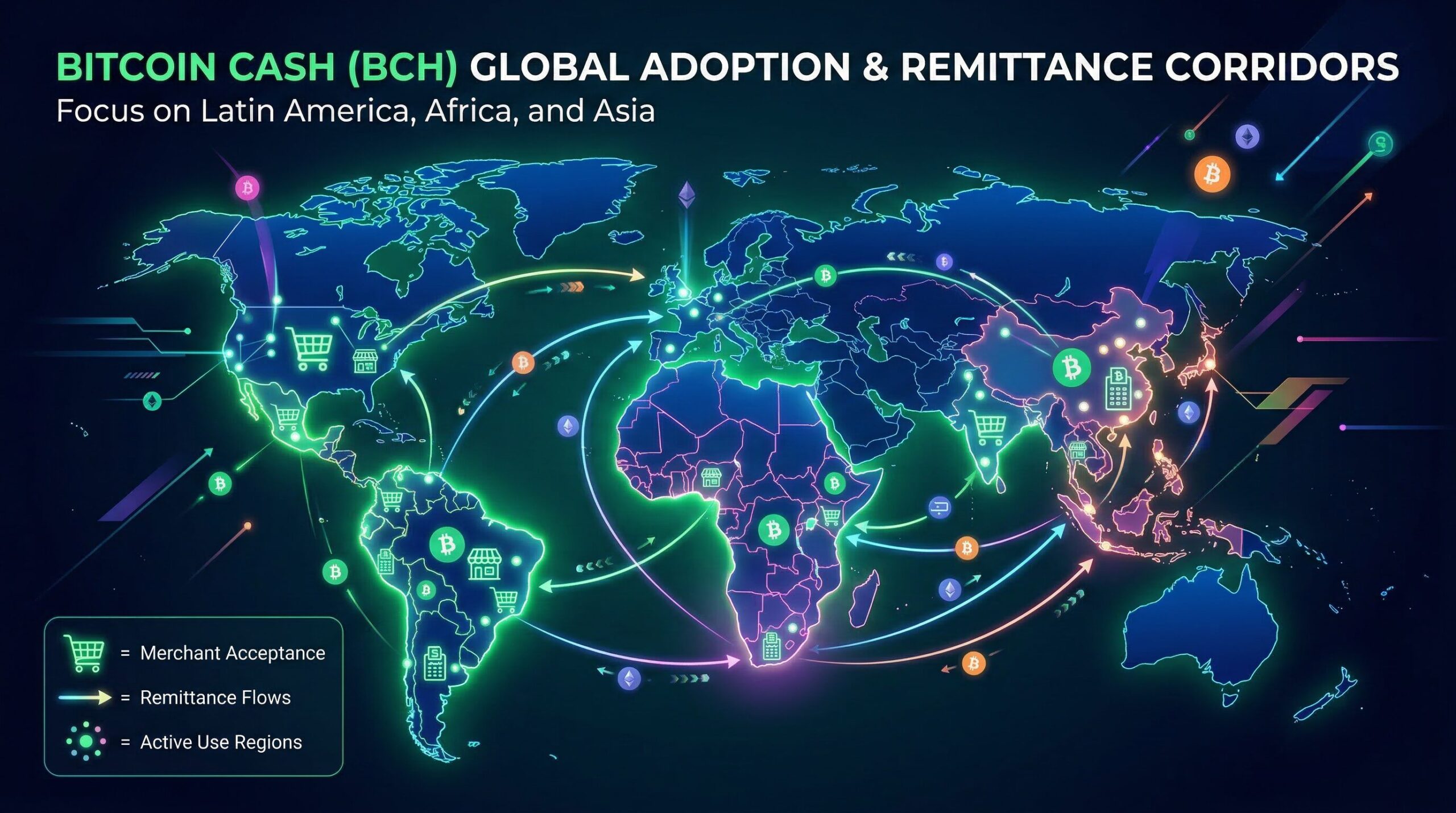
Cross-border money transfer is one of BCH’s strongest use cases. Traditional wire transfers and services like Western Union charge fees ranging from 3% to 8% for international transfers, with settlement times of 1–5 business days. A BCH transaction can be sent anywhere in the world for less than a cent and confirmed within 10 minutes — often effectively instantly for recipients using 0-conf.
In countries with limited banking access or high inflation — including parts of Venezuela, Argentina, Nigeria, and the Philippines — BCH has seen grassroots adoption as a means of preserving purchasing power and sending money internationally.
iGaming and Online Gambling
BCH’s instant confirmation and sub-cent fees have made it a preferred payment method for the online gaming and casino industry. By 2026, BCH-accepting casinos and gaming platforms have become one of the largest drivers of BCH transaction volume. The combination of transparency (verifiable on-chain outcomes), speed, and low fees creates a compelling product for operators and users alike.
DeFi and CashTokens Ecosystem
The 2023 CashTokens upgrade unlocked a growing decentralized finance ecosystem on BCH. Unlike Ethereum, where token transfers require complex smart contract calls and carry gas fees of several dollars, CashTokens transactions are as cheap as regular BCH payments. This creates compelling economics for DeFi protocols targeting retail users who have been priced out of Ethereum.
Projects operating on BCH’s DeFi layer include decentralized exchanges, yield farming protocols, and stablecoin issuance. The upcoming CashVM capabilities from the Layla upgrade are expected to substantially expand what is buildable on BCH.
Bitcoin Cash Tokenomics and Economics
Supply Schedule
Like Bitcoin, BCH has a fixed maximum supply of 21 million coins and undergoes halving events approximately every four years (every 210,000 blocks). The most recent BCH halving occurred in April 2024, reducing the block reward from 6.25 BCH to 3.125 BCH. The next halving is expected around April 2028.
As of March 2026, approximately 20.01 million BCH are in circulation — over 95% of the maximum supply. This limited remaining supply adds a degree of scarcity to the asset, though BCH’s price is primarily driven by demand for its payment utility rather than stock-to-flow narratives.
Mining Economics
BCH miners earn block rewards plus transaction fees. The low per-transaction fees mean that fee revenue is a smaller fraction of miner income compared to Bitcoin, where fees can represent 10–30% of miner revenue during high-demand periods. This is a long-term economic consideration: as block rewards decline through future halvings, BCH will need sustained high transaction volume to compensate miners through fees.
BCH proponents argue that the network’s design — low fees encouraging high volume — will generate adequate fee revenue at scale. Critics contend that low fees create a structurally weaker security budget over time. This tension is an ongoing topic in BCH development discussions.
How to Buy and Store Bitcoin Cash
Where to Buy BCH
Bitcoin Cash is available on virtually every major cryptocurrency exchange. In 2026, the highest-volume BCH trading pairs are available on:
- Binance — BCH/USDT, BCH/BTC, BCH/BUSD
- Coinbase — BCH/USD, BCH/USDC
- Kraken — BCH/USD, BCH/EUR
- OKX — BCH/USDT, BCH/BTC
- Bybit — BCH/USDT
- KuCoin — BCH/USDT
Always verify you are buying the correct token (BCH) and not confusing it with Bitcoin SV (BSV) or eCash (XEC), which are separate assets that share BCH’s history.
Storing BCH Safely
BCH supports a range of storage options:
- Hardware wallets: Ledger and Trezor both support BCH natively, offering the highest security for long-term storage
- Desktop wallets: Electron Cash (the most widely used BCH-specific desktop wallet), supporting advanced features including CashTokens
- Mobile wallets: Bitcoin.com Wallet, Paytaca (supports CashTokens), and Neutrino
- Web wallets: Available through various exchanges, though not recommended for large holdings
Note that BCH uses its own address formats (CashAddr format starting with “bitcoincash:q…” for receiving addresses) distinct from Bitcoin’s address formats. Always double-check the network before sending.
BCH Price History and 2026 Market Context
Historical Price Milestones
Bitcoin Cash has experienced the full range of cryptocurrency market cycles since its launch:
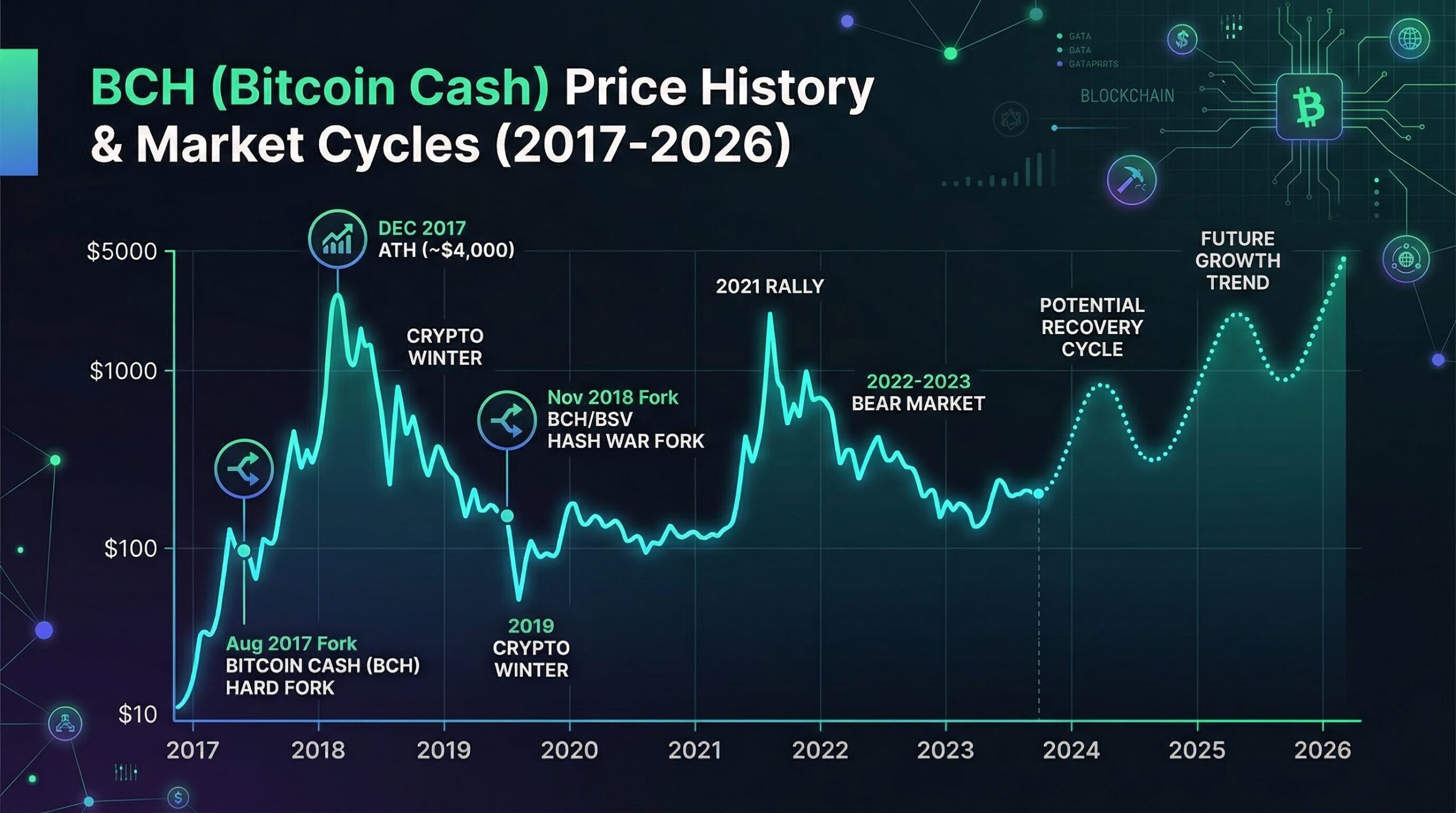
- August 2017 (launch): BCH debuted at approximately $300–400
- December 2017 (first bull peak): BCH reached an all-time high above $4,000
- 2018–2019 bear market: BCH fell below $100 at its 2019 low
- 2021 bull market: BCH reached approximately $1,600 in May 2021
- 2022–2023 bear market: BCH fell to approximately $90–$100
- 2024–2025 bull market: BCH rose significantly with the broader market, approaching $700+ at the 2025 peak
- March 2026: BCH trades around $470, down from 2025 highs but maintaining support
2026 Market Context
Bitcoin hit its most recent all-time high of approximately $126,200 in October 2025, then entered a correction phase. The broader cryptocurrency market has followed, with BCH declining from its 2025 highs to the $450–$500 range in early 2026. Despite the bearish macro context, BCH has shown relative resilience compared to many altcoins.
Key factors shaping BCH’s 2026 trajectory include: the upcoming Layla upgrade (May 15, 2026), its new regulatory classification as a digital commodity, continued growth in the iGaming and merchant adoption sectors, and the broader cryptocurrency market cycle. Analysts generally expect the May 2026 upgrade to serve as a potential catalyst for renewed interest in BCH, particularly from developers interested in its growing DeFi capabilities.
Criticism and Challenges Facing Bitcoin Cash
A balanced assessment of BCH must acknowledge its challenges and the criticisms leveled at it by the broader cryptocurrency community:
Network Effect and Adoption Gap
Despite years of development, BCH’s market capitalization remains roughly 1% of Bitcoin’s. This reflects a persistent gap in network effects, brand recognition, and institutional adoption. Bitcoin has become the cryptocurrency standard for institutional investors, ETF products, and corporate treasury holdings. BCH, while technically capable, has not achieved comparable adoption in these high-value segments.
Competition from Lightning Network
Bitcoin’s Lightning Network — the Layer 2 payment channel solution that BCH critics argued would not work — has grown substantially. By 2026, Lightning Network capacity and usability have improved significantly, enabling fast, cheap Bitcoin transactions without requiring a fork. This reduces the differentiation that BCH offered for payment use cases.
Developer Ecosystem
BCH’s developer ecosystem, while active, is smaller than those of Ethereum, Solana, or even Bitcoin. The number of developers building on BCH is a fraction of those working on Ethereum’s EVM ecosystem. The Layla upgrade’s new smart contract capabilities aim to attract more developers, but building a substantial dApp ecosystem requires sustained community growth over years.
History of Contentious Forks
BCH has experienced two significant further forks (BSV in 2018, eCash in 2020), each accompanied by community conflict and reputational damage. The “blockchain wars” narrative — particularly around the 2018 BCH/BSV hash war — introduced uncertainty about BCH’s governance and stability. The current BCH community has been relatively unified since 2021, but the history remains part of the project’s reputation.
The Case for Bitcoin Cash in 2026
Despite the challenges, several factors present a compelling case for BCH’s continued relevance:
1. Demonstrated utility: BCH actually works for what it claims to do. Sub-cent transactions, fast confirmations, and broad exchange support make it a practical payment tool today, not a future promise.
2. The Layla upgrade is a genuine inflection point: CashVM’s smart contract capabilities could attract developers who want Ethereum-like programmability without Ethereum’s gas fees. If even a fraction of the potential DeFi applications migrate to or launch on BCH post-Layla, the ecosystem could grow substantially.
3. Regulatory clarity: The March 2026 SEC/CFTC digital commodity classification removes legal uncertainty and potentially opens institutional access.
4. Growing iGaming adoption: The iGaming sector’s rapid BCH adoption is driving real, sustained transaction volume — a key metric for blockchain health.
5. Relative value proposition: At a market cap roughly 100 times smaller than Bitcoin’s, BCH presents a different risk/reward profile for investors who believe in the electronic cash use case and see potential in CashVM’s programmability expansion.
Frequently Asked Questions About Bitcoin Cash
Is Bitcoin Cash the same as Bitcoin?
No. Bitcoin Cash (BCH) and Bitcoin (BTC) are separate cryptocurrencies with separate blockchains, wallets, and prices. They share a common history before August 1, 2017, when the BCH fork occurred. Sending BCH to a Bitcoin address (or vice versa) will result in loss of funds.
Which is better: BTC or BCH?
It depends on the use case. BTC is superior for store of value purposes, has a much larger market cap and liquidity, and benefits from the strongest security and institutional support in crypto. BCH is superior for payment transactions, offering dramatically lower fees and similar confirmation times without requiring Lightning Network. Both have legitimate use cases.
What happened to Bitcoin Cash’s price after the fork?
BCH experienced enormous volatility in its early years. It reached an all-time high above $4,000 in December 2017, fell below $100 in 2019, recovered to around $1,600 in the 2021 bull market, and fell again in 2022. As of March 2026, BCH trades around $470, significantly below its all-time high but substantially above its bear market lows.
Can Bitcoin Cash be used for DeFi?
Yes. The 2023 CashTokens upgrade enabled native token functionality and basic DeFi on BCH. The upcoming May 2026 Layla upgrade will substantially expand DeFi capabilities through CashVM’s smart contract functionality, enabling more complex protocols like automated market makers, lending platforms, and yield strategies.
Is Bitcoin Cash a good investment?
This site does not provide investment advice. BCH, like all cryptocurrencies, carries significant price volatility risk. Investors should conduct their own research, consider their risk tolerance, and consult a qualified financial advisor before making investment decisions.
Conclusion: Bitcoin Cash in 2026
Bitcoin Cash enters 2026 at an important juncture. The network has established a clear identity as a practical payment cryptocurrency — fast, cheap, and genuinely useful for everyday transactions, remittances, and iGaming. After years of primarily competing on payments, the Layla upgrade in May 2026 represents BCH’s first serious push into smart contract programmability, a move that could significantly expand its developer ecosystem and DeFi presence.
The regulatory tailwind from BCH’s digital commodity classification provides institutional clarity, while the growing iGaming adoption demonstrates real-world demand. BCH faces real challenges — a significant adoption gap versus Bitcoin and Ethereum, competition from Lightning Network, and a smaller developer ecosystem — but the network is actively building rather than standing still.
For those interested in the original vision of cryptocurrency as everyday digital cash — combined with an emerging smart contract platform — Bitcoin Cash remains one of the most technically capable and underexplored assets in the top 20 by market capitalization.
Last updated: March 2026. Cryptocurrency prices and market data change rapidly. Always verify current information from exchange platforms before making any decisions.