
Who really controls Bitcoins price? Discover how major banks now own the market plumbing, shaping 2025 trends.#Bitcoin #CryptoMarket #BankInfluence
Quick Video Breakdown: This Blog Article
This video clearly explains this blog article.
Even if you don’t have time to read the text, you can quickly grasp the key points through this video. Please check it out!
If you find this video helpful, please follow the YouTube channel “BlockChainBulletin,” which delivers daily Crypto news.
https://www.youtube.com/@BlockChainBulletins
Read this article in your native language (10+ supported) 👉
[Read in your language]
Bitcoin’s Market Plumbing: How Major Banks Are Influencing Price Action in 2025
Jon: Hey Lila, I came across this intriguing piece from CryptoSlate titled “Bitcoin’s market ‘plumbing’ is now owned by these major banks that are controlling the price action.” It’s dated just a couple of days ago, and it dives into how big banks have essentially taken over the behind-the-scenes infrastructure of the Bitcoin market. Think of it as the pipes and valves that keep the price flowing—or sometimes, manipulated.
Lila: Oh, interesting. I’ve been hearing whispers about institutional involvement in crypto, but “plumbing” sounds a bit mysterious. What’s the high-level scoop from this article?
Jon: Basically, the article highlights a shift in Bitcoin’s market dynamics. In 2025, we’re seeing exchange-traded products (ETPs) pulling in a massive $46.7 billion, and banks processing trillions in tokenized repos—those are repurchase agreements on blockchain. This marks a move from the wild retail frenzy of past years, like those Reddit-driven pumps, to more controlled institutional plays. Major banks are now the custodians, market makers, and liquidity providers, influencing price action through their dominance in the “plumbing”—the operational backbone like settlements, custody, and trading infrastructure.
Lila: Why does this matter? Is this good or bad for Bitcoin’s future?
Jon: It matters because it signals Bitcoin’s maturation into a mainstream asset class, but with trade-offs. On one hand, this institutional plumbing brings stability and deeper liquidity, potentially reducing wild swings. On the other, it raises questions about centralization—ironic for a decentralized currency. The article notes how banks’ 13F filings (those are regulatory disclosures of holdings) are now key indicators, showing their control over price movements. For context, Bitcoin’s been volatile this year; predictions from sources like CoinDCX suggest it could rally to $105K by December 2025 if it breaks $85K, but we’ve seen it struggle against trendlines around $126K. This bank dominance might stabilize or stifle that.
Lila: Got it—that’s under 300 words of intro, and it’s already eye-opening. But let’s dig deeper into the problem here.
Jon: The core issue is the evolution of Bitcoin’s market structure. Traditionally, Bitcoin was all about peer-to-peer, decentralized trading—think early exchanges like Mt. Gox, where retail traders drove prices through sheer enthusiasm or panic. But now, with banks owning the plumbing, we’re seeing a concentration of power. The article points out that retail frenzy has died down, replaced by institutional flows. This creates a problem: potential price manipulation or suppression, as banks control the liquidity pipes. For instance, if a bank dominates tokenized repos, they can influence short-term lending rates, which indirectly affects Bitcoin’s spot price.
Lila: That sounds a bit abstract. Can you clarify with an analogy? I’m picturing something everyday.
Jon: Sure, let’s use a plumbing analogy since the article does. Imagine Bitcoin’s market as a city’s water system. In the early days, it was like backyard wells and hoses—decentralized, chaotic, with water (liquidity) splashing everywhere based on individual users’ whims. Prices spiked or crashed on viral tweets or forum hype. Now, major banks are like utility companies that own the main pipes, reservoirs, and treatment plants. They control the flow: deciding when to release water (provide liquidity) or restrict it, which can stabilize supply but also let them tweak pressure to favor their positions. For example, through ETPs, banks can bundle Bitcoin exposure into tradable products, drawing in $46.7 billion as noted, but this means retail traders are sipping from a faucet they don’t control. The risk? If the utility company (banks) has a monopoly, they might prioritize their profits over fair distribution, leading to “controlled” price action that doesn’t reflect true market sentiment.
Lila: Ah, that makes sense. So the “why” is about losing some decentralization to gain maturity, but with new vulnerabilities.
Jon: Exactly. And this ties into 2025’s trends, where Bitcoin’s down 6% year-to-date while gold is up 70%, per The Guardian. Banks’ involvement might be dampening the buzz, turning Bitcoin into just another asset in their portfolio.
Under the Hood: How it Works
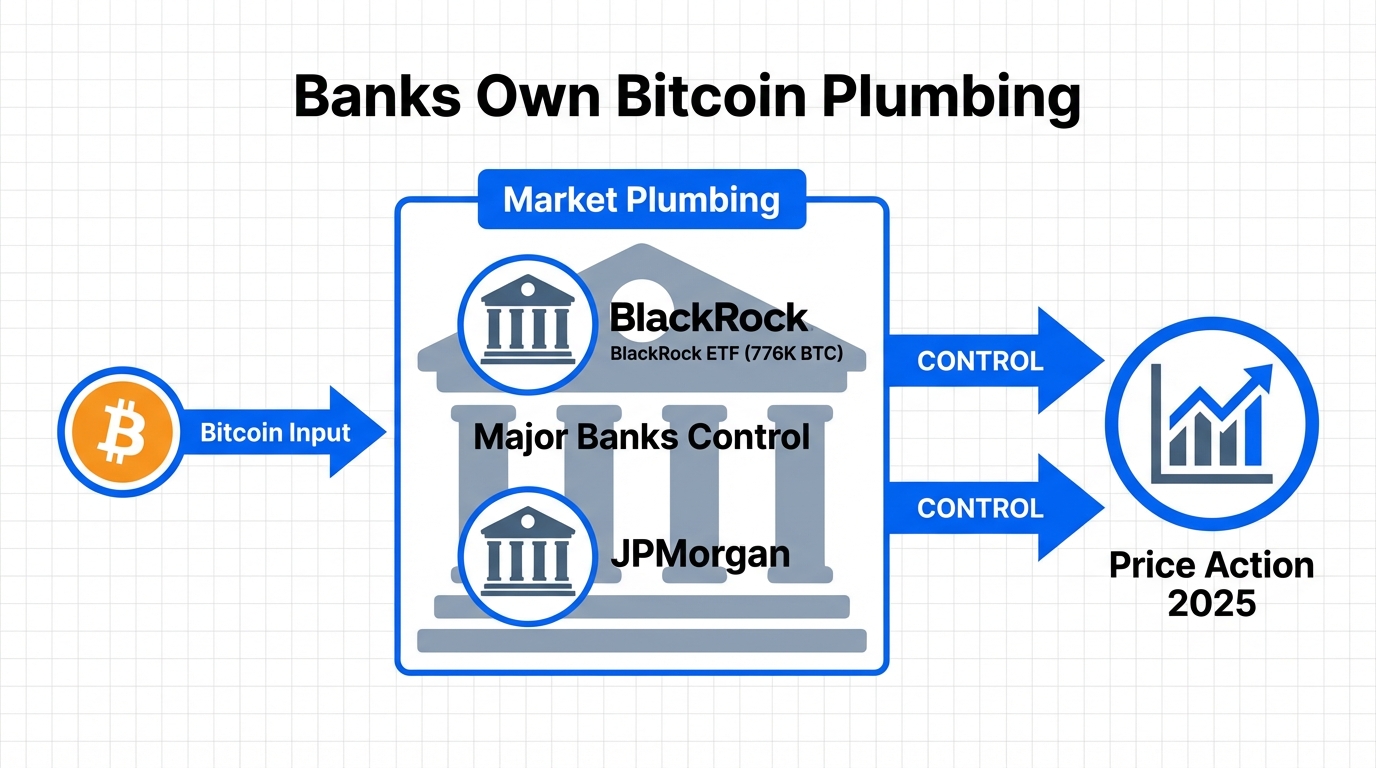
Jon: Alright, let’s peel back the layers. This diagram illustrates the Bitcoin market’s plumbing—essentially the infrastructure for trading, custody, and settlement. At its core, Bitcoin operates on a blockchain: a decentralized ledger where transactions are verified by miners or validators using proof-of-work. But the “plumbing” the article refers to is the off-chain ecosystem, where banks come in. Major players like JPMorgan or Goldman Sachs are now providing custody services, meaning they hold Bitcoin for institutions via secure vaults and wallets. They also facilitate tokenized repos—short-term loans backed by Bitcoin or other assets, tokenized on blockchains like Ethereum for efficiency.
Lila: Tokenized repos? Break that down—I’m following, but want to confirm.
Jon: Repos are agreements where one party sells an asset with a promise to buy it back later, often used for short-term funding. Tokenizing them means representing these on blockchain, allowing instant settlement via smart contracts. Banks process trillions in these, controlling liquidity. For price action, this plumbing influences through market making: banks provide buy/sell quotes, stabilizing prices but also potentially front-running or manipulating via high-frequency trading algorithms. The article mentions a shift to 13F filings, where banks disclose holdings, giving insight into their influence on ETPs—exchange-traded products that track Bitcoin without direct ownership.
Lila: So, in simple terms, banks are the new middlemen?
Jon: Precisely. To compare traditional vs. current setups:
| Aspect | Traditional Retail-Driven Market | Bank-Dominated Plumbing (2025) |
|---|---|---|
| Liquidity Source | Individual traders, exchanges like Binance | Banks via ETPs and tokenized repos ($46.7B inflows) |
| Price Influence | Social media hype, retail FOMO | Institutional flows, 13F filings, whale positions |
| Risks | High volatility from panic sells | Centralization, potential manipulation |
| Benefits | Decentralized, accessible | Stability, deeper liquidity for large trades |
Jon: This table shows the evolution. In 2025, with Bitcoin eyeing support at $77K and resistance at $155K per InvestingHaven, banks’ control could cap upside if they lean bearish, as seen in whale short positions noted in AI Invest reports.
Lila: So who actually uses this? I mean, beyond the banks themselves.
Jon: Great question. On the developer side, blockchain engineers use this plumbing for building DeFi apps that integrate with institutional liquidity—think protocols like Aave or Compound borrowing from bank-provided pools. For users, it’s institutional investors accessing Bitcoin via ETPs without handling keys themselves, reducing technical barriers. Technically, it benefits by enabling faster settlements; tokenized repos can clear in seconds via smart contracts, versus days in traditional finance. Retail users indirectly benefit from stabilized prices, making Bitcoin a more reliable store of value. Even in payments, banks’ custody ensures secure large-scale transfers. However, the focus is on efficiency gains, not hype—risks like counterparty failures remain.
Lila: That highlights the technical upside without overpromising. Now, for someone wanting to learn more, what’s an educational action plan? No buying stuff, just knowledge-building.
Jon: Absolutely, let’s structure it in levels for progressive learning.
Jon: Level 1: Research and Observation. Start by reading whitepapers on Bitcoin’s protocol—Satoshi’s original is a must. Then, use block explorers like Blockchain.com to track transactions and see institutional wallets (look for large, labeled addresses from custodians like Coinbase Custody). Dashboards from Glassnode or Chainalysis offer on-chain metrics, showing how bank inflows affect supply. Follow 13F filings on the SEC’s EDGAR database to spot bank holdings. This builds understanding of market dynamics without any commitment.
Lila: Sounds passive but insightful. How about getting hands-on safely for Level 2?
Jon: Level 2: Testnet and Hands-on Learning. Dive into Bitcoin’s testnet—it’s a sandbox version of the blockchain where you can experiment with transactions using fake BTC. Tools like Bitcoin Core wallet let you simulate sending/receiving, understanding custody mechanics. For tokenized aspects, explore Ethereum testnets (like Sepolia) to deploy simple smart contracts mimicking repos via Solidity. Platforms like Remix IDE make this accessible. Emphasize: this is for learning mechanics, not real value—minimal risk, pure education on how plumbing like settlements works under the hood.
Lila: Perfect, that keeps it safe and focused on skills.
Jon: In summary, this bank takeover of Bitcoin’s plumbing is a double-edged sword: it brings maturity and liquidity but introduces centralization risks. Looking ahead, with 2026 predictions from FXStreet suggesting Bitcoin could build on 2025’s institutional momentum under favorable regs, it’s worth watching how this evolves. Yet, limitations persist—volatility, regulatory shifts, and macroeconomic factors like a struggling dollar (as CoinDesk notes) could sway things.
Lila: Yeah, and remember, crypto markets are unpredictable. Volatility and uncertainty are par for the course—approach with caution and continuous learning.
Jon: Well said. It’s an evolving space; stay informed, stay analytical.
—
About the Authors
Jon is a Web3 researcher with over a decade in blockchain architecture. Lila is a developer advocate focused on making tech accessible.
—
References
- Bitcoin’s market “plumbing” is now owned by these major banks that are controlling the price action
- Official Bitcoin Website
- Bitcoin Price Prediction 2025, 2026–2030: Can BTC Rally to $105K in December 2025?
- Bitcoin’s buzz is gone. Investors chose real gold in 2025 | Nils Pratley | The Guardian