In my view, stable oil markets after the raid highlight the unique utility of Bitcoin.#Bitcoin #Oil
Quick Video Breakdown: This Blog Article
This video clearly explains this blog article.
Even if you don’t have time to read the text, you can quickly grasp the key points through this video. Please check it out!
If you find this video helpful, please follow the YouTube channel “BlockChainBulletin,” which delivers daily Crypto news.
https://www.youtube.com/@BlockChainBulletins
Read this article in your native language (10+ supported) 👉
[Read in your language]
Oil Prices Just Did the Unthinkable After the Venezuela Raid, and It Hands Bitcoin a Rare Advantage
Jon: Hey Lila, have you seen the latest buzz from CryptoSlate? The title alone grabbed me: “Oil prices just did the unthinkable after the Venezuela raid, and it hands Bitcoin a rare advantage.” It’s dated just a day ago, right on the heels of the US military’s capture of Venezuelan President Maduro. Instead of the expected oil price spike from geopolitical tension, prices have actually settled higher but in a way that’s counterintuitive—up about $1 a barrel, yet signaling a potential long-term supply shock. This could rewrite liquidity flows, giving Bitcoin an edge as investors look beyond traditional commodities.
Lila: Wow, Jon, that sounds like a plot twist in the global markets. I get the news—US raid on Venezuela, Maduro captured, and Venezuela’s massive oil reserves are in play. But oil prices doing the “unthinkable”? And how does this tie into Bitcoin? Why does this matter for someone trying to understand crypto?
Jon: Great questions, as always. Let’s break it down. The “unthinkable” here is that everyone braced for a sharp oil price surge due to supply fears—Venezuela sits on 303 billion barrels of crude, per Business Insider. But markets are pricing in a scenario where US involvement might actually stabilize or increase supply long-term, avoiding a spike and instead causing a dip in oil’s appeal. This shifts capital toward alternatives like Bitcoin, which thrives on liquidity and as a hedge against fiat instability. It matters because it highlights Bitcoin’s role not just as “digital gold,” but as a beneficiary when traditional assets like oil face uncertainty. No hype, just observing how macro events can tilt the scales.
Lila: Okay, that makes sense at a high level. But let’s dig into the “why”—what’s the underlying problem here with oil markets and how Bitcoin gets an advantage?
Jon: The core problem is volatility in traditional energy markets driven by geopolitics. Oil is tied to physical supply chains, sanctions, and political regimes—like Venezuela’s under Maduro, where production has tanked due to mismanagement and isolation. The raid introduces uncertainty: short-term disruption, but potential for revival under new oversight, as Trump has vowed to “unlock” those reserves. This creates a bearish outlook for oil prices, per sources like DL News, where lower oil could mean more capital flowing into risk assets like crypto.
Lila: Uncertainty leading to lower prices? That seems backward. Can you clarify with an analogy?
Jon: Sure, think of oil markets like a busy highway during rush hour. Geopolitical events are like accidents— they usually cause massive jams (price spikes) as traffic (supply) slows. But if a raid clears a long-blocked lane (Venezuela’s reserves), traffic might flow better long-term, easing congestion and lowering “tolls” (prices). Bitcoin, on the other hand, is like a high-speed rail system: decentralized, not reliant on any single route or government, so when highways get unpredictable, more people opt for the rail—shifting liquidity to BTC. It’s not that oil crashes overnight, but the market’s betting on abundance, making Bitcoin’s scarcity model shine. Analysts note Bitcoin jumped above $90,000 post-raid, per DL News.
Lila: Ah, the highway vs. rail analogy clicks—oil’s tangled in physical and political bottlenecks, while Bitcoin runs on a network that’s harder to disrupt. So, how does this all work under the hood for Bitcoin in this scenario?
Under the Hood: How it Works
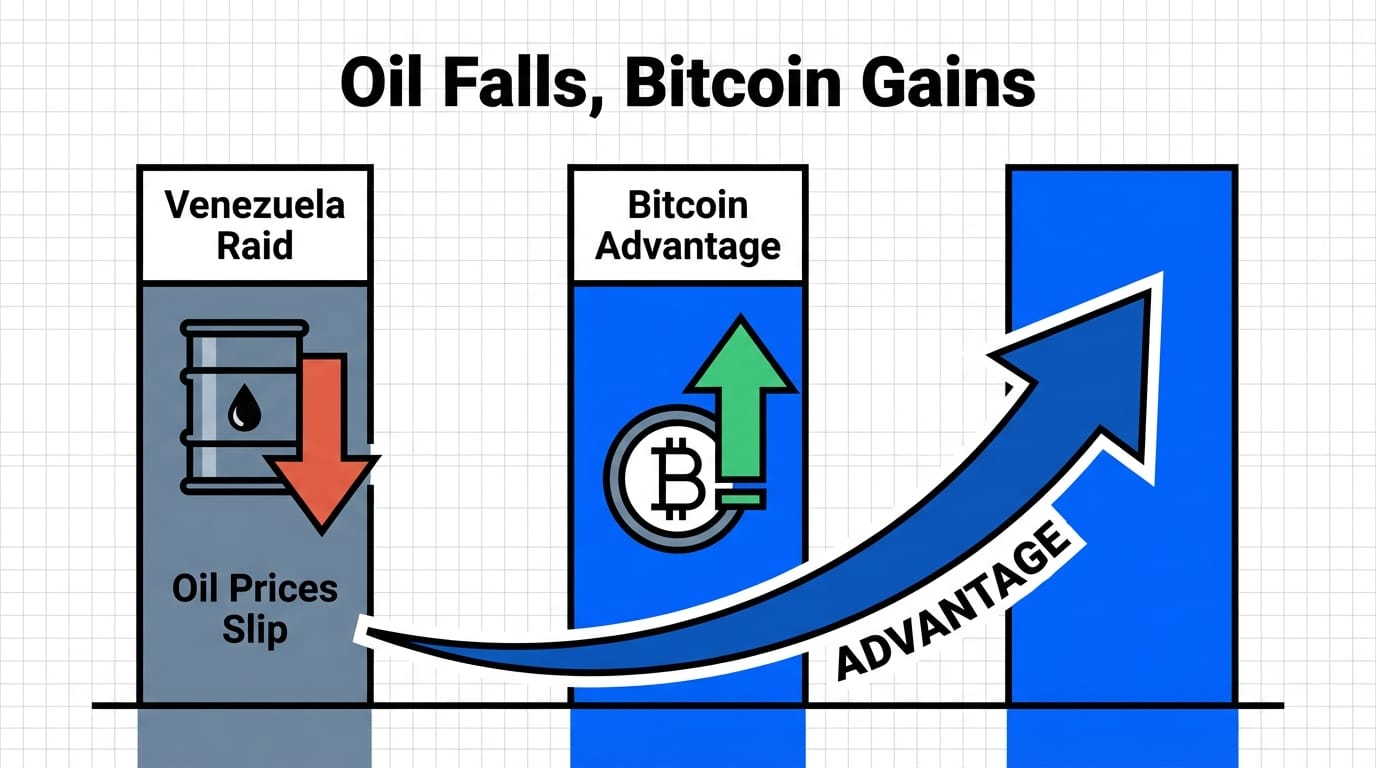
Jon: Alright, let’s peel back the layers. That diagram above illustrates Bitcoin’s blockchain architecture juxtaposed with oil supply chains—click it to enlarge for a closer look. At its core, Bitcoin operates on a proof-of-work consensus mechanism, where miners compete to validate transactions and add blocks to the chain, securing the network through computational power. This creates inherent scarcity: only 21 million BTC will ever exist, unlike oil, which can surge in supply with new discoveries or tech.
Lila: Proof-of-work— that’s the energy-intensive mining, right? But how does this give Bitcoin an edge over oil in a post-raid world?
Jon: Exactly. In the Venezuela context, oil’s value is manipulated by central entities—governments, OPEC, sanctions. Bitcoin’s decentralized ledger means no single authority controls it; nodes worldwide verify everything. Token mechanics: BTC isn’t just currency; it’s a store of value with halvings every four years reducing new supply, mimicking gold’s scarcity. Post-raid, if oil floods the market (as per Reuters, US refiners could benefit from revived production), inflation in commodities might push investors to BTC for its deflationary nature. Let’s compare this directly.
| Aspect | Oil Markets | Bitcoin |
|---|---|---|
| Supply Control | Centralized (governments, cartels like OPEC) | Decentralized (fixed 21M cap, algorithmic halvings) |
| Volatility Drivers | Geopolitics, physical supply disruptions | Market sentiment, adoption, halvings |
| Liquidity Impact from Raid | Potential oversupply lowers prices, per AP News | Attracts capital as hedge, BTC above $90K post-event |
| Scarcity Model | Infinite potential via exploration | Hard-capped, deflationary |
Jon: As the table shows, Bitcoin’s architecture provides a counterbalance. In code terms, it’s like a smart contract on steroids—immutable, peer-to-peer, with SHA-256 hashing ensuring security. No central bank printing more; it’s all in the protocol.
Lila: Got it—that table really clarifies the contrasts. So who actually uses this? I mean, beyond traders reacting to news like the Venezuela raid, what are the real technical benefits and applications for Bitcoin here?
Jon: Good pivot. At the developer level, Bitcoin’s network is a foundation for building—think Lightning Network for faster transactions, or protocols like Ordinals for NFTs on Bitcoin. Users benefit as a hedge: in unstable economies like Venezuela’s (ironically), people have turned to BTC for value storage amid hyperinflation. Technically, it’s about borderless transfers without intermediaries, which shines when oil-driven fiat currencies wobble. For instance, if oil prices stabilize low, central banks might cut rates, boosting risk assets—Bitcoin gets inflows as “digital gold.” No ROI promises, but understanding this mechanic is key for anyone in Web3.
Lila: Practical—hedging against instability without the physical hassles of oil. Now, if someone’s interested in learning more without jumping in headfirst, what’s an educational action plan?
Jon: Let’s structure it progressively. Level 1: Research and observation. Start with the Bitcoin whitepaper by Satoshi Nakamoto—it’s a quick read explaining the peer-to-peer electronic cash system. Use block explorers like Blockchain.com to watch real-time transactions; track how halvings affect supply. Follow dashboards on sites like CoinMetrics for metrics on hash rate and network health, especially post-events like this raid.
Lila: Observing sounds safe. What about Level 2—how to try it hands-on without risks?
Jon: Absolutely, emphasize learning over anything else. Use Bitcoin testnets like Testnet or Signet to experiment with wallets and transactions—send fake BTC, understand confirmations. Tools like Electrum wallet support testnet mode. Or simulate mining with open-source software to grasp proof-of-work, but on a small scale. Risks remain in real networks, so stick to education; this builds intuition on why events like Venezuela’s raid could drive adoption.
Lila: Perfect—no commitments, just building knowledge.
Jon: To wrap up, this Venezuela raid underscores Bitcoin’s rare advantage: in a world of abundant oil potentially lowering prices, BTC’s scarcity and decentralization make it worth watching as a liquidity magnet. Limitations abound—volatility, regulatory shifts, energy debates—but it’s a fascinating intersection of macroeconomics and blockchain.
Lila: Well said, Jon. Remember, markets are unpredictable; volatility and uncertainty are par for the course. Approach with curiosity and caution.
Jon: Exactly—stay informed, think critically.
About the Authors
Jon is a Web3 researcher with over a decade in blockchain architecture. Lila bridges complex topics for newcomers, ensuring accessible insights.
References & Further Reading
- Oil prices just did the unthinkable after the Venezuela raid, and it hands Bitcoin a rare advantage
- Official Bitcoin Website
- How Trump’s Venezuela gambit is seen to boost Bitcoin price in 2026 – DL News
- Possible Oil Price Impact of US Venezuela Raid – Business Insider