What Is Avalanche?
Avalanche is a high-performance Layer-1 blockchain platform designed to enable fast, low-cost transactions, decentralized applications (dApps), and custom blockchain deployments. It was developed by Ava Labs, a company founded by computer science professor Emin Gün Sirer alongside Kevin Sekniqi and Maofan Ted Yin. Avalanche launched its mainnet in September 2020 and has since grown into one of the most prominent smart contract platforms in crypto, competing directly with Ethereum, Solana, and BNB Chain.
The native token of the Avalanche network is AVAX. It serves three core functions: paying transaction fees on the network, participating in proof-of-stake consensus as a staking asset, and paying fees to create and operate custom blockchains (called “subnets” or, after the Avalanche9000 upgrade, “Avalanche L1s”).
As of March 2026, AVAX trades at approximately $9.55, with a 24-hour trading volume exceeding $245 million, placing it among the top 25 cryptocurrencies by market capitalization.
Avalanche’s Architecture: Three Chains Working Together
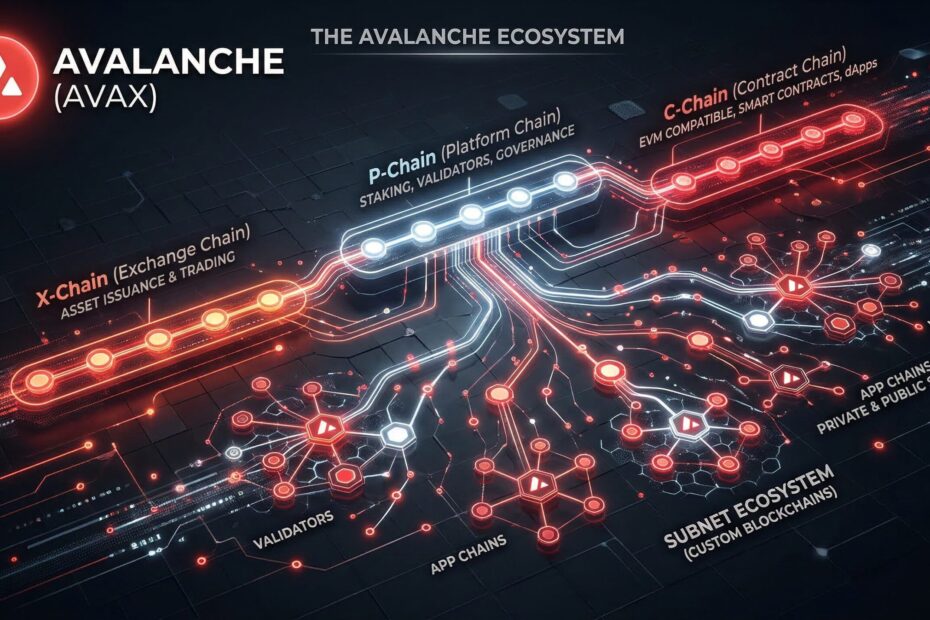
Avalanche’s most distinctive structural feature is its use of three separate blockchains, each optimized for a specific purpose. This stands in contrast to most blockchains, which use a single chain to handle all activity. The three chains communicate seamlessly but are independently optimized.
The X-Chain (Exchange Chain)
The X-Chain is the default asset creation and transfer layer within Avalanche. It is where AVAX is created, where assets like non-fungible tokens (NFTs) and other Avalanche-native tokens are issued, and where basic token transfers between wallets occur. The X-Chain uses a DAG (Directed Acyclic Graph) data structure, which enables extremely fast parallel transaction processing. Under normal conditions, the X-Chain can finalize transactions in under two seconds.
The C-Chain (Contract Chain)
The C-Chain is where Avalanche’s smart contract ecosystem lives. It is fully compatible with the Ethereum Virtual Machine (EVM), meaning any smart contract written in Solidity — the programming language used to build Ethereum dApps — can be deployed on the C-Chain with minimal or no modification. This compatibility is why Avalanche quickly attracted a large DeFi and NFT ecosystem: developers could port existing Ethereum applications to a faster, cheaper environment with minimal effort.
The C-Chain hosts Avalanche’s primary DeFi protocols, including decentralized exchanges (DEXs), lending platforms, stablecoins, and liquidity pools. Most user-facing applications on Avalanche operate on the C-Chain.
The P-Chain (Platform Chain)
The P-Chain is the coordination layer for Avalanche’s broader ecosystem. It manages validator membership, the staking system, and the creation of new subnets (custom blockchains). When a developer or enterprise wants to deploy their own custom blockchain on the Avalanche network, they interact with the P-Chain to register validators and configure their chain’s parameters. The P-Chain is not used for everyday transactions by end users but is critical infrastructure for network-level governance and expansion.
The Avalanche Consensus Mechanism
Avalanche uses a novel consensus protocol that differs fundamentally from both Bitcoin‘s proof-of-work and the traditional proof-of-stake systems used by most other smart contract platforms. The Avalanche consensus protocol works through a process of repeated random sampling:
- A node that receives a transaction broadcasts it to the network and randomly queries a small, statistically representative subset of other validators.
- If the queried validators agree on the transaction’s validity, the originating node updates its confidence level in the transaction.
- This sampling process is repeated in rapid succession until a sufficient confidence threshold is reached across the network.
- Once the threshold is crossed, the transaction is finalized — typically in 1–2 seconds.
This approach achieves near-instant finality, meaning transactions are irreversible almost immediately after being submitted, unlike Ethereum where multiple block confirmations are recommended for high-value transactions. The protocol also scales well: adding more validators to the network actually increases security without significantly degrading speed or decentralization.
The Avalanche9000 Upgrade: The Network’s Largest Evolution
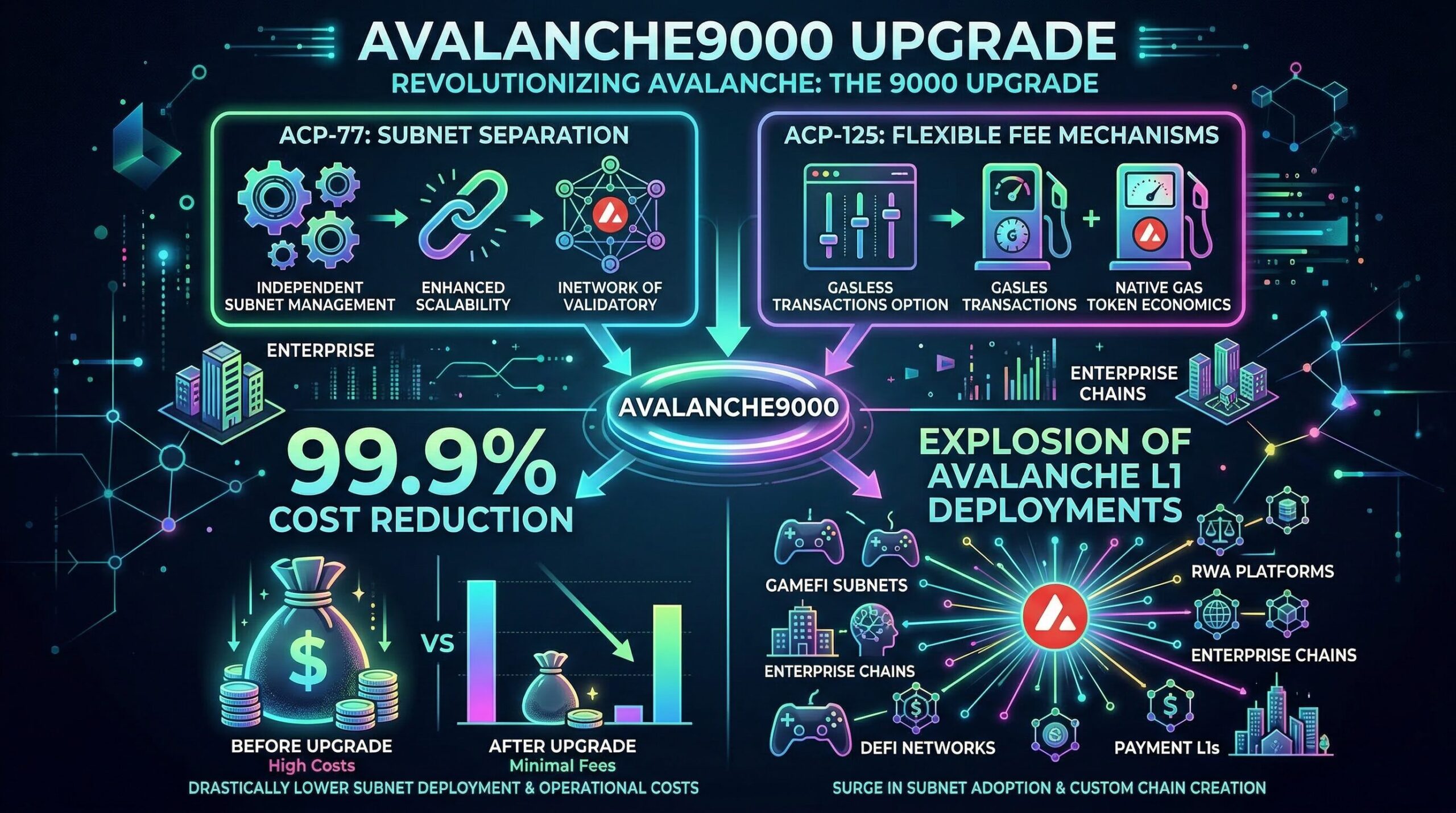
In December 2024, Avalanche activated its most significant network upgrade to date: Avalanche9000, also known as the Etna Upgrade. This upgrade implemented two major technical improvements — ACP-77 and ACP-125 — that fundamentally changed the economics and flexibility of building on Avalanche.
ACP-77: Reinventing Subnets as Avalanche L1s
Before Avalanche9000, launching a custom blockchain (subnet) on Avalanche required each validator of that subnet to also validate the entire Avalanche Primary Network, which meant holding a stake of at least 2,000 AVAX — worth tens of thousands of dollars at most market prices. This requirement created a significant financial barrier for smaller developers and projects.
ACP-77 eliminated this dependency. Validators of custom Avalanche L1s are no longer required to validate the Primary Network. This change reduced the cost of deploying and running a custom blockchain by approximately 99.9%. An enterprise or gaming studio that previously needed hundreds of thousands of dollars in AVAX to launch its own chain can now do so for a fraction of that cost.
The upgrade also introduced more flexible validator management: subnet operators can now manage their own validator sets using custom logic, including ERC-20 token-based staking, NFT governance, and other mechanisms not previously possible.
ACP-125: Reducing C-Chain Gas Fees
ACP-125 addressed fees on the C-Chain by reducing the minimum base fee from 25 nAVAX to 1 nAVAX — roughly $0.00000004 at current prices. Prior to this change, the minimum fee was described by the Avalanche team as “artificially high.” The reduction makes smart contract interactions on the C-Chain significantly more affordable, particularly for high-frequency applications like gaming and microtransactions.
The Retro9000 Program
Alongside the technical upgrade, the Avalanche Foundation launched Retro9000, a $40 million retroactive grant program for developers building on Avalanche9000. The program rewards teams that deploy Avalanche L1 blockchains and critical developer tooling, creating strong financial incentives for ecosystem growth. By January 2026, the Foundation had extended Retro9000 to include a C-Chain round, directing rewards toward projects driving on-chain activity on the main smart contract chain.
The Avalanche Ecosystem in 2026
Avalanche has grown into a multi-vertical ecosystem spanning decentralized finance, gaming, real-world asset tokenization, and enterprise blockchain infrastructure.
DeFi on Avalanche
The C-Chain hosts a robust DeFi ecosystem. Key protocols include DEXs, cross-chain bridges, decentralized lending markets, and yield aggregators. The Avalanche ecosystem benefits from native bridging to Ethereum and other major chains, allowing liquidity to flow in and out efficiently. Avalanche’s TVL (Total Value Locked) positions it as a top-tier DeFi destination alongside Ethereum’s Layer 2 networks and competing Layer 1 chains.
Gaming and Entertainment
Avalanche has emerged as a major platform for blockchain gaming, driven in part by the ease of deploying dedicated gaming subnets — now Avalanche L1s. Developers can launch their own custom chain with gaming-optimized parameters (fast finality, custom fee structures, controlled validator sets) without the overhead of the Primary Network. Several notable gaming studios have chosen Avalanche as their blockchain infrastructure precisely because of this flexibility.
Real-World Asset Tokenization
Avalanche has attracted significant institutional interest for tokenizing real-world assets (RWAs) — representing off-chain financial instruments like bonds, real estate, and fund shares as blockchain tokens. The network’s regulatory flexibility (subnet operators can enforce KYC/AML compliance within their validator set) makes it particularly suitable for regulated financial applications. Partnerships with traditional finance entities announced through 2024 and 2025 have advanced this use case considerably.
The Build Games 2026 Competition
In 2026, Avalanche launched its flagship online builder competition, Build Games, offering up to $1 million in prizes for developers building crypto-native applications on the network. This initiative reflects the ecosystem’s emphasis on practical builder activity rather than purely speculative growth.
AVAX Tokenomics
AVAX has a fixed maximum supply of 720 million tokens, making it a deflationary asset relative to many other proof-of-stake blockchains. Here are the key tokenomic properties:
- Maximum supply: 720,000,000 AVAX
- Initial distribution (2020): 360 million AVAX released at mainnet launch
- Staking rewards: New AVAX is minted as staking rewards, but the rate is capped and will gradually bring total supply toward the maximum
- Fee burning: Transaction fees on the network are burned (destroyed), creating a deflationary mechanism as network usage grows
- Staking minimum: 25 AVAX to delegate stake to a validator; 2,000 AVAX to run your own validator node
The fee-burning mechanism is important: as the Avalanche network processes more transactions, more AVAX is removed from circulation. If usage growth outpaces new staking emissions, the net effect is deflationary.
How to Stake AVAX
AVAX holders can earn staking rewards by participating in network security. There are two participation options:
Running a Validator Node
Validators are the backbone of Avalanche’s consensus. To run a validator, you need a minimum of 2,000 AVAX and must keep your node online for the duration of your staking period (minimum two weeks, maximum one year). Validators can earn between 7% and 12% APY in AVAX rewards, depending on their uptime, staking duration, and delegation fees charged.
Delegating to a Validator
Users without 2,000 AVAX can delegate a minimum of 25 AVAX to an existing validator. Delegators earn staking rewards minus a delegation fee set by the validator (typically 2–10%). This is the most accessible way for most AVAX holders to participate in network security and earn yield.
Most major exchanges and custody platforms also offer AVAX staking products with simplified interfaces, though typically with lower yields than self-delegating due to the platform’s fee layer.
AVAX vs. Ethereum: Key Differences
Many Avalanche users come from an Ethereum background, so understanding the key differences helps set accurate expectations:
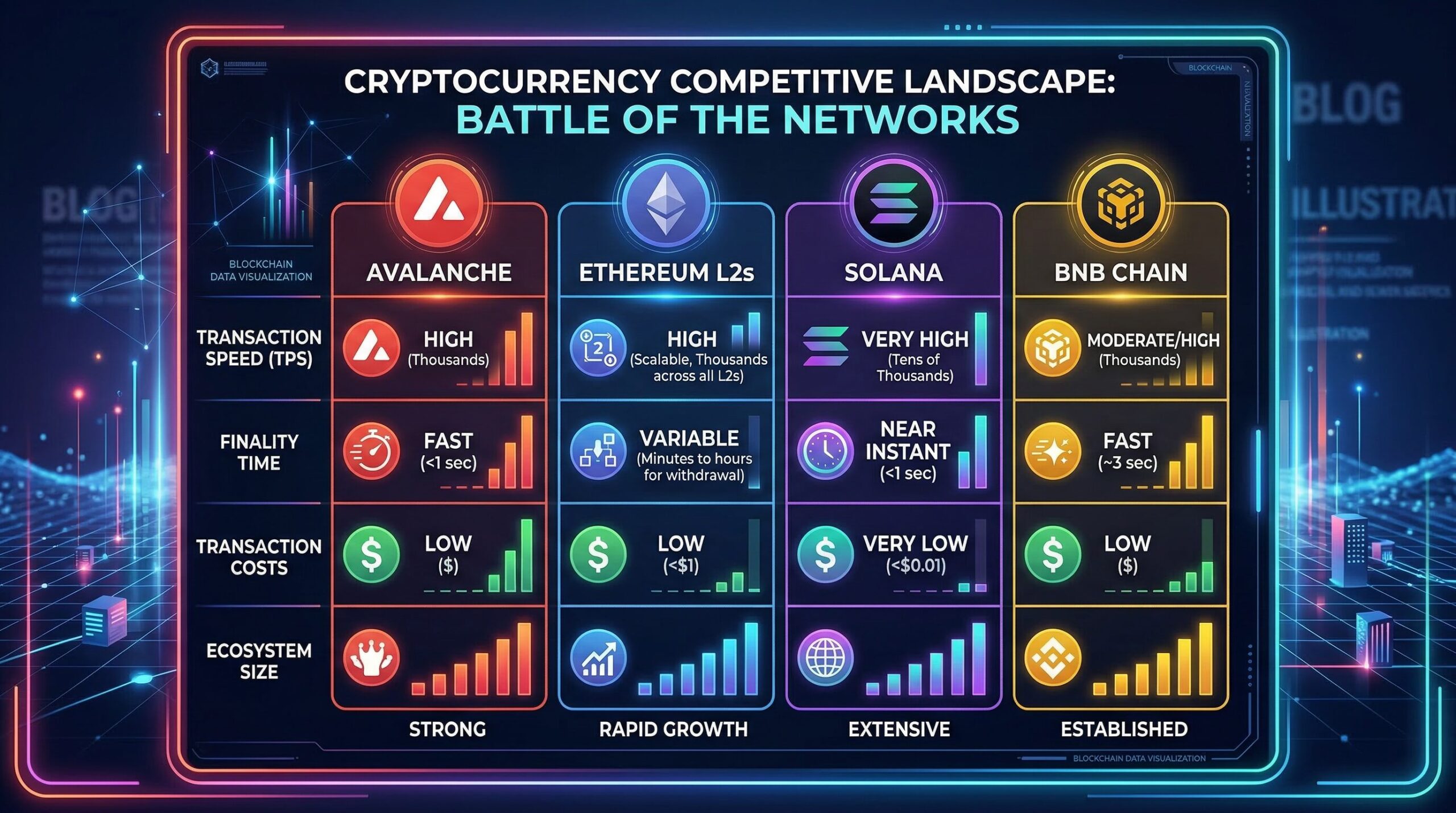
- Speed: Avalanche finalizes transactions in approximately 1–2 seconds. Ethereum’s base layer achieves finality in roughly 12–15 minutes (though L2 rollups provide faster user-experienced confirmations). For applications where immediate finality matters — like trading or gaming — Avalanche has a clear advantage at the base layer.
- Fees: C-Chain transaction fees on Avalanche are typically much lower than Ethereum mainnet fees, especially after the ACP-125 reduction. However, heavily used Ethereum L2s like Arbitrum and Base can achieve comparable fee levels.
- EVM compatibility: Both networks support Solidity smart contracts, meaning developers can target both without rewriting code.
- Ecosystem maturity: Ethereum has a larger total DeFi ecosystem, more developer tooling, and greater institutional recognition. Avalanche is catching up but remains smaller by absolute TVL and developer count.
- Custom blockchain deployments: Avalanche’s L1 architecture offers deployment flexibility that Ethereum mainnet cannot match, though Ethereum’s L2 ecosystem (Arbitrum Orbit, OP Stack) offers competitive alternatives.
Avalanche’s Competitive Position in 2026
The blockchain competitive landscape in 2026 is more contested than ever. Avalanche’s primary competition comes from multiple directions:
vs. Ethereum L2s
Ethereum’s Layer 2 ecosystem — led by Arbitrum, Base, and Optimism — has matured significantly. These networks offer EVM compatibility, Ethereum security inheritance, and increasingly low fees following Ethereum’s Pectra (May 2025) and Fusaka (December 2025) upgrades. For developers primarily targeting the Ethereum user base, L2s provide a compelling alternative to Avalanche.
Avalanche’s counter-argument is its L1 architecture: teams that want dedicated blockchains with custom rules, validator sets, and tokenomics prefer deploying an Avalanche L1 over becoming one rollup among hundreds competing on Ethereum’s shared infrastructure.
vs. Solana
Solana competes with Avalanche primarily for high-frequency, consumer-facing applications (DeFi, NFTs, consumer apps). Solana boasts higher raw throughput and a larger DeFi TVL, but its history of network outages remains a concern. Avalanche offers more reliability and custom-chain flexibility, while Solana offers a more unified high-performance environment.
vs. BNB Chain
BNB Chain, backed by Binance, has a larger absolute user base in several regions, particularly emerging markets. However, BNB Chain’s more centralized validator set limits its appeal to developers who prioritize decentralization. Avalanche has a meaningfully more decentralized validator network.
AVAX Price History and 2026 Market Overview
AVAX’s price history reflects the broader crypto market cycles:
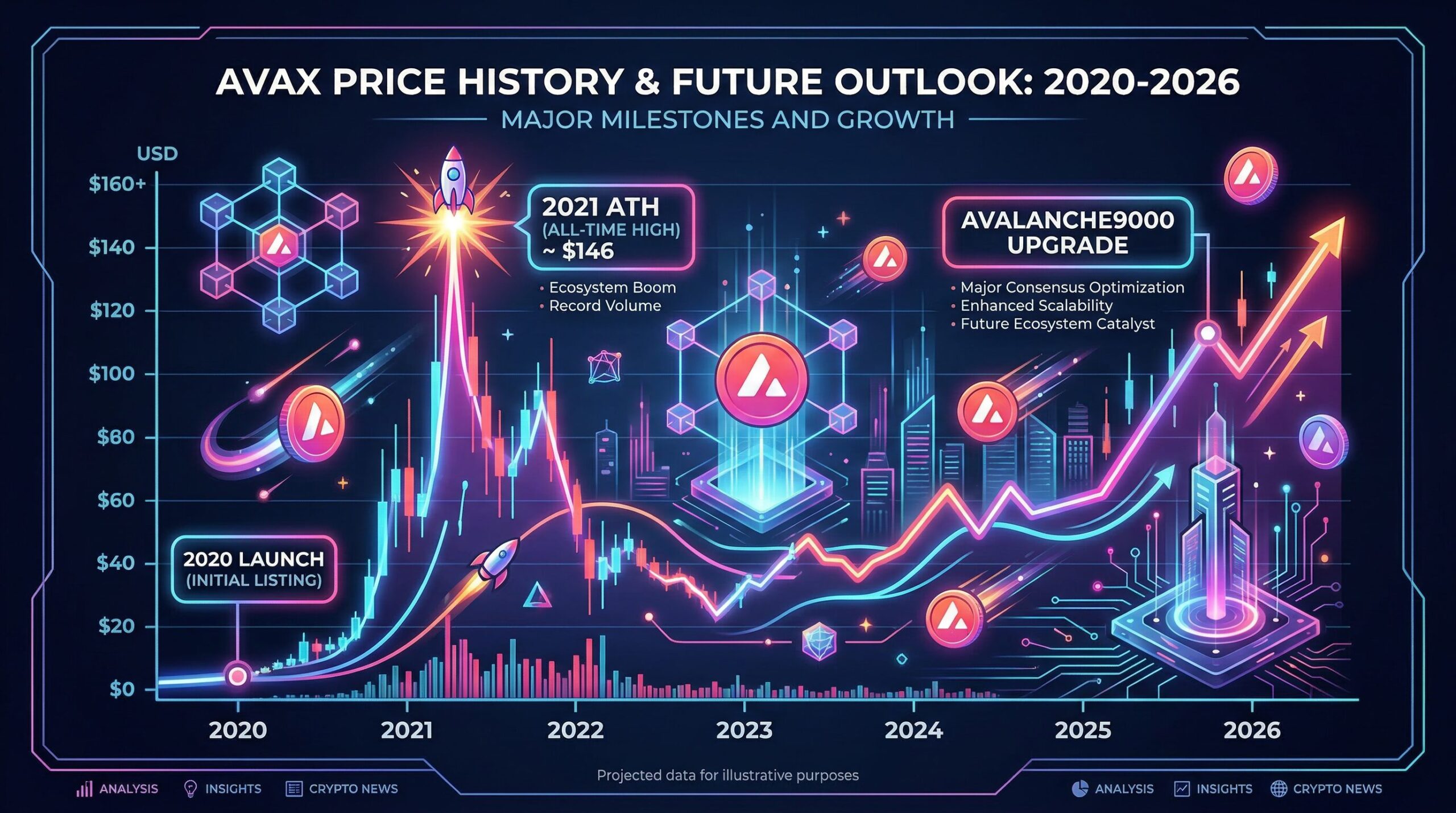
- 2020 (launch): AVAX began trading at approximately $3–$4 at the September 2020 mainnet launch.
- 2021 bull market: AVAX reached an all-time high of approximately $146 in November 2021, driven by explosive DeFi growth on the C-Chain and the broader crypto bull market.
- 2022 bear market: AVAX fell as low as $11 during the 2022 crypto winter, losing over 90% from its all-time high.
- 2023–2024 recovery: AVAX recovered through 2023 and reached $60–$70 during the 2024 bull run, supported by the Avalanche9000 upgrade announcement and $250 million in new funding from Galaxy Digital, Dragonfly Capital, and ParaFi Capital.
- March 2026: AVAX currently trades at approximately $9.55 in a broader market correction, reflecting a pullback from 2024 highs across most large-cap crypto assets.
At current levels, AVAX trades significantly below historical highs, which analysts attribute to the broader macro environment and increased competition rather than any fundamental deterioration in the Avalanche network itself.
How to Buy AVAX
AVAX is available on virtually every major cryptocurrency exchange. Here are the most commonly used platforms in 2026:
- Coinbase: Straightforward purchase with bank transfer or card. Available to US residents.
- Kraken: Competitive fees and strong security reputation. Available in the US and most of Europe.
- Binance: Largest trading volume globally. Not available to US residents.
- OKX: Popular in Asia and Europe with competitive fees.
- Bybit, KuCoin, MEXC: Additional options with various fee structures and regional availability.
For those who want self-custody, the official Core Wallet (developed by Ava Labs) supports AVAX and all Avalanche subnets. MetaMask can also connect to the Avalanche C-Chain by adding the network manually.
Risks and Considerations for AVAX Investors
- Competition: Avalanche faces intense competition from Ethereum L2s and other Layer 1 chains. Maintaining developer mindshare requires continuous execution.
- Price volatility: AVAX, like all crypto assets, is highly volatile. The drop from $146 to under $10 demonstrates the scale of potential losses.
- Subnet/L1 adoption pace: The value proposition of Avalanche9000 depends on whether developers actually deploy Avalanche L1s at scale. If adoption is slower than expected, the bullish case weakens.
- Regulatory risk: Global crypto regulation continues to evolve. Staking rewards and token classification face ongoing legal uncertainty in multiple jurisdictions.
Frequently Asked Questions About Avalanche
What makes Avalanche different from Ethereum?
Avalanche achieves near-instant (1–2 second) transaction finality at the base layer, uses three specialized blockchains instead of one, and enables custom blockchain deployments through its L1 architecture. Both platforms support EVM-compatible smart contracts, but Avalanche’s architecture is designed for higher throughput and greater deployment flexibility.
Is Avalanche proof of stake?
Yes. Avalanche uses a proof-of-stake consensus mechanism where validators stake AVAX to participate in securing the network. Unlike traditional PoS systems, Avalanche’s consensus protocol uses repeated random sampling rather than deterministic block production, which contributes to its speed.
How many Avalanche L1s exist in 2026?
As of early 2026, Avalanche reports supporting over 500 custom Layer 1 blockchains built on its infrastructure, a number that has grown significantly following the Avalanche9000 upgrade’s drastic reduction in deployment costs.
What is the AVAX staking reward rate?
Staking rewards on Avalanche range from approximately 7% to 12% APY depending on uptime, staking period, and delegation fees. Validators who maintain high uptime for longer staking periods receive the highest rewards.