
Personally, this Bitcoin surge highlights how options data signals market strength over hype.#Bitcoin #Crypto
Quick Video Breakdown: This Blog Article
This video clearly explains this blog article.
Even if you don’t have time to read the text, you can quickly grasp the key points through this video. Please check it out!
If you find this video helpful, please follow the YouTube channel “BlockChainBulletin,” which delivers daily Crypto news.
https://www.youtube.com/@BlockChainBulletins
Read this article in your native language (10+ supported) 👉
[Read in your language]
Bitcoin Ripped to $94,000: Unpacking the Surge and That Critical Metric
Jon: Hey Lila, have you seen the latest on Bitcoin? It’s making headlines again—Bitcoin just surged to $94,000, and there’s this critical metric that’s turned positive for the first time since October. According to CryptoSlate, it’s all about options positioning, on-chain flows, and some low-leverage dynamics signaling real conviction in the market. ETF inflows are pouring in beyond $1.2 billion, which is fueling this rally.
Lila: Wow, Jon, that sounds exciting. I’ve been following crypto news, but $94,000 is a big jump. Why does this matter? Is this just another hype cycle, or is there something substantial here?
Jon: It’s a fair question, Lila. This isn’t just random price action; it’s tied to underlying indicators that suggest the market might be shifting from caution to confidence. That “critical metric” likely refers to things like the Bitcoin options skew or funding rates turning bullish—basically, signs that traders are betting on upward movement without overleveraging, which reduces the risk of sudden crashes. Why it matters: It could indicate structural strength in Bitcoin’s price, especially after the dips we’ve seen. But remember, crypto is volatile— this is about understanding the signals, not predicting the future.
Lila: Okay, that helps. So, it’s not just the price; it’s these behind-the-scenes metrics giving it legs. But let’s dig deeper—what’s the problem this surge is highlighting or solving in the broader crypto ecosystem?
Jon: Exactly. The problem here is market uncertainty. Back in October, we had a crypto crash that wiped out gains and shook investor confidence—think of it like a sudden storm hitting a bustling city, causing traffic jams and delays everywhere. Bitcoin’s price dipped, ETF outflows happened, and metrics like on-chain activity turned negative, signaling reduced participation. This surge to $94,000, with metrics flipping positive, is like the traffic clearing up because the weather improved and roads got repaired. It shows renewed flows and conviction, potentially stabilizing the ecosystem.
Lila: I like the traffic analogy—it makes sense for something as interconnected as crypto markets. But can you clarify what exactly that “critical metric” is? Is it something specific, or a combination?
Jon: From the reports, it’s a mix, but a key one is the options positioning turning positive—meaning more calls (bets on price increases) than puts (bets on decreases) for the first time since October. Analogize it to plumbing: If the pipes were clogged with bearish sentiment (negative flows), this metric flipping is like clearing the blockage, allowing positive pressure to build and push prices up steadily.
Lila: Got it. So, it’s about restoring flow in the system. Now, how does Bitcoin actually handle all this under the hood?
Under the Hood: How it Works
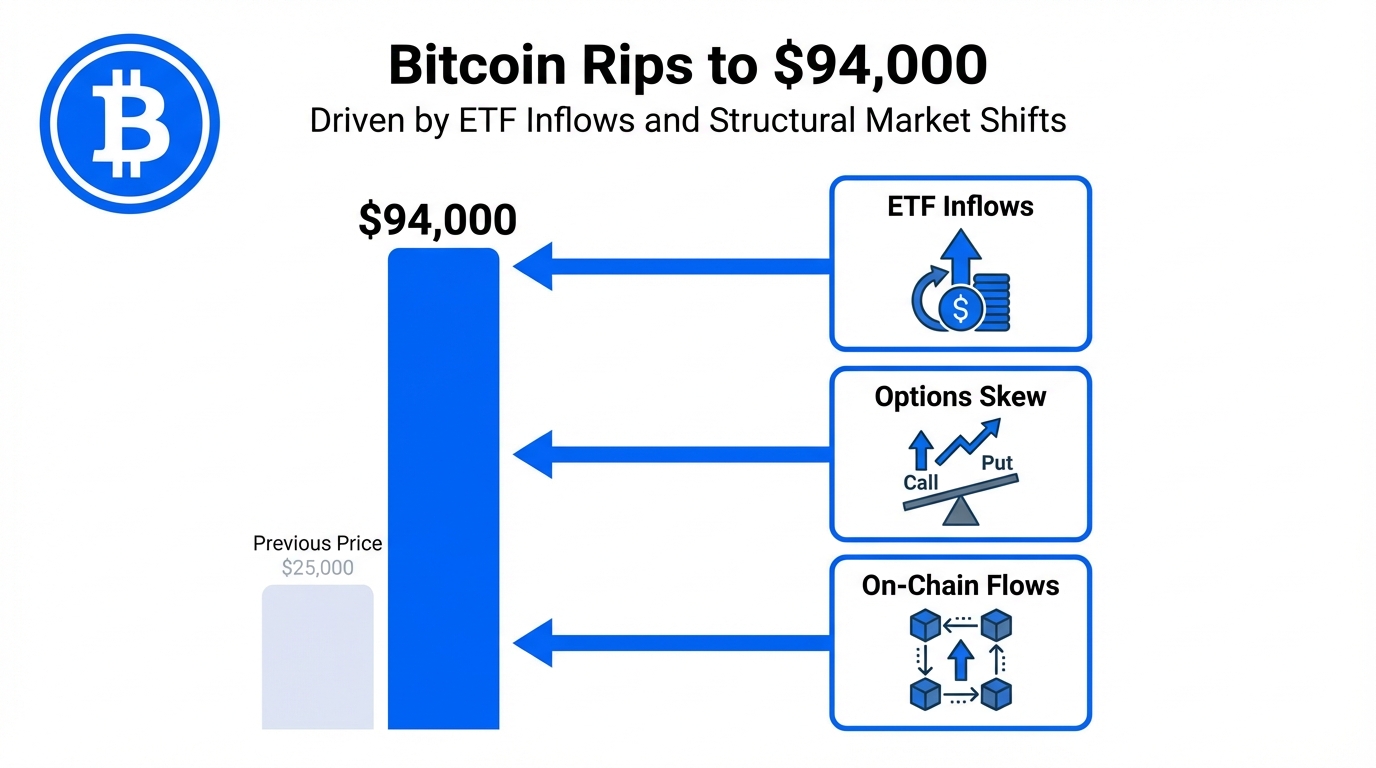
Jon: Alright, let’s peel back the layers. Bitcoin operates on a decentralized blockchain—essentially a public ledger where transactions are recorded in blocks and secured by miners using proof-of-work. This surge ties into market metrics, but at its core, Bitcoin’s architecture ensures trustless value transfer. Think of it as a global accounting book that no single entity controls. When prices rip like this, it’s influenced by supply-demand dynamics, but the “critical metric” here is often the realized volatility or funding rates in derivatives markets, which have turned positive, indicating sustainable momentum.
Lila: Proof-of-work— that’s the energy-intensive mining, right? Where computers solve puzzles to validate blocks?
Jon: Spot on. It secures the network against attacks. For this price action, on-chain flows (like large transfers to exchanges) and options data show conviction. Low leverage means fewer forced liquidations, which is witty in a market that loves drama—it’s like traders finally learning not to bet the farm.
Lila: Haha, yeah, less drama is good. To compare, how does this positive turn stack up against past metrics?
Jon: Great point. Let’s break it down in a table for clarity.
| Metric | Pre-October (Negative Phase) | Current (Positive Turn) |
|---|---|---|
| Options Skew | Bearish bias, more puts than calls | Bullish, calls dominating for first time since October |
| On-Chain Flows | Net outflows, reduced activity | Positive inflows, increased transfers |
| Leverage Levels | High, leading to volatility spikes | Low, signaling structural conviction |
| ETF Inflows | Outflows during crash | Over $1.2 billion in recent inflows |
Jon: As you can see, this shift isn’t trivial—it’s a quiet but powerful change in market health.
Lila: That table really highlights the before-and-after. So who actually uses this? I mean, beyond traders, what are the real applications driving this?
Jon: Bitcoin’s use cases go beyond speculation. At a technical level, it’s a store of value—like digital gold—used by institutions for hedging inflation or geopolitical risks. Developers build on it via layers like Lightning Network for fast, cheap payments. Users in unstable economies use it for remittances or savings, bypassing volatile local currencies. The positive metrics boost confidence for these applications, as a stable price encourages adoption without the wild swings.
Lila: Interesting— so it’s not just for buying lambos; it’s practical tech. For example, how do developers integrate it?
Jon: Precisely. Developers use Bitcoin’s scripting for smart contracts, though limited compared to Ethereum. Applications include decentralized finance (DeFi) on sidechains or even NFTs via Ordinals. The surge reinforces its role as a base layer for Web3, where reliability matters more than hype.
Lila: Okay, that makes sense. If someone’s interested in learning more, what’s a good action plan? Without jumping into risky stuff.
Jon: Let’s structure it step by step. Start with Level 1: Research and Observation. Dive into Bitcoin’s whitepaper on bitcoin.org—it’s foundational, explaining the peer-to-peer electronic cash system. Use block explorers like Blockchain.com to watch live transactions and on-chain metrics. Dashboards from Glassnode or CryptoQuant show things like the “critical metric” in action, helping you track flows without any commitment.
Lila: Sounds accessible. And for hands-on, Level 2?
Jon: Level 2: Testnet Experimentation. Bitcoin has a testnet where you can play with fake BTC—no real money involved. Set up a wallet like Electrum, get testnet coins from faucets, and practice sending transactions. It’s a safe way to understand mining simulations or even build simple scripts. Emphasize: This is for learning mechanics, not trading. Risks remain in real markets, so always prioritize education over speculation.
Lila: Perfect—keeps it educational and low-risk.
Jon: To wrap up, this Bitcoin surge to $94,000 with metrics turning positive is a noteworthy development, highlighting potential market recovery. It shows Bitcoin’s resilience as a technology, but limitations like scalability and energy use persist. The future could see more institutional adoption, but it’s uncertain—watch for macroeconomic factors.
Lila: Absolutely, Jon. Readers, remember crypto’s volatility; approach with caution and focus on understanding. It’s a fascinating space, but uncertainty is part of it.
Jon: Well said. Stay curious, stay informed.
References
- Bitcoin ripped to $94,000 as critical metric quietly turns positive for first time since October
- Official Bitcoin Website
- Bitcoin Price Jumps 8% Into New Year As Bullish Momentum Builds
- Bitcoin Price Prediction 2026–2030: Can BTC Rally to $105K in Jan 2026?