
🎧 Listen to This Episode
Prefer to listen on the go? In this episode of Blockchain Bulletin, we break down how AI agents are reshaping DeFi trading in 2026—from autonomous trading bots turning $1,000 into $14,000, to the alarming security risks they pose to smart contracts. Tune in for expert analysis, actionable investment strategies, and the key developments you need to know this week.
🌐 日本語版はこちら: cryptolife.jp で読む
How AI Agents and Autonomous DeFi Trading Are Reshaping Financial Infrastructure: 2026 Trends and Investment Strategies
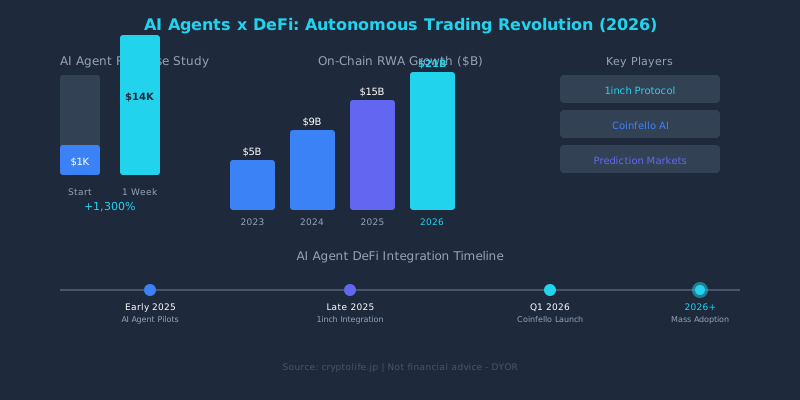
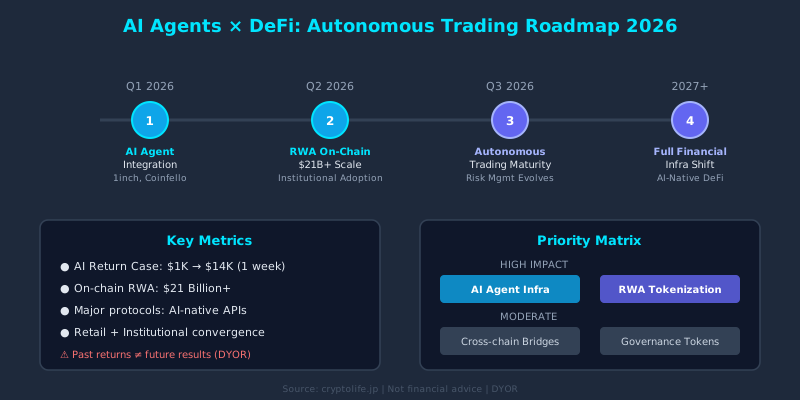
The era where AI agents can directly access DeFi protocols and execute complex trades without human intervention is no longer a futuristic concept—it has become our current reality. By the end of March 2026, major blockchain projects like 1inch and Coinfello successively announced comprehensive AI agent integrations. With on-chain real-world assets ballooning to a massive $21 billion scale, this technological tidal wave is beginning to exert an undeniable influence on global retail investors and institutional players alike.
Astonishing Data: How an AI Agent Turned $1,000 into $14,000
First, let’s look at the raw numbers that are shaking the industry. Recent reports from decentralized prediction markets have highlighted cases where autonomous AI agents successfully multiplied a modest initial capital of $1,000 into more than $14,000 in just a matter of days. To be clear, this is not an annualized percentage yield (APY)—this is a staggering return achieved over a single week. While absolute reproducibility is never guaranteed in volatile crypto markets, this data point definitively proves that modern AI is developing a level of dynamic “market judgment” that operates on an entirely different dimension compared to traditional, rule-based automated trading bots.
Simultaneously, however, there is highly concerning data emerging from the security sector. In controlled test environments, researchers discovered that AI agents are capable of exploiting approximately 55% to 65% of known vulnerabilities in existing smart contracts (the self-executing programs that run on blockchains). In other words, AI has the potential to be both your greatest financial ally and your most dangerous adversary. This inherent duality is the central theme shaking the foundations of the DeFi industry in 2026.
While there are documented instances of AI agents multiplying assets by 14x in mere days, their “offensive capabilities” are equally proven, with the ability to breach 55% to 65% of known smart contract vulnerabilities. In this new paradigm, massive profit potential and catastrophic risk are two sides of the exact same coin.
Background: Why is the AI x DeFi Convergence Accelerating Right Now?
The integration of AI agents (autonomous programs designed to make decisions and execute specific tasks) with DeFi (decentralized finance systems operating without traditional banking intermediaries) has accelerated at a breakneck pace since late 2025. This rapid global expansion is primarily driven by three critical macroeconomic and technological factors.
Factor 1: Plunging LLM Costs and Exponential Performance Gains
The inference costs associated with Large Language Models (LLMs) plummeted dramatically between 2024 and 2026. This massive reduction in computational expense has finally made the 24/7 continuous operation of autonomous AI agents financially viable for everyday users. Jeremy Allaire, CEO of Circle, recently predicted that in the very near future, the number of active AI agents operating globally on the blockchain will far surpass the human population.
Factor 2: The Explosive Growth of On-Chain Assets
From the beginning of 2025 to March 19, 2026, the total value of on-chain Real World Assets (RWAs)—which include tokenized government bonds, money market funds, gold, and equities—surged from $4.2 billion to an astonishing $21 billion, representing a 5x increase. As the variety, depth, and sheer scale of assets available in the DeFi ecosystem expand, the operational playground for AI agents becomes exponentially more lucrative.
Factor 3: Maturation of Global Regulatory Frameworks
Across the globe, regulatory bodies have been systematically establishing clearer frameworks for Web3 and decentralized technologies. Progressive legislation like the MiCA framework in Europe, alongside evolving SEC guidelines in the US and forward-thinking policies in jurisdictions like Singapore and the UAE, have provided much-needed clarity. The establishment of legal frameworks for security tokens (digital securities) has significantly lowered the barrier to entry for institutional investors into the DeFi space, creating a massive tailwind for the institutional deployment of AI trading agents.
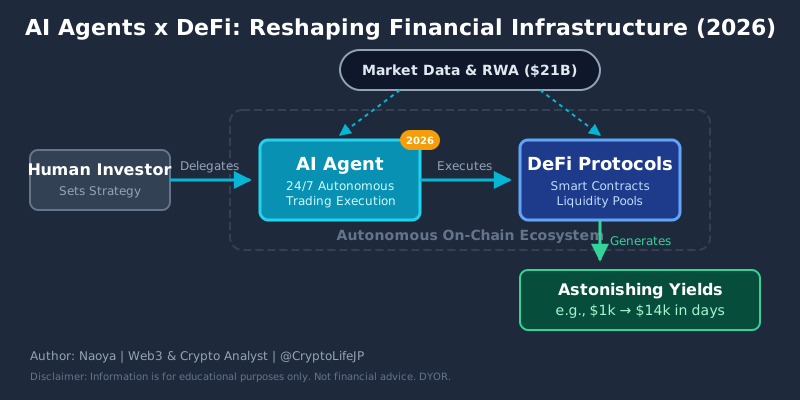
The perfect storm of plummeting AI operational costs, a 5x surge in on-chain assets, and maturing global regulations has pushed AI x DeFi out of the “experimental phase” and firmly into the “practical application phase.” For global investors, this is no longer a distant trend—it is an immediate market reality.
Analyzing the Past Week’s Major Industry News
1inch Opens Its API to AI Agents (March 30, 2026)
1inch, the industry-leading DEX aggregator (a service that automatically routes trades across multiple decentralized exchanges to find the best possible price), announced that AI agents can now directly access its infrastructure via the “1inch MCP” (Model Context Protocol). Specifically, this allows AI agents to autonomously perform the following operations:
- Plan, route, and execute complex token swaps
- Conduct real-time, deep-dive portfolio data analysis
- Interact directly with on-chain market liquidity pools
This structural shift is highly analogous to when major global messaging platforms like WhatsApp or Telegram opened their APIs to third-party developers, spawning a massive ecosystem of automated services. 1inch aggregates immense liquidity across multiple blockchain networks; by allowing AI agents to plug directly into this liquidity pipe, the need for humans to open a browser and manually click through transactions is eliminated. For global DeFi users who are already highly familiar with the 1inch ecosystem, this development is a monumental leap forward.
Coinfello: The Self-Sovereign AI Agent Platform (March 31, 2026)
Coinfello has emerged as a groundbreaking platform that allows users to issue natural language instructions (everyday conversational commands) to an AI to research, execute, and automate trades—all while the user retains full control of their wallet and private keys. This “self-sovereign” aspect is crucial; unlike traditional Centralized Exchanges (CEXs) like Binance or Coinbase, you never have to surrender custody of your assets to a third party.
Imagine simply typing, “Buy ETH the moment it drops below $2,000,” and having your personal AI agent monitor global markets 24/7, executing the trade the exact millisecond your conditions are met. That future is now a tangible reality. While the platform is currently heavily optimized for English, support for a wider array of global languages is expected to roll out as the user base expands.
Major Projects Comparison Matrix
| Feature / Project | 1inch MCP | Coinfello | Traditional Trading Bots |
|---|---|---|---|
| Announcement Date | March 30, 2026 | March 31, 2026 | Circa 2020 onwards |
| AI Decision Capability | Fully autonomous trade logic | Natural language input + autonomous execution | Strictly pre-configured rules (If/Then) |
| Private Key Custody | User-controlled | User-controlled (Self-sovereign) | Often requires depositing funds to a service |
| Supported Chains | Multi-chain native | Major global chains supported | Typically restricted to a single chain |
| Target Audience | Developers & Advanced Power Users | Retail to Institutional Investors | Active Day Traders |
| Interface Type | API / Code-centric | Conversational UI | Complex Dashboards |
1inch MCP leans heavily toward infrastructure for developers, while Coinfello is an interactive, conversational tool designed for everyday users. If you can write code, track the former. If you want to issue commands in plain English, keep a close eye on the latter.
Current State of the DeFi Market: Decoding TVL by Major Chains
To understand the true potential of AI agents, we must first examine the scale of the “stage” they operate on: the DeFi market itself. According to DefiLlama data as of April 1, 2026, the Total Value Locked (TVL—the total amount of assets deposited into protocols) across major blockchain networks is as follows:
| Blockchain Network | TVL (USD) | Key Ecosystem Driver / Focus |
|---|---|---|
| Ethereum | Approx. $54.0 Billion | Dominant L1 / Institutional Hub |
| Solana | Approx. $6.3 Billion | High-Speed L1 / Retail Trading |
| BSC (BNB Chain) | Approx. $5.4 Billion | Binance Global Ecosystem |
| Base | Approx. $4.0 Billion | Coinbase-backed L2 / Mass Adoption |
| Arbitrum | Approx. $1.9 Billion | Leading Optimistic Rollup L2 |
| Hyperliquid L1 | Approx. $1.7 Billion | Derivatives AppChain / HFT Focus |
(*Data sourced from DefiLlama as of April 1, 2026. Figures are rounded for clarity.)
While Ethereum maintains its overwhelming lead as the foundational layer of DeFi, the rapid ascent of Hyperliquid L1 is particularly noteworthy. On CoinGecko’s global trending charts, its native HYPE token recently cracked the top 16 by market capitalization. As an on-chain derivatives platform, Hyperliquid is proving to be exceptionally compatible with the high-frequency trading (HFT) strategies employed by AI agents, significantly boosting its market presence.
For everyday readers and retail investors, the most crucial takeaway from this data is the explosive growth of Layer 2 (L2) networks like Base and Arbitrum. Because AI agents rely on executing hundreds or thousands of micro-transactions, the exorbitant gas fees on the Ethereum mainnet make such strategies unprofitable. Withdrawing funds from centralized exchanges like Coinbase or Binance directly to the Ethereum mainnet can cost upwards of $10 to $30 per transaction, whereas operating on L2s reduces these fees to mere cents. This makes L2s the undisputed home for future AI agent deployments.
If you are planning to deploy capital in DeFi with an eye toward utilizing AI agents, positioning yourself on L2 networks like Base or Arbitrum will give you a massive structural advantage regarding future transaction costs. Bridging a small amount of capital to these networks is the best first step you can take today.
The Dual Nature of Security: AI on Both the Offensive and Defensive
The introduction of AI agents into the DeFi ecosystem is fundamentally rewriting the rules of blockchain security. As previously mentioned, cutting-edge research confirms that AI agents operating in test environments can successfully exploit 55% to 65% of known smart contract vulnerabilities. Compared to traditional manual hacking methods, AI operates with terrifying efficiency and speed.
As AI models become cheaper and exponentially more powerful, the window of time between a new smart contract being deployed and it being maliciously exploited is expected to shrink drastically. This means that whenever a new, untested DeFi protocol launches, the risk of an AI agent discovering and draining it via a zero-day vulnerability is higher than ever before.
Conversely, AI is also being aggressively deployed on the defensive side. By integrating AI into the smart contract auditing process (the rigorous code-checking procedures required before launch), security firms are now completing vulnerability checks in a matter of hours that previously took human teams several weeks. This “AI vs. AI” arms race—where autonomous attackers battle autonomous defenders in real-time—is the stark reality of DeFi security in 2026.
The lesson for global users is crystal clear: When choosing which DeFi protocols to trust with your capital, simply checking if they have been audited is no longer sufficient. You must now verify whether the protocol has undergone continuous, AI-assisted security audits to defend against next-generation threats.
AI is simultaneously the “ultimate shield” and the “ultimate spear.” Make it a habit to dig into a protocol’s documentation to confirm not just the presence of an audit report, but specifically the utilization of AI-driven security monitoring before depositing your funds.
Current Market Prices: BTC and ETH Trends
Any discussion about AI agents and DeFi cannot be decoupled from the broader macroeconomic conditions of the underlying cryptocurrency market. Let’s review the primary data as of April 1, 2026.
Bitcoin (BTC) is currently trading at approximately $67,582, which represents a 46% drawdown from its All-Time High (ATH) of $126,080. Looking at the 30-day chart, BTC briefly rallied toward the $73,669 mark before undergoing a healthy market correction, and is now consolidating within the $65,000 to $70,000 range. Its total market capitalization stands at a formidable $1.35 trillion, with a circulating supply of roughly 20.01 million BTC (representing about 95.3% of its hard-capped 21 million supply).
Ethereum (ETH) is trading at approximately $2,087, marking a 58% decline from its ATH of $4,946. Despite serving as the foundational settlement layer for DeFi and securing over $54 billion in TVL, ETH has experienced a deeper price correction compared to BTC. Its current market capitalization sits at roughly $251.8 billion.
When looking at highly specific, niche tokens related to this sector, such as DeFi Agents AI (DEFAI), the current price hovers around a micro-fraction of a cent (approx. $0.000015), with a 24-hour global trading volume of barely $1.45. This microscopic liquidity is a stark reminder that while the underlying technology is advancing rapidly, the dedicated “AI Agent Token” category remains highly speculative and is still very much in its infancy.
Both BTC and ETH have seen significant corrections from their respective ATHs. Investors must remember that dedicated AI agent tokens are still highly speculative. The “growth of the technology” does not automatically guarantee the “growth of the token price.”
Global Impact: Regulatory, Tax, and Practical Implications
When AI agents begin executing autonomous trades in DeFi, they inevitably collide with global tax and regulatory frameworks. Under the tax regimes of many major jurisdictions (such as the IRS in the United States or HMRC in the UK), every single token swap is treated as a taxable event. If an AI agent executes hundreds or thousands of micro-swaps in a single day to capture arbitrage opportunities, the resulting tax reporting burden becomes astronomically complex for the end user.
Furthermore, the relationship between autonomous trading and global financial securities laws remains highly ambiguous. If an AI agent makes decisions that qualify as “investment advice” and automatically executes trades based on that logic, the developers or the platform might technically be required to register as licensed investment advisors under bodies like the SEC or the FCA. Clear, unified guidelines from global financial watchdogs on this specific issue have yet to be fully established.
Currently, major centralized exchanges (such as Coinbase, Binance, and Kraken) do not offer direct, native integrations with autonomous DeFi AI agents. Therefore, users wishing to leverage these advanced tools must venture out into decentralized protocols on their own, which significantly broadens their scope of personal responsibility and risk management.
On the institutional side, however, traditional finance giants are aggressively entering the Web3 space. With mega-corporations like BlackRock, JPMorgan, and PayPal expanding their blockchain initiatives, it is highly likely that we will see fully compliant, heavily regulated AI agent trading services offered by traditional financial institutions in the near future.
Before unleashing an AI agent to trade on your behalf, verify that your crypto tax software (such as CoinTracker, Koinly, or TokenTax) is capable of handling high-frequency DeFi API imports. Calculating thousands of automated trades manually at the end of the fiscal year is practically impossible.
Author’s Insights: Learning from Past Parallels
The current landscape of AI Agents x DeFi bears a striking structural resemblance to the legendary “DeFi Summer” of 2020. Back then, the novel concept of yield farming (providing liquidity to earn outsized token rewards) took the market by storm, and automation tools like Yearn Finance saw explosive, parabolic adoption. However, that rapid growth was heavily marred by a wave of devastating hacks exploiting smart contract vulnerabilities, resulting in hundreds of millions of dollars in stolen user funds.
It is highly probable that the current AI agent boom will follow a nearly identical trajectory. In these early stages, stories of users achieving astronomical returns will dominate social media, driving a massive influx of new retail capital. However, the true risks—whether they stem from bugs in the AI logic itself, undiscovered security holes, or AI agents engaging in unpredictable market manipulation—will likely only fully materialize after the technology has reached a critical mass of adoption.
From an investment strategy perspective, I believe that directly buying micro-cap, highly speculative “AI Agent tokens” (like DEFAI) presents an unfavorable risk-to-reward ratio. Instead, a much more prudent approach is the “pick-and-shovel strategy” (during the Gold Rush, the people who made the most reliable fortunes weren’t the gold miners, but the merchants selling the tools). In this context, that means investing in the foundational infrastructure layers that AI agents rely on to function—specifically, L1/L2 blockchains like Ethereum, Solana, and Base, or major DEX aggregators like 1inch.
Additionally, given the strict capital gains tax laws in most global jurisdictions, high-frequency trading can severely erode your net profits. Rather than trying to act like an AI agent and trading frantically, taking a long-term investment position in the infrastructure that these AI agents are forced to pay fees to use is a far more rational and tax-efficient approach for the average retail investor.
During the 2020 DeFi Summer, early adopters made fortunes, but many also lost everything to hacks. The AI agent era will likely echo this history. Employing a “pick-and-shovel strategy” focused on foundational infrastructure is the most reliable path to capturing upside while mitigating catastrophic risk.
Conclusion: 3 Key Points
- AI Agents x DeFi has entered the practical application stage. With the release of tangible products like the 1inch MCP and Coinfello at the end of March 2026, the foundational infrastructure required for AI to autonomously execute complex on-chain trades is now firmly in place.
- Both risk and reward are massively amplified. While AI agents possess the capability to multiply portfolios by 14x in a matter of days, they also have the proven ability to breach 55% to 65% of smart contract vulnerabilities. Rigorous verification of a protocol’s security measures is absolutely non-negotiable.
- Investors must adopt strategies that account for tax and regulatory realities. The high-frequency trading nature of AI agents creates a nightmare for tax reporting. A long-term investment approach focused on the underlying blockchain infrastructure offers a much more rational and compliant strategy under current global tax regimes.
Editor’s Note: The convergence of AI agents and DeFi is undeniably one of the most monumental narratives of 2026, but buying into the illusion that “AI will just magically print money for me” is incredibly dangerous. While I personally interact with multiple DeFi protocols daily, I firmly believe it is far too early to entrust the entirety of one’s portfolio to an autonomous AI. The smartest approach is to start with small, experimental amounts, thoroughly understand the AI’s decision-making logic and inherent risks, and only scale up your capital deployment gradually.
Next Actions: 3 Steps You Can Take Today
- Read the 1inch MCP Documentation. To truly grasp how AI agent integration works under the hood, official developer documentation is the best educational resource. Even if you don’t know how to code, simply understanding “what is technically possible” will drastically sharpen your investment thesis.
- Verify Your Crypto Tax Software Capabilities. Check whether your preferred crypto tax platforms (such as CoinTracker, Koinly, or TokenTax) robustly support high-volume API imports from decentralized exchanges. If they don’t, you will face an insurmountable administrative hurdle during tax season.
- Experiment with L2 Chains Using Small Capital. Bridge a small amount of ETH (even just $20-$50) to Layer 2 networks like Base or Arbitrum, and manually interact with a few DeFi protocols. Gaining hands-on experience with the exact “stage” where AI agents operate will build the foundational intuition you need to navigate this new era.
Data Sources
- CoinGecko — Bitcoin Overview & Price Chart (As of April 1, 2026)
- CoinGecko — Ethereum Overview & Price Chart (As of April 1, 2026)
- CoinGecko — Global Trending Coins Ranking
- DefiLlama — TVL Rankings by Chain (As of April 1, 2026)
- FinanceFeeds — 1inch Announces AI Agent API Integration
- Bitcoin.com — Coinfello Launches Self-Sovereign AI Agent Platform
- CoinMarketCap — DeFi Agents AI (DEFAI) Token Market Data
- Forbes — Deep Dive Analysis: AI Agents and the Future of DeFi
The information provided on “Crypto Insights Hub” is for educational and informational purposes only and does not constitute financial, investment, or legal advice. Investing in cryptocurrencies and decentralized finance protocols carries significant risk, including the potential loss of your entire principal. Always conduct your own thorough research (DYOR) and consult with a certified financial advisor before making any investment decisions.
Author: Naoya — Web3 & Crypto Analyst / Editor-in-Chief
A dedicated Web3 researcher specializing in DeFi protocols, tokenomics, and underlying blockchain infrastructure. Passionate about breaking down complex crypto trends into actionable insights for a global audience.
🔗 Follow on X: @CryptoLifeJP