Intellectual property — the legal rights that protect creative works, inventions, brands, and original ideas — is one of the most valuable asset classes on the planet. Yet the systems governing IP rights have changed little in decades. Registration is slow. Licensing is complex and expensive. Royalty payments are opaque and often delayed. Enforcement across international borders is inconsistent at best.
Blockchain technology offers solutions to each of these problems. By creating immutable, timestamped records of creation and ownership, automating licensing agreements through smart contracts, and enabling the tokenization of IP rights into tradable on-chain assets, blockchain is gradually transforming how intellectual property is registered, managed, licensed, and monetized.
This guide explains the core concepts of on-chain intellectual property and cultural asset tokenization, covers the leading platforms and projects building this infrastructure in 2026, and addresses the practical implications for creators, businesses, and investors.
What Is On-Chain Intellectual Property?
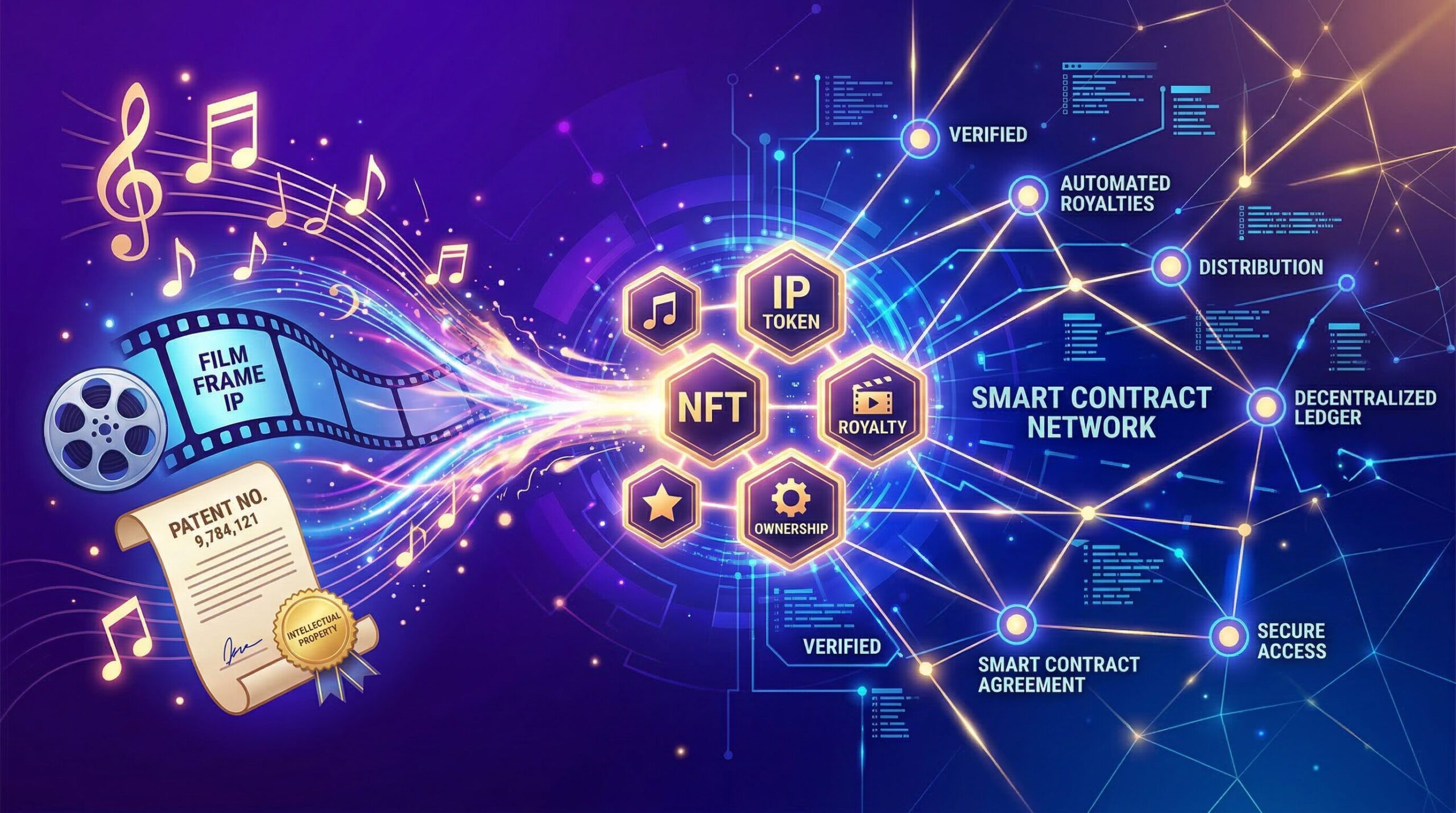
On-chain intellectual property refers to intellectual property rights that are registered, tracked, licensed, and enforced through blockchain-based systems. The blockchain serves as an immutable ledger: once a creator registers their work, the record of authorship, creation date, and ownership cannot be altered or disputed without on-chain evidence.
This matters because traditional IP systems rely on centralized databases maintained by government bodies — the US Patent and Trademark Office, the European Union Intellectual Property Office, national copyright registries — that are slow, siloed, and often incompatible with the global, digital nature of modern creative work. A digital artwork published online simultaneously reaches audiences in dozens of jurisdictions, none of which may have automatic knowledge of the work’s registered ownership.
Blockchain provides an alternative: a single global ledger where ownership records are publicly verifiable, jurisdictionally neutral, and instantly accessible to anyone who needs to confirm the provenance of an asset.
The Difference Between Registration and Legal Protection
A critical distinction: on-chain IP registration provides verifiable evidence of creation and ownership, but it does not automatically confer legal protection in the same way a government-issued patent or copyright registration does. Courts in most jurisdictions have begun accepting blockchain records as evidence of authorship — timestamped proof of creation predating any dispute — but the legal frameworks for treating on-chain records as legally equivalent to registered IP are still evolving globally.
In practice, on-chain registration is most immediately powerful as: evidence in IP disputes; a mechanism for automating licensing and royalty payments through smart contracts; and a tool for creating liquid, tradable representations of IP rights through tokenization.
Core Applications of Blockchain in Intellectual Property
1. Timestamped Proof of Creation
The simplest and most universally applicable use case: recording a cryptographic hash of a creative work on a blockchain at a specific time. The hash is a unique mathematical fingerprint of the work — if the work changes by even a single character or pixel, the hash changes completely. The blockchain timestamp proves that a specific version of the work existed at a specific moment.
This creates irrefutable prior art evidence for patents, establishes authorship dating for copyright disputes, and provides creators with a low-cost alternative to formal registration for works that may not warrant the expense of legal registration but benefit from documented provenance. Several blockchain-based IP platforms make this process available for as little as the cost of a single blockchain transaction.
2. Smart Contract Licensing
Smart contracts — self-executing code on a blockchain — can encode licensing terms directly into an asset’s on-chain record. Rather than negotiating a separate licensing agreement each time a creator grants someone permission to use their work, a smart contract can automatically:
- Grant usage rights upon payment of a specified fee
- Define the scope of permitted use (personal, commercial, exclusive, non-exclusive)
- Distribute royalty payments to all rights holders in real time as revenue is generated
- Automatically enforce geographic restrictions or time-limited licenses
- Revoke rights if payment conditions are not met
For creators in the music industry, this means royalties that flow within seconds of a play or sync license execution, rather than the months-long lag typical of traditional royalty collection societies. For film and television, it means licensing packages for international distribution rights that execute automatically when territory-specific conditions are met.
3. IP Tokenization and Fractional Ownership
Tokenization converts IP rights into blockchain tokens that can be bought, sold, and held like other digital assets. A creator can issue tokens representing ownership of a music catalog, a patent portfolio, or the commercial rights to a brand — allowing investors to purchase fractional interests in those rights and receive proportional income as the IP generates revenue.
This unlocks liquidity in an asset class that has historically been extremely illiquid. A film studio that owns the rights to a valuable franchise cannot easily sell a 5% stake in those rights to raise working capital through traditional means. With IP tokenization, the rights are represented as on-chain tokens that institutional investors, high-net-worth individuals, or even retail participants can purchase on a secondary market.
Analysts from BCG and ADDX estimate that tokenized asset markets could be worth approximately $16.1 trillion by 2030 — roughly 10% of global GDP — with intellectual property representing one of the most promising tokenization categories given the global scale of the creative economy.
4. Anti-Piracy and Provenance Verification
On-chain IP records enable instant provenance verification. When a licensee or buyer can verify on-chain that a specific version of a work is registered to a specific creator, it becomes easier to identify unauthorized copies — they won’t have a legitimate on-chain provenance record. While this does not prevent digital piracy, it creates a verifiable chain of authentic distribution that can support legal enforcement and commercial differentiation.
Leading On-Chain IP Platforms in 2026
Story Protocol (IP Token)
Story Protocol is the most prominent dedicated blockchain for intellectual property as of 2026. It operates as a Layer-1 blockchain specifically designed to serve as the foundation for IP management on the internet. The network enables creators to register intellectual property assets, license them permissionlessly, monetize through automated royalty distribution, and participate in governance of the IP ecosystem.
The native token, IP, is used for paying transaction fees, registering IP assets, licensing and obtaining commercial rights, staking for network security, and enabling revenue-sharing. Story’s tool suite includes the Story Explorer (a discovery interface for registered IP), StoryKit (white-label tooling for developers), the IP Hub (central repository for registration), a Licensing Module (permissionless licensing and monetization), and a Dispute Module (staking-based IP dispute resolution).
Story Protocol delayed its first major token unlock from February to August 2026, citing the need for additional time to develop real use cases. Co-founder SY Lee explained that the business model focuses on licensing services for human-generated data to AI training — a rapidly growing market as AI companies seek clean, licensable training data — rather than on-chain gas fees as the primary revenue source. IP traded at a market cap of approximately $266 million in March 2026.
City Protocol: On-Chain IP Capital Markets
City Protocol describes itself as an “onchain IP capital market,” with ambitions to create a $100 billion IP capital market on blockchain infrastructure. The platform introduces a decentralized IP protocol that allows creators to tokenize their IP from inception, facilitating direct access to liquidity and capital without requiring traditional intermediaries like venture capital firms or music labels.
City Protocol’s approach emphasizes community co-ownership — enabling IP holders to share ownership of their assets with supporters, fans, or investors while maintaining creative control. The platform raised $7 million in funding and positions itself as a fair-launch alternative to the opaque access structures of traditional IP finance. The City Protocol token had not been listed as of early 2026, with the project still in development phases.
NFTs as IP Infrastructure
Non-fungible tokens (NFTs) began as art collectibles but have evolved into genuine IP infrastructure. In 2025 and 2026, the use of NFTs has shifted significantly from speculation toward practical ownership verification:
- Music licensing: Warner Music Group deployed NFT-based licensing in 2025, allowing artists to embed royalty splits directly into tracks. When a song generates revenue, royalties distribute automatically to all rights holders without intermediary delays.
- Patent registries: Patent offices in Germany and Singapore have piloted NFT-based patent registries, using tokens as immutable proof of invention dates and ownership transfers.
- Software licensing: Enterprise software companies are experimenting with NFT-based license keys that cannot be duplicated, transferred only under specified conditions, and are automatically revoked upon subscription cancellation.
Regulatory Developments: Government Recognition of On-Chain IP
The US Copyright Office has publicly studied how blockchain can simplify copyright registration and improve public access to ownership data. The office is reviewing how NFTs and blockchain records can help creators verify authorship, automate licensing, and strengthen copyright claims beyond traditional registration systems.
China launched a national blockchain intellectual property platform through the Copyright Society of China, enabling creators to track and manage content ownership across multiple online platforms. The European Commission’s Blockchain Regulatory Sandbox, introduced in 2023, continues operating in 2026, enabling experimentation with blockchain-based IP solutions and helping regulators keep pace with technological development.
India’s National Informatics Centre has integrated blockchain into its digital document infrastructure, with the same framework being extended to creative works for verifiable authorship records.

On-Chain Cultural Assets: The Creative Economy on Blockchain
Cultural assets — art, music, film, literature, gaming content, and historical artifacts — occupy a special category within the broader IP tokenization landscape. These assets carry both economic value (licensing revenue, resale appreciation) and cultural significance that makes their provenance and authenticity particularly important.
Digital Art and Authentication
The explosive NFT market of 2021-2022 established the concept of on-chain digital art authentication, albeit through a speculative lens that ultimately proved unsustainable. The market correction of 2023-2024 eliminated speculative excess, but the underlying infrastructure — immutable provenance records, artist royalty enforcement through smart contracts, frictionless global secondary markets — remained.
In 2026, the NFT market has stabilized into utility. As observed by the Center for Art Law, “the speculative mania may have faded, but the infrastructure remains, waiting to be repurposed by a more mature ecosystem.” Digital art authentication, resale royalty collection, and artist-fan direct relationships have emerged as the enduring value propositions.
Music Rights Tokenization
Music represents one of the most compelling use cases for IP tokenization. A typical music royalty chain involves composers, performing artists, producers, record labels, publishers, collection societies, streaming platforms, and sync licensing agencies — each taking a cut and introducing delays. Blockchain-based music rights systems can collapse this stack substantially.
Several platforms now enable musicians to tokenize their song catalogs and sell fractional ownership to fans and investors. Royalty payments flow directly to token holders’ wallets as streams, downloads, and sync licenses generate revenue — no collection society lag, no label accounting delays, no disputed royalty statements.
Gaming Assets and Virtual World IP
A recent study highlighted the transformative potential of NFTs in the metaverse and gaming contexts, enabling digital ownership of virtual land, vehicles, characters, and in-game items. Game developers are increasingly using on-chain assets to enable true player ownership — items purchased or earned in one game can potentially be used, sold, or transported to compatible environments.
For game studios, on-chain assets also create new IP licensing opportunities: a character’s design can be licensed to merchandise manufacturers, animated series producers, or other game developers through automated smart contract agreements that distribute revenue back to the original studio and any fractional rights holders.
AI and the Intersection with On-Chain IP
The rise of large language models and generative AI systems has created an urgent new demand for on-chain IP infrastructure. AI training requires vast datasets — text, images, audio, video — and the question of whether AI companies have licensed the content they trained on has become one of the central legal disputes of the 2020s.
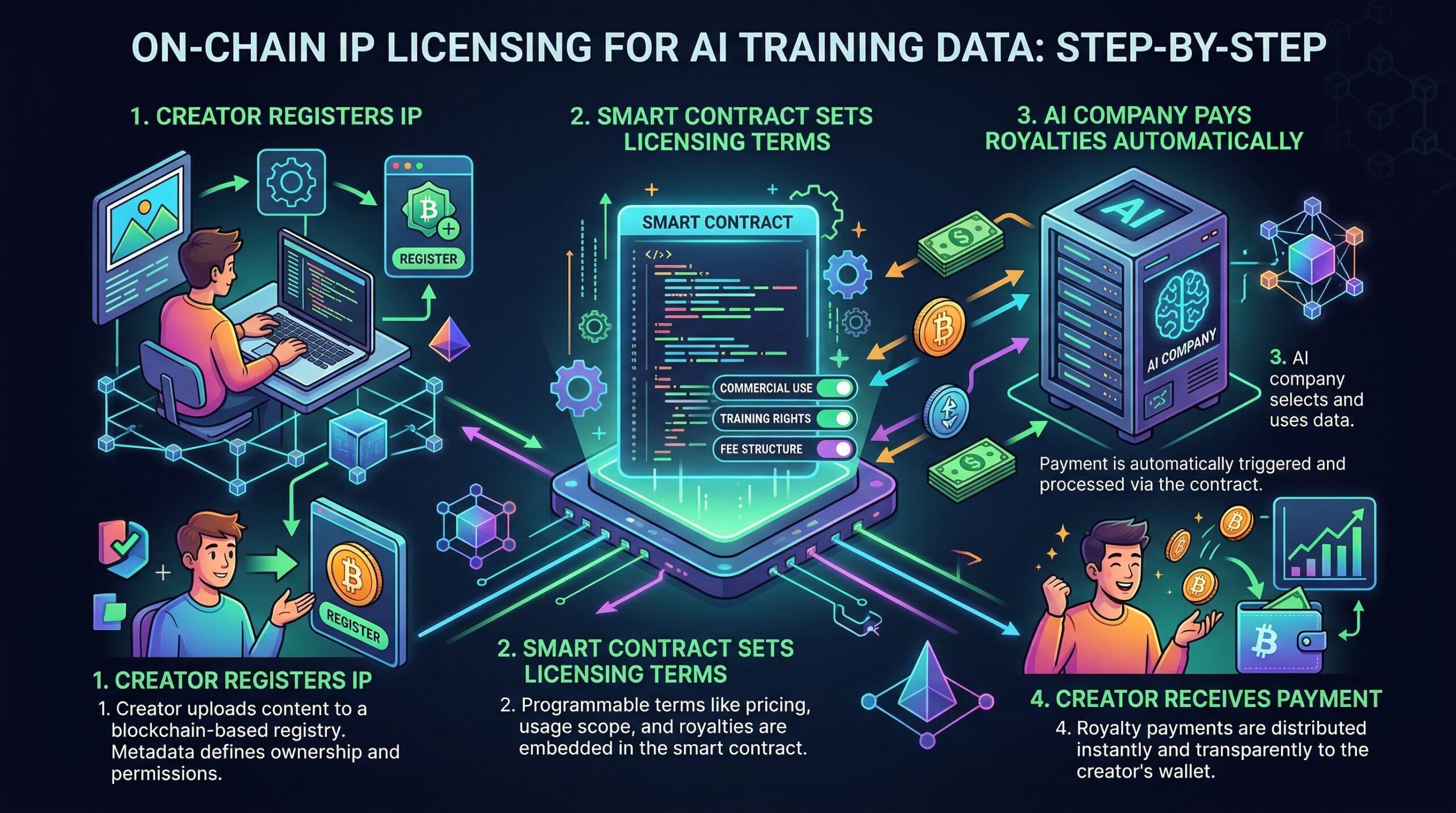
On-chain IP systems offer a potential resolution: creators register their works on-chain, set licensing terms for AI training use (including pricing), and AI companies pay for licenses through automated smart contracts. Revenue flows back to creators whose works contribute to model training. This model transforms AI training from an act that currently occurs in a legal grey area into a clear commercial licensing transaction.
Story Protocol has explicitly targeted this use case, positioning itself as the infrastructure layer for human-generated data licensing to AI systems. Several other on-chain IP platforms are developing similar capabilities, recognizing that the AI training data market represents billions of dollars in potential licensing revenue for creators who previously received nothing for their work’s use in model development.
Challenges and Limitations
Despite significant progress, on-chain IP management faces meaningful challenges that will shape its trajectory through the remainder of the decade:
Legal Recognition Gaps
While courts increasingly accept blockchain records as evidence, they are not universally recognized as equivalent to government-registered IP rights. A creator who registers their work on a blockchain cannot file an infringement lawsuit based solely on the blockchain record in most jurisdictions — they still need formal registration in relevant countries for full legal standing.
Scalability and Cost
Public blockchains with high transaction costs create barriers for small creators who want to register individual works. Layer 2 solutions and purpose-built IP blockchains (like Story Protocol) have substantially reduced these costs, but the economics of on-chain registration must be compared to the value of the IP being registered.
Interoperability
IP registered on one blockchain may not be automatically recognized or readable by systems built on different blockchains. Interoperability standards for on-chain IP are developing but not yet mature, creating fragmentation risks for creators and licensees who operate across multiple ecosystems.
Enforcement
An on-chain record proves ownership but does not automatically enforce rights. If someone infringes a work registered on a blockchain, the creator still needs to pursue traditional legal enforcement mechanisms in relevant jurisdictions. The blockchain record strengthens their legal position but does not replace legal action.
The Future of On-Chain IP: What to Watch
Several developments will shape the on-chain IP landscape through 2026 and beyond:
- Legislative clarity on blockchain IP records: Multiple jurisdictions are developing frameworks that would give on-chain records explicit legal standing in IP disputes. This is the single most important catalyst for mass adoption.
- AI licensing markets: The multi-billion-dollar market for AI training data licensing is emerging as the killer use case for on-chain IP infrastructure, with Story Protocol and competitors racing to capture this market.
- Major label and studio adoption: Major entertainment companies are piloting tokenized rights management. If any major label or studio announces a full transition to on-chain royalty management, it would validate the sector and attract significant developer attention.
- IP tokenization as an asset class: As the infrastructure matures, tokenized IP rights may become a distinct investable asset class — offering income-generating exposure to creative economy revenue streams that are currently accessible only to institutional players.
Frequently Asked Questions About On-Chain IP
What is the difference between an NFT and on-chain IP registration?
An NFT is a token on a blockchain that can represent ownership of anything — art, music, documents, real estate, or IP rights. On-chain IP registration specifically refers to using blockchain technology to record and manage intellectual property rights, including authorship, licensing terms, and royalty payments. NFTs are often used as the token standard for on-chain IP systems, but the IP registration concept is broader than any single token format.
Can I replace a patent or copyright with blockchain registration?
Not currently. Blockchain registration provides powerful evidence of creation and ownership but does not replace government-issued patents or copyright registrations for legal enforcement purposes in most jurisdictions. It is best understood as a complement to traditional IP protection, particularly for digital assets where global, real-time verification is valuable.
What is Story Protocol?
Story Protocol is a Layer-1 blockchain purpose-built for intellectual property management. It enables creators to register IP assets, license them through smart contracts, earn automated royalties, and participate in IP governance. The native IP token is used for transactions, staking, and governance. As of 2026, it is the leading dedicated on-chain IP blockchain by market capitalization and developer activity.
How do smart contract royalties work?
Smart contract royalties are automated payments built into the terms of an on-chain IP license. When a licensee uses the IP and generates revenue, the smart contract automatically calculates the royalty owed and transfers it directly to the rights holder’s wallet — without requiring manual invoicing, collection, or accounting. Payments occur in real time rather than on quarterly or annual royalty cycles.
Is City Protocol the same as Story Protocol?
No. City Protocol and Story Protocol are distinct projects with different approaches to on-chain IP. Story Protocol is a Layer-1 blockchain. City Protocol describes itself as an on-chain IP capital market platform focused on fair-launch tokenization of IP assets. As of early 2026, Story Protocol has a live mainnet and listed token, while City Protocol is in earlier development stages with a token not yet listed.