
🎧 Podcast Episode
How AI Bots Are Exploiting 2026 DeFi Yields: Expert Analysis
Listen to this article as a podcast! Two hosts break down the key points in an easy-to-follow conversation.
▶ Press play to start listening
AI Bots Now Extract More Value From DeFi Than Most Human Traders Earn
Here’s the short version: automated AI agents are quietly siphoning yield from decentralized finance protocols faster than you can refresh a dashboard. If you’re providing liquidity or farming yields in 2026, you’re likely competing against software that never sleeps — and it’s winning.
The Surprising Number That Should Concern You
Across the top DeFi chains tracked by DefiLlama, total value locked (TVL) exceeds $14 billion on just the five largest networks alone. Hyperliquid L1, a chain barely two years old, already holds $1.76 billion in TVL (roughly a third of Base’s $3.97 billion, and growing faster). A significant and rising share of transactions on these networks now originate from AI-powered bots — not humans clicking buttons on a DEX (decentralized exchange — a platform for swapping tokens without intermediaries).
What changed? The bots got smarter. They’re no longer simple scripts running arbitrage loops. They’re multi-agent systems (systems where multiple AIs collaborate with different roles) that monitor mempool activity, predict liquidation cascades, and rebalance LP (liquidity provider — someone who deposits tokens into a pool to earn fees) positions in real time.
AI bots have evolved from basic arbitrage scripts to sophisticated multi-agent systems that can out-compete human DeFi users on speed, strategy, and 24/7 uptime. If you’re yield farming, this directly affects your returns.
Why This Is Happening Right Now
Three forces converged to create the current landscape.
First, cheap inference. Running an LLM (large language model — the AI architecture behind ChatGPT) to interpret on-chain data now costs pennies per query. A year ago it cost dollars. That collapse in compute cost made it economically viable to deploy AI agents that monitor hundreds of DeFi pools simultaneously.
Second, new chain proliferation. The explosion of Layer 2s and alternative Layer 1s created fragmented liquidity. Monad ($334.8 million TVL), Plasma ($1.59 billion TVL), Ink ($463.5 million TVL) — each new chain represents fresh yield opportunities with thinner competition, at least initially. Bots find and exploit these gaps before most humans even hear about the chain.
Third, MEV infrastructure matured. MEV (Maximal Extractable Value — profit that can be captured by reordering, inserting, or censoring transactions in a block) has evolved from a niche Ethereum problem to an industry-wide reality. With Bitcoin at $66,604 and Ethereum at $2,000, the value flowing through DeFi is substantial enough to justify sophisticated extraction operations.
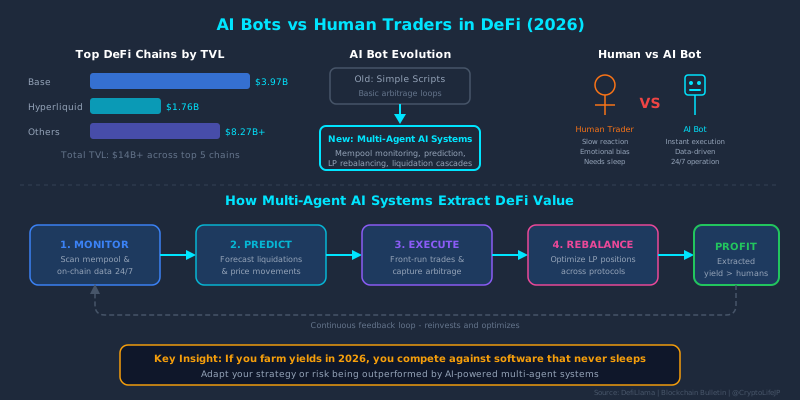
Cheap AI inference + fragmented liquidity across 20+ chains + mature MEV infrastructure = a perfect environment for automated value extraction. Think of it as algorithmic trading hitting Wall Street in the 2000s — except now it’s hitting your liquidity pool.
How AI Bots Actually Exploit DeFi Yields
Let me be specific about the mechanics. These aren’t hypothetical scenarios — they’re documented patterns visible on-chain today.
Strategy 1: Just-In-Time Liquidity (JIT)
An AI bot detects a large pending swap in the mempool. It instantly adds concentrated liquidity at the exact price range the trade will hit, earns the swap fee, then withdraws. The entire cycle completes in a single block. Human LPs who had their liquidity sitting in that range? They get diluted.
Strategy 2: Cross-Chain Arbitrage
With BSC at $5.28 billion TVL, Base at $3.97 billion, and Avalanche at $719.6 million, price discrepancies for the same token across chains are frequent. AI agents using fine-tuned models (models additionally trained for a specific use case) can identify and execute cross-chain arb faster than any manual trader — often within seconds of a price deviation.
Strategy 3: Liquidation Front-Running
When ETH dropped from $2,041 to $1,841 over recent days (a 9.8% decline), lending protocol positions came under pressure. Bots monitoring health factors across Aave, Compound, and their forks on every chain can predict liquidations before they happen and position themselves to capture the liquidation bonus.
Strategy 4: Yield Optimization Hopping
AI agents continuously compare APYs (Annual Percentage Yields — the rate of return earned on deposited assets) across protocols and chains, moving capital to the highest-yielding opportunity faster than any human can research, approve, bridge, and deposit. They factor in gas costs, bridge fees, and impermanent loss risk in milliseconds.
| Bot Strategy | Target Chains | Estimated Edge Over Humans | Impact on Regular Users |
|---|---|---|---|
| JIT Liquidity | Ethereum, Base, Arbitrum | ~200-500ms reaction time | Dilutes LP fee income by 10-30% |
| Cross-Chain Arb | BSC, Avalanche, Monad, Plasma | Executes before price corrects | Tightens spreads (actually helpful) |
| Liquidation Sniping | Ethereum, BSC, OP Mainnet | Pre-positions before health factor trips | Borrowers lose more during volatility |
| Yield Hop Optimization | All major chains (20+) | Monitors 1000+ pools simultaneously | Compresses yields across the board |
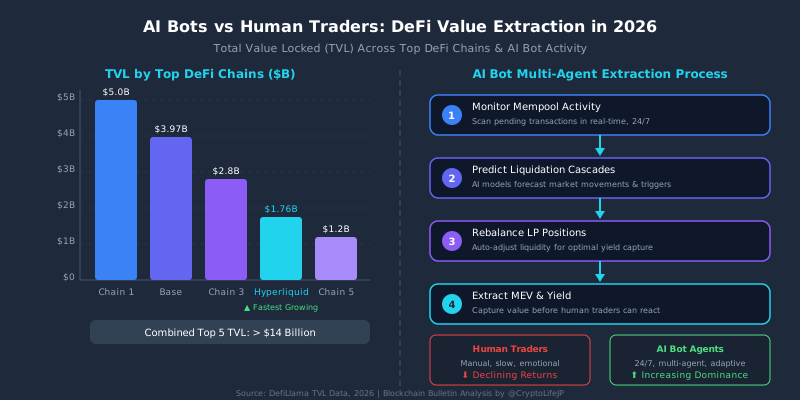
Not all bot activity hurts you. Cross-chain arbitrage actually improves price efficiency. The strategies that directly eat into your returns are JIT liquidity and yield-hopping compression. Understanding which is which helps you decide where to deploy capital.
The Chain-by-Chain Landscape: Where Bots Concentrate
Bot activity isn’t evenly distributed. It follows TVL and transaction volume.
| Chain | TVL | Bot Activity Level | Why |
|---|---|---|---|
| BSC | $5.28B (#1 in dataset) | Very High | Cheap gas, high retail volume |
| Base | $3.97B (#2) | High | Growing fast, fragmented DEX liquidity |
| Hyperliquid L1 | $1.76B (#3) | Very High | Perp-focused, ideal for liquidation bots |
| Plasma | $1.59B (#4) | Moderate (growing) | Newer chain, less saturated |
| Avalanche | $719.6M (#5) | Moderate | Established but slower growth |
| Monad | $334.9M | Low-Moderate | Early stage, possible alpha window |
The pattern is clear. Hyperliquid’s $1.76 billion TVL makes it a prime target for liquidation bots, given its derivatives focus. BSC’s $5.28 billion TVL and low gas fees make it the preferred playground for sandwich attacks (when a bot places trades before and after yours to profit from the price movement it creates). Newer chains like Monad and Plasma, while showing strong early TVL, likely still offer a window where bot competition is less fierce.
If you’re choosing where to provide liquidity, newer chains with growing TVL (like Monad at $334.9M) may offer better risk-adjusted returns simply because bot saturation is lower. By the time a chain hits multi-billion TVL, the bots have already moved in.
How This Directly Affects Your Crypto Activity
Whether you’re an active DeFi user or just holding BTC and ETH, the AI bot phenomenon touches you in concrete ways.
If You Provide Liquidity
Your effective yield is being compressed. When you deposit tokens into a Uniswap or Aerodrome pool, JIT bots can capture a disproportionate share of swap fees during high-volume moments — the exact moments that used to make LP-ing profitable. You keep the low-activity hours. They take the spikes.
If You Swap Tokens
Sandwich attacks remain a persistent tax on retail swaps. Setting a tight slippage tolerance helps, but on chains like BSC where block times are short and gas is cheap, bots can still extract value from medium-sized trades. Using private mempools or MEV-protected RPCs (Remote Procedure Calls — the connection point your wallet uses to communicate with a blockchain) is no longer optional for serious users.
If You Borrow Against Crypto
The ETH price swing from $2,041 to $1,841 (a 9.8% drop) and back demonstrates how quickly positions can get liquidated. AI bots monitoring your health factor will trigger liquidation the instant it’s profitable. Maintaining wider safety margins on loans is now essential, not conservative.
If You’re Simply Holding
Ironically, the spot holder is least affected. Bitcoin sitting in cold storage at $66,604 doesn’t care about MEV. Long-term holding remains the one strategy bots can’t front-run. There’s a certain poetic justice in that.
The practical takeaway: use MEV-protected RPCs for swaps, maintain conservative loan-to-value ratios on borrowing, and consider newer chains for LP positions. Or take the simplest path — hold spot and let the bots fight each other.
Trending Tokens and the Bot Connection
The current trending coins on CoinGecko tell an interesting story. Among the top trending: Bittensor (TAO, rank #33), Hyperliquid (HYPE, rank #14), and Monad (MON, rank #146). All three have direct relevance to the AI-meets-DeFi narrative.
Bittensor is a decentralized AI network — its validators are literally AI models competing for rewards. Hyperliquid’s perpetuals platform is a playground for automated trading strategies. Monad’s high-throughput design (up to 10,000 TPS) is particularly bot-friendly, enabling strategies that can’t execute on slower chains.
Even the meme-adjacent entries like Siren (rank #61) and Wiki Cat (WKC, rank #357) generate the kind of volatility that arbitrage bots feast on. Short attention spans drive retail into these tokens. Bots extract the spread on entry and exit.
The trending list itself is a map of where bots are making money. High volatility tokens + high-throughput chains = maximal bot opportunity. When you see something trending, the bots likely already have positions.
Summary: Three Things to Remember
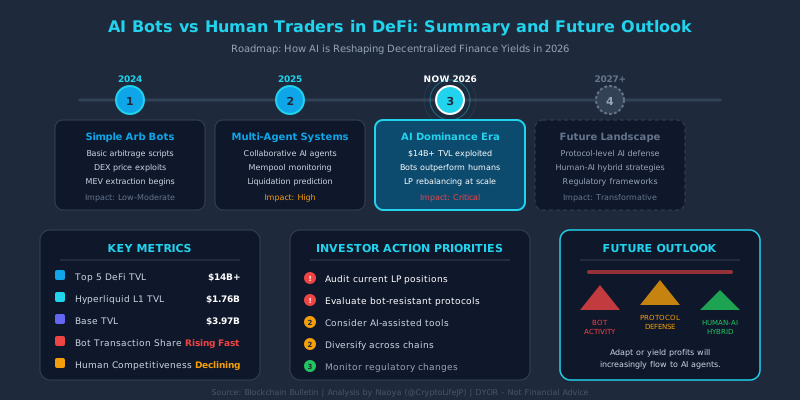
- AI bots have moved beyond simple arbitrage. They now use multi-agent architectures to execute JIT liquidity, cross-chain arbitrage, liquidation sniping, and yield optimization — simultaneously and across 20+ chains with over $14 billion in combined TVL.
- Your DeFi returns are being silently compressed. Whether you’re an LP on BSC ($5.28B TVL), a borrower on Ethereum ($2,000 ETH with 9.8% recent swings), or a swapper on Base ($3.97B TVL), automated agents are extracting value from your transactions.
- The simplest defense is awareness and tool selection. MEV-protected RPCs, wider loan collateral margins, and strategic chain selection (newer chains with lower bot saturation) are practical countermeasures available today.
Author’s Take: I’ve been watching DeFi bot evolution since the Flashbots era on Ethereum. What’s different now isn’t the concept — it’s the intelligence. Earlier bots were brittle, hard-coded scripts. Current AI agents can adapt strategies mid-block based on mempool conditions. That’s a qualitative shift. The DeFi protocols that survive this era will be the ones that build bot-resistance into their core design — think order-flow auctions, encrypted mempools, and fair-ordering protocols. Users who ignore this trend will see their yields quietly erode without understanding why.
Next Steps: What You Can Do Today
- Switch to an MEV-protected RPC. Services like Flashbots Protect (for Ethereum) or similar chain-specific options route your transactions through private channels, preventing sandwich attacks. Most wallets let you add a custom RPC in settings — it takes under 2 minutes.
- Audit your LP positions for JIT dilution. Tools like Revert Finance and DefiLlama’s yield dashboard let you check whether your LP fees match expected returns. If actual fees are consistently 15-25% below projected APY, JIT bots are likely the cause.
- Explore newer-chain yield opportunities with caution. Chains like Monad ($334.9M TVL) and Ink ($463.5M TVL) are still in their growth phase with lower bot competition. The yields are real, but so are the smart contract risks on newer platforms. Start small, diversify across chains, and never commit funds you can’t afford to lose.
Original Analysis: What This Means for the Crypto Market
Author’s Perspective: The AI bot explosion in DeFi mirrors what happened to traditional equity markets when high-frequency trading (HFT) firms arrived in the mid-2000s. Retail traders didn’t disappear from stock markets — but their strategies changed. They shifted toward longer timeframes, index investing, and positions where millisecond speed didn’t matter. DeFi is undergoing the same structural transformation right now.
Investment Strategy Implications: For the average crypto investor, this trend strongly favors two approaches. First, simple spot holding of blue-chip assets like BTC and ETH — strategies that can’t be front-run. Second, using aggregator platforms and yield vaults (like Yearn or Beefy) that employ their own sophisticated strategies to compete with bots on your behalf. Going it alone as a manual LP on a major-chain DEX is increasingly a losing game unless you actively manage positions.
Historical Comparison: The 2020-2021 “DeFi Summer” saw human-driven yield farming produce triple-digit APYs. Those returns compressed as more capital entered. The current compression is different — it’s not driven by more human capital but by more intelligent automated capital. The speed of compression is faster, and the floor yields are lower. Protocols that thrived in 2021 by simply offering liquidity mining incentives now need to offer something bots can’t easily exploit.
Looking Ahead: Expect DeFi protocols to increasingly integrate “bot-aware” designs — intent-based trading (where you specify what you want, not how to execute it), batch auctions that prevent front-running, and encrypted mempools. The protocols that adopt these features will likely attract more retail TVL. Chains like Hyperliquid, already trending at rank #14 with $1.76B TVL, are building with this awareness. The winners of the next DeFi cycle won’t just have the highest yields — they’ll have the fairest execution.
Data Sources
- CoinGecko — Bitcoin Market Data & Price History
- CoinGecko — Ethereum Market Data & Price History
- CoinGecko — Trending Coins
- DefiLlama — Chain TVL Rankings
- Flashbots — MEV Protection Documentation
- Hyperliquid — Protocol Documentation
- Monad — Official Website & Technical Overview
Disclaimer: The information on this site is for educational and informational purposes only and should not be considered financial or investment advice. Cryptocurrency investments carry significant risk. Always do your own research (DYOR) before making any investment decisions.
About the Author: Naoya — Web3 researcher specializing in DeFi protocols, tokenomics, and blockchain infrastructure. He analyzes complex crypto asset trends and delivers clear, actionable insights for investors and enthusiasts.
🔗 Follow on X: @CryptoLifeJP
Related Posts not found.