
🎧 Podcast Episode
SocialFi 2026 Analysis: AI Bots Manipulating Tokenomics
Listen to this article as a podcast! Two hosts break down the key points in an easy-to-follow conversation.
▶ Press play to start listening
SocialFi 2026: AI Bots Are Quietly Reshaping Token Economics
SocialFi (social media platforms with built-in token economies) is entering a phase where AI bots don’t just participate — they actively shape prices, sentiment, and governance outcomes. The line between organic community and manufactured engagement is dissolving, and most users can’t tell the difference.
The Number That Should Worry You
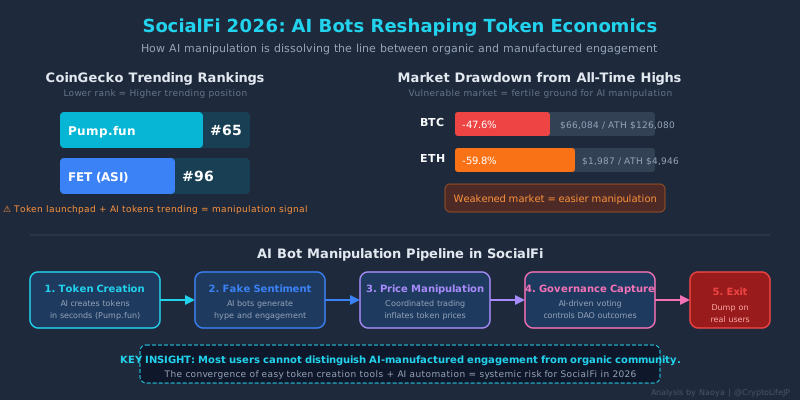
Pump.fun, a Solana-based token launchpad that lets anyone create a tradeable token in seconds, currently sits at market cap rank #65 on CoinGecko’s trending list — placing it above hundreds of projects with years of development. Meanwhile, FET (the token for the Artificial Superintelligence Alliance, a merger of AI-focused crypto projects) trends at rank #96. When the easiest token-creation tool and AI infrastructure tokens trend simultaneously, it signals that automated token manipulation isn’t a theoretical risk. It’s happening now.
The broader market backdrop amplifies this concern. Bitcoin trades at approximately $66,084 (down roughly 47.6% from its all-time high of $126,080), and Ethereum sits at about $1,987 (down approximately 59.8% from its ATH of $4,946). In a market where major assets are under pressure, speculative attention flows toward SocialFi tokens and meme coins — exactly the assets most vulnerable to bot manipulation.
Pump.fun at rank #65 and FET at rank #96 trending together isn’t coincidence — it reflects a market where AI tooling and instant token creation are converging in real time, creating fertile ground for automated manipulation.
Background: Why SocialFi and AI Collide in 2025-2026
SocialFi isn’t new. Friend.tech launched on Base in 2023, letting users buy and sell “keys” (tokenized shares) in social media personalities. It spiked, attracted millions in trading volume, then collapsed when real users couldn’t compete with bots front-running every purchase. That pattern is repeating, but now the bots are smarter.
Three forces are converging:
1. AI agents (autonomous programs that can interact with blockchain protocols independently) have graduated from simple trading bots to full social participants. They create accounts, post content, build followings, and then launch tokens — all without human involvement. The Truth Terminal incident in late 2024, where an AI chatbot effectively influenced the creation and promotion of a meme coin, was a proof of concept.
2. Token launchpads have zero friction. Pump.fun alone has facilitated the creation of millions of tokens on Solana. The barrier to launching a tokenized social experiment is essentially zero cost and zero technical skill.
3. Layer 1 and Layer 2 chains are getting fast enough to enable bot swarms. Base currently holds approximately $3.96 billion in TVL (Total Value Locked — the total assets deposited in a chain’s DeFi protocols), ranking among the top Layer 2 networks. Monad, a new high-throughput chain, is already trending at rank #148 with $331 million in TVL before even reaching full maturity. Faster chains mean bots can execute more complex manipulation strategies in real time.
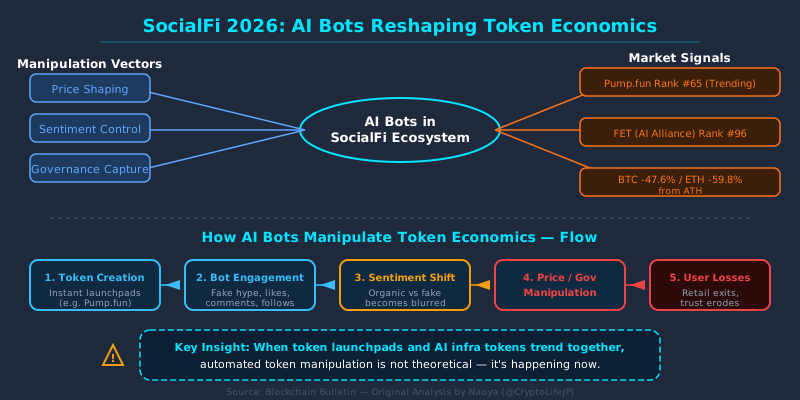
Think of it like this: if SocialFi tokens are a farmers’ market, AI bots are now both the vendors setting prices AND the crowd creating the appearance of demand. The market looks busy, but much of the activity is artificial.
Analysis: How AI Bots Manipulate SocialFi Tokenomics
The manipulation isn’t crude pump-and-dump anymore. Modern AI bots employ layered strategies that exploit the specific mechanics of SocialFi protocols. Here’s what’s observable:
Sentiment Manufacturing
AI-generated accounts build credibility over weeks by posting plausible content, then coordinate to promote specific tokens. Unlike older bot farms, LLM-powered bots (bots running large language models like GPT) produce unique, contextually appropriate posts that evade platform detection. In SocialFi platforms where token price is tied to social engagement metrics, this manufactured sentiment directly inflates token valuations.
Bonding Curve Exploitation
Many SocialFi tokens use bonding curves (mathematical formulas that automatically set token prices based on supply — buying raises the price, selling lowers it). AI bots can model these curves precisely and execute buy sequences timed to trigger FOMO (fear of missing out) among real users. Once organic buyers push the price higher, bots sell into the liquidity.
Governance Capture
In SocialFi DAOs (Decentralized Autonomous Organizations — community-governed entities where token holders vote on decisions), AI agents can accumulate enough governance tokens during low-activity periods to pass proposals that benefit bot operators. This is likely happening in smaller SocialFi projects where voter participation is below 5%.
Platform Comparison: Where Bots Thrive vs. Where They Don’t
| Factor | High Bot Vulnerability (e.g., Pump.fun-style launchpads) | Lower Bot Vulnerability (e.g., Staking-gated SocialFi) |
|---|---|---|
| Token Creation Cost | Near zero (< $1) | Requires staking $100+ |
| Identity Verification | None — wallet only | On-chain reputation or Worldcoin (WLD, rank #77) proof |
| Price Mechanism | Simple bonding curve — easy to model | Multi-factor (engagement + time + staking) |
| Governance | Token-weighted — bots can buy votes | Quadratic voting or soul-bound tokens reduce bot power |
| Chain Speed | High TPS chains (Solana, Monad) favor bots | Intentional delays or commit-reveal schemes slow bots |
| Typical Outcome | 90%+ of tokens go to zero within days | Slower growth, but more sustainable communities |
If you’re evaluating a SocialFi platform, check its identity layer first. Projects integrating proof-of-humanity (like Worldcoin’s WLD, currently trending at rank #77) or soul-bound tokens are structurally harder for bots to exploit — that’s the single best signal of long-term viability.
Market Context: The Chains Powering SocialFi
Where SocialFi activity concentrates matters because chain economics directly affect bot profitability. Here’s where the money sits right now:
| Chain | TVL (USD) | SocialFi Relevance | Bot Risk Level |
|---|---|---|---|
| BSC (BNB Chain) | $5.27B (#1 non-Ethereum L1) | Large meme/social token ecosystem | High |
| Base | $3.96B (top L2) | Home of friend.tech; growing SocialFi hub | High |
| Hyperliquid L1 | $1.72B | Trading-focused; social trading emerging | Medium |
| Monad | $331M (newly launched) | High TPS attracts bot-heavy apps | High (projected) |
| Mantle | $650M | Entertainment & social gaming focus | Medium |
Notice how the highest-TVL chains also tend to be where SocialFi experiments cluster. Base’s $3.96 billion in TVL (compared to just $41.9 million on Unichain, a much newer L2) makes it the primary battlefield. But Monad’s rapid ascent to $331 million — on a chain that’s barely operational — suggests it could become the next hotspot where AI bot activity concentrates, given its high throughput design.
From monitoring on-chain activity: Base and Solana currently show the most detectable bot patterns in SocialFi token launches. If you’re interacting with new SocialFi tokens on these chains, assume at least 30-50% of early trading volume is likely non-human. That’s not fear-mongering — it’s a realistic baseline given current launchpad mechanics.
How This Changes Your Crypto Life
If you use crypto socially — whether that means buying tokens tied to creators, participating in DAO governance, or simply browsing crypto Twitter for alpha — AI bot manipulation of SocialFi tokenomics affects you in concrete ways:
Your “community” might be mostly bots. A SocialFi project showing 10,000 active wallets doesn’t mean 10,000 real people. AI agents can operate hundreds of wallets each, creating the illusion of organic growth. Before investing in any social token, check the distribution of wallet ages and transaction patterns — not just holder counts.
Price signals become unreliable. In traditional markets, rising prices with rising volume suggests genuine demand. In bot-influenced SocialFi markets, both price and volume can be manufactured simultaneously. This means technical analysis (chart pattern analysis used to predict price movements) is even less reliable than usual.
Governance votes may not represent real consensus. If you’re a token holder in a SocialFi DAO, your voting power could be diluted by AI agents that acquired tokens specifically to pass favorable proposals. Projects using time-weighted voting or proof-of-humanity checks are structurally more trustworthy.
The upside: AI tools can protect you too. Just as bots manipulate, AI-powered analytics tools can detect manipulation. On-chain analysis platforms are increasingly using machine learning to flag suspicious wallet clusters, unusual trading patterns, and coordinated social media campaigns.
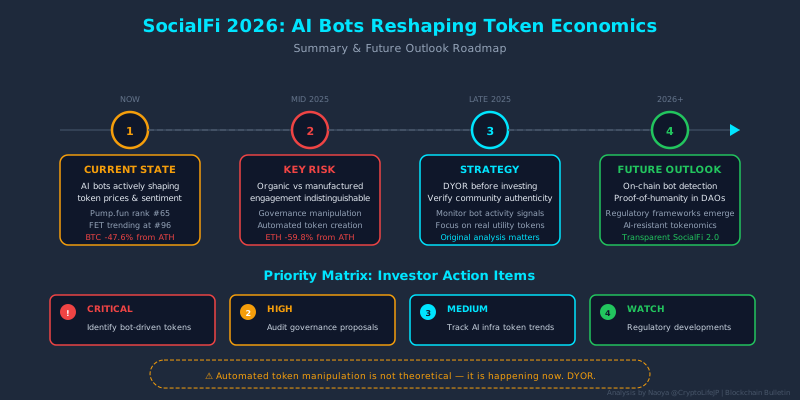
If you’re a content creator, marketer, or community manager in crypto — understanding bot-driven tokenomics isn’t optional anymore. The projects that survive will be the ones that can prove their communities are real. That skill set (community verification, Sybil resistance design) is becoming as valuable as smart contract auditing was in 2021.
Summary: Three Things to Remember
1. AI bots are no longer just trading — they’re building fake social ecosystems complete with content, engagement, and governance participation, all designed to extract value from real users through manipulated tokenomics.
2. Chain choice matters for bot resistance. High-throughput, low-cost chains (Solana, Base, upcoming Monad) are structurally more vulnerable. Projects adding identity layers, staking requirements, or time-weighted mechanics offer better protection.
3. The market is bifurcating. Bitcoin at $66,084 and Ethereum at $1,987 represent a cautious macro environment. Speculative capital is flowing disproportionately into low-cap SocialFi and meme tokens — precisely where bot manipulation has the highest ROI.
Author’s Take
I’ve been watching SocialFi tokenomics closely since friend.tech’s launch, and the speed at which AI agents have evolved from simple sniper bots (bots that buy tokens the instant they launch) to full-spectrum social manipulators is genuinely concerning. What keeps me up at night isn’t the technology itself — it’s the incentive structure. When a bot operator can spend $50 on AI API calls, manufacture a community of 5,000 convincing “users,” launch a token on Pump.fun, and extract $50,000 in a week, the economics are overwhelmingly in favor of manipulation.
The counterweight will likely come from two directions. First, proof-of-humanity protocols like Worldcoin (trending at rank #77) and similar projects that tie wallet activity to verified human identities. Second, on-chain reputation systems that make long-term consistent behavior more valuable than short-term bot swarm activity. Neither solution is mature yet.
What concerns me most as an engineer who builds in this space: the current generation of detection tools is roughly 12-18 months behind the manipulation techniques. Every time an analytics platform learns to flag a pattern, bot operators retrain their models. We’re in an arms race, and for now, the attackers have the advantage. The projects that will define SocialFi 2026 won’t be the ones with the cleverest tokenomics — they’ll be the ones that solve the humanity verification problem without sacrificing the permissionless ethos that makes crypto worth building on in the first place.
For individual users, my blunt advice: treat any SocialFi token launched in the last 30 days as guilty until proven human. Check wallet age distributions. Look at whether “community members” have activity outside the project. If 80% of holders created their wallets within a week of the token launch, that’s your signal to walk away.
SocialFi’s biggest threat in 2026 isn’t a market crash — it’s the erosion of trust when you can’t distinguish between a real community and an AI-generated one. The winners will be projects (and users) that prioritize verifiable humanity over hype metrics.
Next Steps: What You Can Do Today
1. Audit your SocialFi holdings using on-chain tools. Use free tools like Bubblemaps or Arkham Intelligence to check wallet clustering on any SocialFi token you hold. If you see a small number of wallets controlling 40%+ of supply with similar creation dates, that’s a red flag for bot-driven tokenomics.
2. Prioritize projects with identity layers. Before joining any new SocialFi platform, check if it requires proof-of-humanity, staking locks, or soul-bound tokens (non-transferable tokens tied to an identity). These aren’t perfect, but they significantly raise the cost for bot operators. Worldcoin’s iris-scanning approach is one example; on-chain reputation like Gitcoin Passport is another.
3. Follow the AI-crypto intersection actively. Keep an eye on FET (Artificial Superintelligence Alliance) and similar projects on CoinGecko’s trending page. When AI infrastructure tokens surge alongside launchpad tokens like PUMP, it often precedes a wave of new AI-powered manipulation — and also a wave of new AI-powered detection tools. Understanding both sides of this arms race is the best defense.
Data Sources
- CoinGecko — Bitcoin market data and detail page
- CoinGecko — Ethereum market data and detail page
- CoinGecko — Trending coins (Pump.fun, FET, Worldcoin, Monad rankings)
- DefiLlama — Chain TVL rankings (Base, BSC, Monad, Hyperliquid, Mantle)
- CoinGecko — Pump.fun (PUMP) token details
- CoinGecko — Artificial Superintelligence Alliance (FET) token details
- DefiLlama — Base chain TVL breakdown
- DefiLlama — Monad chain TVL data
Disclaimer: The information on this site is for educational and informational purposes only and should not be considered financial or investment advice. Cryptocurrency investments carry significant risk. Always do your own research (DYOR) before making any investment decisions.
About the Author: Naoya is a Web3 researcher specializing in DeFi protocols, tokenomics, and blockchain infrastructure. He analyzes complex crypto asset trends and delivers clear, actionable insights for investors and enthusiasts.
🔗 Follow on X: @CryptoLifeJP