AI Agents Are Reshaping DeFi: New Infrastructure and Hidden Risks
Autonomous AI agents are moving from chatbot novelty into live DeFi protocols — managing portfolios, executing trades, and even governing DAOs. The opportunity is massive, but so is the attack surface. Here is what you need to know before these bots start managing real money at scale.
The Surprising Signal in the Trending Data
Three of the top fifteen trending tokens on CoinGecko right now are directly tied to AI infrastructure: Bittensor (TAO, ranked #33 by market cap), Artificial Superintelligence Alliance (FET, ranked #91), and NEAR Protocol (NEAR, ranked #50), which has pivoted heavily toward AI-agent capabilities. This is not a coincidence. Capital is flowing into the intersection of AI and blockchain faster than into almost any other crypto sub-sector in 2025.
Meanwhile, Ethereum — the chain hosting the majority of DeFi activity — sits at $2,165 with $55.7 billion in total value locked (TVL, meaning the total assets deposited in DeFi protocols). That $55.7 billion is the playground where AI agents are now being deployed. Even a 1% misallocation by an autonomous agent across that pool represents over $550 million at risk.
AI-linked tokens are dominating trending lists while DeFi’s $55.7B TVL on Ethereum alone creates both a massive opportunity and a massive risk surface for autonomous agents.
Background: Why AI Agents in DeFi Matter Right Now
An AI agent (an autonomous program that perceives its environment and takes actions to achieve goals without human intervention) is fundamentally different from a trading bot. Traditional bots follow if-then rules. An AI agent can interpret complex, unstructured information — a governance proposal, a liquidity shift across three chains, a sentiment change on social media — and decide what to do next.
Several forces are converging to make this moment critical:
DeFi complexity has outgrown human capacity. With over 200 chains tracked by DefiLlama, from Ethereum ($55.7B TVL) down to chains like Harmony ($314K TVL), the number of yield opportunities, risk parameters, and cross-chain bridges is simply too large for any individual to monitor. AI agents can scan all of them continuously.
LLM costs have cratered. Running inference (the process of an AI model generating outputs from inputs) dropped roughly 90% in the past 18 months, making it economically viable to run AI agents that evaluate DeFi positions every few seconds rather than every few hours.
On-chain infrastructure is ready. Smart contracts (self-executing programs on a blockchain) can now interact with AI outputs through oracle networks (services that feed external data to blockchains) and verified computation layers, closing the gap between “AI recommends” and “AI executes.”
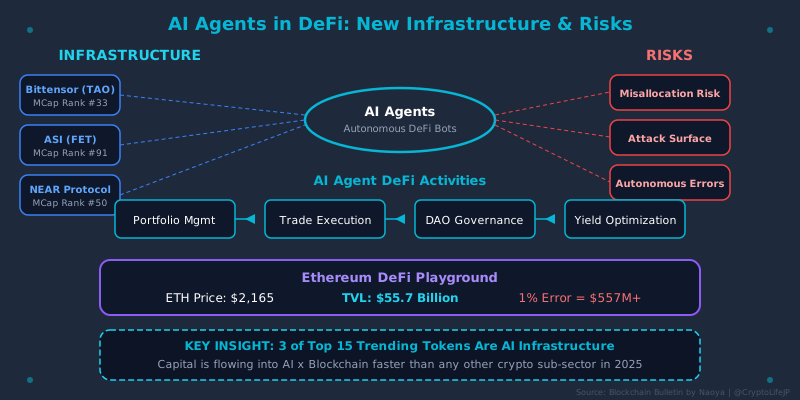
200+ chains, $55.7B on Ethereum alone, inference costs down ~90% — the conditions for AI agents to operate profitably in DeFi have never been better. Think of it like giving a tireless analyst access to every trading desk on the planet, simultaneously.
Analysis: The AI-Agent DeFi Stack, Compared
The AI-agent ecosystem in DeFi is not monolithic. It is fragmenting into distinct layers, each with different players and risk profiles. Here is how the major approaches compare:
| Layer | What It Does | Key Projects | Primary Risk |
|---|---|---|---|
| Decentralized AI Compute | Provides GPU power for running AI models on-chain or near-chain | Bittensor (TAO, #33 market cap), NEAR Protocol (#50) | Compute reliability; latency for time-sensitive DeFi |
| Agent Frameworks | Toolkits for building, deploying, and managing DeFi agents | Artificial Superintelligence Alliance (FET, #91), Autonolas | Framework bugs propagating across all agents |
| Execution & Wallet Layer | Agents that hold keys and execute trades autonomously | Intent-based protocols, account abstraction wallets | Private key exposure; irreversible on-chain errors |
| Strategy & Yield Optimization | AI picks which pools, vaults, or positions to enter | AI-powered yield aggregators on Base ($4.16B TVL), Hyperliquid ($1.85B TVL) | Herding: many agents pursuing the same strategy simultaneously |
| Governance Agents | AI votes on proposals based on delegated token holder preferences | Experimental DAOs on Ethereum, Arbitrum | Manipulation through prompt injection (tricking AI with crafted inputs) |
Where the Money Is Going
Look at the chains attracting the most TVL. Ethereum dominates at $55.7 billion, but the real action for AI agents is on faster, cheaper chains. Base has $4.16 billion locked — it barely existed two years ago. Hyperliquid, a derivatives-focused chain, holds $1.85 billion. These environments are ideal for AI agents because transaction costs are low enough to justify frequent rebalancing.
Bittensor (TAO), currently ranked #33 by market cap and trending on CoinGecko, is particularly interesting. It operates as a decentralized network where AI models compete and collaborate, with miners incentivized to produce the best AI outputs. This is the compute layer that DeFi agents can tap into — decentralized, censorship-resistant AI inference.
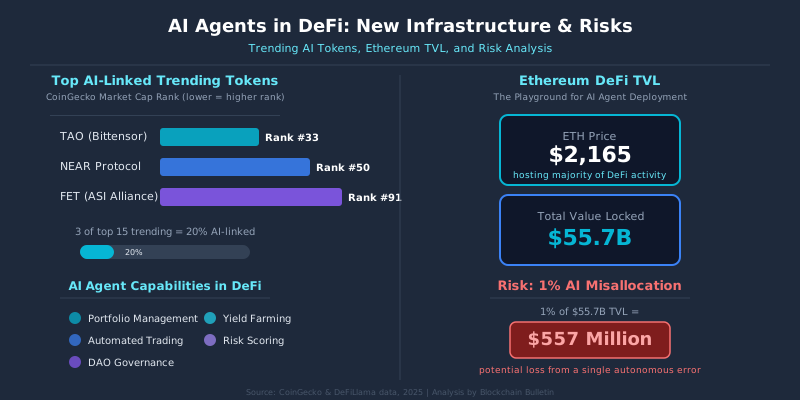
If you are evaluating AI-agent tokens, understand which layer they serve. A compute-layer token like TAO has different risk/reward than a strategy-layer token. It is like comparing a cloud provider (AWS) to a hedge fund — both involve technology, but the business models and risks are worlds apart.
The Risk Landscape: Five Threats That Keep Analysts Up at Night
1. Cascading Liquidations from Herding
When thousands of AI agents use similar training data and similar strategies, they tend to converge on the same positions. If a market shock hits — say Bitcoin drops 10% from its current $70,982 — these agents may all rush to deleverage at the same time. This is not theoretical. We already see correlated behavior in traditional algorithmic trading. In DeFi, where liquidity is thinner, the impact could be amplified.
2. Oracle Manipulation
AI agents rely on price feeds from oracles. If an attacker manipulates an oracle — even briefly — an AI agent could execute trades based on false data. Unlike a human who might hesitate at an obviously wrong price, an agent acts instantly. The damage is done before anyone notices.
3. Smart Contract Composability Risk
An AI agent does not just interact with one protocol. It might borrow on Aave, swap on Uniswap, deposit into a Curve pool, and hedge on Hyperliquid — all in one transaction. Each protocol interaction adds a layer of composability risk (the danger that protocols interact in unexpected ways). One edge case in any of those protocols could cascade into a catastrophic loss.
4. Private Key Management
For an agent to execute transactions autonomously, it needs access to private keys. This is the fundamental tension: the more autonomous the agent, the more exposure the key has. Solutions like account abstraction (allowing smart contracts to act as wallets with custom rules) and multi-signature requirements help, but they add latency. In fast-moving DeFi markets, that latency can be costly.
5. Regulatory Uncertainty
Who is liable when an AI agent loses user funds? The developer? The user who delegated? The protocol? Regulators have not answered these questions. The SEC approved spot Bitcoin ETFs in January 2024 and spot Ethereum ETFs later that year, signaling growing institutional engagement. But autonomous AI agents operating in DeFi exist in a regulatory gray zone that likely will not remain gray forever.
The biggest risk is not any single failure — it is correlated failure. When 10,000 agents all trained on similar data hit the same liquidation threshold at the same millisecond, the result could make the Terra/LUNA collapse look slow-motion.
Market Context: Where We Stand Today
To understand why AI agents matter right now, look at the broader market environment:
Bitcoin is trading at approximately $70,982 — down 43.7% from its all-time high of $126,080 (reached earlier in 2025). With a market cap of $1.42 trillion and a circulating supply of 20 million out of 21 million max, Bitcoin remains the dominant store-of-value narrative. But its DeFi footprint is expanding through BTCFi protocols like Babylon, which allow BTC holders to stake their coins to secure Proof of Stake chains.
Ethereum at $2,165 (down significantly from its ATH of $4,946) hosts the largest DeFi ecosystem at $55.7 billion TVL — roughly 10x the next largest chain (BSC at $5.5 billion). Its transition to Proof of Stake and ongoing scalability upgrades (targeting 100,000+ transactions per second) make it the primary battleground for AI-agent deployment.
The trending list tells its own story. Among the top trending tokens: Bittensor (#33), FET (#91), NEAR (#50), and Venice Token (VVV, #131) — all with AI narratives. Compare that to a year ago when memecoins dominated trending. The market is rotating into AI infrastructure.
| Asset | Price | Market Cap | From ATH | DeFi Relevance |
|---|---|---|---|---|
| Bitcoin (BTC) | $70,982 | $1.42T (#1 globally) | -43.7% | BTCFi expanding via Babylon staking |
| Ethereum (ETH) | $2,165 | $261B (#2 globally) | -56.2% | $55.7B TVL; primary AI-agent deployment chain |
| Bittensor (TAO) | Trending | #33 ranked | — | Decentralized AI compute layer |
| FET (ASI Alliance) | Trending | #91 ranked | — | Agent frameworks & autonomous services |
If you hold ETH or use DeFi protocols, AI agents will likely affect your positions even if you never deploy one yourself. Liquidity dynamics, gas costs, and yield rates will increasingly be shaped by autonomous agents competing in the same pools you use.
How This Changes Your Daily Life and Work
If you are a DeFi user: Expect yields to compress. AI agents are ruthlessly efficient at finding and arbitraging yield differentials. The 20% APY opportunities that used to last weeks will get competed away in hours. On the positive side, slippage (the difference between expected and actual trade price) should decrease as AI-driven market making improves liquidity depth.
If you are a developer: The tooling gap is enormous. There are not enough frameworks for building secure AI agents that interact with smart contracts. If you can build middleware that connects LLMs (large language models — the technology behind ChatGPT) to on-chain actions with proper safety rails, you are sitting on a valuable skill set.
If you are an investor: The AI-DeFi narrative is in its early innings but already attracting significant capital. The presence of TAO, FET, and NEAR in trending suggests retail attention is catching up to institutional positioning. However, most AI-agent tokens are infrastructure plays — they will rise and fall with actual adoption, not just hype.
If you just use ChatGPT daily: This trend is a preview of what AI agents will do in every industry. DeFi is the first environment where AI agents can autonomously execute financial transactions without human gatekeepers. The patterns established here — the wins, the failures, the regulations — will shape how AI agents are deployed in traditional banking, insurance, and investment management.
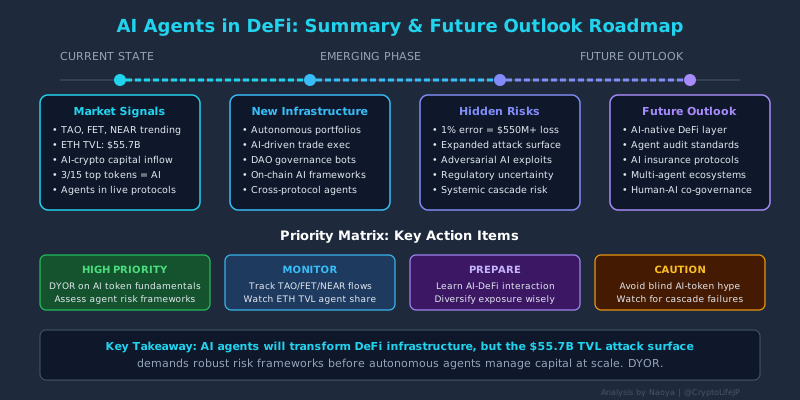
DeFi is the live testing ground for autonomous AI agents handling real money. What happens here will define how AI agents work in traditional finance — so even if you do not use DeFi today, pay attention to the playbook being written.
Summary
Three things to remember:
- AI agents are already operating in DeFi — from yield optimization on Ethereum’s $55.7B TVL ecosystem to decentralized compute networks like Bittensor. This is not a 2027 prediction. It is happening now.
- The risks are systemic, not just individual. Herding behavior among similarly-trained agents, oracle manipulation, and composability failures could trigger cascading losses that affect every participant in a protocol — not just the agent operators.
- Infrastructure tokens are the current investment thesis. TAO (#33), FET (#91), and NEAR (#50) are trending because they provide the compute, frameworks, and execution layers that AI agents need. But infrastructure plays require patience — they only pay off if adoption follows.
Author’s Take
I have been building and testing AI tools in the blockchain space for years, and the current AI-agent wave in DeFi feels both inevitable and premature. Inevitable because the complexity of managing positions across 200+ chains genuinely exceeds human cognitive bandwidth. Premature because the safety infrastructure is nowhere near ready.
The comparison I keep coming back to is early algorithmic trading in traditional markets. In the 2000s, algo trading brought efficiency and tighter spreads, but it also brought flash crashes. The May 2010 Flash Crash erased $1 trillion in market value in minutes because correlated algorithms amplified a single sell order. DeFi has thinner liquidity, less regulatory oversight, and irreversible transactions. The potential for an AI-driven DeFi flash crash is not speculative — it is a matter of when, not if.
What makes the current moment different from previous crypto hype cycles is that AI agents have genuine utility. Unlike many ICO-era projects that were solutions in search of problems, AI agents solving DeFi’s complexity problem is a legitimate use case. The challenge is that the market tends to price in utility years before it is delivered safely. Bittensor, FET, and NEAR are all interesting projects, but their current valuations likely include significant premium for potential that has not yet been de-risked.
My advice: watch the infrastructure layer closely, but do not commit capital you cannot afford to lose. The first generation of autonomous DeFi agents will likely produce both massive wins and spectacular failures. The protocols that survive will define the next era of finance. The ones that do not will serve as very expensive lessons.
Next Steps: What You Can Do Today
- Monitor the AI-DeFi narrative through data, not hype. Bookmark DefiLlama to track TVL flows into chains favored by AI agents (Base, Hyperliquid, Ethereum L2s). If TVL surges on a chain with new AI-agent integrations, that is a signal worth investigating.
- Review your DeFi positions for AI-agent exposure. If you are providing liquidity on popular DEXs (decentralized exchanges), understand that AI agents are increasingly your counterparty. Check whether the pools you use have experienced abnormal flow patterns — this may indicate heavy agent activity that could affect your returns.
- Explore the tools. If you are technically curious, try interacting with Bittensor’s subnet ecosystem or read the Autonolas documentation to understand how AI agents are actually built. You do not need to deploy one — just understanding the architecture will give you an edge in evaluating projects and risks in this space.
Start by tracking TVL changes on DefiLlama and watching which protocols announce AI-agent integrations. Knowledge compounds — understanding the infrastructure now positions you ahead of the curve when these agents become as common as trading bots.
Data Sources
- CoinGecko — Bitcoin Market Data
- CoinGecko — Ethereum Market Data
- CoinGecko — Trending Coins
- DefiLlama — Chain TVL Rankings
- CoinGecko — Bittensor (TAO)
- CoinGecko — Artificial Superintelligence Alliance (FET)
- CoinGecko — NEAR Protocol
- Bitcoin.org — Official Bitcoin Project Page
Disclaimer: The information on this site is for educational and informational purposes only and should not be considered financial or investment advice. Cryptocurrency investments carry significant risk. Always do your own research (DYOR) before making any investment decisions.
About the Author: Naoya — Web3 researcher specializing in DeFi protocols, tokenomics, and blockchain infrastructure. He analyzes complex crypto asset trends and delivers clear, actionable insights for investors and enthusiasts.
🔗 Follow on X: @CryptoLifeJP