
Read this article in your native language (10+ supported) 👉
[Read in your language]
Tokenized Real-World Assets (RWA): Why Institutions Are Moving On-Chain in 2026
Jon: Hey Lila, institutions are tokenizing real-world assets like real estate and bonds on blockchains, bridging traditional finance with crypto infrastructure for better efficiency and liquidity.[Important Insight] This matters in crypto terms because it drives demand for scalable, interoperable chains to handle high-value assets without legacy intermediaries.[Important Insight] By the end, you’ll know how to verify RWA projects on-chain and spot real traction from hype.
Lila: Why does this matter in crypto terms specifically—beyond just big money entering?
Jon: It solves liquidity fragmentation in crypto markets, where assets trade in silos. Tokenized RWAs can flow across chains via protocols like IBC, creating unified market structure.
Lila: So institutions moving on-chain means more composable liquidity pools and less siloed trading—takeaway is this could mature crypto’s plumbing. What’s next on why this is gaining steam?
The Crypto Problem (The Why)
Jon: Crypto’s core issue is fragmented liquidity—think spot markets on isolated exchanges with poor price discovery, much like disconnected plumbing in a city.[Important Insight] Institutions hold trillions in illiquid assets like private equity, but on-chain tokenization unlocks fractional ownership and 24/7 trading.
Lila: Define fragmented liquidity in plain English?
Jon: It means capital doesn’t flow easily between markets or chains, leading to volatility and inefficiencies—like traffic jams where cars can’t switch lanes freely.
Lila: So the takeaway is RWAs address crypto’s liquidity plumbing via tokenization, like adding highways. Tease me the mechanics next.
Under the Hood: How it Works
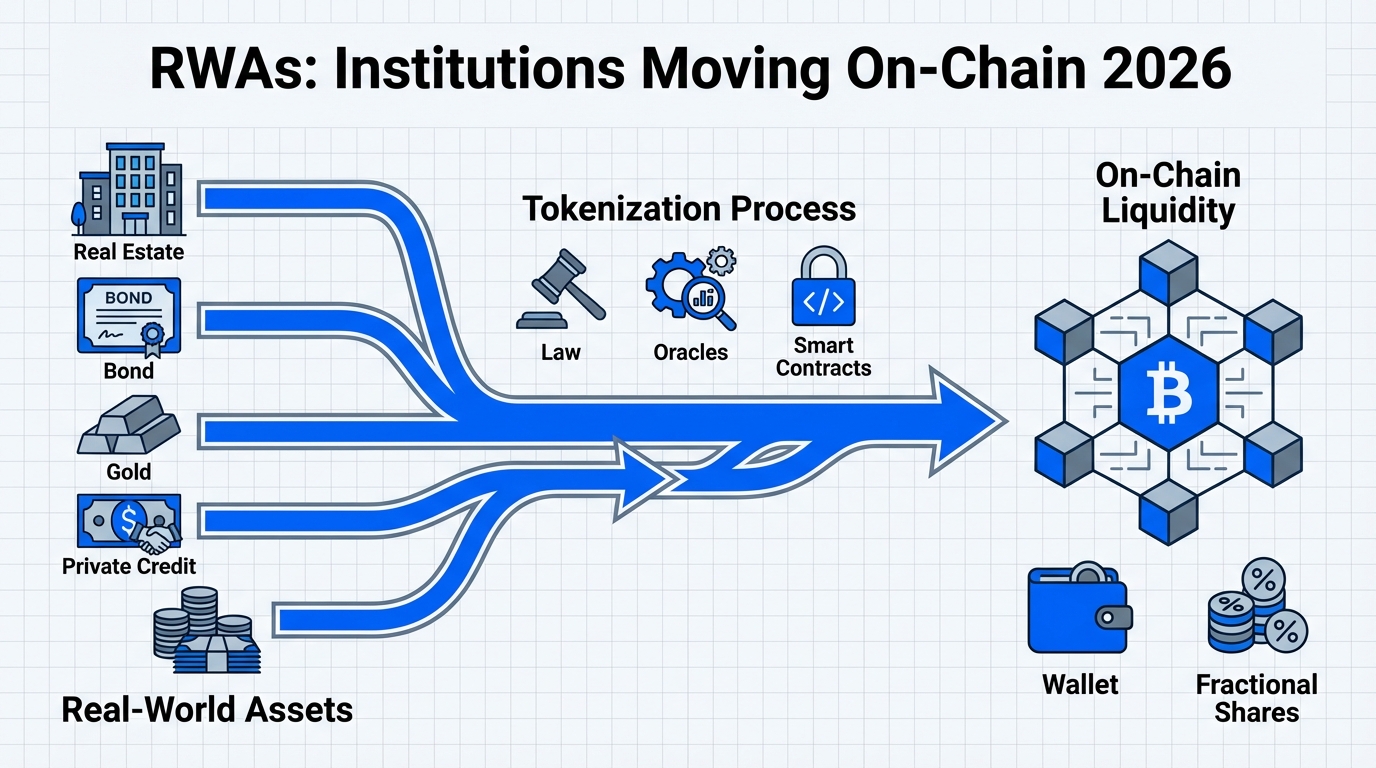
Jon: RWA tokenization works by wrapping off-chain assets—like bonds or property—into on-chain tokens using oracles for price feeds and smart contracts for ownership.[Important Insight] Tokens act as collateral or governance assets on app-specific chains built with frameworks like Cosmos SDK, where modules handle staking, governance, and transfers.
Lila: What must be true for this to work, and what can break it?
Jon: Reliable oracles must accurately reflect real-world value, and chains need sovereign validators for security. Breaks happen via oracle failures or bridge exploits.
Lila: Plain English: oracles are trusted data bridges from reality to chain.
Common Misunderstandings
- RWAs aren’t “free money”—they mirror real asset volatility and add smart contract risks.
- Tokenization doesn’t bypass regulation; compliance like KYC often applies on-chain.
- Not all chains suit RWAs—needs IBC-like interoperability for cross-chain liquidity.
| Item | Baseline | This Crypto Approach |
|---|---|---|
| Market plumbing (liquidity / price discovery) | Siloed TradFi exchanges with T+2 settlement | On-chain 24/7 trading via IBC-connected chains |
| Supply & incentives (emissions / fees / rewards) | Fixed issuance via custodians | Dynamic via staking rewards, fee capture |
| Security assumptions (custody / contracts / counterparties) | Centralized banks/trusts | Decentralized validators + oracles |
Lila: Takeaway: RWAs leverage modular chains for tokenized efficiency, but hinge on oracles and interoperability. How do we check if it’s real?
On-Chain & Reality Checks
Lila: How do we verify this isn’t just a good story?
Jon: Start with explorers like Etherscan or Cosmos explorers for token contracts, holder distribution, and transfer volume. Check TVL on DeFiLlama for RWA protocols.
Lila: Give me a checklist grouped by time.
Jon: Here’s actionable steps:
- 5-min checks: Verify token contract on explorer; scan top holders for custody clustering; check recent transfers for activity.
- 15-min checks: Review audit reports on GitHub; confirm oracle integrations; assess TVL vs. locked supply ratio.
- Weekly checks: Track active addresses and volume trends; monitor vesting unlocks via dashboards; watch fee revenue for sustainability.
Lila: Takeaway: Quick explorer scans reveal if RWAs have real on-chain traction. Who’s actually using this?
Use Cases & Who Actually Uses It
Lila: So who uses this today—traders, builders, or normal users?
Jon: Builders use Cosmos SDK for custom RWA chains with IBC for cross-chain yields. Traders get fractional real estate exposure; institutions park funds in tokenized treasuries.
Jon: Everyday users? Early, but DeFi apps make low-entry bonding possible.
Lila: Takeaway: Starts with builders and traders, scaling to institutions for utility. What about risks?
Risk Map + Invalidation Signals
Jon: Risks include oracle manipulation, bridge vulnerabilities, smart contract bugs, custody centralization, and regulatory shifts—like Japan’s strict rules.[Important Insight] Headline risk from exploits can cascade liquidations.
Lila: What falsifies the thesis?
Jon: If TVL stagnates below $1B, oracle failures spike, regulators ban cross-border flows, unlocks flood supply without demand, or IBC volumes drop.
Lila: Takeaway: Multiple failure points; watch for liquidity dries or regulatory clamps.
Educational Action Plan
Jon: Level 1: Research via explorers and docs—track RWA dashboards weekly.
Jon: Level 2: Hands-on with testnets for token bridging; use minimal mainnet views for hygiene like hardware wallets.
Lila: Takeaway: Observe first, test safely—no rush to mainnet.
Conclusion & Future Outlook
Jon: RWAs offer institutional-grade liquidity on crypto rails, but success needs robust interoperability and security.
Lila: Agreed—volatility and regs keep it uncertain; stay vigilant with on-chain checks.
Mini Glossary (3 Terms)
Lila: Quick one—what does IBC mean here?
Jon: Inter-Blockchain Communication: protocol for secure data and token transfers between chains. Like secure tunnels between isolated cities. Example: RWA tokens moving from one app-chain to a DeFi hub.
Lila: Got it. What’s TVL?
Jon: Total Value Locked: dollars in a protocol’s contracts. Measures real usage. Example: $500M TVL in an RWA pool signals locked assets earning yield.
Lila: Clear. Define oracle?
Jon: Off-chain data provider to smart contracts, like real-world prices. Trusts minimize via decentralization. Example: Chainlink feeding bond yields to RWA tokens.
Lila: Takeaway: IBC connects, TVL proves, oracles bridge—core to RWAs.
Editorial note: This article is for educational purposes. We focus on verifiable sources and on-chain checks, not investment advice.
References & Further Reading
▼ AI tools to streamline research and content production (free tiers may be available)
Free AI search & fact-checking
👉 Genspark
Recommended use: Quickly verify key claims and track down primary sources before publishing
Ultra-fast slides & pitch decks (free trial may be available)
👉 Gamma
Recommended use: Turn your article outline into a clean slide deck for sharing and repurposing
Auto-convert trending articles into short-form videos (free trial may be available)
👉 Revid.ai
Recommended use: Generate short-video scripts and visuals from your headline/section structure
Faceless explainer video generation (free creation may be available)
👉 Nolang
Recommended use: Create narrated explainer videos from bullet points or simple diagrams
Full task automation (start from a free plan)
👉 Make.com
Recommended use: Automate your workflow from publishing → social posting → logging → next-task creation
※Links may include affiliate tracking, and free tiers/features can change; please check each official site for the latest details.