
Read this article in your native language (10+ supported) 👉
[Read in your language]
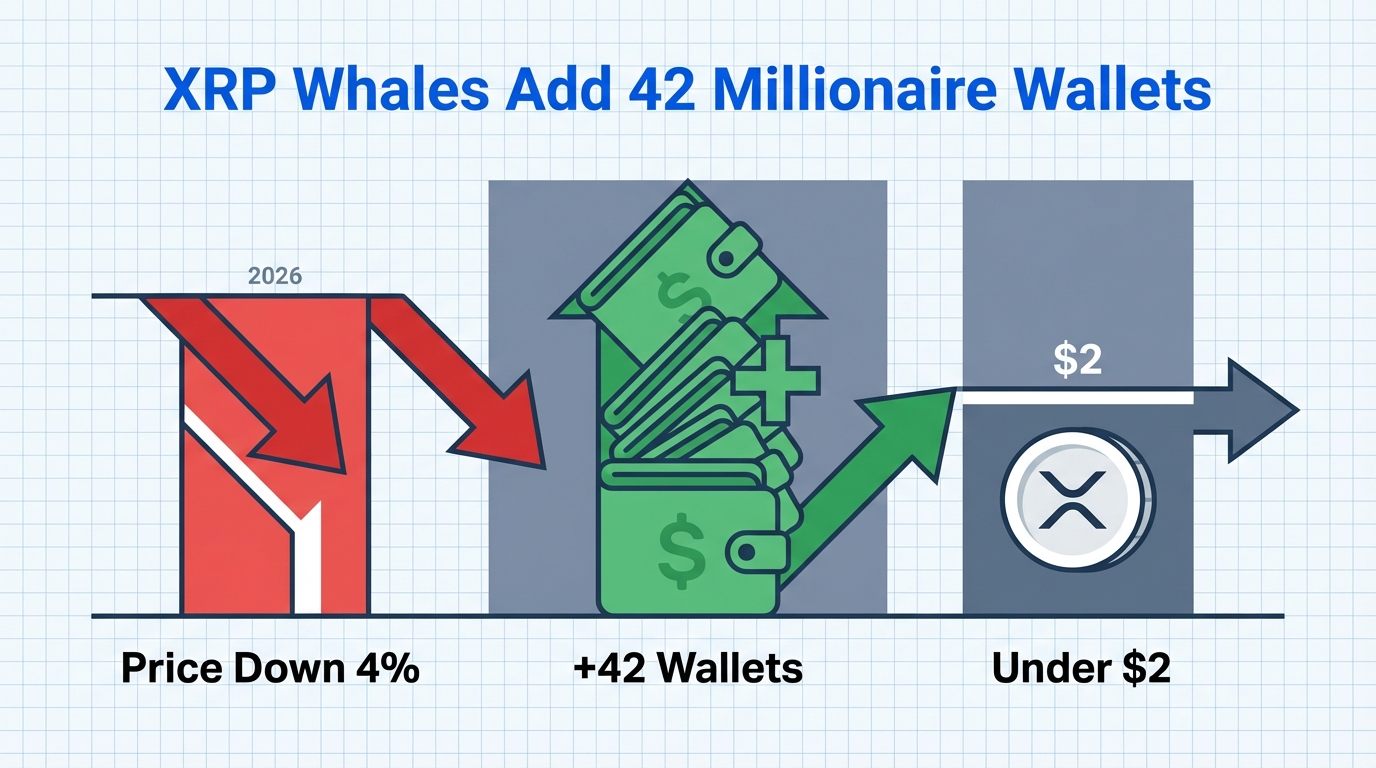
Shockingly quiet XRP whales are stacking up 42 new millionaire wallets as price stays stuck under $2
Jon: Hey Lila, check out this headline from CryptoSlate: XRP whales have quietly created 42 new wallets holding over a million dollars each, even as the price lingers below $2. It’s a classic case of on-chain activity diverging from spot price action.
Lila: Interesting—whales stacking while price stalls. Why does this matter in crypto terms, beyond the obvious?
Jon: In crypto market structure, it signals potential accumulation by large holders amid low retail visibility, which can influence liquidity and future volatility without immediate price impact. Exchanges dominate volume flows, but wallet-level moves reveal holder conviction.
Lila: Got it. By the end, readers will know how to verify whale wallet data themselves on explorers and spot real signals from noise.
Lila: So the takeaway is whale activity hints at positioning in a fragmented market, but verification is key. What’s next on the why?
The Crypto Problem (The Why)
Jon: The core issue here is crypto’s fragmented market structure—spot trading on centralized exchanges drives most volume, but on-chain whale accumulation happens quietly via self-custody wallets. Think of it like plumbing: exchanges are the noisy public pipes, while whales build private reservoirs.
Lila: Plain English: spot vs. derivatives? And what’s liquidity fragmentation mean exactly?
Jon: Spot is direct token buys on exchanges like Binance; derivatives are futures amplifying leverage. Fragmentation means siloed liquidity pools across venues, leading to uneven price discovery—75% of blockchain volume ties to trading, mostly exchanges.
Lila: Like traffic jams on main highways while side roads fill up unnoticed. So the takeaway is whales bypass exchange noise for on-chain control. Tease me the mechanics next.
Under the Hood: How it Works
Jon: XRP’s tokenomics center on Ripple’s ledger: fixed 100 billion supply, no mining emissions, partial burns via transaction fees. Whales “stack” by transferring to new wallets holding ~500k+ XRP at current prices, creating millionaire addresses.
Lila: What must be true for this to signal real accumulation? What can break it?
Jon: It requires verifiable on-chain transfers from known whale clusters to fresh addresses without immediate sells. Breaks if they’re exchange hot wallets or dusting attacks—security assumes trusted ledger consensus via Ripple Protocol Algorithm.
Lila: Demand from cross-border payments, but vesting from Ripple escrow adds supply pressure.
- Common misunderstanding: New “millionaire wallets” aren’t always new millionaires—could be whales splitting holdings for security, like moving cash to multiple safes.
- Common misunderstanding: Price stagnation ignores derivatives dominance; spot lags on-chain shifts due to fragmented liquidity.
- Common misunderstanding: Whale count spikes don’t guarantee pumps—ownership concentration means a few control flows.
- Decision Lens: Watch for sustained holder growth vs. exchange inflows.
- Token supply: Fixed total, check escrow releases quarterly.
- Activity signals: Rising active addresses amid flat price.
- Network fees: Low fees enable quiet stacking.
- Compare to BTC: Similar whale concentration patterns.
Lila: So the takeaway is XRP’s fixed supply enables quiet accumulation, but verify wallet intent. How do we check on-chain?
On-Chain & Reality Checks
Lila: How do we verify this isn’t just a good story?
Jon: Use XRP Ledger explorers like XRPScan or Bithomp for wallet balances, transaction histories. Track holder distribution dashboards like Rich-List tools; confirm 42+ new wallets exceed 1M USD equivalent without outflows.
Lila: Group the checks by time?
Jon: Sure—quick sanity first.
- 5-min checks: Search “XRP millionaire wallets” on explorer; note top holders’ recent tx count.
- Confirm price & supply on CoinMarketCap for USD threshold.
- Spot exchange inflows via Whale Alert.
- 15-min checks: Dive into specific wallet clusters; check creation dates & fund sources (exchanges vs. OTC).
- Cross-reference with Santiment for netflow trends.
- Validate no immediate sells to DEXes.
- Weekly checks: Monitor holder concentration via Messari dashboards.
- Track active addresses vs. volume.
- Watch Ripple escrow unlocks.
- Compare to BTC whale patterns for context.
Lila: So the takeaway is layered checks separate signal from hype. Who’s actually using XRP like this?
Use Cases & Who Actually Uses It
Lila: So who uses this today—traders, builders, or normal users?
Jon: Primarily institutions and payment processors for fast, low-fee remittances—RippleNet users settle cross-border via XRP as bridge asset. Builders integrate for ODL (On-Demand Liquidity); traders hold off-exchange amid regulatory clarity waits.
Lila: Normal users? Market structure impact?
Jon: Retail via wallets for cheap txns; boosts liquidity in emerging markets. Reduces remittance friction vs. TradFi wires.
Lila: So the takeaway is utility in payments drives whale interest. Risks ahead?
Risk Map + Invalidation Signals
Jon: Risks: Custody risk in self-hosted wallets (private key loss); regulatory uncertainty—e.g., SEC suits linger, Japan mandates strict compliance. Headline risk from lawsuits; no smart contract risk as it’s not EVM, but ledger centralization via UNLs.
Lila: Geopolitical? Bridge/oracle?
Jon: Geopolitical via Ripple’s global ops; no bridges/oracles core to XRP Ledger. Liquidity cascades if derivatives unwind.
Jon: Invalidation signals: 1) Mass outflows to exchanges. 2) Holder count drops despite price flat. 3) Spike in small tx spam. 4) Escrow dumps exceed norms. 5) Active addresses decline.
Lila: So the takeaway is watch custody/regs; clear signals falsify accumulation.
Educational Action Plan
Jon: Level 1: Research—bookmark explorers, follow on-chain dashboards weekly. Observe netflows without trading.
Lila: Hands-on?
Jon: Level 2: Minimal-risk learning—set up read-only XRP wallet viewer, simulate txns on testnet. Prioritize hardware wallet hygiene, multi-sig for larger holds. This is informational only.
Lila: So the takeaway is observe first, learn securely second.
Conclusion & Future Outlook
Jon: Whale stacking highlights XRP’s payment utility amid market fragmentation, but volatility and regs constrain.
Lila: Agreed—crypto’s uncertain; always verify on-chain and diversify knowledge sources.
Mini Glossary (3 Terms)
Lila: Quick one—what does whale mean here?
Jon: A whale is a large holder able to move markets with trades. Example: Wallets with 1M+ USD in XRP influencing liquidity.
Lila: Next: on-chain?
Jon: On-chain means recorded directly on the blockchain, verifiable publicly. Example: Wallet creations visible on XRP Ledger explorers.
Lila: Last: market structure?
Jon: Market structure covers how trading venues, liquidity, and participants interact. Example: Spot vs. derivatives fragmentation in crypto.
Lila: So the takeaway is whales, on-chain data, and structure explain quiet moves.
Editorial note: This article is for educational purposes. We focus on verifiable sources and on-chain checks, not investment advice.
References & Further Reading
- Shockingly quiet XRP whales are stacking up 42 new millionaire wallets as price stays stuck under $2
▼ AI tools to streamline research and content production (free tiers may be available)
Free AI search & fact-checking
👉 Genspark
Recommended use: Quickly verify key claims and track down primary sources before publishing
Ultra-fast slides & pitch decks (free trial may be available)
👉 Gamma
Recommended use: Turn your article outline into a clean slide deck for sharing and repurposing
Auto-convert trending articles into short-form videos (free trial may be available)
👉 Revid.ai
Recommended use: Generate short-video scripts and visuals from your headline/section structure
Faceless explainer video generation (free creation may be available)
👉 Nolang
Recommended use: Create narrated explainer videos from bullet points or simple diagrams
Full task automation (start from a free plan)
👉 Make.com
Recommended use: Automate your workflow from publishing → social posting → logging → next-task creation
※Links may include affiliate tracking, and free tiers/features can change; please check each official site for the latest details.