
Read this article in your native language (10+ supported) 👉
[Read in your language]
Federal Prison Sentence Highlights Growing DOJ Focus on Crypto Money Laundering Networks
Jon: Hey Lila, have you seen the latest on that federal prison sentence tied to crypto money laundering? It’s a stark reminder of how the DOJ is ramping up scrutiny on networks using blockchain for illicit flows.
Lila: Yeah, Jon, sounds serious. What exactly happened in this case?
Jon: A key figure in a crypto money laundering operation just got handed a federal prison sentence, spotlighting the DOJ’s sharpened focus on these networks. This matters in crypto terms because it underscores how traceable on-chain activity—despite pseudonymity—can lead to real-world accountability, pushing exchanges and users toward stricter compliance.
Lila: Got it. And what will readers walk away understanding by the end?
Jon: By the end, you’ll know how to spot laundering patterns on-chain, verify compliance signals, and map the risks in Bitcoin‘s network structure where exchanges dominate volume.
Lila: Why does this DOJ push matter specifically for crypto market structure?
Jon: Crypto markets, especially Bitcoin, rely heavily on exchanges for liquidity and price discovery—think spot trading versus derivatives, where volatility spikes on catalysts like regulatory news. But blockchain analysis shows 75% of volume ties to trading via highly interconnected exchanges, making them central nodes for potential laundering.
Lila: Define “network structure” plainly—what’s that look like?
Jon: Imagine exchanges as major highway interchanges in a city’s traffic system; they’re linked in an almost complete graph, with massive cross-exchange flows for arbitrage, but that plumbing can carry illicit cargo if unchecked.
Lila: So the takeaway is that DOJ cases highlight how exchange-centric liquidity creates both efficiency and vulnerability to laundering probes. Next, how does this actually work under the hood?
The Crypto Problem (The Why)
Jon: The core problem is pseudonymity meets traceability: Bitcoin’s blockchain records every transfer publicly, but without KYC, tainted coins can flow through non-compliant exchanges.[2][4]
Lila: Plain English—what’s “tainted coins” and why do they persist?
Jon: Tainted coins are those linked to crime, like hacks or dark markets. Current KYC has limited effect because exchanges form dense networks—large flows between KYC’d ones like Coinbase and non-KYC like others enable mixing.[2][6]
Lila: Analogy?
Jon: Like plumbing in a building: clean water enters, but old pipes with leaks let contaminants circulate until regulators inspect the whole system.
Lila: So the takeaway is pseudonymity enables laundering via exchange networks, but traceability invites DOJ crackdowns. Teaser: under the hood next?
Under the Hood: How it Works
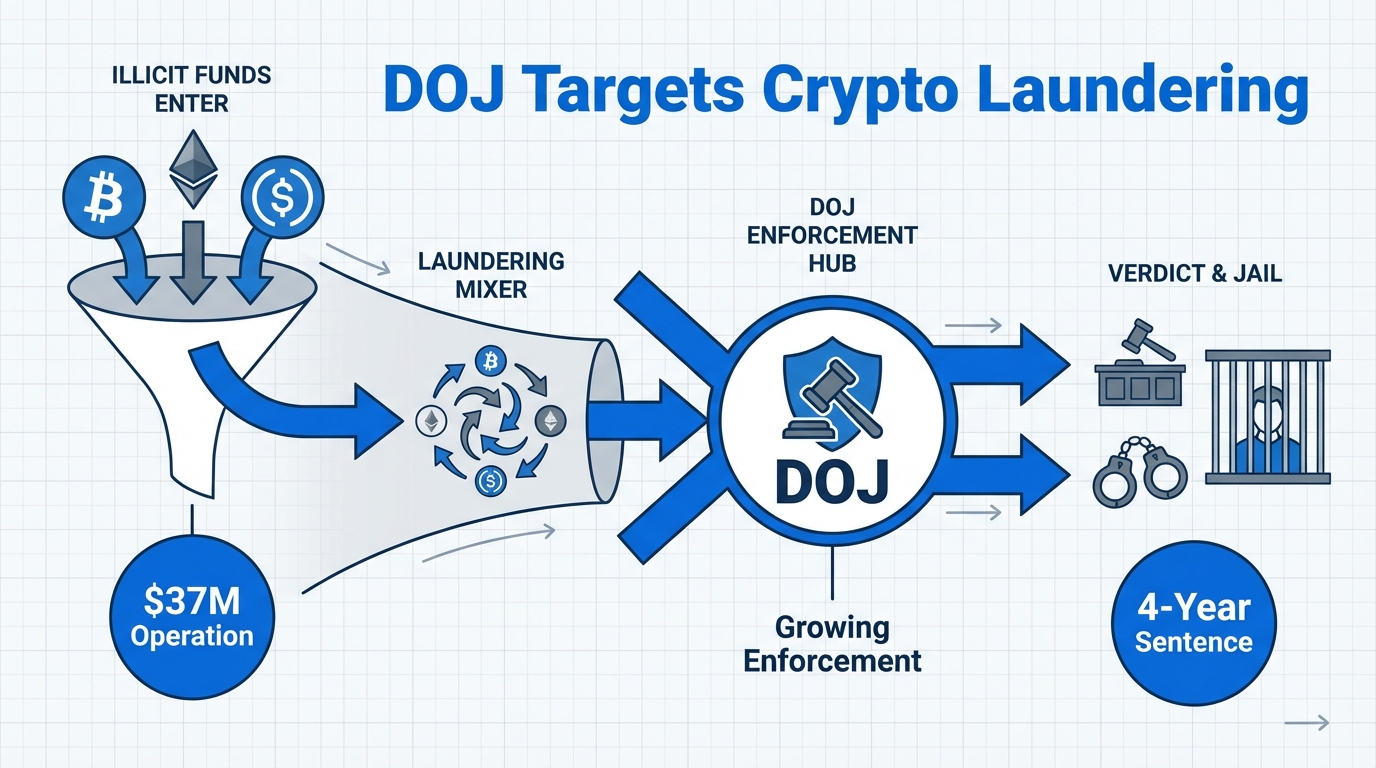
Jon: In Bitcoin’s mechanics, there’s no native tokenomics like emissions or vesting—it’s fixed supply at 21 million, with miners securing via proof-of-work. Laundering exploits this by clustering addresses into wallets that mimic legit trading volume.[2][4]
Lila: What must be true for laundering to work undetected?
Jon: Exchanges must handle high internal and pass-through volume without flagging clusters—75% of blockchain volume is trading-related, with exchanges as hubs.[2]
Lila: What can break it?
Jon: Blockchain analytics graphing flows from known illicit sources to exchanges, revealing concentration like top 10,000 clusters controlling massive BTC.[4][6]
[Important Insight] Common misunderstandings:
- Bitcoin is anonymous: It’s pseudonymous—addresses link to entities via clustering, enabling DOJ tracing.[2]
- Exchanges prevent all illicit flows: KYC limits but doesn’t stop cross-exchange tainted transfers.[6]
- Laundering is rare: It’s <5% of volume but DOJ targets networks amplifying it via hubs.[2]
- Decision Lens: Check exchange centrality before interacting.
- Monitor top holder concentration for custody risks.
- Verify flows via explorers for tainted signals.
- Assess regional miner spread for network resilience.
- Prioritize protocols with built-in compliance modules.
Lila: So the takeaway is laundering hides in exchange volume and clusters, broken by analytics. What’s next for verification?
On-Chain & Reality Checks
Lila: How do we verify this isn’t just a story—show me on-chain checks?
Jon: Start with explorers like Blockchain.com or Etherscan equivalents for BTC: track clusters, transfers to/from exchanges. Look for LEOTD—likely exchanges or trading desks—dominating flows.[2]
Lila: Concrete checklist, grouped by time?
- 5-min checks:
- Scan top addresses for exchange labels on explorer.
- Check recent large transfers (>500K BTC) between hubs.
- Flag clusters with high internal volume (pass-through laundering sign).
- 15-min checks:
- Graph network centrality—exchanges should form dense complete graphs.[4]
- Decompose volume: ensure >70% trading, <5% suspicious.[2]
- Cross-check ownership: intermediaries hold ~1/3 BTC supply.[6]
- Weekly checks:
- Track miner concentration—25 pools often control 50% hash rate.[6]
- Monitor tainted flow ratios via analytics dashboards like Chainalysis public reports.
- Review DOJ announcements for network takedowns.
Lila: So the takeaway is quick explorer scans reveal exchange dominance and risks; trends show DOJ pressure. Who actually navigates this?
Use Cases & Who Actually Uses It
Lila: Who uses Bitcoin’s structure today—traders, builders, normal users?
Jon: Traders leverage spot/derivatives liquidity on exchanges for volatility plays. Builders use it for payments or DeFi primitives, but compliance-focused ones add KYC layers.[2]
Lila: Market impact?
Jon: Enhances price discovery via interconnected hubs but fragments on regulations, creating arb opportunities.[4]
Lila: So the takeaway is traders and builders drive volume, with compliance shaping usability. Risks ahead?
Risk Map + Invalidation Signals
Jon: Risks: Custody risk high—intermediaries hold 5.5M BTC as of 2020, vulnerable to hacks or freezes.[6] Regulatory risk escalating with DOJ cases; headline risk from sentences spikes volatility. No smart contracts here, but bridge risk if cross-chain; geopolitical via miner concentration (e.g., past China clustering).[4]
Lila: Japan example?
Jon: Japan exemplifies strict compliance culture—exchanges must register, delist non-compliant assets, raising bar globally without advice.
Jon: Invalidation signals: 1) Exchange volume drops below 60% trading share. 2) KYC fully blocks tainted flows per analytics. 3) Ownership decentralizes—top 10K under 4M BTC. 4) Miners spread evenly, no 50% pool dominance. 5) DOJ cases halt for 6+ months.[2][6]
Lila: So the takeaway is custody/regulatory risks loom large; watch signals like volume purity.
Educational Action Plan
Jon: Level 1: Research—track explorers weekly, read blockchain papers on networks.[2]
Jon: Level 2: Hands-on—use testnet faucets for BTC-like sims, practice clustering addresses on public tools. Emphasize self-custody hygiene: hardware wallets, multi-sig, no unverified clusters.
Lila: So the takeaway is observe first, then minimal-risk testnets for mechanics grasp.
Conclusion & Future Outlook
Jon: This DOJ focus clarifies crypto’s traceable reality amid exchange liquidity, balancing innovation with accountability.
Lila: True—volatility and uncertainty persist; stay vigilant on-chain.
Mini Glossary (3 Terms)
Lila: Quick one—what does network structure mean here?
Jon: It’s the graph of blockchain participants, like exchanges forming interconnected nodes driving 75% volume. Exchanges link densely for arb, but this amplifies laundering risks. Example: Top hubs like Binance-Coinbase flows.[2][4]
Lila: What’s tainted coins?
Jon: Coins traced to crime via analytics, flowing despite KYC limits. They mix into legit volume. Example: Hack proceeds hitting exchanges.[6]
Lila: Define LEOTD?
Jon: Likely Exchanges, OTC brokers, Trading Desks—top volume clusters holding sway. They process 60%+ flows. Example: Unlabeled high-volume addresses linking exchanges.[2]
Lila: So the takeaway is these terms reveal how analytics unmasks laundering in exchange plumbing.
Editorial note: This article is for educational purposes. We focus on verifiable sources and on-chain checks, not investment advice.
References & Further Reading
- Federal Prison Sentence Highlights Growing DOJ Focus on Crypto Money Laundering Networks
- Blockchain Analysis of the Bitcoin Market (NBER Slides)
- Blockchain Analysis of the Bitcoin Market (Full Paper)
▼ AI tools to streamline research and content production (free tiers may be available)
Free AI search & fact-checking
👉 Genspark
Recommended use: Quickly verify key claims and track down primary sources before publishing
Ultra-fast slides & pitch decks (free trial may be available)
👉 Gamma
Recommended use: Turn your article outline into a clean slide deck for sharing and repurposing
Auto-convert trending articles into short-form videos (free trial may be available)
👉 Revid.ai
Recommended use: Generate short-video scripts and visuals from your headline/section structure
Faceless explainer video generation (free creation may be available)
👉 Nolang
Recommended use: Create narrated explainer videos from bullet points or simple diagrams
Full task automation (start from a free plan)
👉 Make.com
Recommended use: Automate your workflow from publishing → social posting → logging → next-task creation
※Links may include affiliate tracking, and free tiers/features can change; please check each official site for the latest details.