
In my view, Thailand crypto is evolving as new rules welcome institutional participants.#Thailand #Bitcoin
Quick Video Breakdown: This Blog Article
This video clearly explains this blog article.
Even if you don’t have time to read the text, you can quickly grasp the key points through this video. Please check it out!
If you find this video helpful, please follow the YouTube channel “BlockChainBulletin,” which delivers daily Crypto news.
https://www.youtube.com/@BlockChainBulletins
Read this article in your native language (10+ supported) 👉
[Read in your language]
Thailand Finalizes Rules for Bitcoin ETFs and Crypto Futures in Early-2026 Push
Jon: Hey Lila, have you caught wind of the latest from Thailand? Their Securities and Exchange Commission just finalized regulations for Bitcoin ETFs and crypto futures trading. It’s all set to roll out early this year, aiming to make the country a bigger player in Asia’s crypto scene. Basically, this opens doors for institutional investors to get into crypto without directly holding the assets, and it includes rules for futures on exchanges like TFEX.
Lila: Oh, interesting. I’ve been reading about how countries are warming up to crypto regs. But Jon, why does this matter? Isn’t Thailand already pretty crypto-friendly?
Jon: It does matter, especially for broader adoption. Thailand has been retail-focused so far, with lots of individual traders, but this shift targets institutions. Think about it: Bitcoin ETFs let you invest in Bitcoin’s price through traditional stock exchanges, without the hassle of wallets or keys. And crypto futures? They’re contracts to buy or sell crypto at a future date, useful for hedging. The SEC‘s three-year plan from 2026-2028 is pushing for tokenized assets too, aligning with global trends. According to recent reports, this could boost institutional interest, with Bitcoin hovering around $96,000 lately after ETF inflows. But remember, it’s not without risks—markets are volatile.
Lila: Got it. So it’s like making crypto more accessible for big players. But let’s dig into the “why” here. What’s the problem these rules are solving?
Jon: The core issue is that crypto has been a wild west for institutions in many places—regulatory uncertainty keeps them on the sidelines. In Thailand, retail trading exploded, but without clear rules for ETFs and futures, bigger investors faced custody risks, compliance hurdles, and limited ways to integrate crypto into portfolios. This leads to fragmented markets: retail folks trade spot crypto directly, but institutions need safer, regulated vehicles to avoid direct exposure to hacks or volatility spikes.
Lila: That makes sense, but can you clarify with an analogy? I’m picturing something everyday to wrap my head around it.
Jon: Sure, think of it like traffic in a busy city. Without proper roads and signals (regulations), you’ve got chaos—cars (retail traders) zooming everywhere, risking crashes. Institutions are like big trucks that need highways and toll booths to move efficiently. Thailand’s new rules are building those highways: ETFs are like express lanes where you pay a fee to ride along without driving yourself, and futures are like booking a parking spot in advance to hedge against traffic jams. It reduces accidents (risks) and lets more vehicles (investors) flow in. Without this, the economy (crypto market) stays congested and underdeveloped.
Lila: Haha, love the traffic analogy—now I see how regulations smooth things out. So, what’s actually changing under these rules?
Under the Hood: How it Works
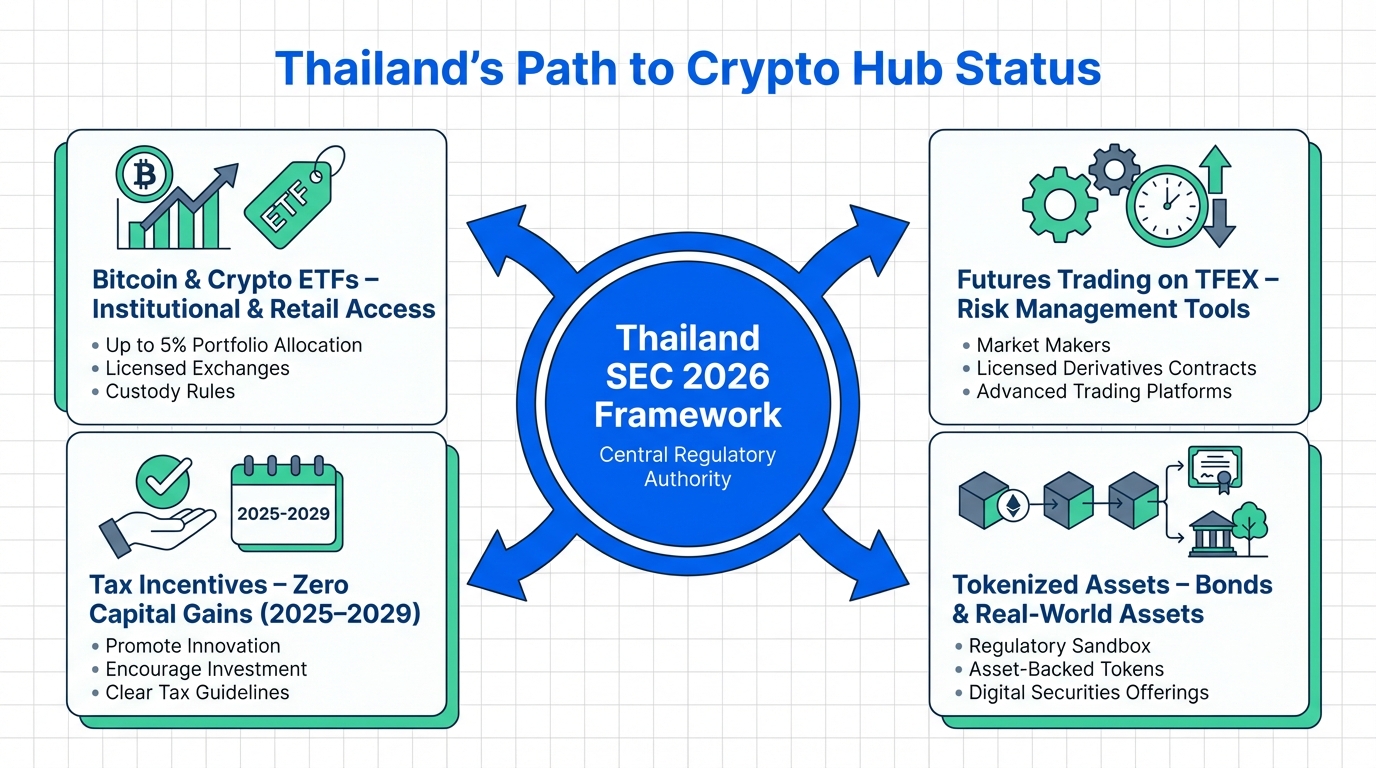
Jon: Alright, let’s break it down. At its core, a Bitcoin ETF is a fund that tracks Bitcoin’s price, traded on stock exchanges like any other ETF. In Thailand’s setup, the SEC is allowing these without requiring investors to custody the crypto themselves—fund managers handle that through regulated custodians. For crypto futures, they’re launching on the Thailand Futures Exchange (TFEX), where you can enter contracts based on crypto indices. The mechanics involve underlying assets: for ETFs, it’s spot Bitcoin held in cold storage; for futures, it’s derivatives settled in cash or physically, depending on the contract.
Lila: Okay, rephrasing to confirm: ETFs are like shares in a basket of Bitcoin, and futures are bets on future prices without owning the coin right away?
Jon: Exactly. The architecture here builds on traditional finance but integrates blockchain. Consensus for the underlying crypto (like Bitcoin) remains proof-of-work—miners validating transactions. But the ETF layer adds a wrapper: fund issuers buy Bitcoin via approved exchanges, then issue shares. Token mechanics? Well, ETFs aren’t tokenized per se, but Thailand’s rules expand to tokenized investment products, which could use blockchain for fractional ownership. Risks remain, like market manipulation or liquidity issues, but regs aim to mitigate with oversight.
Lila: Gotcha. How does this compare to, say, the US or other spots?
Jon: Good question. Let’s compare key aspects in a table to highlight differences.
| Aspect | Thailand (2026 Rules) | US (Current) | Hong Kong (Emerging) |
|---|---|---|---|
| ETF Availability | Spot Bitcoin ETFs launching early 2026, no direct custody required. | Spot ETFs approved since 2024, with massive inflows like $1.7B in days. | Expanding cryptoasset oversight, including ETFs for institutions. |
| Futures Trading | On TFEX, regulated for hedging and speculation. | CME futures well-established, tied to CFTC oversight. | Progressing with licensing, but more retail-focused. |
| Institutional Focus | Shift from retail to sophisticated venue, with tokenized products. | Heavy institutional inflows, SEC and CFTC involvement. | Institutional demand rising, aligned with Asia trends. |
| Risks/Trade-offs | Volatility persists; regs reduce but don’t eliminate custody risks. | High liquidity but regulatory scrutiny on manipulation. | Stablecoin delays; focus on AML compliance. |
Jon: As you can see, Thailand is catching up, blending retail heritage with institutional tools. The diagram above illustrates the flow: from Bitcoin blockchain to ETF shares via custodians.
Lila: Super helpful table—really clarifies the global picture. So who actually uses this? Like, beyond just investors?
Jon: Great pivot. On the user side, institutional investors like pension funds or banks use ETFs for diversified exposure—it’s a technical win for portfolio balancing without blockchain ops overhead. Developers? They might build apps around tokenized assets, where real-world items (like bonds) are represented on-chain for faster settlement. For everyday users, futures enable hedging: if you’re a business dealing in crypto payments, you lock in prices to avoid volatility. Technically, this fosters liquidity—more participants mean tighter spreads and better price discovery. But it’s all about understanding the mechanics, not chasing gains.
Lila: Yeah, sounds like it democratizes access. Now, if someone’s curious, what’s an educational action plan? No buying stuff, just learning.
Jon: Absolutely, let’s structure it step-by-step. Level 1: Research and Observation. Start by reading the SEC’s official docs—Thailand’s SEC website has the three-year plan outlining ETF rules. Check whitepapers on Bitcoin ETFs from sources like ETFDB for mechanics. Use explorers like Blockchain.com to observe Bitcoin transactions feeding into ETFs. Dashboards on CoinMarketCap show ETF flows; watch how inflows correlate with prices. It’s like studying a map before a trip—builds context without risk.
Lila: Cool, that’s passive learning. What about Level 2—how to try it safely, hands-on?
Jon: For hands-on, emphasize testnets or simulations. Platforms like TradingView offer crypto futures simulators—practice trading virtual contracts without real money. For ETFs, some broker demos let you track hypothetical portfolios. If you’re into dev side, experiment with tokenized assets on testnets like Ethereum‘s Sepolia, building simple smart contracts for fractional ownership. It’s minimal-risk: learn hedging strategies or ETF tracking errors through free tools. Remember, this is for education—volatility can bite even in sims.
Lila: Perfect, keeps it safe and informative.
Jon: To wrap up, Thailand’s rules are a solid step toward maturing crypto markets—offering regulated paths for ETFs and futures that could attract billions in institutional capital, based on trends in the US and elsewhere. It highlights blockchain’s integration into finance, but limitations persist: regulatory changes could evolve, and crypto’s inherent volatility isn’t going away. Worth watching how this plays out in Asia.
Lila: Totally agree, Jon. Readers, remember: markets are unpredictable, and this is all about understanding, not speculation. Do your homework, stay rational.
References
- Thailand Finalizes Rules for Bitcoin ETFs and Crypto Futures in Early-2026 Push
- Thailand Securities and Exchange Commission Official Site
- Thailand Targets Early 2026 for Crypto ETF Regulations (Yahoo Finance)
- Thailand Moves Toward Formal Crypto ETF Rules (Coinpaper)
▼ AI tools to streamline research and content production (free tiers may be available)
Free AI search & fact-checking
👉 Genspark
Recommended use: Quickly verify key claims and track down primary sources before publishing
Ultra-fast slides & pitch decks (free trial may be available)
👉 Gamma
Recommended use: Turn your article outline into a clean slide deck for sharing and repurposing
Auto-convert trending articles into short-form videos (free trial may be available)
👉 Revid.ai
Recommended use: Generate short-video scripts and visuals from your headline/section structure
Faceless explainer video generation (free creation may be available)
👉 Nolang
Recommended use: Create narrated explainer videos from bullet points or simple diagrams
Full task automation (start from a free plan)
👉 Make.com
Recommended use: Automate your workflow from publishing → social posting → logging → next-task creation
※Links may include affiliate tracking, and free tiers/features can change; please check each official site for the latest details.