
It seems these blockchain developments demand clearer governance frameworks.#regulation #blockchain
Quick Video Breakdown: This Blog Article
This video clearly explains this blog article.
Even if you don’t have time to read the text, you can quickly grasp the key points through this video. Please check it out!
If you find this video helpful, please follow the YouTube channel “BlockChainBulletin,” which delivers daily Crypto news.
https://www.youtube.com/@BlockChainBulletins
Read this article in your native language (10+ supported) 👉
[Read in your language]
Understanding Today’s Crypto and Blockchain Developments: Regulatory Hurdles and Network Milestones
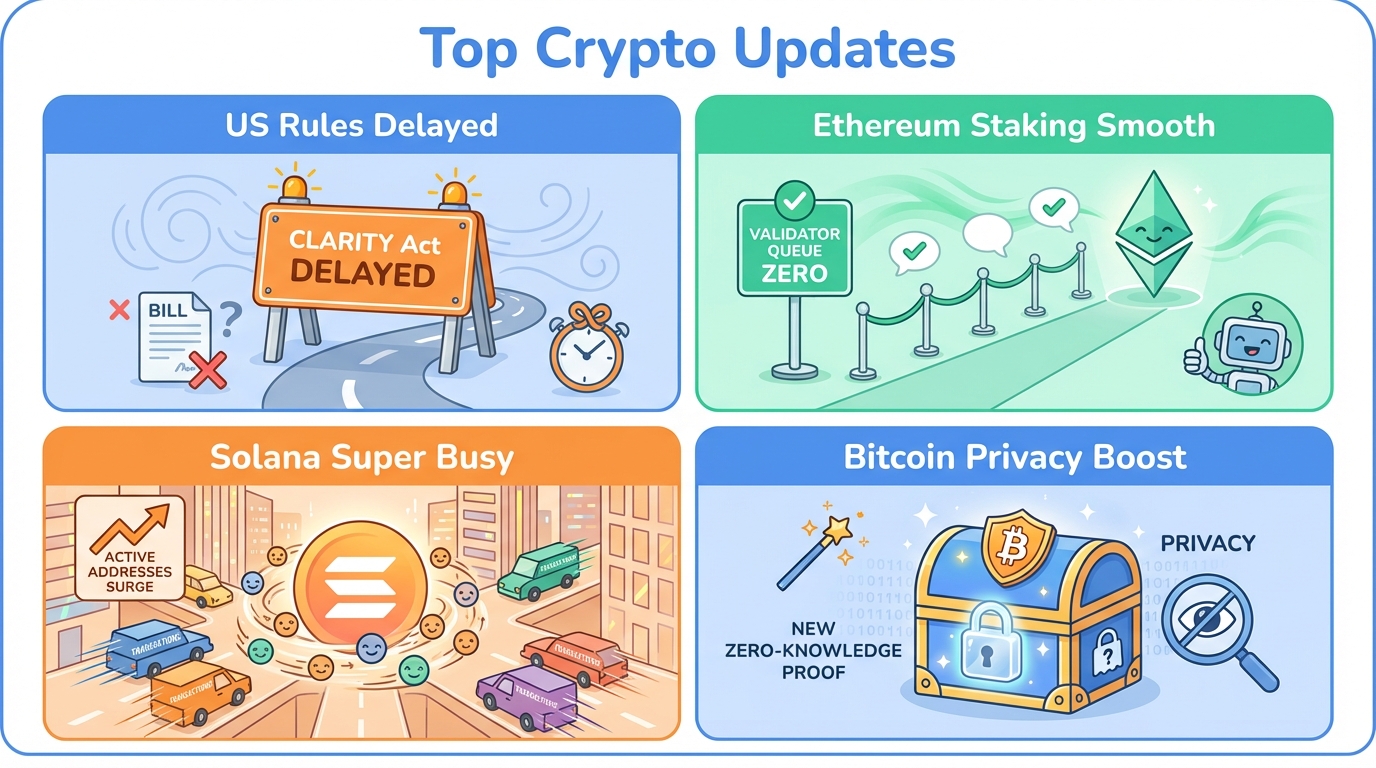
Jon: Today’s news in crypto and blockchain highlights important shifts in regulation and technology that could shape digital infrastructure and user access. For instance, debates over U.S. laws like the CLARITY Act show how governance is evolving, while advancements in networks like Ethereum and Solana demonstrate progress in scalability and security. These matter for society because they influence how decentralized systems integrate with traditional finance and regulations, potentially affecting innovation and user protections.
Lila: That sounds significant, but as someone new to this, I’m wondering: why should everyday people care about these regulatory changes and tech updates? Aren’t they mostly for experts?
Coinbase Withdraws Support for Senate’s CLARITY Act, Delaying U.S. Crypto Market Structure Reform
Jon: One key story is Coinbase’s decision to withdraw support from the revised Senate version of the CLARITY Act, which has delayed a planned committee markup. This act aims to create a federal framework for regulating digital assets, including how tokens are classified and overseen. Based on recent reports, this withdrawal happened after changes in the bill that expanded SEC authority and added restrictions on decentralized finance (DeFi) and stablecoins. DeFi refers to financial services built on blockchain without central intermediaries, like lending or trading directly between users.
Lila: So, what’s the CLARITY Act exactly? And why did Coinbase pull out—does this mean the whole thing is off?
Jon: The CLARITY Act, or Digital Asset Market Clarity Act, is legislation designed to clarify rules for crypto markets, such as granting the CFTC (Commodity Futures Trading Commission) oversight over certain digital commodities like Bitcoin. Fact-checking against current sources, the Senate’s version includes provisions that could limit tokenized assets—think digital versions of stocks on blockchain—and impose anti-money laundering rules on DeFi protocols. Coinbase objected because they see it as favoring traditional banks and restricting innovation. This isn’t the end, but it delays progress, as confirmed by outlets like FinTech Weekly and Reuters.
Lila: Okay, that makes sense. But what’s the consensus mechanism here? And is this a Layer 1 thing or something else?
Jon: This is more about regulation than a specific blockchain’s tech. However, it impacts chains like Ethereum, which uses proof-of-stake consensus—where validators stake tokens to secure the network instead of mining. Ethereum is a Layer 1 blockchain, meaning it’s the base layer for building apps. The bill could affect DeFi on such chains by requiring compliance that challenges their permissionless nature. Governance-wise, this highlights industry divides: companies like Ripple support it for clarity, while Coinbase wants revisions.
Lila: So what does this change for users or developers? Does it make things safer or just more complicated?
Jon: For users, it could mean clearer rules but also potential restrictions on DeFi access, increasing costs or limiting options. Developers might need to redesign protocols to comply, which could slow innovation. Societally, it risks U.S. lag behind places like Europe with frameworks like MiCA. Remember, crypto involves significant risks, including regulatory uncertainty that can lead to enforcement actions.
Ethereum Staking Validator Exit Queue Hits Zero, Signaling Network Maturity
Jon: Another development is Ethereum’s validator exit queue reaching zero for the first time. This means no validators are waiting to withdraw their staked ETH, showing the network’s stability after upgrades like Shanghai, which enabled withdrawals.
Lila: Validator exit queue? That sounds technical. Can you explain staking and why this queue matters?
Jon: Staking is like putting money in a savings account to help secure the network; in Ethereum’s proof-of-stake, validators stake ETH to validate transactions and earn rewards. The exit queue manages withdrawals to prevent sudden floods. Hitting zero indicates smooth operations, as per on-chain data from sources like Binance Square. It’s a sign of maturity in Ethereum’s consensus mechanism, Casper FFG, which coordinates validators on the beacon chain.
Lila: Is Ethereum a Layer 1 or 2? And how does this compare to other chains?
Jon: Ethereum is a Layer 1 blockchain, the foundational layer. Layer 2s, like Optimism, build on top for faster, cheaper transactions. This zero queue contrasts with Solana’s proof-of-history, which focuses on speed but has different centralization risks. Governance implications include better trust for institutional users, but risks like slashing—penalties for misbehavior—remain.
Lila: What does this change for everyday users or society?
Jon: It could encourage more staking, enhancing network security, but users should note the risks of volatility and lock-up periods. For society, it shows blockchain’s potential for reliable digital infrastructure, though adoption depends on regulations.
Solana Network Experiences Surge in Active Addresses and Transactions
Jon: Solana has seen a surge in active addresses and transactions, driven by ecosystem growth like discussions on smart cashtags—tools for social-financial interactions.
Lila: Active addresses? Is that like users logging in? And what’s Solana’s deal?
Jon: Active addresses track unique users interacting with the network. Solana is a high-throughput Layer 1 blockchain using proof-of-history for timestamping and Turbine for fast block propagation, enabling thousands of transactions per second (TPS). Recent data confirms this surge, highlighting its efficiency for DeFi and apps.
Lila: Consensus mechanism and chain type? How does it differ from Ethereum?
Jon: Proof-of-history combines with proof-of-stake for consensus, differing from Ethereum’s pure proof-of-stake. As a Layer 1, it competes directly but focuses on speed, though it has faced outages. Governance is community-driven, with risks from centralization in validators.
Lila: So, changes for users or developers?
Jon: More activity means better liquidity for users, but potential fees or congestion. Developers gain from low-latency tools, yet must consider network reliability risks. Societally, it pushes for faster blockchains in real-world apps like payments.
Stanford Professor Introduces New Zero-Knowledge Proof Protocol for Bitcoin
Jon: A Stanford professor has introduced a zero-knowledge proof (ZKP) protocol for Bitcoin, allowing privacy-preserving transactions without changing its core.
Lila: Zero-knowledge proofs? That sounds like magic. Break it down?
Jon: ZKPs let you prove something is true without revealing details—like proving you’re over 21 without showing your ID. This adapts SNARKs or STARKs to Bitcoin’s UTXO model and proof-of-work consensus, where miners solve puzzles to add blocks. Fact-checking shows it’s aimed at scalability and privacy, competing with Ethereum’s zk-rollups.
Lila: Chain type and governance?
Jon: Bitcoin is a Layer 1 focused on value storage. Governance is decentralized via miner and node consensus. This could enable Bitcoin Layer 2s for more apps.
Lila: What does it change?
Jon: For users, better privacy; developers, new tools. But implementation risks exist, and crypto’s uncertainty means thorough testing is key. Societally, it advances secure, private digital money.
| Story Topic | Key Impact | Relevance to Users/Developers/Society |
|---|---|---|
| CLARITY Act Delay | Postponed regulatory framework, industry divides | Affects compliance and innovation; highlights need for balanced governance |
| Ethereum Exit Queue Zero | Improved network stability and staking confidence | Encourages secure participation; shows blockchain maturity |
| Solana Surge | Increased activity and throughput | Boosts usability for apps; raises scalability discussions |
| Bitcoin ZKP Protocol | Enhanced privacy and scalability | Advances secure tech; promotes privacy in digital assets |
Jon: Overall, these stories point to a trend of maturing blockchain infrastructure amid regulatory challenges. They underscore the need for robust governance to support long-term adoption and utility in areas like finance and data security.
Lila: Thanks for breaking it down. It reminds me to approach crypto with caution—always do your own research and be aware of risks and regulations.
👨💻 Author: SnowJon
A researcher sharing practical insights on Web3 and AI based on academic study and real-world observation.
His focus is on translating complex technologies into clear, responsible explanations for a general audience.
*AI tools may assist drafting, but all factual verification and editorial judgment are performed by the author.*
⚠️ Risk & Education Notice
Cryptocurrency and blockchain technologies involve legal, technical, and financial risks.
This article is provided strictly for educational and informational purposes and does not constitute financial advice.
Readers are encouraged to conduct independent research and comply with local laws and regulations.
▼ AI tools to streamline research and content production (free tiers may be available)
Free AI search & fact-checking
👉 Genspark
Recommended use: Quickly verify key claims and track down primary sources before publishing
Ultra-fast slides & pitch decks (free trial may be available)
👉 Gamma
Recommended use: Turn your article outline into a clean slide deck for sharing and repurposing
Auto-convert trending articles into short-form videos (free trial may be available)
👉 Revid.ai
Recommended use: Generate short-video scripts and visuals from your headline/section structure
Faceless explainer video generation (free creation may be available)
👉 Nolang
Recommended use: Create narrated explainer videos from bullet points or simple diagrams
Full task automation (start from a free plan)
👉 Make.com
Recommended use: Automate your workflow from publishing → social posting → logging → next-task creation
※Links may include affiliate tracking, and free tiers/features can change; please check each official site for the latest details.