
In my view, Spot Bitcoin ETFs effectively lower technical barriers for large entities.#Bitcoin #ETF
Quick Video Breakdown: This Blog Article
This video clearly explains this blog article.
Even if you don’t have time to read the text, you can quickly grasp the key points through this video. Please check it out!
If you find this video helpful, please follow the YouTube channel “BlockChainBulletin,” which delivers daily Crypto news.
https://www.youtube.com/@BlockChainBulletins
Read this article in your native language (10+ supported) 👉
[Read in your language]
Spot Bitcoin ETFs Capture $1.4 Billion in Best Week Since October as Institutional Conviction Returns
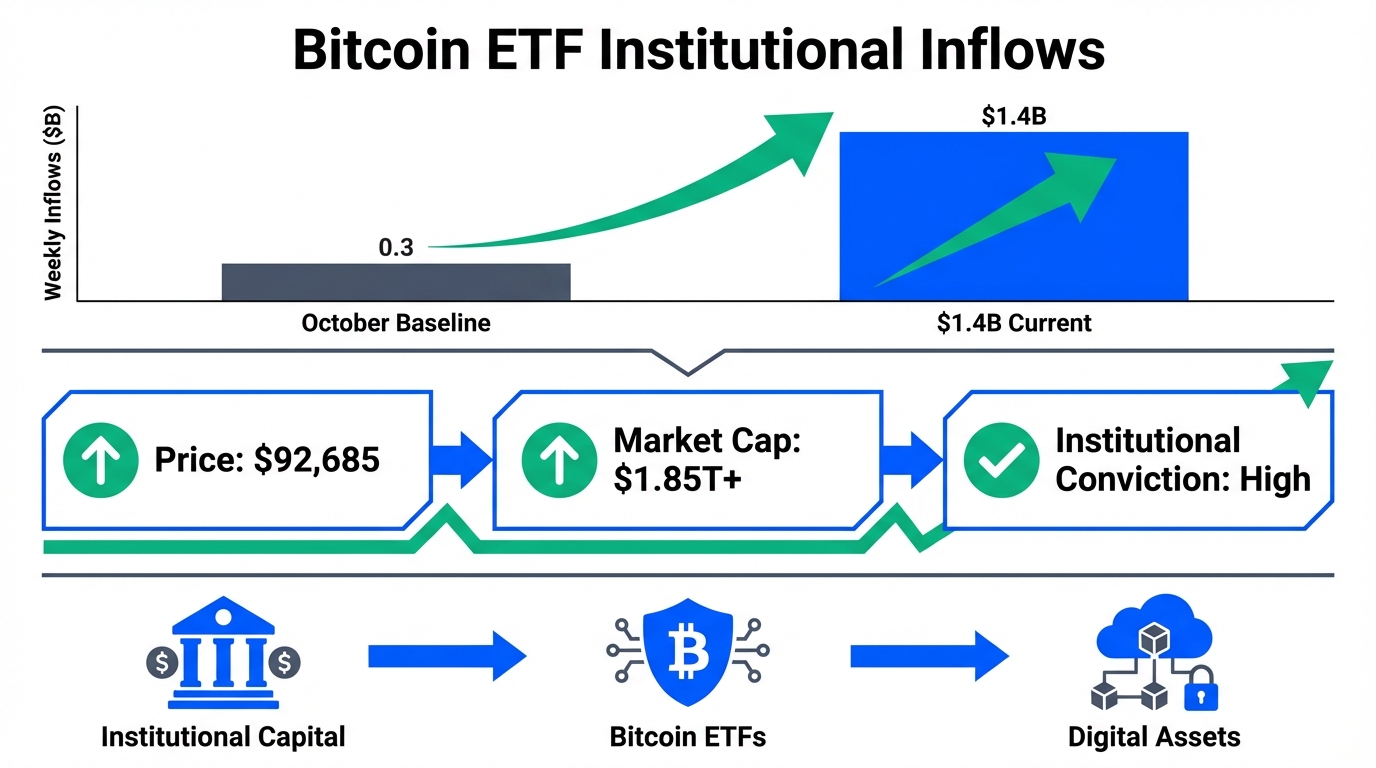
Jon: Hey Lila, have you seen the latest buzz in the crypto world? Spot Bitcoin ETFs just raked in $1.4 billion in inflows last week—their best performance since October. It’s a sign that institutional investors are dipping their toes back in, especially with the market dynamics shifting in early 2026. According to recent reports from sources like Bloomberg and Kitco News, this comes amid a broader resurgence, with cumulative inflows hitting over $56 billion by mid-January.
Lila: Whoa, Jon, that’s a hefty number. I’ve been following some of the headlines—US crypto ETFs drew nearly $670 million on the first trading day of 2026 alone. But as someone still wrapping my head around this, why does this matter? Isn’t Bitcoin always volatile? What’s the big deal with these ETFs and institutional conviction returning?
Jon: Great question, Lila. It matters because spot Bitcoin ETFs bridge the gap between traditional finance and crypto. These aren’t just speculative bets; they’re regulated vehicles that let big players like pension funds and asset managers gain exposure to Bitcoin without directly holding it. The $1.4 billion inflow signals renewed confidence after some market dips, potentially kickstarting a new cycle. But remember, it’s not a guarantee—crypto’s still a wild ride. Think of it as institutions saying, “Okay, we’re convinced enough to allocate real money again.”
Lila: Okay, that makes sense on the surface. But let’s dig into the “why” here. What’s the underlying problem these ETFs are solving, especially for institutions?
Jon: The core problem is accessibility and risk management in a fragmented market. Institutions deal with massive capital, but direct crypto ownership involves custody issues, regulatory hurdles, and volatility that can scare off conservative boards. Spot Bitcoin ETFs solve this by packaging Bitcoin exposure into a familiar format—like stocks traded on exchanges. It’s like trying to drink from a firehose; without ETFs, institutions get blasted with complexity, but ETFs turn it into a manageable sip.
Lila: Firehose analogy? I like it—crypto can feel overwhelming. Can you break that down with a real-world example? Maybe something everyday like traffic or banking?
Jon: Sure. Imagine traffic in a busy city without traffic lights or highways—that’s direct crypto investment for institutions: chaotic, prone to jams (like exchange hacks), and hard to navigate at scale. ETFs are like building express lanes and installing signals. They provide liquidity, oversight from regulators like the SEC, and easy integration into portfolios. No need to worry about private keys or wallet security; it’s all handled through trusted custodians. This reduces the “problem” of entry barriers, making Bitcoin feel more like a standard asset class. But hey, even with lanes, accidents happen—volatility remains.
Lila: Got it. So it’s about streamlining access without the full crypto headache. That explains why inflows are surging now in 2026, with reports of mid-to-large investors driving the cycle.
Under the Hood: How it Works
Jon: Alright, let’s pop the hood on spot Bitcoin ETFs. At their core, these are investment funds that track the price of Bitcoin directly—hence “spot.” Unlike futures-based ETFs, which bet on future prices, spot ones hold actual Bitcoin through custodians. The architecture involves issuers like BlackRock or Fidelity buying Bitcoin, storing it securely, and issuing shares that trade on stock exchanges. Token mechanics? Well, there’s no native token here; it’s more about shares representing fractional Bitcoin ownership. The key is the creation/redemption process: authorized participants (big banks) can create new ETF shares by delivering Bitcoin to the fund or redeem them for Bitcoin, keeping the ETF price aligned with actual Bitcoin value.
Lila: That sounds straightforward, but what’s keeping the price from diverging? And how does this tie into institutional trends we’re seeing in 2026?
Jon: Good catch. The arbitrage mechanism prevents divergence. If the ETF trades at a premium, participants buy Bitcoin cheap, create shares, and sell them for profit—pushing the price down. Vice versa for discounts. In 2026, with inflows like the $104 million net on January 15, this shows institutions are using ETFs to scale up exposure efficiently. It’s witty how something as wild as Bitcoin gets tamed into Wall Street wrappers. But let’s compare spot ETFs to traditional crypto holding for clarity.
| Aspect | Direct Bitcoin Holding | Spot Bitcoin ETF |
|---|---|---|
| Ownership | You hold actual BTC in a wallet | Fund holds BTC; you own shares |
| Custody | Self-managed, risk of loss/theft | Professional custodians (e.g., Coinbase Custody) |
| Regulation | Minimal, varies by jurisdiction | SEC-regulated, transparent reporting |
| Liquidity | 24/7 on exchanges, but fees vary | Stock market hours, easy trading |
| Fees | Network fees for transfers | Management fees (e.g., 0.2-0.4% annually) |
| Institutional Appeal | High risk, compliance challenges | Familiar, portfolio-friendly |
Lila: This table really highlights the differences—it’s like choosing between driving your own car (direct holding) versus taking a taxi (ETF). Safer for some, but with a fare. So, under the hood, it’s all about that creation/redemption balancing act. Makes sense why experts are watching for sustained inflows in 2026.
Jon: Exactly. And in terms of architecture, it’s built on blockchain for the underlying Bitcoin, but the ETF layer adds financial engineering. No hype here—just solid mechanics that could stabilize market structure, though fragile points remain, like if Bitcoin dips below key EMAs as some analyses warn.
Lila: So who actually uses this? I mean, beyond the headlines of institutional resurgence, what are the real-world applications?
Jon: Spot Bitcoin ETFs are primarily used by institutional investors for diversified exposure—think hedge funds allocating a small percentage to crypto as a hedge against inflation or fiat devaluation. On the developer side, it’s not directly “used” like a blockchain protocol, but it influences ecosystem building. For example, custodians and exchanges enhance their tech stacks for ETF support, improving overall liquidity. User-level? Retail investors via brokerage accounts get easy access without crypto wallets. Technically, it benefits by increasing on-chain flows—more ETF demand means more Bitcoin locked in funds, potentially reducing circulating supply and supporting price stability. Worth watching for how this drives innovations like tokenized assets, but always with risks in mind.
Lila: Interesting— so it’s more about integration than direct usage. For developers, it could mean building better tools around custody. And for users, simpler entry. Okay, if someone’s curious like me, what’s an educational action plan? How do we learn more without jumping in headfirst?
Jon: Let’s break it into levels. Level 1: Research and Observation. Start by reading official docs from ETF issuers—BlackRock’s iShares Bitcoin Trust site has whitepapers explaining the mechanics. Use explorers like Blockchain.com to track Bitcoin addresses linked to ETF custodians. Dashboards from CoinGlass or ETFDB.com show real-time inflows/outflows. Observe trends without committing—track how inflows correlate with Bitcoin’s price, like the recent $697 million on the second trading day of 2026.
Lila: That sounds safe. What about Level 2—something hands-on but low-risk?
Jon: Level 2: Testnet or Hands-on Learning. Since ETFs aren’t “testable” like blockchains, simulate with educational tools. Use platforms like TradingView to paper-trade ETF shares (no real money). For deeper crypto understanding, experiment on Bitcoin testnet—set up a wallet, send test BTC, and see custody concepts. Tools like Blockstream’s explorer let you monitor test transactions. Emphasize: this is for learning mechanics, not speculating. Risks remain minimal here, as it’s all simulated.
Lila: Perfect—builds knowledge step by step.
Jon: To wrap up, this $1.4 billion week highlights spot Bitcoin ETFs as a maturing bridge for institutional adoption, potentially leading to a $240K Bitcoin path as some analysts suggest. Limitations? Market fragility, regulatory shifts, and outflows like the $750 million from Bitcoin/ether funds last week show it’s not all smooth. Opportunities lie in understanding the tech, but volatility is king.
Lila: Absolutely, Jon. Readers, remember crypto’s uncertain—volatility and external factors can flip things fast. Stay informed, think critically.
Jon: Well said. Let’s keep exploring thoughtfully.
Author Profiles
Jon is a Web3 researcher with years of experience in blockchain architecture.
Lila is a developer focused on making tech accessible to newcomers.
References
- Spot Bitcoin ETFs Capture $1.4 Billion in Best Week Since October as Institutional Conviction Returns
- Bitcoin ETFs List
- Bitcoin ETFs See Biggest Inflow Since October’s Crypto Crash – Bloomberg
- US Crypto ETFs Draw $670 Million in Inflows on First Trading Day of 2026
▼ AI tools to streamline research and content production (free tiers may be available)
Free AI search & fact-checking
👉 Genspark
Recommended use: Quickly verify key claims and track down primary sources before publishing
Ultra-fast slides & pitch decks (free trial may be available)
👉 Gamma
Recommended use: Turn your article outline into a clean slide deck for sharing and repurposing
Auto-convert trending articles into short-form videos (free trial may be available)
👉 Revid.ai
Recommended use: Generate short-video scripts and visuals from your headline/section structure
Faceless explainer video generation (free creation may be available)
👉 Nolang
Recommended use: Create narrated explainer videos from bullet points or simple diagrams
Full task automation (start from a free plan)
👉 Make.com
Recommended use: Automate your workflow from publishing → social posting → logging → next-task creation
※Links may include affiliate tracking, and free tiers/features can change; please check each official site for the latest details.