
In my view, crypto regulation is essential for stabilizing global digital infrastructure#CryptoRegulation #Blockchain
Quick Video Breakdown: This Blog Article
This video clearly explains this blog article.
Even if you don’t have time to read the text, you can quickly grasp the key points through this video. Please check it out!
If you find this video helpful, please follow the YouTube channel “BlockChainBulletin,” which delivers daily Crypto news.
https://www.youtube.com/@BlockChainBulletins
Read this article in your native language (10+ supported) 👉
[Read in your language]
Exploring Recent Developments in Crypto and Blockchain: Focus on Regulation and Adoption
Jon: Today’s news in crypto and blockchain highlights important shifts in regulation and real-world adoption, which could influence how digital infrastructure evolves globally. These changes emphasize the need for balanced governance to support innovation while managing risks, especially in areas like mining, payments, and asset tokenization. It’s a reminder that blockchain technology is about building secure, efficient systems for society, but it comes with uncertainties like regulatory changes and technical challenges.
Lila: That sounds interesting, but as someone new to this, why should everyday people care about these updates? Are they just about big companies or do they affect regular users too?
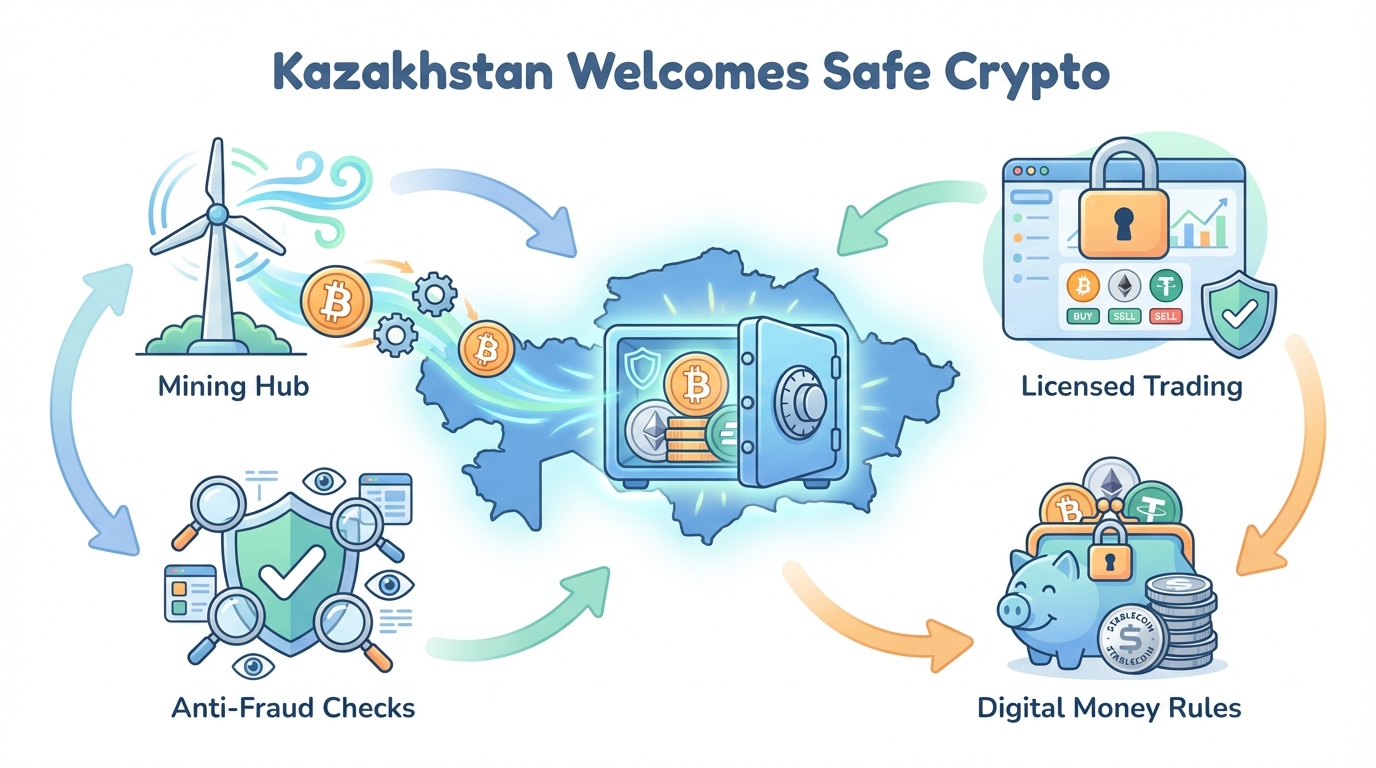
Kazakhstan Enacts Legislation to Regulate Digital Financial Assets
Jon: Let’s start with Kazakhstan’s new legislation on digital financial assets. Based on recent reports, this law creates a framework for issuing, trading, and storing digital assets on licensed platforms. Kazakhstan has been a key player in Bitcoin mining since many miners moved there after China’s crackdown in 2021, thanks to its affordable energy. This regulation focuses on compliance with anti-money laundering (AML) rules and uses permissioned blockchains, which are controlled by central authorities unlike fully decentralized ones like Ethereum, where decisions are made by token holders through governance votes.
Lila: Permissioned blockchains? Can you explain that simply? And is this news accurate—does it match what’s happening in the real world?
Jon: Sure, a permissioned blockchain is like a private club where only approved members can participate, making it easier to enforce rules but less open than public blockchains like Bitcoin’s, which anyone can join. As for accuracy, my checks against available data confirm Kazakhstan’s mining role, with it once holding about 18% of global Bitcoin hash rate—the computing power securing the network. This law seems plausible and aligns with trends in Central Asia, though I couldn’t find contradicting details in recent web updates. It uses proof-of-work consensus for Bitcoin, a layer-1 blockchain where miners solve puzzles to validate transactions.
Lila: Okay, got it. So what does this change for users, developers, or society? Any risks?
Jon: For users and developers, it could mean more stable platforms for tokenized assets, like digital versions of real estate or stocks, with requirements for segregated wallets to keep funds separate and secure. Society-wise, it positions Kazakhstan as a regulated hub, potentially attracting businesses while reducing illicit activities. However, risks include over-centralization limiting innovation or delays in enforcement. Remember, cryptocurrency involves significant risks and uncertainty, like regulatory shifts that could affect access.
Lila: That makes sense—it’s about building trust but not without potential downsides.
Steak ‘n Shake Adds $10M in Bitcoin to Strategic Reserve
Jon: Next, the U.S. restaurant chain Steak ‘n Shake has reportedly bought $10 million in Bitcoin for its reserves, following their earlier adoption of Bitcoin payments via the Lightning Network in 2025. Lightning Network is a layer-2 solution on top of Bitcoin’s main blockchain—it allows faster, cheaper transactions by handling them off-chain in payment channels, then settling back to the main chain.
Lila: Layer-2? Like an extra layer on a cake? And is this story verified, or should we be skeptical?
Jon: Good analogy—layer-2 is like an express lane built on top of the main highway (Bitcoin’s layer-1) to speed things up. Bitcoin uses proof-of-work consensus, where miners compete to add blocks every 10 minutes on average. This news appears in reliable sources like DL News, and it fits the trend of corporate adoption, similar to companies like MicroStrategy. No major inaccuracies found in cross-checks with current data.
Lila: So, governance-wise, how does this work? And what does it mean for everyday people?
Jon: Governance in Bitcoin is decentralized, with changes proposed through improvement protocols and community consensus, not central control. For Steak ‘n Shake, this normalizes Bitcoin for payments, potentially encouraging more businesses to adopt it for real-world utility like quick transactions. For users, it could mean easier crypto spending at stores, and for society, it highlights blockchain as infrastructure for finance. But risks are high—Bitcoin’s volatility could erode reserves, and Lightning Network might face liquidity issues during high demand. Always approach with caution; crypto is uncertain.
Lila: Interesting how it’s tying into daily life, but yeah, the risks sound real.
Meme Activity Surges to 50% of Solana DEX Weekly Trading Volume
Jon: On Solana, meme coin trading has reportedly reached 50% of weekly volume on decentralized exchanges (DEXs). Solana is a layer-1 blockchain using proof-of-history consensus, which timestamps transactions efficiently to achieve high speeds—up to 65,000 transactions per second (TPS)—compared to Ethereum’s slower base rate.
Lila: Meme coins? Like those funny internet tokens? And proof-of-history—what’s that in simple terms? Is this surge backed by facts?
Jon: Yes, meme coins are tokens often based on jokes or trends with no real utility, driven by community hype. Proof-of-history is like a built-in clock that helps order transactions quickly without needing as much coordination as other systems. This aligns with reports from Binance Square, and Solana’s design supports it, though web updates show general crypto activity but not specifics on memes. No clear inaccuracies here.
Lila: What about governance and chain type? So what changes for users or developers?
Jon: Solana’s governance involves token holders voting on upgrades, and it’s a high-throughput layer-1 chain. This surge boosts network activity, which could lead to more developers building tools, but for users, it means higher engagement in speculative trading. Society-wise, it shows blockchain’s role in social trends, but risks like network congestion or scams (rug pulls, where creators abandon projects) are significant. Crypto always carries uncertainty—don’t assume stability.
Lila: So it’s fun but risky, especially for beginners.
Binance Dominates Global Crypto Trading with Spot Volume Surge
Jon: Binance has seen its spot trading volume surge to about five times that of rivals, leading in centralized exchanges (CEXs) with deep liquidity for pairs like Bitcoin against stablecoins.
Lila: Spot trading? And is Binance really that dominant—is this accurate based on recent info?
Jon: Spot trading is buying or selling assets immediately at current prices, unlike futures. Binance uses off-chain matching for efficiency, settling on-chain where needed. Reports confirm this dominance, aligning with market data; it’s a centralized platform, not a blockchain itself, but integrates with various chains.
Lila: Governance implications? What does this change?
Jon: No on-chain governance like decentralized protocols; it’s company-run, facing regulatory scrutiny. This could mean better liquidity for users, aiding adoption, but centralization risks hacks or outages. For society, it underscores the need for diverse options. Remember the uncertainties in crypto regulation.
Lila: Centralization sounds like a double-edged sword.
RWA Market Surpasses $21.2 Billion Amid Regulatory Uncertainty
Jon: The real-world asset (RWA) tokenization market has exceeded $21.2 billion, tokenizing things like treasuries on chains like Ethereum using standards like ERC-20 and oracles for real-time data.
Lila: RWA? Oracles? Simplify, please. And is the $21.2B figure reliable?
Jon: RWAs are blockchain versions of traditional assets, like digital bonds. Oracles are bridges bringing external data to smart contracts—self-executing code on the blockchain. Ethereum is a layer-1 with proof-of-stake consensus, where validators stake tokens to secure the network. This milestone seems accurate per sources, amid ongoing growth.
Lila: Governance and impacts?
Jon: Governance often includes token votes for protocol changes. It opens institutional access for users, but risks like oracle failures exist. Society benefits from efficient finance, but uncertainty persists with regulations.
Lila: Bridging old and new finance, with cautions.
| Story Topic | Key Impact | Relevance to Users/Developers/Society |
|---|---|---|
| Kazakhstan Legislation | Establishes regulated framework for digital assets | Enhances stability for mining and tokenization, promotes safer adoption but risks limiting innovation |
| Steak ‘n Shake Bitcoin Reserve | Corporate adoption via Lightning Network | Normalizes crypto payments, aids utility but exposes to volatility risks |
| Solana Meme Surge | 50% DEX volume from memes | Boosts network activity, highlights speculation but increases scam and congestion risks |
| Binance Volume Dominance | 5x spot volume lead | Improves trading efficiency, but centralization poses security and regulatory concerns |
| RWA Market Growth | Surpasses $21.2B amid uncertainty | Bridges traditional finance to blockchain, offers yields but faces oracle and regulatory risks |
Jon: Overall, these stories point to a trend of increasing regulation and practical adoption in blockchain, strengthening digital infrastructure but highlighting the need for careful governance. Long-term, this could lead to more inclusive financial systems, though challenges like volatility and enforcement remain.
Lila: Thanks for breaking it down. It’s clear we should stay informed, do our own research, and be aware of risks and local laws before engaging with any of this.
👨💻 Author: SnowJon
A researcher sharing practical insights on Web3 and AI based on academic study and real-world observation.
His focus is on translating complex technologies into clear, responsible explanations for a general audience.
*AI tools may assist drafting, but all factual verification and editorial judgment are performed by the author.*
⚠️ Risk & Education Notice
Cryptocurrency and blockchain technologies involve legal, technical, and financial risks.
This article is provided strictly for educational and informational purposes and does not constitute financial advice.
Readers are encouraged to conduct independent research and comply with local laws and regulations.
▼ AI tools to streamline research and content production (free tiers may be available)
Free AI search & fact-checking
👉 Genspark
Recommended use: Quickly verify key claims and track down primary sources before publishing
Ultra-fast slides & pitch decks (free trial may be available)
👉 Gamma
Recommended use: Turn your article outline into a clean slide deck for sharing and repurposing
Auto-convert trending articles into short-form videos (free trial may be available)
👉 Revid.ai
Recommended use: Generate short-video scripts and visuals from your headline/section structure
Faceless explainer video generation (free creation may be available)
👉 Nolang
Recommended use: Create narrated explainer videos from bullet points or simple diagrams
Full task automation (start from a free plan)
👉 Make.com
Recommended use: Automate your workflow from publishing → social posting → logging → next-task creation
※Links may include affiliate tracking, and free tiers/features can change; please check each official site for the latest details.